


09 Aug Budget 2026: Farmers Disappointed, Industry Welcomes Key Announcements
✎ The revised Agricultural Budget (Tamil Nadu) prioritizes irrigation infrastructure and micro-irrigation but overlooks organic certification infrastructure, highlighting the need for a balanced policy approach to address both…
Subject Relevance — Where This Topic Fits
- GS Paper III — Agriculture, Food Processing and Related Issues | GS Paper III — Major Crops Cropping Patterns in Various Parts of the Country | GS Paper III — Issues Related to Direct and Indirect Farm Subsidies and Minimum Support Prices | GS Paper III — Public Distribution System Objectives, Functioning, Limitations, Revamping
- Prelims: Agricultural Budget, Micro-irrigation, Organic Certification, Three-phase electricity for agriculture, Minimum Support Price (MSP), Farm ponds, Tube wells, Drip irrigation, Solar pumps, Water-use efficiency
- Essay: Agricultural distress and the paradox of policy priorities: Balancing growth and equity in India’s rural economy, The role of technology and subsidies in transforming Indian agriculture: Lessons from recent budgetary allocations
Quick Revision: The revised Agricultural Budget (Tamil Nadu) prioritizes irrigation infrastructure and micro-irrigation but overlooks organic certification infrastructure, highlighting the need for a balanced policy approach to address both productivity and sustainability in agriculture.
Why is this in the news?
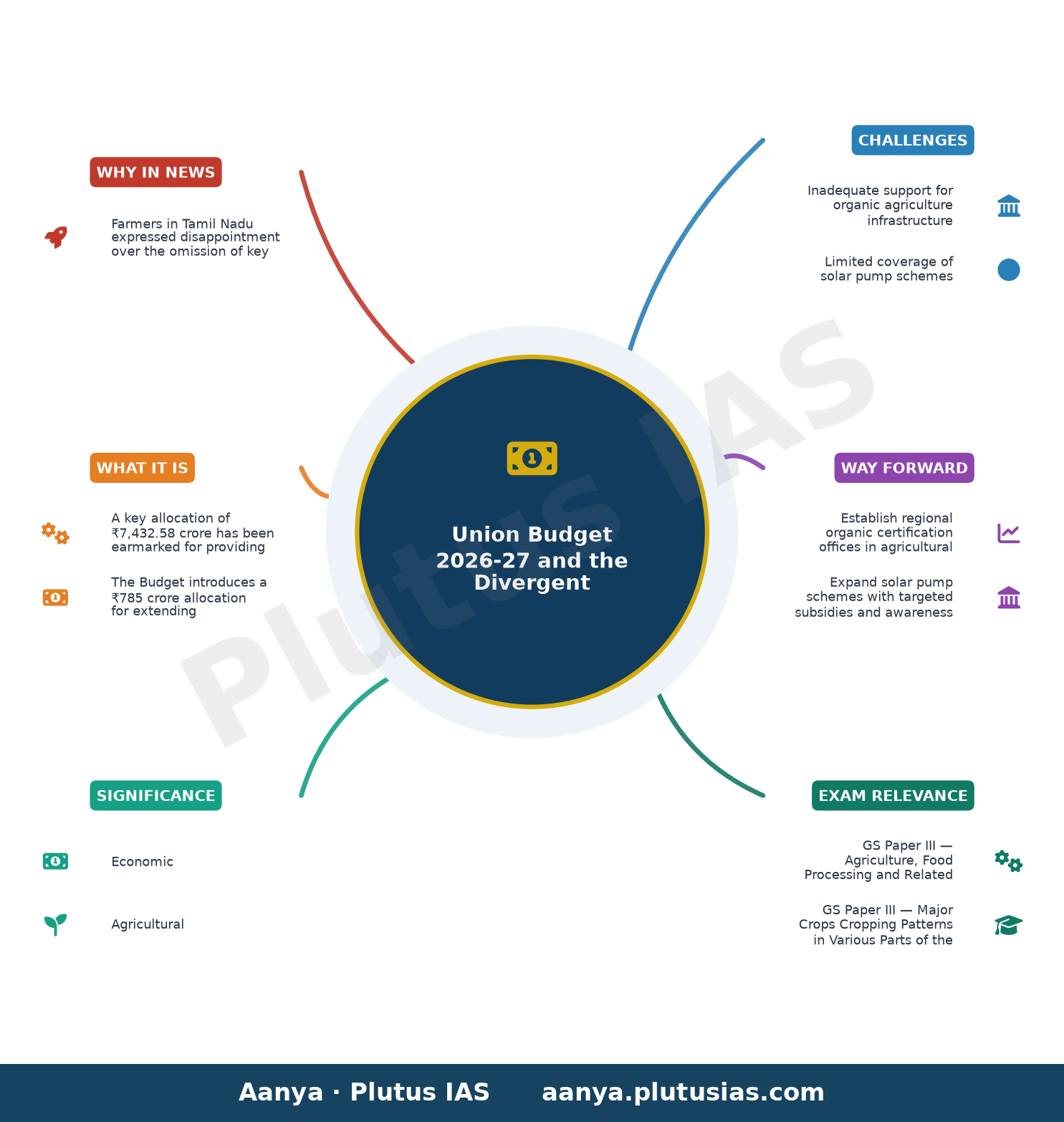
Farmers in Tamil Nadu expressed disappointment over the omission of key demands such as organic certification infrastructure and adequate provisions for solar pumps, while industry associations have welcomed the focus on micro-irrigation, irrigation infrastructure, and energy support for agriculture. This divergence underscores the persistent challenges in aligning policy with ground-level realities and the need for a balanced approach to agricultural development.
Background
- Agricultural distress in India remains a critical challenge, with factors such as fragmented landholdings, climate variability, and inadequate access to irrigation contributing to low productivity and farmer suicides.
- The Government of India has consistently emphasized the need for agricultural transformation through schemes like Pradhan Mantri Krishi Sinchai Yojana (PMKSY) and the promotion of micro-irrigation to enhance water-use efficiency.
- Micro-irrigation systems, including drip and sprinkler irrigation, are recognized globally as effective tools for water conservation and productivity enhancement, particularly in water-scarce regions.
Approach to Agriculture in the revised Agricultural Budget (Tamil Nadu)
- A key allocation of ₹7,432.58 crore has been earmarked for providing free three-phase electricity to agricultural operations, ensuring reliable energy support for irrigation and other farm activities, particularly in states like Tamil Nadu where agriculture is heavily dependent on groundwater.
- The Budget introduces a ₹785 crore allocation for extending micro-irrigation to 2,22,794 acres, benefiting approximately 95,000 farmers, with a 100% subsidy for small and marginal farmers and a 75% subsidy for other farmers, aiming to improve water-use efficiency and agricultural productivity.
- The Budget acknowledges the role of the pump industry in supporting micro-irrigation systems, which require energy-efficient pumpsets to ensure adequate pressure and flow for drip and sprinkler irrigation, highlighting the need for integrated policy interventions.
- The Budget has been criticized for no announcement on having an office in Coimbatore for certifying organic products, which could facilitate market access for organic produce and enhance farmer incomes.
- The Budget’s emphasis on agri-business over traditional agriculture reflects a shift towards commercialization and value addition, which may not fully address the concerns of small and marginal farmers who dominate India’s agricultural landscape.
- The Budget does not announce having an office in Coimbatore for certifying organic products, which would streamline the certification process for farmers transitioning to organic farming.
- The allocation for solar pumps, while acknowledged as inadequate by farmer associations, remains a critical component for sustainable agriculture, particularly in regions facing groundwater depletion and unreliable electricity supply.
Key Features
| Feature | Significance |
|---|---|
| Allocation of ₹7,432.58 crore for free three-phase electricity to agricultural operations | Ensures reliable and uninterrupted power supply for irrigation, critical for agricultural productivity and reducing input costs for farmers. |
| Allocation of ₹785 crore for micro-irrigation extension to 2,22,794 acres | Promotes water-use efficiency, reduces wastage, and enhances productivity, particularly beneficial for small and marginal farmers through targeted subsidies. |
| Subsidy of 100% for small and marginal farmers and 75% for other farmers under micro-irrigation scheme | Addresses affordability barriers, incentivizes adoption of efficient irrigation methods, and aligns with equity considerations in agricultural development. |
| Focus on creating additional irrigation sources (borewells, tube wells, farm ponds) | Expands irrigation coverage, mitigates dependence on monsoons, and enhances resilience against climate variability in rain-fed agricultural regions. |
| Emphasis on energy-efficient pump sets in micro-irrigation systems | Reduces operational costs, aligns with sustainable agriculture goals, and ensures long-term viability of irrigation infrastructure. |
Why it Matters
Economic
- The Budget’s allocations for agricultural infrastructure and irrigation directly contribute to enhancing farm productivity and reducing input costs, thereby improving the income security of farmers.
- Subsidies for micro-irrigation and energy-efficient pumpsets stimulate demand in the agricultural machinery sector, supporting industrial growth and employment generation in rural areas.
- Reliable electricity supply for agriculture reduces operational uncertainties, enabling better planning and investment in farm activities.
- The focus on water-use efficiency addresses critical resource constraints, ensuring sustainable agricultural growth amid increasing water scarcity.
Agricultural
- The Budget’s emphasis on micro-irrigation and additional irrigation sources addresses the structural challenges of low irrigation coverage in rain-fed regions, particularly in Tamil Nadu.
- The exclusion of organic certification infrastructure in Coimbatore highlights a gap in supporting high-value agricultural practices, which are essential for diversifying farm incomes.
- The lack of specific measures for organic product certification and solar pump expansion reflects a misalignment with the evolving demands of sustainable agriculture.
Industrial
- The pump manufacturing industry welcomes the Budget’s focus on irrigation and water-use efficiency, as it directly benefits from increased demand for energy-efficient pumpsets.
- The continued commitment to free electricity for agriculture ensures a stable market for the pump industry, fostering growth and innovation in agricultural machinery.
- The Budget’s alignment with industrial priorities, such as micro-irrigation adoption, strengthens the symbiotic relationship between agriculture and allied industries.
Policy
- The Budget reflects a policy preference for large-scale agricultural infrastructure over smallholder-centric interventions, which may exacerbate disparities in agricultural development.
- The absence of organic certification infrastructure in Coimbatore suggests a policy gap in supporting niche agricultural markets, despite their potential for higher returns.
- The focus on subsidies for micro-irrigation, while laudable, requires robust implementation mechanisms to ensure equitable access and avoid elite capture.
Challenges
1. Inadequate support for organic agriculture infrastructure
- The absence of an organic product certification office in Coimbatore undermines efforts to promote sustainable agriculture and access premium markets.
- Farmers’ associations’ demands for organic certification infrastructure remain unaddressed, limiting the growth of organic farming in Tamil Nadu.
- The Budget’s focus on agri-business over core agricultural needs highlights a policy disconnect with evolving farmer priorities.
UPSC Link: GS3: Agricultural Marketing
2. Limited coverage of solar pump schemes
- The inadequate announcement on solar pumps fails to address the growing demand for renewable energy in agriculture, particularly in water-scarce regions.
- Solar pumps can reduce dependence on grid electricity and mitigate the financial burden on farmers, but the Budget lacks concrete steps for their expansion.
- The omission of solar pump schemes reflects a missed opportunity to align agricultural growth with climate resilience and sustainability goals.
UPSC Link: GS3: Renewable Energy
3. Disparities in subsidy distribution under micro-irrigation
- While the subsidy for micro-irrigation is structured to benefit small and marginal farmers, implementation challenges may lead to elite capture or exclusion of the most vulnerable.
- The 75% subsidy for non-small farmers may not sufficiently incentivize adoption among medium and large farmers, limiting the scheme’s overall impact.
- Ensuring equitable access to subsidies requires robust monitoring and grievance redressal mechanisms to prevent misuse and ensure transparency.
UPSC Link: GS3: Agricultural Extension
4. Over-reliance on irrigation infrastructure to address climate variability
- While irrigation expansion is critical, it may not fully mitigate the risks posed by erratic monsoons and climate change, necessitating a multi-pronged approach.
- The Budget’s focus on irrigation sources like borewells and tube wells could exacerbate groundwater depletion if not accompanied by sustainable water management practices.
- Integrating climate-resilient agriculture practices, such as drought-resistant crops and soil moisture conservation, is essential to complement irrigation infrastructure.
UPSC Link: GS3: Climate Change and Agriculture
5. Policy misalignment with farmer associations’ demands
- The Budget’s perceived focus on agri-business over core agricultural needs reflects a disconnect with the ground realities faced by farmers, particularly smallholders.
- Farmers’ associations’ suggestions, such as organic certification infrastructure, remain unaddressed, indicating a lack of participatory policymaking.
- The absence of mechanisms for farmer feedback in Budget formulation may lead to policy outcomes that do not align with on-ground requirements.
UPSC Link: GS2: Role of Pressure Groups
Challenges — UPSC Perspective
| Issue | Concern |
|---|---|
| Organic certification infrastructure | Absence of regional offices limits access to premium markets for organic produce, reducing income opportunities for farmers. |
| Solar pump schemes | Inadequate allocation and focus fail to address renewable energy adoption in agriculture, exacerbating grid dependence and financial burdens. |
| Subsidy distribution under micro-irrigation | Potential elite capture and exclusion of vulnerable farmers may limit the scheme’s equitable impact. |
| Groundwater depletion from irrigation expansion | Over-reliance on borewells and tube wells risks exacerbating water scarcity, undermining long-term agricultural sustainability. |
| Policy disconnect with farmer associations | Lack of participatory policymaking may lead to outcomes that do not address ground realities, reducing policy effectiveness. |
Government Initiatives — Must-Memorise for Prelims
- Micro-Irrigation Scheme (Pradhan Mantri Krishi Sinchai Yojana – PMKSY)
- Free Electricity for Agricultural Operations (State-level scheme in Tamil Nadu)
Way Forward
- Establish regional organic certification offices in agricultural hubs like Coimbatore to support sustainable agriculture and access to premium markets.
- Expand solar pump schemes with targeted subsidies and awareness campaigns to promote renewable energy adoption in agriculture.
- Strengthen implementation mechanisms for micro-irrigation subsidies to ensure equitable access and prevent elite capture, including grievance redressal systems.
- Integrate climate-resilient agriculture practices, such as drought-resistant crops and soil moisture conservation, into irrigation expansion plans to enhance resilience.
- Conduct participatory consultations with farmer associations during Budget formulation to align policies with ground realities and farmer priorities.
- Promote public-private partnerships for organic certification infrastructure to reduce the financial burden on the state and accelerate adoption.
- Monitor groundwater levels and enforce sustainable water management practices alongside irrigation expansion to prevent depletion and ensure long-term viability.
UPSC Value Addition
Keywords for Mains Answer-Writing
Agricultural Budget 2026-27 · Micro-irrigation subsidy · Organic certification infrastructure · Agricultural pump industry · Water-use efficiency in agriculture · Assured irrigation coverage · Farmers’ associations and policy gaps · Agrarian distress and policy response · State-level agricultural budgeting · Sustainable agriculture and subsidies
Concept Flow
Farmer associations demand organic certification infrastructure → Budget fails to address demand → Policy disconnect with farmer priorities → Budget allocates funds for micro-irrigation and free electricity → Industry welcomes initiatives → Focus on agri-business over core agriculture → Micro-irrigation subsidies introduced → Potential for elite capture → Need for equitable implementation mechanisms → Irrigation expansion prioritized → Risk of groundwater depletion → Requires sustainable water management practices → Solar pump schemes omitted → Continued dependence on grid electricity → Missed opportunity for renewable energy adoption → Climate variability persists → Irrigation alone insufficient → Need for multi-pronged climate-resilient agriculture strategies
Prelims Practice Questions
Q1. Consider the following statements regarding the Agricultural Budget 2026-27 presented for Tamil Nadu:
1. The budget allocated ₹785 crore for extending micro-irrigation to 2,22,794 acres.
2. The subsidy for micro-irrigation is 100% for small and marginal farmers and 75% for other farmers.
3. The budget announced the establishment of an organic product certification office in Coimbatore.
4. The budget allocated ₹7,432.58 crore for providing free three-phase electricity to agricultural operations.
How many of the above statements are correct?
- Only one
- Only two
- Only three
- All four
Answer: Only three — Statements 1, 2, and 4 are correct as per the news report. Statement 3 is incorrect because the budget did not announce an organic product certification office in Coimbatore.
Q2. Assertion (A): The Agricultural Budget 2026-27 for Tamil Nadu emphasizes micro-irrigation to improve water-use efficiency.
Reason (R): Micro-irrigation systems require energy-efficient pumpsets for effective implementation.
Options:
A. Both A and R are true, and R is the correct explanation of A.
B. Both A and R are true, but R is not the correct explanation of A.
C. A is true, but R is false.
D. A is false, but R is true.
- A
- B
- C
- D
Answer: B — Both the assertion and reason are true. The budget indeed emphasizes micro-irrigation (A), and micro-irrigation systems require energy-efficient pumpsets for effective implementation (R). R correctly explains A.
Mains Practice Question
✍ Critically examine the provisions of the Agricultural Budget 2026-27 for Tamil Nadu with reference to its focus on micro-irrigation and water-use efficiency. How far do these provisions address the concerns of farmers and the agricultural pump industry? (15 Marks)
Approach: MODEL-ANSWER SKELETON:
1. **Introduction (2 marks)**: Briefly outline the context of the Agricultural Budget 2026-27 for Tamil Nadu, highlighting its focus on micro-irrigation and water-use efficiency.
2. **Provisions on Micro-Irrigation (4 marks)**:
– Allocation of ₹785 crore for extending micro-irrigation to 2,22,794 acres.
– Subsidy structure: 100% for small and marginal farmers, 75% for other farmers.
– Emphasis on creating additional irrigation sources (borewells, tube wells, farm ponds).
– Assured irrigation coverage for rain-fed agricultural land.
3. **Concerns of Farmers (4 marks)**:
– Lack of organic certification infrastructure in Coimbatore.
– Inadequate provisions for solar pumps.
– Perceived tilt towards agri-business rather than agriculture.
– Farmer associations’ suggestions not addressed adequately.
4. **Perspective of Agricultural Pump Industry (3 marks)**:
– Appreciation for the focus on micro-irrigation and water-use efficiency.
– Need for energy-efficient pumpsets to complement micro-irrigation systems.
– Reliable energy support for agricultural operations via free three-phase electricity.
5. **Critique and Way Forward (2 marks)**:
– Evaluate the balance between micro-irrigation subsidies and other farmer concerns.
– Suggest measures to address organic certification and solar pump gaps.
– Highlight the need for inclusive policy formulation involving farmer associations.
Source: The Hindu
Generated by AanyaAi for educational purpose.

- UPSC Alert: India-Bangladesh Methanol Cargo Flagged Off from Dibrugarh - October 5, 2026
- स्टॉक मार्केट में गिरावट, महंगाई ने बढ़ाया संकट: जानिए कारण और प्रभाव - October 5, 2026
- Rediscovered plant ‘Haplothismia exannulata’ inspires Wildlife Week in Kerala - October 5, 2026

No Comments