


09 Aug Supreme Court Considers Transferring Tamil Nadu DVAC Case Against ED Officer to CBI
✎ The Supreme Court may transfer a state-level corruption case involving a central government employee to a central agency like the CBI if it deems necessary to ensure impartiality, particularly in cases where political vendetta is…
Subject Relevance — Where This Topic Fits
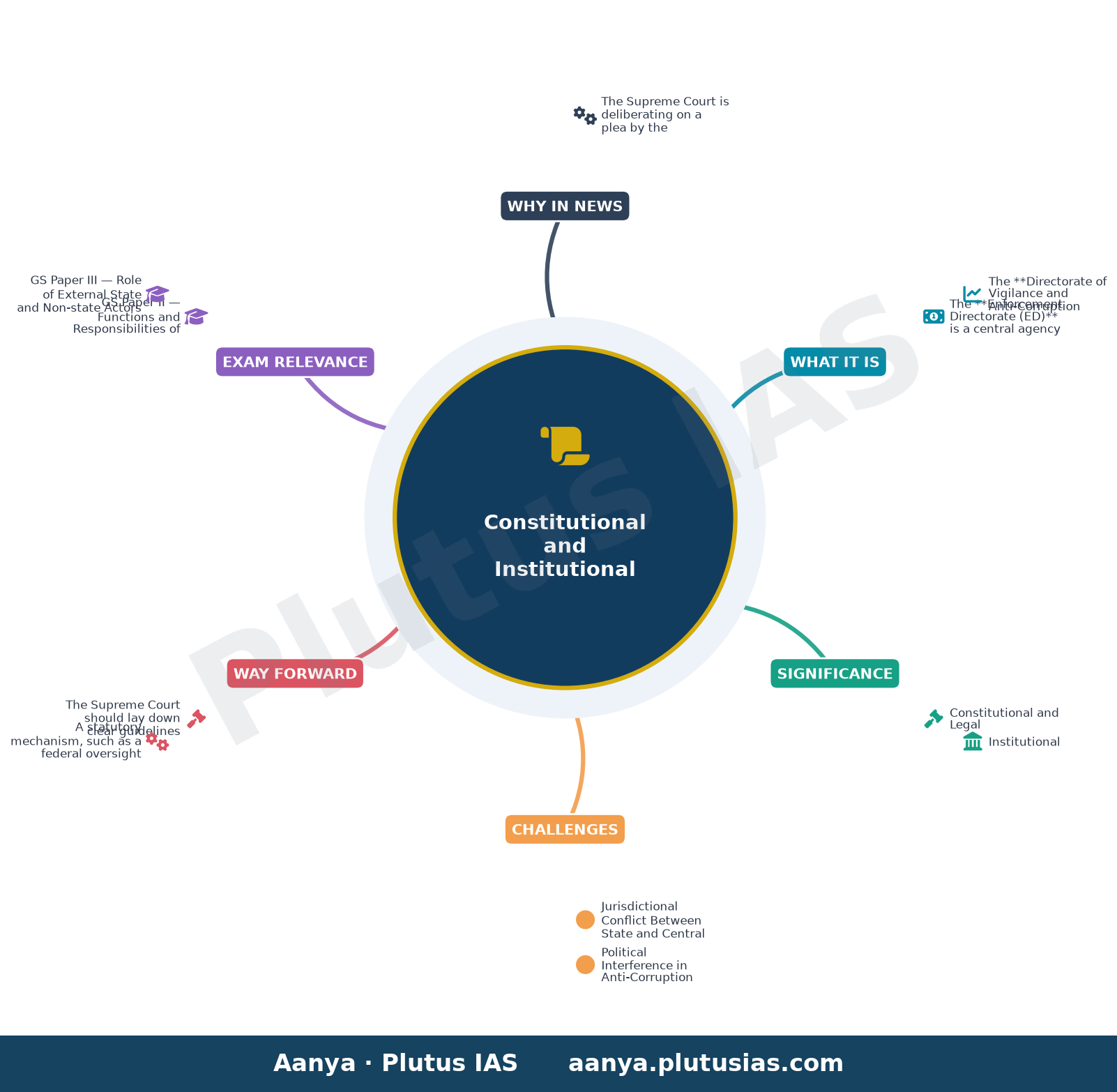
- GS Paper II — Functions and Responsibilities of the Union and the States, Issues and Challenges Pertaining to the Federal Structure | GS Paper III — Role of External State and Non-state Actors in Creating Challenges to Internal Security, Money Laundering and its Prevention
- Prelims: Enforcement Directorate (ED), Directorate of Vigilance and Anti-Corruption (DVAC), Central Bureau of Investigation (CBI), Section 4 of the Delhi Special Police Establishment Act, 1946, Federalism in India, Money Laundering (Prevention) Act, 2002, Criminal Procedure Code (CrPC), 1973
- Essay: Federalism and the Balance of Power: Centre-State Relations in India, Judicial Intervention in Executive Functions: Accountability and Autonomy
Quick Revision: The Supreme Court may transfer a state-level corruption case involving a central government employee to a central agency like the CBI if it deems necessary to ensure impartiality, particularly in cases where political vendetta is suspected.
Why is this in the news?
The Supreme Court is deliberating on a plea by the Enforcement Directorate (ED) to transfer a bribery case against one of its officers, Ankit Tiwari, from the Tamil Nadu Directorate of Vigilance and Anti-Corruption (DVAC) to a central agency such as the Central Bureau of Investigation (CBI). The case involves allegations of bribery and misuse of official position, raising critical questions about prosecutorial jurisdiction, federalism, and the potential for political vendetta in investigative processes.
Background
- The ED officer, Ankit Tiwari, is alleged to have accepted a bribe of ₹20 lakh from a doctor in Dindigul district, Tamil Nadu, and was caught red-handed.
- The Tamil Nadu DVAC initiated proceedings against Tiwari, which the ED has contested, arguing that the case is an act of retaliation against the ED for its investigations into money laundering cases involving powerful politicians and former ministers in Tamil Nadu.
- The Supreme Court had stayed the DVAC proceedings in January 2024, and the matter has resurfaced for consideration of transfer to a central agency.
- The ED contends that offences committed by central government employees, particularly those involving misuse of official capacity, should be investigated by a central agency like the CBI rather than a state agency.
- The case highlights the recurring tension between central investigative agencies and state governments, particularly in Opposition-ruled states, over prosecutorial jurisdiction and perceived political interference.
- The Supreme Court has also raised concerns about the potential for political vendetta in the actions of both the Centre and state governments, suggesting the need for a mechanism to screen such cases.
Prosecutorial Jurisdiction and Federalism in India: Key Institutions and Legal Frameworks
- The **Enforcement Directorate (ED)** is a central agency under the Department of Revenue, Ministry of Finance, tasked with enforcing the **Prevention of Money Laundering Act (PMLA), 2002**, and the **Foreign Exchange Management Act (FEMA), 1999**.
- The **Directorate of Vigilance and Anti-Corruption (DVAC)** is a state-level agency in Tamil Nadu responsible for investigating corruption and vigilance cases within the state, including offences committed by state officials.
- The **Central Bureau of Investigation (CBI)** is the premier investigating agency of the Government of India, with jurisdiction over offences affecting the central government, public servants, and matters of national importance. Its powers are derived from the **Delhi Special Police Establishment Act, 1946**.
- Under **Article 246** of the Constitution, the Union and the States have concurrent jurisdiction in matters of criminal law, but the **Code of Criminal Procedure (CrPC), 1973**, provides mechanisms for the transfer of cases to ensure impartial investigation and trial.
- The **Supreme Court** has the power to transfer cases from one state to another or to a central agency under **Section 406** of the CrPC, if it is satisfied that such transfer is necessary to ensure a fair trial or to prevent abuse of process.
- The **doctrine of federalism** in India balances the autonomy of states with the need for central oversight, particularly in matters of national security, economic offences, and inter-state crimes.
- The **PMLA, 2002**, empowers the ED to investigate money laundering cases, which often intersect with corruption and bribery, leading to jurisdictional conflicts between central and state agencies.
- The **Supreme Court’s intervention** in this case underscores the judiciary’s role in resolving conflicts between central and state agencies, ensuring that investigative processes are not influenced by political considerations.
Key Features
| Feature | Significance |
|---|---|
| Transfer of DVAC case to Central agency | Ensures impartial investigation by a neutral agency, reducing perceived bias in state-centre disputes over corruption cases. |
| Stay on criminal proceedings | Prevents premature adjudication while the Supreme Court examines the jurisdictional and constitutional validity of the case. |
| ED’s argument of ‘political vendetta’ | Highlights the tension between central investigative agencies and state authorities in politically sensitive cases. |
| Supreme Court’s scrutiny of motive | Probes whether allegations of corruption are genuine or politically motivated, reinforcing judicial oversight. |
| Interim bail to accused officer | Balances the right to fair trial with the need to prevent arbitrary detention pending judicial resolution. |
Why it Matters
Constitutional and Legal
- Examines the balance of power between the Union and States under Article 256-257, particularly in cases involving central government employees.
- Tests the jurisdiction of State anti-corruption bodies (DVAC) vis-à-vis Central agencies (CBI/ED) in cases of alleged corruption.
- Reinforces the principle of judicial review over executive actions in corruption cases to prevent misuse of investigative powers.
Institutional
- Underscores the need for a robust mechanism to resolve inter-agency conflicts in high-stakes corruption investigations.
- Raises questions about the autonomy and impartiality of State vigilance bodies when investigating central officials.
- Highlights the role of the Supreme Court in arbitrating federal disputes involving investigative agencies.
Political
- Exposes the potential weaponisation of investigative agencies (ED/DVAC) for political purposes in Opposition-ruled States.
- Demonstrates the Centre-State friction in federal governance, particularly in cases involving high-profile individuals.
- Illustrates the challenges of maintaining institutional integrity amid political polarisation.
Challenges
1. Jurisdictional Conflict Between State and Central Agencies
- Determining whether a case involving a central government employee should be investigated by a State agency (DVAC) or a Central agency (CBI/ED) is legally ambiguous.
- State agencies may face allegations of bias, while Central agencies could be perceived as overreaching into State jurisdiction.
- Lack of clear guidelines on the division of investigative powers in such cases.
UPSC Link: https://main.sci.gov.in/jurisdiction
2. Political Interference in Anti-Corruption Investigations
- Risk of investigative agencies being used as tools for political vendetta, particularly in cases involving Opposition-ruled States.
- Need to distinguish between genuine corruption and politically motivated prosecutions.
- Lack of a statutory mechanism to screen the motives behind such investigations.
UPSC Link: https://main.sci.gov.in/political-interference
3. Ensuring Impartiality in High-Profile Cases
- Perception of bias can undermine public trust in anti-corruption agencies, regardless of the outcome of the case.
- Need for transparent processes to ensure that investigations are not influenced by external pressures.
- Balancing the right to a fair trial with the urgency of investigating corruption allegations.
UPSC Link: https://main.sci.gov.in/impartiality
4. Legal and Procedural Delays
- Prolonged judicial scrutiny can lead to delays in justice, particularly in cases where evidence is time-sensitive.
- Risk of witnesses or evidence being tampered with during prolonged stays on proceedings.
- Need for expedited judicial processes in cases involving high-profile individuals.
UPSC Link: https://main.sci.gov.in/procedural-delays
Challenges — UPSC Perspective
| Issue | Concern |
|---|---|
| Jurisdictional ambiguity | Risk of conflicting claims between State and Central agencies over investigative authority. |
| Perception of bias | Allegations of political interference can erode public confidence in anti-corruption institutions. |
| Procedural delays | Prolonged judicial scrutiny may hinder timely justice and evidence preservation. |
| Institutional autonomy | Need to safeguard the independence of State vigilance bodies from central interference. |
| Motive verification | Difficulty in distinguishing between genuine corruption and politically motivated prosecutions. |
| Legal ambiguity | Lack of clear constitutional or statutory guidelines on the division of investigative powers. |
Way Forward
- The Supreme Court should lay down clear guidelines delineating the jurisdiction of State and Central agencies in cases involving central government employees.
- A statutory mechanism, such as a federal oversight body, should be established to screen allegations of political vendetta in anti-corruption investigations.
- State and Central agencies should collaborate through formal MoUs to ensure seamless investigation without jurisdictional conflicts.
- Judicial reforms should be pursued to expedite high-profile corruption cases, ensuring timely justice and evidence preservation.
- Strengthen the autonomy of State vigilance bodies by insulating them from political interference through constitutional or statutory safeguards.
- The Union and States should engage in structured dialogue to resolve inter-agency conflicts and foster mutual trust in investigative processes.
- Public awareness campaigns should be conducted to educate citizens on the role and limitations of investigative agencies in corruption cases.
UPSC Value Addition
Keywords for Mains Answer-Writing
Supreme Court of India · Constitutional governance · federalism · Centre-State relations · judicial review · Enforcement Directorate · Directorate of Vigilance and Anti-Corruption · corruption · bribery · money laundering · investigative agencies · political vendetta · Article 32 · judicial activism · CBI vs State agencies · money bill · cooperative federalism
Constitutional & Policy Linkages
- {‘Article 256-257’: ‘Union and State executive powers and their coordination.’}
- {‘Article 142’: “Supreme Court’s power to pass orders for doing complete justice.”}
- {‘Article 32’: ‘Right to constitutional remedies against arbitrary state action.’}
- {‘Seventh Schedule’: ‘Division of powers between Union and States, List I (Union List) and List II (State List).’}
Concept Flow
Allegation of bribery against ED officer Ankit Tiwari in Tamil Nadu → Tamil Nadu DVAC initiates investigation → ED argues for transfer to Central agency (CBI) citing political vendetta → Supreme Court stays DVAC proceedings in January 2024 → Supreme Court examines jurisdictional conflict and motive behind investigation → Supreme Court considers whether case should be transferred to Central agency → Supreme Court grants interim bail to accused officer → Supreme Court mulls transfer of case to Central agency for impartial investigation.
Prelims Practice Questions
Q1. Consider the following statements regarding the Enforcement Directorate (ED) in India:
1. The ED is a statutory body established under the Prevention of Money Laundering Act, 2002.
2. The ED operates under the administrative control of the Ministry of Home Affairs.
3. The ED is empowered to investigate offences under the Foreign Exchange Management Act (FEMA), 1999.
How many of the above statements are correct?
- Only one
- Only two
- All three
- None
Answer: Only two — Statement 1 is correct as the ED was established under the PMLA, 2002. Statement 2 is incorrect because the ED operates under the Ministry of Finance. Statement 3 is correct as the ED investigates FEMA violations.
Q2. Assertion (A): The Supreme Court of India can transfer a case from a State agency to a Central agency under Article 32 of the Constitution.
Reason (R): Article 32 empowers the Supreme Court to issue writs for the enforcement of Fundamental Rights and to ensure justice.
- Both A and R are true, and R is the correct explanation of A.
- Both A and R are true, but R is not the correct explanation of A.
- A is true, but R is false.
- A is false, but R is true.
Answer: A is true, but R is false. — Assertion (A) is true as the Supreme Court can transfer cases under Article 32 to ensure justice. Reason (R) is true but does not directly explain the assertion, as Article 32 is broader and not limited to case transfers.
Q3. Match the following investigative agencies with their respective jurisdictions:
| Column I (Agency) | Column II (Jurisdiction) |
|———————————|———————————————–|
| A. Central Bureau of Investigation | 1. Money laundering and FEMA offences |
| B. Enforcement Directorate | 2. Corruption and vigilance in Central PSUs |
| C. Directorate of Vigilance and Anti-Corruption | 3. Investigation of serious crimes nationwide|
| D. National Investigation Agency | 4. State-level corruption and vigilance |
- A-3, B-1, C-4, D-2
- A-2, B-1, C-4, D-3
- A-3, B-4, C-1, D-2
- A-1, B-2, C-3, D-4
Answer: A-2, B-1, C-4, D-3 — A matches with 3 (CBI investigates serious crimes nationwide), B with 1 (ED handles money laundering and FEMA), C with 4 (DVAC operates at the state level), and D with 2 (NIA investigates terror-related crimes).
Mains Practice Question
✍ The Supreme Court’s observation on the need to evolve a mechanism to screen whether political vendetta underlies the registration of cases by the Enforcement Directorate (ED) against officials and Ministers in Opposition-ruled States, and retaliatory actions by State agencies, raises critical questions about the balance between federalism and judicial activism. Critically examine the constitutional and institutional dimensions of this issue. Also, analyse the implications for cooperative federalism in India. (15 Marks)
Approach: MODEL-ANSWER SKELETON:
1. **Constitutional Framework and Federalism**:
– Briefly outline the constitutional provisions governing Centre-State relations (Articles 245-255, 32, 262, 73, 162).
– Explain the concept of cooperative federalism and its significance in India’s quasi-federal structure.
2. **Role of Investigative Agencies**:
– Discuss the mandates of the ED (PMLA, 2002), CBI (DSPE Act, 1946), and DVAC (Tamil Nadu DVAC Act).
– Highlight the potential for conflict when Central agencies operate in State jurisdictions (e.g., ED raids in Opposition States).
3. **Judicial Activism and Judicial Review**:
– Cite landmark Supreme Court judgments on Centre-State disputes (e.g., S.R. Bommai v. Union of India, 1994; State of West Bengal v. Union of India, 1963).
– Discuss the Supreme Court’s power under Article 32 to transfer cases (e.g., Supreme Court Bar Association v. Union of India, 1998).
4. **Political Vendetta and Institutional Credibility**:
– Analyse the Supreme Court’s concern about political motivations behind investigative actions (refer to the current case and past instances like the arrest of ED officers in Tamil Nadu).
– Discuss the need for an independent mechanism to assess the bonafide of such actions (e.g., a judicial screening committee or parliamentary oversight).
5. **Implications for Cooperative Federalism**:
– Weigh the arguments for centralisation (uniformity, efficiency) vs. decentralisation (State autonomy, accountability).
– Suggest reforms: codification of guidelines for Centre-State agency interactions, establishment of a federal investigative body, or strengthening State-level vigilance institutions.
6. **Conclusion**:
– Take a reasoned position on whether the Supreme Court’s intervention is justified to preserve federal balance or if it risks overreach. Emphasise the need for institutional safeguards to prevent misuse of investigative agencies.
Source: The Hindu
Generated by AanyaAi for educational purpose.

- KWML’s Feasibility Reports for Water Metro in 18 Cities: UPSC & PCS Insights - October 3, 2026
- ओडिशा में वन्यजीव अनुसंधान अनुदान कार्यक्रम शुरू, सिमिलिपाल में 300 कैमरे और बढ़ेंगे - October 3, 2026
- India Summons Pakistan High Commission Official Over Violation - October 3, 2026

No Comments