


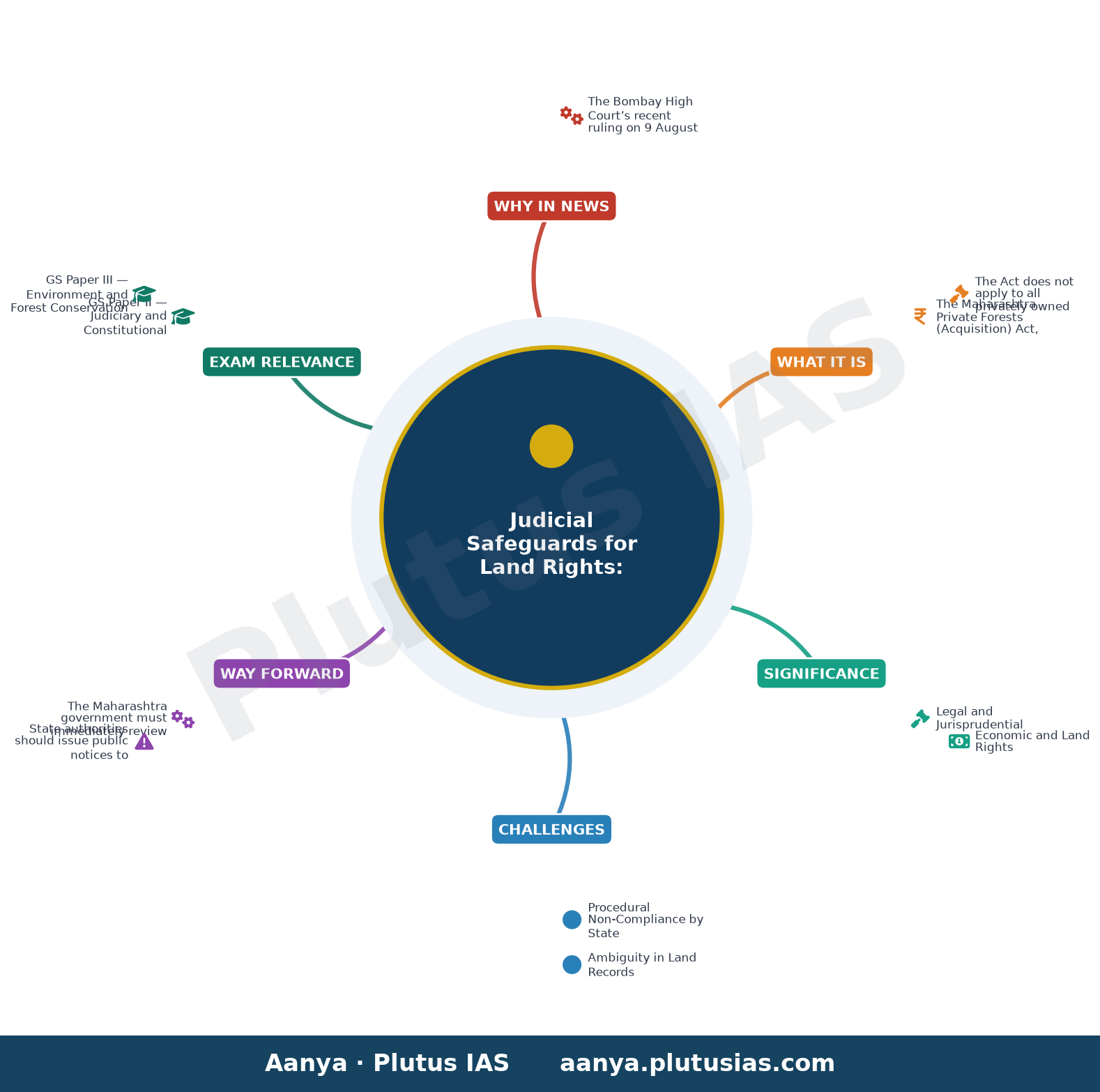
09 Aug Bombay HC Ruling: Private Forest Claims Need Due Process in Maharashtra
✎ The Bombay High Court’s ruling reiterates that the vesting of lands as 'private forests' under the Maharashtra Private Forests (Acquisition) Act, 1975, cannot be automatic and must follow a statutorily prescribed procedure…
Subject Relevance — Where This Topic Fits
- GS Paper II — Judiciary and Constitutional Framework | GS Paper III — Environment and Forest Conservation | GS Paper III — Land Reforms and Land Use
- Prelims: Maharashtra Private Forests (Acquisition) Act, 1975, Supreme Court’s forest rights jurisprudence, Forest Rights Act, 2006, Constitutional provisions on property rights (Article 300A), Forest Conservation Act, 1980, Revenue records and land title disputes, Judicial review of executive actions, Procedural fairness in administrative law
- Essay: Judicial activism vs. executive overreach in environmental governance, Balancing conservation imperatives with property rights in India
Quick Revision: The Bombay High Court’s ruling reiterates that the vesting of lands as ‘private forests’ under the Maharashtra Private Forests (Acquisition) Act, 1975, cannot be automatic and must follow a statutorily prescribed procedure, including notice to landholders and consideration of objections, in compliance with the principles of natural justice and the Constitution.
Why is this in the news?
The Bombay High Court’s recent ruling on 9 August 2026 has significant implications for landholders across Maharashtra, particularly those whose properties were unilaterally declared as ‘private forests’ by the state government under the Maharashtra Private Forests (Acquisition) Act, 1975. The court held that such declarations cannot be automatic and must follow a statutorily prescribed procedure, including notice to landholders and consideration of objections. This verdict underscores the judiciary’s role in protecting property rights while ensuring adherence to due process in environmental conservation efforts.
Background
- The Maharashtra Private Forests (Acquisition) Act, 1975, was enacted to vest certain privately owned forest lands in the state for conservation, extinguishing the rights of original landowners.
- The Supreme Court has repeatedly ruled that lands cannot be automatically vested in the state as ‘private forests’ without following due process, as established in cases like *T.N. Godavarman Thirumulpad v. Union of India* (1997) and *Wildlife First v. Ministry of Environment and Forests* (2011).
- The Maharashtra government has historically claimed ownership over thousands of hectares of land by treating them as ‘private forests’ without adhering to the procedural safeguards mandated by the Act or judicial precedents.
- Landholders across Maharashtra—including individuals, housing societies, companies, and educational institutions—have faced prolonged litigation and uncertainty over land titles due to such arbitrary declarations.
- The Bombay High Court’s ruling aligns with the principle of *audi alteram partem* (right to be heard) and the doctrine of *procedural fairness* in administrative law.
What is a ‘Private Forest’ under the Maharashtra Private Forests (Acquisition) Act, 1975?
- The Maharashtra Private Forests (Acquisition) Act, 1975, was enacted to acquire privately owned forest lands for conservation and vest them in the state government, thereby extinguishing the rights of original landowners.
- The Act does not apply to all privately owned lands with trees; instead, it targets specific categories of lands classified as ‘private forests’ under Section 2(f).
- The Act mandates a statutory procedure for vesting lands as ‘private forests,’ including the issuance of notifications, publication of draft notifications, and consideration of objections from landholders before final declaration.
- The Act empowers the state government to acquire such lands free from all encumbrances, but only after following the prescribed procedure, including the constitution of a committee to examine objections.
- The Supreme Court has consistently held that the vesting of lands as ‘private forests’ cannot be automatic and must comply with the principles of natural justice and due process.
- The Act does not override constitutional protections for property rights under Article 300A of the Constitution, which guarantees that no person shall be deprived of their property save by authority of law.
- The Bombay High Court’s ruling reaffirms that the state government cannot bypass the statutory procedure and must adhere to the principles of fairness and transparency in land acquisition.
Key Features
| Feature | Significance |
|---|---|
| Automatic vesting under Section 2(f)(iii) of the 1975 Act | The Maharashtra government’s practice of automatically declaring private lands as ‘private forests’ without statutory process, leading to widespread litigation and title uncertainty. |
| Statutory procedure under the 1975 Act | Mandates notice to landholders, consideration of objections by a committee, and a formal notification before vesting land as a ‘private forest’. |
| Supreme Court precedent | Repeated rulings (e.g., T.N. Godavarman Thirumulpad) that invalidate automatic vesting, requiring due process for forest declarations. |
| Scope of Section 2(f) of the 1975 Act | Defines ‘private forest’ narrowly, excluding lands with dwelling houses, appurtenant lands, or those under pre-existing legal frameworks. |
| Batch of 184 petitions | Highlights systemic overreach by the state in declaring lands as ‘private forests’ without adhering to statutory or judicial norms. |
Why it Matters
Legal and Jurisprudential
- Reaffirms the principle that administrative actions must comply with statutory procedures and judicial precedents, curbing arbitrary executive overreach.
- Clarifies the narrow definition of ‘private forest’ under the 1975 Act, limiting the state’s power to declare lands as such.
- Strengthens the doctrine of due process in land acquisition and forest conservation laws, aligning with constitutional principles of natural justice.
Economic and Land Rights
- Provides legal certainty to landholders (individuals, societies, developers) whose titles were clouded by state claims of automatic vesting.
- Reduces litigation burden on the judiciary by addressing systemic procedural lapses in forest declarations.
- May incentivize investment in land development by resolving long-standing title disputes in Maharashtra.
Administrative and Governance
- Highlights the need for bureaucratic adherence to statutory frameworks, reducing discretionary power in land governance.
- Emphasizes the role of higher authorities in ensuring compliance with judicial directives and legislative mandates.
- Underscores the importance of inter-departmental coordination in land records and forest conservation.
Challenges
1. Procedural Non-Compliance by State
- The state’s ‘defiant approach’ in ignoring Supreme Court rulings and statutory procedures has led to avoidable litigation and title uncertainty.
- Failure to issue notices or consider objections before declaring lands as ‘private forests’ violates natural justice principles.
- Systemic delays in resolving disputes due to bureaucratic inertia and lack of accountability.
UPSC Link: GS Paper 2: Judiciary and Constitutional Framework
2. Ambiguity in Land Records
- Pre-existing land records may not accurately reflect the status of ‘private forests,’ leading to conflicting claims.
- Inadequate documentation of encumbrances or prior legal proceedings complicates the vesting process.
- Need for digitization and updating of land records to align with judicial and statutory requirements.
UPSC Link: GS Paper 2: Governance and Land Reforms
3. Balancing Conservation and Land Rights
- Ensuring conservation of ecologically sensitive lands while protecting the rights of private landholders remains a policy challenge.
- The narrow definition of ‘private forest’ under the 1975 Act may exclude certain lands that require conservation, necessitating legislative review.
- Potential conflict between state conservation goals and individual property rights under the Constitution.
UPSC Link: GS Paper 3: Environment and Biodiversity
Challenges — UPSC Perspective
| Issue | Concern |
|---|---|
| State’s non-adherence to statutory procedure | Systemic overreach in declaring lands as ‘private forests’ without due process. |
| Title uncertainty for landholders | Long-standing disputes over land ownership due to state claims of automatic vesting. |
| Ambiguity in land records | Inconsistent or outdated records complicating forest declarations and land rights. |
| Judicial backlog and litigation | Proliferation of petitions due to state’s failure to comply with judicial precedents. |
| Balancing conservation and property rights | Ensuring ecological protection without infringing on constitutional property rights. |
Way Forward
- The Maharashtra government must immediately review all notifications declaring lands as ‘private forests’ and initiate due process where required.
- State authorities should issue public notices to landholders whose lands are under dispute, inviting objections and providing a fair hearing.
- Digitize and update land records to reflect accurate statuses of ‘private forests’ and pending legal proceedings.
- Conduct a legislative review of the 1975 Act to align its provisions with Supreme Court rulings and current conservation needs.
- Establish a dedicated grievance redressal mechanism for landholders affected by arbitrary forest declarations.
- Ensure inter-departmental coordination between revenue, forest, and legal authorities to streamline the vesting process.
- Promote awareness among landholders about their rights and the statutory procedures for challenging forest declarations.
- Encourage alternative dispute resolution mechanisms to expedite the resolution of pending petitions.
UPSC Value Addition
Keywords for Mains Answer-Writing
Maharashtra Private Forests (Acquisition) Act, 1975 · private forest vesting · due process in land acquisition · Supreme Court rulings on forest rights · procedural justice in administrative law · right to property under Article 300A · judicial review of executive actions · Maharashtra land disputes · forest conservation laws · administrative adjudication · vesting of private lands · constitutional remedies for landholders
Constitutional & Policy Linkages
- Article 300A: Right to Property — Ensures protection against arbitrary deprivation of property by the state.
- Article 21: Right to Livelihood — Implies that title uncertainty affects economic rights.
- Article 14: Equality before Law — Mandates non-arbitrary and procedurally fair state actions.
Concept Flow
State’s automatic vesting of private lands as ‘private forests’ under the 1975 Act → → Supreme Court rulings invalidate automatic vesting, requiring due process → → Bombay High Court upholds judicial precedents and mandates statutory compliance → → Landholders challenge state actions, leading to a batch of 184 petitions → → Court rules that due process (notice, objections, committee consideration) must precede vesting → → State’s failure to follow procedure results in title uncertainty and litigation → → Way forward: Review notifications, digitize records, and align legislation with judicial directives.
Prelims Practice Questions
Q1. Consider the following statements regarding the Maharashtra Private Forests (Acquisition) Act, 1975:
1. The Act empowers the State to automatically vest private lands as ‘private forests’ without following due process.
2. Section 2(f)(iii) of the Act defines ‘private forest’ to include lands covered by pending forest proceedings under earlier laws.
3. The Act extinguishes all rights, titles, and interests of landowners upon vesting.
4. The Bombay High Court in 2026 ruled that the State must follow the prescribed procedure before declaring land as a ‘private forest’.
How many of the above statements are correct?
- Only one
- Only two
- Only three
- All four
Answer: All four — Statements 1 is incorrect because the Act does not allow automatic vesting; due process must be followed. Statements 2, 3, and 4 are correct as they accurately reflect the Act’s provisions and the Bombay High Court’s ruling.
Q2. Assertion (A): The vesting of private lands as ‘private forests’ under the Maharashtra Private Forests (Acquisition) Act, 1975, extinguishes all rights of the landowners.
Reason (R): The Act was enacted to acquire privately owned forest lands for conservation and management by the State, free from encumbrances.
Select the correct option:
A. Both A and R are true, and R is the correct explanation of A.
B. Both A and R are true, but R is not the correct explanation of A.
C. A is true, but R is false.
D. A is false, but R is true.
- A
- B
- C
- D
Answer: B — Both the assertion and reason are true. The Act explicitly extinguishes all rights, titles, and interests of landowners upon vesting, and the reason correctly explains the purpose of vesting.
Q3. Match the following provisions of the Maharashtra Private Forests (Acquisition) Act, 1975 with their descriptions:
Column I (Provision) | Column II (Description)
———————|———————-
1. Section 2(f) | A. Extinguishes all rights, titles, and interests of landowners upon vesting.
2. Section 2(f)(iii) | B. Defines categories of land that may qualify as ‘private forest’.
3. Section 4 | C. Specifies the procedure for vesting private lands as ‘private forests’.
4. Section 5 | D. Includes lands covered by pending forest proceedings under earlier laws.
Choose the correct match:
A. 1-B, 2-D, 3-C, 4-A
B. 1-A, 2-B, 3-D, 4-C
C. 1-D, 2-A, 3-B, 4-C
D. 1-C, 2-D, 3-A, 4-B
- A
- B
- C
- D
Answer: A — The correct match is: 1-B (Section 2(f) defines categories of land), 2-D (Section 2(f)(iii) includes lands covered by pending forest proceedings), 3-C (Section 4 specifies the procedure for vesting), and 4-A (Section 5 extinguishes rights).
Mains Practice Question
✍ The Bombay High Court’s recent ruling in 2026 underscores the primacy of procedural justice in administrative actions concerning land rights. Critically examine the implications of this judgment for the balance between forest conservation and the constitutional right to property under Article 300A of the Constitution. Also, analyse how this ruling aligns with the Supreme Court’s jurisprudence on the vesting of private lands as ‘private forests’. (15 Marks)
Approach: A full answer must cover the following dimensions:
1. **Procedural Justice and Due Process**:
– Explain the Bombay High Court’s ruling that the Maharashtra government cannot automatically declare private lands as ‘private forests’ without following due process under the Maharashtra Private Forests (Acquisition) Act, 1975.
– Highlight the requirement of notice to landholders, consideration of objections, and adherence to the statutory procedure (Sections 4, 5, and 7 of the Act).
– Link this to the constitutional principle of procedural justice under Articles 14 and 21.
2. **Right to Property under Article 300A**:
– Discuss Article 300A of the Constitution, which protects the right to property from arbitrary deprivation.
– Explain how the Bombay High Court’s ruling reinforces this right by ensuring that the State cannot extinguish property rights without following due process.
– Contrast this with the earlier practice of automatic vesting, which violated the principles of natural justice.
3. **Forest Conservation vs. Land Rights**:
– Acknowledge the State’s legitimate objective of forest conservation under the Act and the Forest Rights Act, 2006.
– Examine how the ruling balances conservation goals with the rights of landholders, ensuring that conservation measures do not infringe upon constitutional rights.
4. **Supreme Court’s Jurisprudence**:
– Cite relevant Supreme Court judgments, such as *T.N. Godavarman Thirumulpad v. Union of India* (1997), which expanded the definition of ‘forest’ to include all statutorily recognised forests.
– Discuss *K. Balakrishnan v. State of Kerala* (2021), where the Supreme Court held that the vesting of private lands as forests must follow due process.
– Highlight the consistency of the Bombay High Court’s ruling with these precedents.
5. **Implications for Landholders and the State**:
– Explain the immediate impact on landholders whose lands were wrongly declared as ‘private forests’ without due process.
– Discuss the long-term implications for the State’s ability to acquire lands for conservation, including the need for transparent and participatory processes.
– Mention the potential for increased litigation if the State fails to adhere to the prescribed procedure.
6. **Conclusion**:
– Summarise the judgment’s significance in upholding constitutional rights while ensuring forest conservation.
– Offer a balanced view: the ruling strengthens the rule of law but may pose challenges for conservation efforts if the State does not reform its procedures.
Source: The Indian Express
Generated by AanyaAi for educational purpose.

- भारत सेमीकंडक्टर उद्योग में ‘सकारात्मक चक्र’ की ओर: अशोक चंदक - September 24, 2026
- India’s Semiconductor Ecosystem Enters Positive Spiral: SEMICON 2.0 Insights - September 24, 2026
- आईआईडब्ल्यूडब्ल्यू 2026: जल सुरक्षा के लिए नवाचार, जलवायु-लचीलेपन और डिजिटल समाधान - September 24, 2026

No Comments