


10 Aug FCRA Amendment 2026: Fadnavis Clarifies Opposition’s ‘Worried’ Claims Explained
✎ The Foreign Contribution (Regulation) Amendment Bill, 2026, seeks to enhance transparency and accountability in foreign funding by mandating audits and stricter compliance, while balancing constitutional rights under Article…
Subject Relevance — Where This Topic Fits
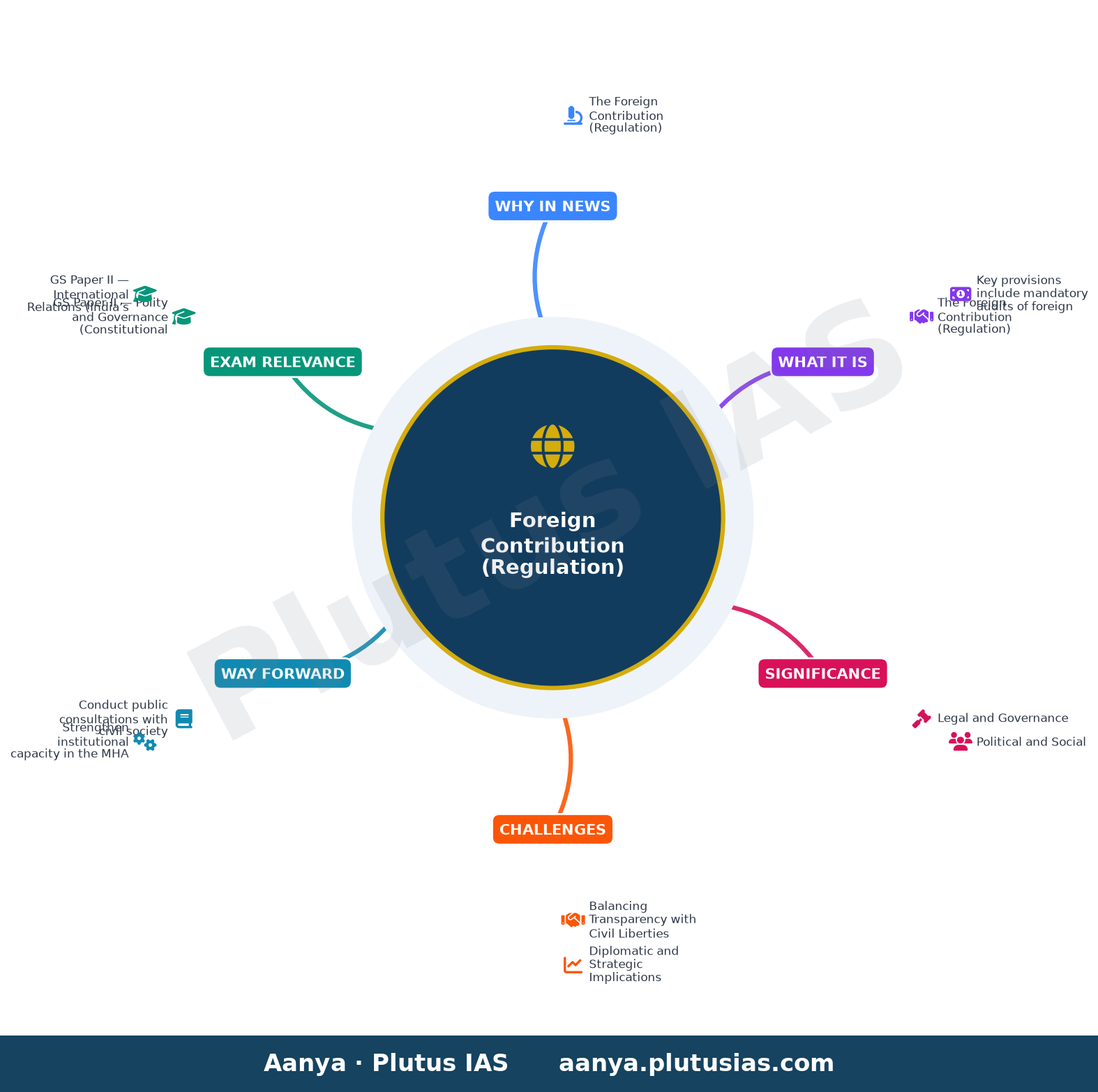
- GS Paper II — Polity and Governance (Constitutional Provisions, Fundamental Rights, Directive Principles) | GS Paper II — International Relations (India’s Foreign Policy, Bilateral Relations with the USA) | GS Paper III — Economy (Regulation of NGOs and Non-Profit Organisations, Foreign Funding)
- Prelims: Foreign Contribution (Regulation) Act, 2010, FCRA (Amendment) Bill, 2026, Article 19(1)(c) — Right to form associations, Article 21 — Right to Privacy, Anti-National Activities, Audit Mandate under FCRA, Ministry of Home Affairs (MHA), US-India Bilateral Relations
- Essay: Transparency vs. Accountability: Balancing Rights and National Security in Regulatory Frameworks, The Role of Non-Governmental Organisations in Democratic Societies: Challenges and Governance
Quick Revision: The Foreign Contribution (Regulation) Amendment Bill, 2026, seeks to enhance transparency and accountability in foreign funding by mandating audits and stricter compliance, while balancing constitutional rights under Article 19(1)(c) with national security imperatives.
Why is this in the news?
The Foreign Contribution (Regulation) Amendment Bill, 2026, has sparked significant political debate following its introduction, with the Opposition alleging discriminatory intent and the government asserting its necessity to curb misuse of foreign donations for anti-national activities. The Bill’s provisions, including mandatory audits and stricter compliance, have drawn criticism from domestic stakeholders and international observers, including concerns raised by a US Congressman, prompting the Ministry of External Affairs to reaffirm that such legislative matters are India’s internal affair. The discourse underscores the tension between transparency in foreign funding and the preservation of constitutional freedoms, particularly the right to form associations under Article 19(1)(c).
Background
- The Foreign Contribution (Regulation) Act (FCRA), 2010, governs the acceptance and utilisation of foreign contributions by individuals, associations, and companies in India, aiming to ensure that such funds do not compromise national interest or sovereignty.
- The FCRA was amended in 2020 to introduce stricter provisions, including a reduction in the administrative expenses cap for NGOs from 50% to 20% and the mandatory opening of FCRA accounts in the State Bank of India’s New Delhi branch.
- The 2026 Amendment Bill introduces further provisions, including mandatory audits of foreign donations and enhanced scrutiny of organisations receiving foreign funds, particularly those suspected of engaging in anti-national activities.
- The Bill has faced opposition from political parties and civil society groups, who argue that it disproportionately targets specific communities and organisations, particularly those working in religious or social sectors.
- Concerns have also been raised by international stakeholders, including the US Congress, regarding the potential impact of the Bill on bilateral relations, though the Indian government has maintained that legislative matters are internal affairs.
- The debate reflects broader tensions between national security imperatives and the constitutional right to association, as enshrined in Article 19(1)(c) of the Indian Constitution.
What is the Foreign Contribution (Regulation) Amendment Bill, 2026?
- The Foreign Contribution (Regulation) Amendment Bill, 2026, is a legislative proposal aimed at amending the Foreign Contribution (Regulation) Act, 2010, to enhance accountability and transparency in the receipt and utilisation of foreign contributions by Indian entities.
- Key provisions include mandatory audits of foreign donations, stricter compliance requirements, and enhanced scrutiny of organisations receiving foreign funds to prevent misuse for anti-national activities.
- The Bill seeks to address concerns that foreign funds are being channelled to organisations engaged in activities detrimental to India’s sovereignty, integrity, or public interest, including separatist movements or activities threatening national security.
- The Bill introduces provisions to ensure that organisations misusing foreign funds for anti-national activities are dealt with firmly, including cancellation of registration and legal action under relevant laws.
- The Bill does not target any specific religious community or organisation but aims to ensure that all entities receiving foreign funds comply with transparency and accountability norms.
- The Bill has been justified by the government as a measure to curb the misuse of foreign funds while preserving the right of genuine NGOs to operate, provided they adhere to regulatory compliance.
- The Bill reflects a broader trend in global governance, where states increasingly regulate foreign funding to NGOs to prevent interference in domestic affairs, as seen in countries like Russia, Israel, and the United States.
Key Features
| Feature | Significance |
|---|---|
| Mandatory Audit of Foreign Donations | Ensures transparency by requiring all foreign contributions to be audited under specified provisions, reducing misuse and enhancing accountability. |
| Prohibition of ‘Anti-National Activities’ | Empowers authorities to take firm action against entities misusing foreign funds for activities deemed prejudicial to India’s sovereignty or security. |
| Clarification on Non-Targeting of Communities | Explicitly states that the bill does not discriminate against any religious or social group, addressing misconceptions and political narratives. |
| Enhanced Scrutiny Mechanisms | Introduces stricter compliance requirements, including mandatory reporting and verification of foreign contributions to prevent illegal or unauthorised funding. |
| Legislative Autonomy in Internal Affairs | Reaffirms India’s sovereign right to regulate foreign funding, aligning with global practices while addressing domestic concerns about external influence. |
Why it Matters
Legal and Governance
- Strengthens the regulatory framework governing foreign contributions, aligning with constitutional provisions on sovereignty and public order (Article 19(2)).
- Enhances trust in NGOs and civil society by ensuring accountability, thereby fostering a more transparent and responsible philanthropic ecosystem.
- Deters misuse of foreign funds for subversive or anti-national activities, safeguarding national security interests.
Political and Social
- Reduces political polarisation by clarifying that the bill is not community-specific, thereby mitigating accusations of bias or discrimination.
- Encourages constructive engagement from civil society by exempting genuine welfare organisations from undue scrutiny.
- Highlights the tension between transparency and freedom of association, a recurring theme in democratic governance.
International Relations
- Asserts India’s sovereign right to regulate foreign funding, a stance consistent with global practices in countries like the USA (Foreign Agents Registration Act) and Australia.
- Potential diplomatic friction with nations or organisations accustomed to unrestricted funding flows, necessitating calibrated diplomatic responses.
Economic
- Ensures that foreign funds are utilised for intended purposes, preventing diversion to non-developmental or illicit activities.
- May reduce the inflow of foreign donations if compliance burdens deter smaller NGOs, impacting grassroots development initiatives.
Challenges
1. Balancing Transparency with Civil Liberties
- Risk of overreach in defining ‘anti-national activities’, which could stifle legitimate dissent or criticism of government policies.
- Need to ensure that stringent regulations do not disproportionately burden genuine NGOs, particularly those working in marginalised communities.
UPSC Link: GS-2: Fundamental Rights (Article 19(1)(c))
2. Diplomatic and Strategic Implications
- Potential backlash from foreign governments or international organisations accustomed to unfettered funding of Indian NGOs.
- Challenge in maintaining cordial bilateral relations while asserting sovereign regulatory authority over foreign contributions.
UPSC Link: GS-2: India’s Foreign Policy
3. Implementation and Enforcement Gaps
- Risk of bureaucratic delays or inefficiencies in auditing and scrutiny processes, leading to a backlog of cases.
- Need for robust institutional capacity in the Ministry of Home Affairs (MHA) to handle increased compliance and enforcement workload.
UPSC Link: GS-2: Role of Civil Services
4. Political Opposition and Narrative Control
- Opposition parties may frame the bill as an attack on democratic freedoms, complicating its passage and public acceptance.
- Challenge in communicating the bill’s objectives clearly to prevent misinformation and political polarisation.
UPSC Link: GS-2: Parliament and State Legislatures
5. Impact on Grassroots Development
- Smaller NGOs, particularly those in rural or remote areas, may struggle with compliance costs, reducing their operational capacity.
- Potential decline in foreign funding for critical social sector initiatives if donors perceive heightened regulatory risks.
UPSC Link: GS-1: Social Sector Initiatives
Challenges — UPSC Perspective
| Issue | Concern |
|---|---|
| Overbreadth in ‘Anti-National’ Definition | Risk of arbitrary application, leading to suppression of legitimate dissent or criticism. |
| Compliance Burden on NGOs | Small organisations may lack resources to meet audit and reporting requirements, impacting their sustainability. |
| Diplomatic Tensions | Foreign governments may view the bill as restrictive, potentially straining bilateral relations. |
| Implementation Delays | Bureaucratic inefficiencies could delay audits and scrutiny, undermining the bill’s objectives. |
| Political Polarisation | Opposition may weaponise the bill to rally support, complicating its legislative passage. |
| Donor Reluctance | Foreign donors may reduce contributions due to perceived regulatory risks, affecting development funding. |
Way Forward
- Conduct public consultations with civil society organisations to address concerns about overreach and ensure balanced implementation.
- Strengthen institutional capacity in the MHA to expedite audits and scrutiny processes, minimising bureaucratic delays.
- Clarify the definition of ‘anti-national activities’ through rules or guidelines to prevent arbitrary enforcement.
- Engage with foreign governments and international donors to explain the bill’s objectives and mitigate diplomatic friction.
- Provide financial and technical support to smaller NGOs to help them comply with audit and reporting requirements.
- Monitor the bill’s impact on grassroots development initiatives and adjust regulations if unintended consequences arise.
- Enhance transparency in the approval and rejection of foreign contributions to build public trust in the regulatory process.
UPSC Value Addition
Keywords for Mains Answer-Writing
Foreign Contribution (Regulation) Amendment Bill, 2026 · FCRA · Foreign donations · Accountability and transparency in foreign funding · Anti-national activities · Regulation of NGOs · Constitutional provisions on foreign contributions · Supreme Court on FCRA · Parliamentary scrutiny of amendments · Federalism and Centre-State relations in regulatory oversight · Judicial review of legislative amendments · Civil society and democratic accountability · International relations implications of FCRA · Auditing mechanisms for foreign donations · Right to receive foreign contributions vs national interest
Constitutional & Policy Linkages
- Article 19(1)(c): Freedom of Association — Balancing regulation with the right to form associations.
- Article 19(2): Reasonable Restrictions — Legitimising state intervention to curb misuse of foreign funds.
- Article 29: Cultural and Educational Rights — Preventing discrimination against any religious or cultural group in funding.
Concept Flow
Foreign Contributions (Regulation) Act, 2010 → Perceived misuse and lack of transparency → Proposal for amendments (FCRA Amendment Bill, 2026) → Public and political uproar over potential misuse of the bill → Clarifications by government on non-targeting of communities → Debate on sovereignty vs. civil liberties → Need for balanced implementation → Long-term impact on NGOs and development funding.
Prelims Practice Questions
Q1. Consider the following statements regarding the Foreign Contribution (Regulation) Act (FCRA), 2010 and its 2026 amendments:
1. The FCRA, 2010 regulates the acceptance and utilisation of foreign contributions by individuals, associations, and companies in India.
2. The 2026 amendments introduce mandatory audits of foreign donations to ensure accountability and transparency.
3. The amendments explicitly prohibit all religious organisations from receiving foreign contributions.
4. The Ministry of Home Affairs is the nodal authority for implementing the FCRA.
How many of the above statements are correct?
- Only one
- Only two
- Only three
- All four
Answer: Only three — Statements 1, 2, and 4 are correct. Statement 3 is incorrect as the amendments do not explicitly prohibit religious organisations from receiving foreign contributions; they aim to regulate misuse.
Q2. Assertion (A): The Foreign Contribution (Regulation) Amendment Bill, 2026, seeks to enhance transparency by mandating audits of foreign donations.
Reason (R): The Bill aims to curb the misuse of foreign contributions for anti-national activities, as highlighted by the Chief Minister of Maharashtra.
In the context of the above two statements, which of the following is correct?
- Both A and R are true, and R is the correct explanation of A.
- Both A and R are true, but R is not the correct explanation of A.
- A is true, but R is false.
- A is false, but R is true.
Answer: Both A and R are true, but R is not the correct explanation of A. — Both the Assertion (A) and Reason (R) are true. The Bill indeed mandates audits (A) to enhance transparency, and the stated objective is to curb misuse for anti-national activities (R), making R the correct explanation of A.
Q3. Match the following provisions of the Foreign Contribution (Regulation) Act (FCRA) with their respective descriptions:
Column I (Provisions)
A. Section 7
B. Section 12
C. Section 17
D. Section 32
Column II (Descriptions)
1. Prohibits acceptance of foreign contributions by certain persons and associations
2. Empowers the government to prohibit receipt of foreign funds by associations
3. Mandates maintenance of accounts and submission of annual returns
4. Empowers the government to inspect records and seize documents
Select the correct match:
- A-1, B-2, C-3, D-4
- A-2, B-1, C-4, D-3
- A-3, B-4, C-1, D-2
- A-4, B-3, C-2, D-1
Answer: A-1, B-2, C-3, D-4 — The correct match is: A-1 (Section 7 prohibits acceptance of foreign contributions by certain persons and associations), B-2 (Section 12 empowers the government to prohibit receipt of foreign funds by associations), C-3 (Section 17 mandates maintenance of accounts and submission of annual returns), and D-4 (Section 32 empowers the government to inspect records and seize documents).
Mains Practice Question
✍ The Foreign Contribution (Regulation) Amendment Bill, 2026, has been framed as a measure to enhance accountability and transparency in the receipt and utilisation of foreign contributions in India. Critically examine the constitutional and legal dimensions of this amendment, with particular reference to its implications for civil society, federalism, and judicial review. Also, analyse the balance between national security concerns and the right to receive foreign contributions. (15 Marks)
Approach: MODEL-ANSWER SKELETON:
1. **Constitutional and Legal Framework**:
– Article 19(1)(c) (right to form associations) and Article 21 (right to livelihood) as read with the FCRA, 2010.
– Judicial precedents: *Common Cause v. Union of India* (2013) and *Indian Social Action Forum (INSAF) v. Union of India* (2018) on the balance between regulation and fundamental rights.
– The doctrine of proportionality in constitutional adjudication (tested in *Puttaswamy* (2017)).
2. **Amendments in 2026**:
– Mandatory audits of foreign donations (new Section 17A).
– Enhanced powers of the Ministry of Home Affairs (MHA) for scrutiny and cancellation of registrations.
– Provisions to prohibit receipt of foreign funds by associations engaged in ‘anti-national activities’.
3. **Implications for Civil Society**:
– Potential chilling effect on NGOs and civil society organisations (CSOs) due to increased scrutiny.
– Impact on grassroots organisations dependent on foreign funding for welfare activities.
– Comparison with global practices (e.g., USA’s Foreign Agents Registration Act, UK’s Charities Act).
4. **Federalism and Centre-State Relations**:
– Overreach of the Centre in regulating foreign contributions, which may impinge on the federal structure.
– Role of state governments in monitoring NGOs operating within their jurisdictions.
– Constitutional provisions: Entry 17 (Charities and charitable institutions) in the State List (Seventh Schedule).
5. **Judicial Review and Executive Discretion**:
– Scope for judicial review of executive decisions under the FCRA.
– Recent Supreme Court observations on the need for safeguards against arbitrary executive action (e.g., *Anuradha Bhasin v. Union of India* (2020)).
– The role of the judiciary in ensuring that amendments do not violate the basic structure of the Constitution.
6. **National Security vs. Right to Receive Foreign Contributions**:
– The state’s obligation to protect national security (Article 51A(g) and Directive Principles of State Policy).
– The right to receive foreign contributions as part of the right to association (Article 19(1)(c)).
– The principle of ‘least restrictive means’ in balancing these rights.
7. **Conclusion**:
– The amendments reflect a legitimate state interest in regulating foreign contributions to prevent misuse.
– However, the balance must be struck to avoid over-regulation that stifles legitimate civil society activities.
– Recommendations: Clear definitions of ‘anti-national activities’, independent oversight mechanisms, and periodic review of the amendments.
Source: The Indian Express
Generated by AanyaAi for educational purpose.

- KWML’s Feasibility Reports for Water Metro in 18 Cities: UPSC & PCS Insights - October 3, 2026
- ओडिशा में वन्यजीव अनुसंधान अनुदान कार्यक्रम शुरू, सिमिलिपाल में 300 कैमरे और बढ़ेंगे - October 3, 2026
- India Summons Pakistan High Commission Official Over Violation - October 3, 2026

No Comments