


10 Aug Understanding India’s Forex Reserves: RBI’s Role & UPSC Exam Relevance
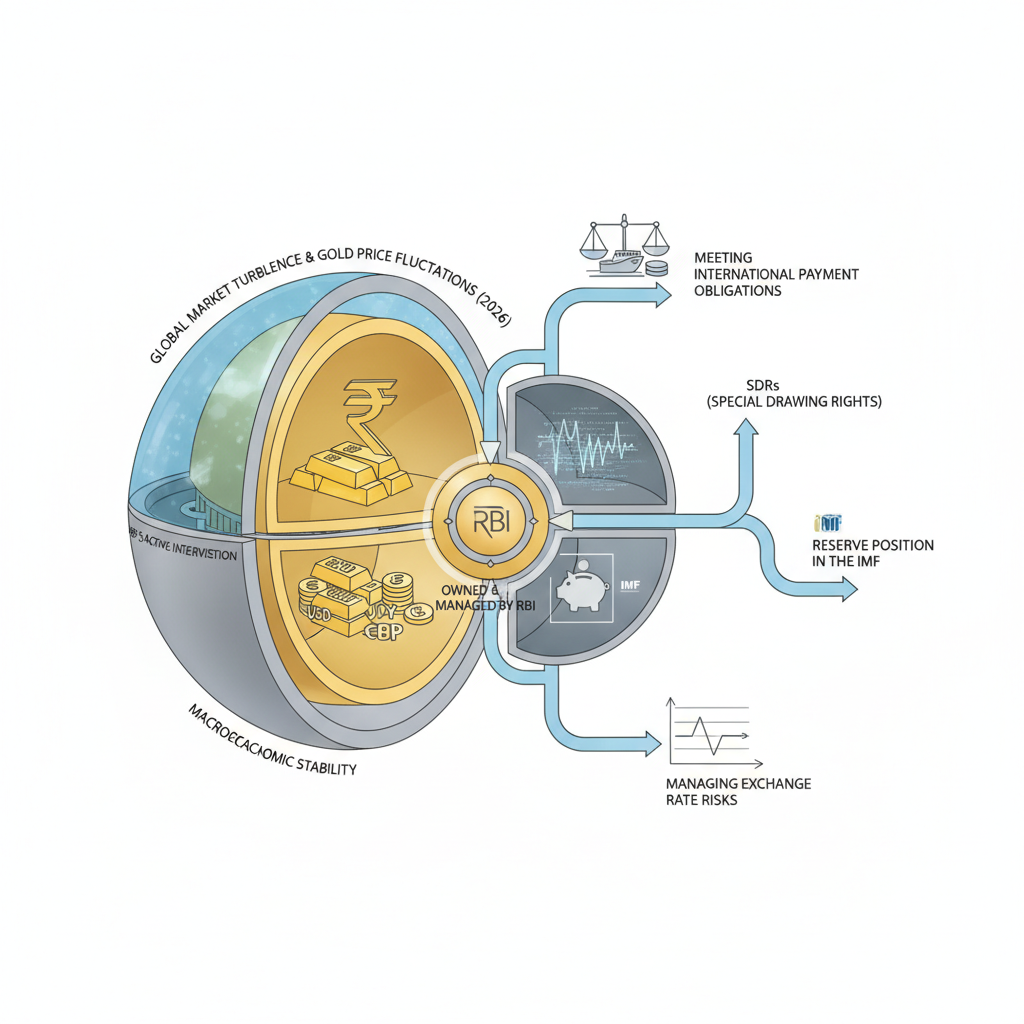
✎ India’s foreign exchange reserves, managed by the RBI, are a diversified portfolio of Foreign Currency Assets, gold, SDRs, and IMF Reserve Tranche Position, designed to ensure macroeconomic stability, exchange rate management…
Subject Relevance — Where This Topic Fits
- GS Paper III — Indian Economy (Money and Banking, Balance of Payments, Exchange Rate Management) | GS Paper II — International Relations (India’s External Sector, Global Financial Stability)
- Prelims: Foreign Exchange Reserves (Forex Reserves), Reserve Bank of India (RBI), Foreign Currency Assets (FCA), Special Drawing Rights (SDRs), Reserve Tranche Position (RTP), Balance of Payments (BoP), Exchange Rate Management, Currency Depreciation/Appreciation, Monetary Policy, Capital Account Convertibility
- Essay: India’s Strategic Resilience in Global Financial Turbulence: The Role of Forex Reserves, Monetary Sovereignty and External Sector Stability: Lessons from India’s Forex Reserve Management
Quick Revision: India’s foreign exchange reserves, managed by the RBI, are a diversified portfolio of Foreign Currency Assets, gold, SDRs, and IMF Reserve Tranche Position, designed to ensure macroeconomic stability, exchange rate management, and external sector resilience.
Why is this in the news?
The topic has gained prominence due to the volatility in India’s foreign exchange reserves during 2026, driven by global market turbulence, fluctuations in gold prices, and active foreign-exchange interventions by the Reserve Bank of India (RBI). As of July 31, 2026, India’s forex reserves stood at approximately $692.87 billion, reflecting their critical role in maintaining macroeconomic stability, managing exchange rate risks, and ensuring India’s ability to meet international payment obligations. For UPSC aspirants, understanding the composition, ownership, and strategic use of forex reserves is essential for addressing questions in GS Paper III and linking them to broader themes in monetary policy, external sector management, and global financial architecture.
Background
- Foreign exchange reserves are a key component of a country’s external sector, acting as a buffer against external shocks such as sudden capital outflows, currency depreciation, or global financial crises.
- The Reserve Bank of India (RBI) is the sole custodian of India’s foreign exchange reserves, managing them under a framework that prioritises safety, liquidity, and return, in that order.
- India’s forex reserves have witnessed significant fluctuations in 2026, influenced by global market volatility, changes in gold prices, and the RBI’s active interventions in the foreign exchange market to stabilise the rupee.
- The composition of India’s forex reserves includes Foreign Currency Assets (FCA), gold, Special Drawing Rights (SDRs), and the Reserve Tranche Position (RTP) in the IMF, each serving distinct purposes in reserve management.
- The RBI’s reserve management strategy is guided by the principle of maintaining adequate liquidity to meet balance-of-payments obligations while ensuring the safety of assets during periods of global financial stress.
- India’s forex reserves are a critical indicator of its external sector health, influencing investor confidence, sovereign credit ratings, and the country’s ability to absorb external shocks without resorting to excessive external borrowing.
What are Foreign Exchange Reserves and How Are They Managed by the RBI?
- Foreign Exchange Reserves are external assets held or controlled by a country’s monetary authority (the RBI in India’s case) that are readily available to meet balance-of-payments financing needs, intervene in foreign exchange markets, and maintain confidence in the domestic currency.
- These reserves are not merely a stockpile of US dollars but comprise a diversified portfolio of international assets, including Foreign Currency Assets (FCA), gold, Special Drawing Rights (SDRs), and the Reserve Tranche Position (RTP) in the IMF.
- Foreign Currency Assets (FCA) constitute the largest component of India’s reserves, primarily comprising assets denominated in major foreign currencies such as the US dollar, euro, Japanese yen, and British pound. These assets include investments in foreign government securities, deposits with foreign central and commercial banks, and other eligible instruments.
- Gold reserves serve as a hedge against currency depreciation and global financial instability, providing diversification benefits and acting as a safe-haven asset during periods of market turbulence.
- Special Drawing Rights (SDRs) are international reserve assets created by the IMF, allocated to member countries to supplement their official reserves. SDRs are a synthetic currency basket comprising the US dollar, euro, Chinese renminbi, Japanese yen, and British pound, and can be converted into usable currencies.
- The Reserve Tranche Position (RTP) in the IMF represents India’s unconditional access to IMF resources, equivalent to 25% of its quota in the IMF. This position serves as a liquidity backstop and enhances the country’s financial resilience.
- The RBI’s reserve management framework is governed by the principle of ‘safety, liquidity, and return’ in descending order of priority. This ensures that reserves are readily available for crisis management while minimising exposure to market risks.
- The RBI actively intervenes in the foreign exchange market to stabilise the rupee, particularly during periods of volatility, by buying or selling foreign currency to prevent excessive appreciation or depreciation.
- India’s forex reserves are reported weekly by the RBI in the ‘Weekly Statistical Supplement’ and are closely monitored by financial markets, policymakers, and international institutions for insights into the country’s external sector health.
Key Features
| Feature | Significance |
|---|---|
| Foreign Currency Assets (FCA) | Largest component (approx. 80-90%) of reserves; provides liquidity for foreign exchange interventions and meets external obligations; denominated in USD, EUR, GBP, JPY, and other major currencies. |
| Gold Reserves | Acts as a safe-haven asset during global financial stress; provides diversification beyond currency risk; India’s gold reserves are held both domestically and abroad. |
| Special Drawing Rights (SDRs) | IMF-created international reserve asset; supplements foreign exchange reserves; allocated to member countries based on IMF quotas; can be exchanged for freely usable currencies. |
| Reserve Tranche Position (RTP) in IMF | India’s unconditional borrowing capacity with the IMF; part of the country’s quota subscription; provides automatic access to IMF resources without conditionality. |
| Liquidity and Safety Framework | RBI’s reserves management prioritises safety and liquidity over returns; ensures reserves are available for crisis management and exchange-rate stability. |
Why it Matters
Economic Stability
- Acts as a buffer against external shocks such as sudden capital outflows, global financial crises, or geopolitical tensions.
- Supports the Indian rupee during periods of volatility by enabling the RBI to intervene in foreign exchange markets.
- Enhances investor confidence by demonstrating India’s ability to meet international payment obligations, including imports and debt servicing.
Monetary Policy Transmission
- Forex reserves influence domestic liquidity conditions; interventions by the RBI to manage reserves can affect money supply and interest rates.
- Provides the RBI with tools to implement exchange-rate management policies, including managed float regimes.
- Supports the credibility of the monetary authority in maintaining price stability and exchange-rate stability.
Balance of Payments Management
- Helps finance current account deficits by providing foreign exchange liquidity for imports and external debt repayments.
- Supports the capital account by instilling confidence in foreign investors and creditors regarding India’s external sector resilience.
- Facilitates the settlement of trade and financial transactions in foreign currencies.
Sovereign Risk Mitigation
- Reduces reliance on external borrowing during periods of global financial stress by providing a self-insurance mechanism.
- Lowers the risk of a balance-of-payments crisis by ensuring sufficient foreign exchange liquidity to meet short-term obligations.
- Enhances India’s sovereign credit rating by demonstrating robust external sector fundamentals.
Challenges
1. Volatility in Global Financial Markets
- Sudden shifts in global risk sentiment can lead to capital outflows, exerting depreciation pressure on the rupee and depleting forex reserves.
- Fluctuations in global oil prices and commodity markets directly impact India’s import bill, affecting the current account deficit and reserve levels.
- Geopolitical tensions, such as conflicts or sanctions, can disrupt trade and financial flows, increasing the need for reserve utilisation.
UPSC Link: GS3: External Sector
2. Exchange Rate Management Constraints
- Excessive forex interventions to stabilise the rupee can lead to an accumulation of reserves, which may incur costs in terms of sterilisation and opportunity loss.
- The RBI faces a trade-off between defending the currency and allowing market-determined adjustments, which can impact reserve depletion.
- Overvaluation of the rupee due to reserve accumulation can harm export competitiveness over the medium term.
UPSC Link: GS3: Exchange Rate Management
3. Opportunity Cost of Holding Reserves
- Forex reserves are typically held in low-yielding assets (e.g., US Treasuries) to ensure safety and liquidity, leading to an opportunity cost compared to higher-yielding domestic investments.
- Large reserve holdings can crowd out private investment in domestic financial markets, particularly if sterilisation operations are extensive.
- The cost of maintaining reserves increases during periods of rising global interest rates, as the yield on reserve assets may not keep pace.
UPSC Link: GS3: Monetary Policy
4. Composition and Diversification Risks
- Over-reliance on USD-denominated assets exposes reserves to currency risk and geopolitical vulnerabilities associated with the US financial system.
- Gold reserves, while safe, do not generate income and may underperform compared to other asset classes during periods of high inflation.
- Limited diversification into emerging market assets can reduce the potential for higher returns and resilience against global shocks.
UPSC Link: GS3: Reserve Management
5. Fiscal and Debt Sustainability Concerns
- Excessive reserve accumulation can lead to fiscal costs, such as the interest paid on sterilisation bonds issued by the RBI to mop up excess liquidity.
- Large forex reserves may create moral hazard, encouraging fiscal profligacy by reducing the perceived urgency of structural reforms.
- High reserve levels can distort resource allocation, particularly if they are used to finance inefficient public expenditure.
UPSC Link: GS3: Fiscal Policy
Challenges — UPSC Perspective
| Issue | Concern |
|---|---|
| Sudden capital outflows | Depletion of reserves and pressure on the rupee; risk of balance-of-payments crisis. |
| Geopolitical risks | Disruption of trade and financial flows; increased need for reserve utilisation. |
| Sterilisation costs | Fiscal burden due to issuance of bonds to absorb excess liquidity from forex interventions. |
| Currency risk | Exposure to USD depreciation or appreciation; impact on reserve valuation. |
| Opportunity cost | Low returns on reserve assets compared to alternative domestic investments. |
| Export competitiveness | Overvaluation of the rupee due to reserve accumulation; harm to export sectors. |
Way Forward
- Enhance the diversification of forex reserves by gradually increasing allocations to non-USD assets, including gold, SDRs, and select emerging market currencies, while maintaining safety and liquidity.
- Strengthen the RBI’s reserves management framework by adopting a more dynamic asset allocation strategy that balances return, risk, and liquidity needs in line with global best practices.
- Promote structural reforms to reduce reliance on forex reserves for crisis management, such as improving export competitiveness, attracting long-term foreign investment, and deepening domestic financial markets.
- Develop contingency plans for reserve utilisation during extreme external shocks, including pre-approved swap lines with multilateral institutions like the IMF or regional arrangements.
- Improve transparency in forex reserve reporting by providing detailed breakdowns of asset composition, valuation methodologies, and intervention strategies to enhance market confidence.
- Integrate forex reserve management with broader macroeconomic policies, including fiscal consolidation, monetary policy normalisation, and trade facilitation, to ensure coherence and sustainability.
- Invest in capacity-building within the RBI and relevant government agencies to enhance expertise in advanced reserve management techniques, including derivatives and hedging strategies.
UPSC Value Addition
Keywords for Mains Answer-Writing
Foreign Exchange Reserves · Reserve Bank of India · Foreign Currency Assets · Special Drawing Rights · Balance of Payments · Exchange Rate Management · Monetary Policy · External Sector Stability · Gold Reserves · Reserve Tranche Position · Liquidity and Return Framework · Global Financial Volatility · International Payment Obligations · Forex Intervention · IMF Reserve Tranche
Concept Flow
Global financial volatility → Capital outflows from India → Depreciation pressure on the rupee → RBI intervention using forex reserves → Depletion of reserves → Risk of balance-of-payments crisis → Rise in global oil prices → Increase in India’s import bill → Widening current account deficit → Pressure on forex reserves → Need for policy adjustments (e.g., import curbs, export promotion) → Excessive forex reserve accumulation → Sterilisation operations by RBI → Issuance of bonds → Fiscal costs → Crowding out of private investment → Impact on growth and inflation → Geopolitical tensions → Disruption of trade flows → Shortfall in foreign exchange earnings → Depletion of reserves → Need for IMF support or other contingency measures → Overvaluation of the rupee due to reserve accumulation → Loss of export competitiveness → Slowdown in manufacturing and employment → Structural economic challenges → Low returns on forex reserves → Opportunity cost → Need for diversification into higher-yielding assets → Balancing safety, liquidity, and return in reserves management → Forex reserves as a tool for monetary policy → RBI interventions to manage liquidity → Impact on money supply and interest rates → Transmission to real economy
Prelims Practice Questions
Q1. Consider the following statements regarding India’s foreign exchange reserves:
1. Foreign Currency Assets (FCA) form the largest component of India’s forex reserves.
2. The Reserve Bank of India (RBI) manages the country’s foreign exchange reserves.
3. The Reserve Tranche Position (RTP) in the IMF is part of India’s forex reserves.
4. Gold reserves are not included in the calculation of India’s forex reserves.
How many of the above statements are correct?
- Only one
- Only two
- Only three
- All
Answer: Only three — Statements 1, 2, and 3 are correct. Statement 4 is incorrect as gold reserves are a component of India’s forex reserves.
Q2. Assertion (A): The Reserve Bank of India (RBI) prioritizes return over liquidity when managing foreign exchange reserves.
Reason (R): The RBI’s reserves-management framework emphasizes safety, liquidity, and return, in that order, to ensure reserves are available during a crisis.
Options:
A. Both A and R are true, and R is the correct explanation of A.
B. Both A and R are true, but R is not the correct explanation of A.
C. A is true, but R is false.
D. A is false, but R is true.
Answer: ? — Assertion (A) is false because the RBI’s framework prioritizes safety and liquidity over return. Reason (R) is true and correctly explains the framework.
Q3. Match the following components of India’s foreign exchange reserves with their respective descriptions:
Column I (Component)
A. Foreign Currency Assets (FCA)
B. Special Drawing Rights (SDRs)
C. Reserve Tranche Position (RTP)
D. Gold Reserves
Column II (Description)
1. Assets denominated in major foreign currencies, including investments in foreign government securities.
2. A potential claim on freely usable currencies of IMF members, created by the IMF.
3. A portion of India’s quota in the IMF that can be drawn without conditions.
4. Physical gold held by the RBI as part of the reserves.
Options for matching:
A-1, B-2, C-3, D-4
A-2, B-1, C-4, D-3
A-3, B-4, C-1, D-2
A-4, B-3, C-2, D-1
- A-1, B-2, C-3, D-4
- A-2, B-1, C-4, D-3
- A-3, B-4, C-1, D-2
- A-4, B-3, C-2, D-1
Answer: A-1, B-2, C-3, D-4 — The correct matching is: A-1 (FCA are assets in foreign currencies), B-2 (SDRs are IMF-created assets), C-3 (RTP is a portion of India’s IMF quota), D-4 (Gold reserves are physical gold holdings).
Mains Practice Question
✍ Critically examine the role of India’s foreign exchange reserves in maintaining macroeconomic stability and external sector resilience. How does the Reserve Bank of India (RBI) manage these reserves to balance safety, liquidity, and return? Also, assess the implications of recent global financial volatility on India’s forex reserves and exchange rate management. (15 Marks)
Approach: MODEL-ANSWER SKELETON:
1. **Definition and Composition of Forex Reserves**
– Define foreign exchange reserves and their components: Foreign Currency Assets (FCA), Gold, Special Drawing Rights (SDRs), and Reserve Tranche Position (RTP).
– Highlight the dominance of FCA (e.g., ~80% of total reserves) and the strategic role of gold as a hedge against currency depreciation.
2. **Macroeconomic Stability and External Sector Resilience**
– Explain the buffer function of forex reserves in mitigating balance-of-payments (BoP) crises, import cover (e.g., 10-12 months of imports), and confidence-building in global markets.
– Link to India’s external sector challenges: trade deficits, capital outflows, and currency volatility.
– Cite recent data (e.g., forex reserves at $692.87 billion as of July 31, 2026) to illustrate resilience.
3. **RBI’s Management Framework**
– Detail the RBI’s tripartite priority: safety (low-risk assets), liquidity (immediate availability), and return (yield optimization within constraints).
– Discuss the investment strategy: diversification across currencies (e.g., USD, EUR, GBP), sovereign bonds, and deposits with foreign central banks.
– Mention the role of gold in diversifying risk and its historical performance during crises.
4. **Global Financial Volatility and Forex Reserves**
– Analyze recent volatility drivers: geopolitical tensions, oil price fluctuations, and monetary policy shifts (e.g., US Fed rate hikes).
– Explain the RBI’s forex intervention mechanisms: spot and forward market operations to stabilize the rupee.
– Assess the trade-offs: frequent interventions may deplete reserves but are necessary to prevent excessive currency depreciation.
5. **Implications and Challenges**
– Discuss the opportunity cost of holding large reserves (e.g., foregone domestic investment) and the debate on optimal reserve levels.
– Highlight the role of SDRs and RTP as supplementary liquidity tools during crises.
– Conclude with a balanced view: forex reserves are a critical tool for stability but require prudent management to align with India’s developmental goals.
Key Provisions/Committees:
– RBI Act, 1934 (Sections 40 and 41 on reserve management).
– Report of the Committee on Capital Account Convertibility (Tarapore Committee, 1997).
– Recent RBI Annual Reports and Monetary Policy Statements.
Recent Context:
– Impact of global financial volatility in 2026 on India’s forex reserves and exchange rate management.
Source: Times of India
Generated by AanyaAi for educational purpose.

- KWML’s Feasibility Reports for Water Metro in 18 Cities: UPSC & PCS Insights - October 3, 2026
- ओडिशा में वन्यजीव अनुसंधान अनुदान कार्यक्रम शुरू, सिमिलिपाल में 300 कैमरे और बढ़ेंगे - October 3, 2026
- India Summons Pakistan High Commission Official Over Violation - October 3, 2026

No Comments