


10 Aug NIRF Rankings 2025: 7,692 HEIs Join, Quality & Competition Rise
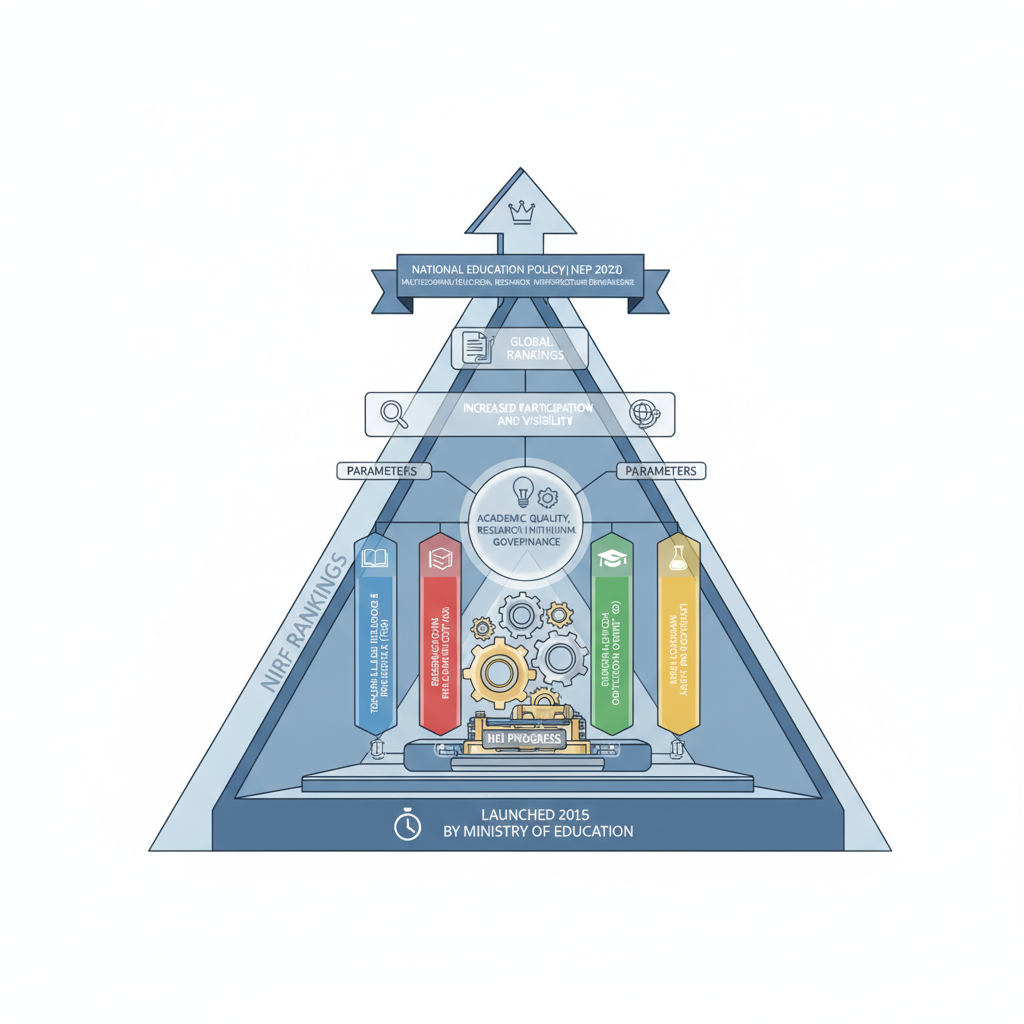
NIRF FrameworkHEIs ParticipationAcademic QualityResearch OutputInstitutional GovernanceNEP 2020✎ NIRF is India’s premier higher education ranking framework, launched in 2015, evaluating institutions on five parameters to drive quality, research, and global competitiveness.
Subject Relevance — Where This Topic Fits
- GS Paper II — Governance, Transparency and Institutions | GS Paper III — Science and Technology, Education, Human Resource Development
- Prelims: NIRF, NEP 2020, IOE Scheme, RUSA, PM-USHA, MERU, QS World University Rankings, HEI, NAAC, NBA, UGC
- Essay: Higher education reforms in India: Challenges and opportunities, Role of rankings in fostering institutional excellence and accountability
Quick Revision: NIRF is India’s premier higher education ranking framework, launched in 2015, evaluating institutions on five parameters to drive quality, research, and global competitiveness.
Why is this in the news?
The National Institutional Ranking Framework (NIRF) has witnessed a significant increase in participation and visibility of Indian higher education institutions (HEIs) in global rankings, reflecting systemic improvements in academic quality, research output, and institutional governance. This development is aligned with the objectives of the National Education Policy (NEP) 2020, which emphasises multidisciplinary education, research promotion, and infrastructure enhancement to elevate India’s higher education ecosystem.
Background
- The NIRF was launched in 2015 by the Ministry of Education to rank HEIs in India annually, fostering healthy competition and accountability.
- The framework evaluates institutions across five broad parameters: Teaching, Learning & Resources (TLR), Research and Professional Practices (RP), Graduation Outcomes (GO), Outreach and Inclusivity (OI), and Perception (PR).
- Participation in NIRF has grown from 6,272 applications in 2021 to 14,163 in 2025, with unique institutions rising from 4,030 to 7,692.
- The number of Indian institutions featured in the QS World University Rankings has increased from 11 in 2015 to 52 in 2027, indicating improved global recognition.
- NEP 2020 prioritises quality enhancement in higher education through multidisciplinary learning, critical thinking, research promotion, and infrastructure development.
- Government initiatives such as RUSA, PM-USHA, IOE Scheme, and establishment of new IITs, IIMs, and central universities have complemented NIRF’s objectives.
What is the National Institutional Ranking Framework (NIRF)?
- NIRF is an annual ranking system for higher education institutions in India, introduced by the Ministry of Education in 2015.
- It ranks institutions across five key parameters: Teaching, Learning & Resources (TLR), Research and Professional Practices (RP), Graduation Outcomes (GO), Outreach and Inclusivity (OI), and Perception (PR).
- The framework aims to promote accountability, transparency, and competition among HEIs, driving improvements in academic and research standards.
- NIRF rankings are published annually and are widely referenced by students, policymakers, and institutions for benchmarking performance.
- The methodology is designed to be objective, data-driven, and aligned with global best practices in higher education assessment.
- Participation in NIRF is voluntary, but the increasing number of applicants reflects growing institutional commitment to quality enhancement.
- NIRF rankings have contributed to India’s improved visibility in global university rankings, such as QS and THE.
- The framework also serves as a tool for identifying strengths and weaknesses in HEIs, enabling targeted policy interventions.
Key Features
| Feature | Significance |
|---|---|
| National Institutional Ranking Framework (NIRF) | Establishes a transparent, multi-criteria benchmark for assessing HEIs, fostering competition and accountability in higher education quality. |
| Five Evaluation Parameters | Provides a holistic assessment of institutions across teaching-learning resources, research output, graduate outcomes, inclusivity, and institutional perception. |
| Expansion of NIRF Participation | From 6,272 applications in 2021 to 14,163 in 2025, indicating growing institutional engagement and transparency in quality assessment. |
| Integration with Global Rankings | Increase in Indian institutions featured in QS World University Rankings from 11 (2015) to 52 (2027), reflecting improved global visibility and competitiveness. |
| Institutional Initiatives under NEP 2020 | Promotes multidisciplinary education, research, infrastructure development, and teacher training to enhance overall academic excellence. |
Why it Matters
Higher Education Governance
- NIRF serves as a policy tool for evidence-based decision-making in higher education governance by providing objective performance metrics.
- Encourages institutions to align with global standards, thereby improving employability and research output of graduates.
- Facilitates targeted interventions by the government through schemes like RUSA/PM-USHA and IOE for underperforming or high-potential institutions.
Economic and Human Capital Development
- Enhanced quality of HEIs directly contributes to the development of a skilled workforce, aligning with India’s demographic dividend and economic growth objectives.
- Research and innovation outputs from ranked institutions strengthen India’s position in global knowledge economies and attract foreign investment.
- Improved inclusivity and outreach metrics in NIRF rankings ensure equitable access to quality education, reducing regional disparities.
Global Competitiveness
- NIRF’s alignment with international ranking frameworks (e.g., QS) enhances India’s soft power in higher education and attracts global talent.
- Increased participation in global rankings demonstrates the efficacy of domestic reforms and institutional capacity building.
- Promotes cross-border collaborations and partnerships, fostering knowledge exchange and innovation.
Challenges
1. Quality Disparities Across Institutions
- Significant variation in infrastructure, faculty quality, and research output persists between top-ranked and lower-ranked institutions.
- Urban-rural divide exacerbates inequities, with most high-ranking institutions concentrated in metropolitan areas.
- Limited capacity of state universities to meet NIRF parameters due to resource constraints and administrative bottlenecks.
UPSC Link: GS-II: Higher Education Governance
2. Data Integrity and Transparency
- Ensuring the accuracy and reliability of self-reported data by institutions remains a challenge, risking manipulation of rankings.
- Lack of standardized assessment protocols for certain parameters (e.g., ‘perception’) may introduce subjectivity.
- Need for periodic third-party audits to validate institutional claims and maintain credibility of the ranking system.
UPSC Link: GS-II: Regulatory Frameworks
3. Sustainability of Reforms
- Long-term sustainability of initiatives like IOE and MERUs depends on consistent funding and political will beyond election cycles.
- Institutional autonomy granted under schemes may lead to governance challenges without robust accountability mechanisms.
- Balancing global competitiveness with local developmental needs (e.g., language of instruction, regional relevance) is a persistent dilemma.
UPSC Link: GS-II: Policy Implementation
4. Faculty Shortages and Quality
- Chronic faculty shortages, particularly in state universities and rural areas, undermine teaching and research quality.
- High attrition rates among faculty due to better opportunities abroad or in private sectors reduce institutional stability.
- Inadequate professional development opportunities hinder the adoption of modern pedagogical and research practices.
UPSC Link: GS-II: Human Resource Development
5. Industry-Academia Collaboration
- Limited synergy between academic curricula and industry requirements results in skill mismatches among graduates.
- Insufficient funding for applied research and innovation restricts the commercialization of academic outputs.
- Bureaucratic hurdles in technology transfer and intellectual property rights (IPR) management deter private sector partnerships.
UPSC Link: GS-III: Skill Development
Challenges — UPSC Perspective
| Issue | Concern |
|---|---|
| Infrastructure Deficits | Inadequate labs, libraries, and digital resources in many HEIs hinder quality education and research. |
| Regional Imbalances | Concentration of top institutions in select states (e.g., Karnataka, Maharashtra) exacerbates inter-state disparities. |
| Research Output Gaps | Low publication rates and patent filings in state universities compared to central institutions limit global impact. |
| Perception Bias | Over-reliance on subjective parameters like ‘perception’ may disadvantage newer or niche institutions. |
| Funding Volatility | Fluctuations in government allocations for schemes like RUSA/PM-USHA disrupt long-term institutional planning. |
Government Initiatives — Must-Memorise for Prelims
- National Institutional Ranking Framework (NIRF)
- National Education Policy (NEP) 2020
- Rashtriya Uchchatar Shiksha Abhiyan (RUSA)
- Pradhan Mantri Uchchatar Shiksha Abhiyan (PM-USHA)
- Institutes of Eminence (IoE) Scheme
Way Forward
- Strengthen institutional capacity in underrepresented regions through targeted grants and mentorship programs.
- Develop a national digital repository for faculty recruitment and professional development to address shortages.
- Introduce mandatory third-party audits for NIRF data submission to ensure transparency and accuracy.
- Expand industry-linked internships and apprenticeships in HEIs to bridge skill gaps and enhance employability.
- Establish a dedicated corpus for applied research and innovation, with simplified IPR and technology transfer policies.
- Promote regional language-based multidisciplinary programs to cater to local developmental needs while maintaining global standards.
- Enhance collaboration between central and state universities through joint research initiatives and resource-sharing platforms.
- Institutionalize periodic reviews of NIRF parameters to align with evolving global education trends and domestic priorities.
UPSC Value Addition
Keywords for Mains Answer-Writing
National Institutional Ranking Framework (NIRF) · Higher Education Institutions (HEIs) · National Education Policy (NEP) 2020 · multi-disciplinary education · research and innovation · Institutes of Eminence (IoE) Scheme · National Higher Education Campaign (RUSA/PM-USHA) · QS World University Rankings · computational thinking and AI curriculum · teacher capacity building · skill-integrated education
Concept Flow
NEP 2020 mandates quality enhancement in HEIs → Government launches NIRF (2015) to assess institutions transparently → Institutions participate, improving data-driven governance → NIRF rankings drive competition and reforms → Enhanced rankings improve global visibility (QS) → Increased foreign collaborations and funding → Sustainable development of human capital and research ecosystem.
Prelims Practice Questions
Q1. Consider the following statements regarding the National Institutional Ranking Framework (NIRF):
1. NIRF rankings are based on five broad parameters: Teaching, Learning & Resources; Research and Professional Practices; Graduation Outcomes; Outreach and Inclusivity; and Perception.
2. The number of unique institutions participating in NIRF increased from 4,030 in 2021 to 7,692 in 2025.
3. NIRF rankings are mandatory for all higher education institutions in India.
How many of the above statements are correct?
- Only one
- Only two
- All three
- None
Answer: Only two — Statements 1 and 2 are correct as per the NIRF framework and official data. Statement 3 is incorrect because NIRF participation is voluntary, not mandatory.
Q2. Assertion (A): The Institutes of Eminence (IoE) Scheme aims to grant autonomy to selected institutions to emerge as world-class academic and research institutions.
Reason (R): The IoE Scheme was launched in 2017 to provide financial and administrative autonomy to institutions classified under it.
Examine the Assertion and Reason and select the correct code:
- Both A and R are true, and R is the correct explanation of A.
- Both A and R are true, but R is not the correct explanation of A.
- A is true, but R is false.
- A is false, but R is true.
Answer: Both A and R are true, and R is the correct explanation of A. — The Assertion (A) correctly states the objective of the IoE Scheme. The Reason (R) accurately describes the scheme’s provisions, including autonomy. Thus, both are true, and R correctly explains A.
Q3. Match the following initiatives with their respective objectives:
Column I (Initiative) | Column II (Objective)
———————————————–|————————————————–
A. National Higher Education Campaign (RUSA) | 1. Establishing world-class institutions with autonomy
B. Institutes of Eminence (IoE) Scheme | 2. Improving higher education infrastructure and quality in states
C. QS World University Rankings | 3. Enhancing global visibility of Indian HEIs
D. AI curriculum in schools | 4. Promoting computational thinking and AI literacy
- A-2, B-1, C-3, D-4
- A-1, B-2, C-3, D-4
- A-4, B-3, C-2, D-1
- A-3, B-4, C-1, D-2
Answer: A-2, B-1, C-3, D-4 — A matches with 2 (RUSA aims to improve state-level higher education infrastructure). B matches with 1 (IoE Scheme grants autonomy to institutions). C matches with 3 (QS Rankings enhance global visibility). D matches with 4 (AI curriculum promotes computational thinking).
Mains Practice Question
✍ The National Institutional Ranking Framework (NIRF) has emerged as a pivotal mechanism in India’s higher education landscape, reflecting the National Education Policy (NEP) 2020’s emphasis on quality, inclusivity, and global competitiveness. Critically examine the role of NIRF in fostering institutional excellence and its alignment with the broader goals of NEP 2020. (15 Marks)
Approach: MODEL-ANSWER SKELETON:
1. **Introduction**: Define NIRF and its 2015 launch as a voluntary, outcome-based ranking framework under the Ministry of Education. Highlight its alignment with NEP 2020’s objectives: multi-disciplinary education, research promotion, infrastructure improvement, and global competitiveness.
2. **Key Features of NIRF**:
– **Five Parameters**: Teaching, Learning & Resources; Research and Professional Practices; Graduation Outcomes; Outreach and Inclusivity; Perception.
– **Voluntary Participation**: Contrast with mandatory rankings in some countries; emphasize India’s participatory model.
– **Data-Driven**: Discuss the increasing participation (14,163 applications in 2025 vs. 6,272 in 2021) and its impact on institutional accountability.
3. **Role in Institutional Excellence**:
– **Benchmarking and Competition**: Explain how NIRF fosters healthy competition among HEIs, driving improvements in teaching, research, and infrastructure.
– **Global Visibility**: Cite the increase in QS World University Rankings participants (from 11 in 2015 to 52 in 2027) as a proxy for NIRF’s success in enhancing global recognition.
– **Policy Feedback Loop**: Discuss how NIRF data informs government schemes (e.g., IoE Scheme, RUSA/PM-USHA) and targeted interventions.
4. **Alignment with NEP 2020**:
– **Multi-Disciplinary Education**: Link NIRF’s emphasis on diverse parameters to NEP’s push for holistic, multi-disciplinary learning.
– **Inclusivity and Outreach**: Highlight NIRF’s focus on outreach and inclusivity, reflecting NEP’s commitment to equitable access.
– **Research and Innovation**: Discuss how NIRF’s research parameter aligns with NEP’s goal of promoting indigenous research and innovation.
5. **Critiques and Challenges**:
– **Overemphasis on Metrics**: Acknowledge concerns about metric-driven rankings potentially overshadowing qualitative aspects like ethics and social impact.
– **Regional Disparities**: Note disparities in participation and performance across states, reflecting uneven development in higher education.
– **Perception Bias**: Critique the ‘Perception’ parameter, which may favor older, well-established institutions over newer ones.
6. **Conclusion**: Summarize NIRF’s contribution to institutional excellence and its role as a tool for achieving NEP 2020’s vision. Emphasize the need for continuous refinement to address critiques and ensure equitable growth.
Source: PIB (Press Information Bureau)
Generated by AanyaAi for educational purpose.

- KWML’s Feasibility Reports for Water Metro in 18 Cities: UPSC & PCS Insights - October 3, 2026
- ओडिशा में वन्यजीव अनुसंधान अनुदान कार्यक्रम शुरू, सिमिलिपाल में 300 कैमरे और बढ़ेंगे - October 3, 2026
- India Summons Pakistan High Commission Official Over Violation - October 3, 2026

No Comments