


10 Aug Karnataka HC: PMLA Prosecution Post Conviction Not Double Jeopardy for UPSC Aspirants
Money Laundering ActPredicate offencesProsecution under PMLADouble jeopardy clause✎ Prosecution under the PMLA for money laundering is independent of the predicate offence and does not constitute double jeopardy, as the offence under PMLA derives its existence from the laundering of proceeds of crime, not the…
Subject Relevance — Where This Topic Fits
- GS Paper II — Polity and Governance (Constitutional Provisions, Judicial Review) | GS Paper III — Economy (Money Laundering, Financial Crimes)
- Prelims: Prevention of Money Laundering Act (PMLA), 2002, Predicate Offences, Section 300 CrPC (Double Jeopardy), Article 20(2) of the Constitution, Scheduled Offences under PMLA
- Essay: The interplay between economic justice and constitutional safeguards in financial crime legislation
Quick Revision: Prosecution under the PMLA for money laundering is independent of the predicate offence and does not constitute double jeopardy, as the offence under PMLA derives its existence from the laundering of proceeds of crime, not the predicate offence itself.
Why is this in the news?
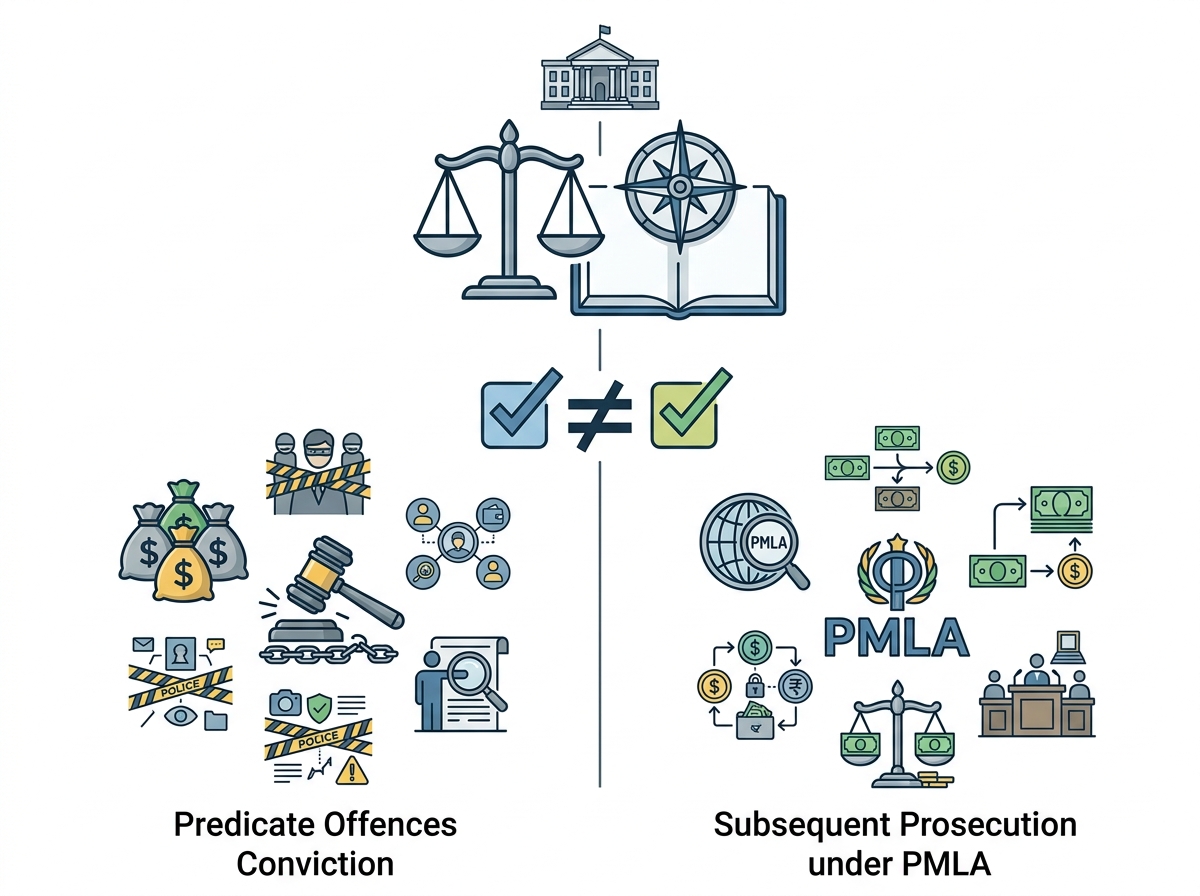
The Karnataka High Court, in a judgment dated August 10, 2026, clarified that prosecution under the Prevention of Money Laundering Act (PMLA), 2002, for money laundering offences subsequent to a conviction for predicate offences does not constitute double jeopardy under Section 300 of the Criminal Procedure Code (CrPC) or violate Article 20(2) of the Constitution. The ruling underscores the distinct nature of money laundering offences, which are prosecuted independently despite their origin in predicate crimes, thereby reinforcing the legal framework governing financial crimes in India.
Background
- The Prevention of Money Laundering Act (PMLA), 2002, was enacted to combat money laundering and confiscate proceeds of crime, with a focus on scheduled offences (predicate offences) such as those under the IPC, Narcotic Drugs and Psychotropic Substances Act, and other economic offences.
- Money laundering involves the process of concealing the origin of illicitly obtained funds, often through complex financial transactions, to legitimise them as clean money.
- The PMLA operates independently of the predicate offence, with its own set of offences, penalties, and procedural mechanisms, including attachment and confiscation of proceeds of crime.
- The doctrine of double jeopardy, enshrined in Section 300 CrPC and Article 20(2) of the Constitution, prohibits a second prosecution for the same offence after acquittal or conviction.
- The Karnataka High Court’s ruling addresses the legal ambiguity surrounding whether prosecution under PMLA post-conviction for predicate offences amounts to double jeopardy.
- The case involved individuals convicted under IPC sections for cheating and looting, with subsequent prosecution under PMLA for money laundering based on the same criminal conduct.
What is the Prevention of Money Laundering Act (PMLA), 2002?
- The PMLA is a comprehensive legislation enacted to prevent money laundering and to provide for confiscation of proceeds of crime derived from scheduled offences.
- Scheduled offences (predicate offences) are listed in the PMLA and include crimes such as drug trafficking, counterfeiting, and economic offences like cheating and forgery.
- Money laundering is defined under Section 3 of the PMLA as the process of projecting proceeds of crime as untainted property, concealing the true nature of such proceeds, or using them to further criminal activities.
- The Act establishes the Directorate of Enforcement (ED) as the primary agency for investigation and prosecution of money laundering cases.
- PMLA provides for attachment and confiscation of proceeds of crime, with the burden of proof shifted to the accused to demonstrate the legitimacy of seized assets.
- The Act mandates the trial of money laundering cases by Special Courts designated under Section 43, ensuring expeditious disposal of such cases.
- Prosecution under PMLA is distinct from the predicate offence, as it targets the laundering process rather than the underlying crime, thereby serving a separate legal purpose.
- The PMLA is aligned with international standards, including the recommendations of the Financial Action Task Force (FATF), to combat transnational financial crimes.
Key Features
| Feature | Significance |
|---|---|
| Prosecution under PMLA post-conviction for predicate offences | Establishes that PMLA prosecution is independent of the predicate offence conviction, addressing the legal principle of double jeopardy. |
| Distinction between predicate offence and money laundering offence | Clarifies that money laundering involves the proceeds of crime, not the underlying offence itself, thus constituting a separate statutory violation. |
| Section 300 of the Criminal Procedure Code (CrPC) | Prohibits a second trial for the same offence; the High Court ruled that PMLA prosecution is not barred as it pertains to a distinct offence. |
| Special Courts under PMLA | Ensures exclusive jurisdiction for money laundering cases, preventing overlap with trials for predicate offences. |
| Judicial interpretation of PMLA provisions | Reinforces the autonomy of PMLA prosecutions, aligning with the Act’s objective to curb financial crimes and illicit wealth accumulation. |
Why it Matters
Legal Framework and Jurisprudence
- The judgment reinforces the separation of offences under PMLA from predicate offences, ensuring clarity in the prosecution of financial crimes.
- It upholds the constitutional validity of PMLA prosecutions, preventing misuse of the double jeopardy principle to evade accountability for money laundering.
- The ruling aligns with the global standards for anti-money laundering (AML) frameworks, where proceeds of crime are treated as distinct offences.
- It strengthens the legal deterrence against economic offences by ensuring that convictions under PMLA are not undermined by prior or pending appeals for predicate offences.
Institutional Integrity
- The decision underscores the role of Special Courts under PMLA in ensuring expeditious and focused trials for money laundering cases.
- It highlights the judiciary’s commitment to interpreting statutes in a manner that advances the objectives of financial crime prevention.
- The ruling may influence future litigation on the interplay between predicate offences and money laundering, providing a precedent for courts.
Economic Governance Implications
- By delineating the scope of PMLA prosecutions, the judgment aids in the effective enforcement of anti-money laundering measures, which are critical for economic stability.
- It reinforces investor confidence by demonstrating a robust legal framework to combat financial crimes and illicit wealth accumulation.
- The decision supports the objectives of the Financial Action Task Force (FATF) and India’s compliance with international AML standards.
Challenges
1. Jurisdictional Overlap and Legal Complexity
- The concurrent prosecution under IPC and PMLA may lead to procedural delays, especially when appeals against predicate offence convictions are pending.
- Ensuring coordination between Special Courts under PMLA and regular criminal courts to avoid conflicting judgments.
- Balancing the rights of accused persons with the need for stringent enforcement of anti-money laundering laws.
UPSC Link: GS-II: Judiciary and Legal Framework
2. Resource Constraints in Judicial System
- The increasing number of money laundering cases may strain the capacity of Special Courts, leading to delays in justice delivery.
- The need for specialized training for judges and prosecutors to handle complex financial crime cases efficiently.
UPSC Link: GS-II: Judiciary and Legal Framework
3. Interpretation and Application of PMLA Provisions
- The evolving nature of financial crimes necessitates continuous judicial and legislative refinement of PMLA provisions to address emerging challenges.
- Ensuring that the distinction between predicate offences and money laundering offences is clearly understood by law enforcement agencies.
UPSC Link: GS-III: Economic Governance
Challenges — UPSC Perspective
| Issue | Concern |
|---|---|
| Procedural Delays | Pending appeals for predicate offences may delay PMLA prosecutions, impacting timely justice delivery. |
| Judicial Capacity | Limited number of Special Courts and trained personnel may hinder effective enforcement of PMLA. |
| Legal Ambiguity | Potential for conflicting interpretations of PMLA provisions across jurisdictions. |
| Resource Allocation | Need for dedicated funding and infrastructure to support Special Courts and investigative agencies. |
| Compliance with International Standards | Ensuring alignment with FATF recommendations while addressing domestic legal complexities. |
Way Forward
- Enhance capacity-building initiatives for judges, prosecutors, and investigative agencies to handle PMLA cases efficiently.
- Streamline coordination mechanisms between Special Courts under PMLA and regular criminal courts to avoid procedural conflicts.
- Conduct periodic reviews of PMLA provisions to address emerging challenges in financial crime detection and prosecution.
- Strengthen data-sharing frameworks between enforcement agencies to improve the tracing and seizure of illicit proceeds.
- Promote public awareness campaigns to educate stakeholders about the legal distinctions between predicate offences and money laundering.
- Explore technological solutions, such as AI-driven analytics, to expedite the investigation and prosecution of money laundering cases.
- Ensure adequate funding and infrastructure for Special Courts to handle the increasing caseload of PMLA prosecutions.
UPSC Value Addition
Keywords for Mains Answer-Writing
Money Laundering · Predicate Offences · Prevention of Money Laundering Act (PMLA), 2002 · Double Jeopardy · Section 300 of the Criminal Procedure Code (CrPC) · Karnataka High Court Judgment · Proceeds of Crime · Scheduled Offences · Special Courts under PMLA · Constitutional Validity of PMLA · Separate Statutory Offence · Money Laundering vs Predicate Offences · Prosecution for Money Laundering · Judicial Interpretation of PMLA
Constitutional & Policy Linkages
- [‘Article 20(2): Protection against double jeopardy’, ‘Prohibits prosecution for the same offence more than once.’]
- [‘Article 21: Right to Fair Trial’, ‘Ensures due process and fair treatment in money laundering prosecutions.’]
Concept Flow
Commission of predicate offence (e.g., cheating, IPC offences) leads to generation of illicit proceeds. → Proceeds of crime are integrated into the financial system through money laundering activities. → Enforcement agencies investigate and trace the illicit proceeds under PMLA. → Prosecution under PMLA is initiated as a distinct statutory offence, separate from the predicate offence. → Judicial interpretation confirms that PMLA prosecution is not barred by double jeopardy principles. → Special Courts adjudicate money laundering cases, ensuring compliance with legal and constitutional safeguards.
Prelims Practice Questions
Q1. Consider the following statements regarding the Prevention of Money Laundering Act (PMLA), 2002:
1. The PMLA provides for the prosecution of money laundering as a distinct offence separate from the predicate offence.
2. Section 300 of the Criminal Procedure Code (CrPC) prohibits a second trial for the same offence but not for a distinct offence under another enactment.
3. The offence of money laundering under PMLA is derived from the laundering of proceeds of crime, even if the predicate offence has been committed.
How many of the above statements are correct?
- Only one
- Only two
- All three
- None
Answer: All three — Statements 1, 2, and 3 are all correct. The PMLA treats money laundering as a distinct offence, Section 300 CrPC prohibits only a second trial for the same offence, and the offence under PMLA is independent of the predicate offence.
Q2. Assertion (A): The Prevention of Money Laundering Act (PMLA), 2002, allows for prosecution of money laundering even after conviction for the predicate offence.
Reason (R): The offence of money laundering under PMLA is considered a separate statutory offence and not a second trial for the same offence.
Options:
A. Both (A) and (R) are true, and (R) is the correct explanation of (A).
B. Both (A) and (R) are true, but (R) is not the correct explanation of (A).
C. (A) is true, but (R) is false.
D. (A) is false, but (R) is true.
Answer: ? — Both (A) and (R) are true, and (R) correctly explains (A). The PMLA treats money laundering as a distinct offence, allowing prosecution even after conviction for the predicate offence.
Q3. Match the following columns:
Column I (Provision/Concept)
A. Section 3 of PMLA
B. Section 4 of PMLA
C. Section 300 of CrPC
D. Predicate Offence
Column II (Description)
1. Prohibits a second trial for the same offence
2. Defines the offence of money laundering
3. Offence from which proceeds are generated and laundered
4. Punishment for money laundering
Options:
A-2, B-4, C-1, D-3
A-1, B-3, C-2, D-4
A-3, B-1, C-4, D-2
A-4, B-2, C-3, D-1
- A-2, B-4, C-1, D-3
- A-1, B-3, C-2, D-4
- A-3, B-1, C-4, D-2
- A-4, B-2, C-3, D-1
Answer: A-2, B-4, C-1, D-3 — Section 3 of PMLA defines the offence of money laundering, Section 4 prescribes punishment, Section 300 of CrPC prohibits a second trial for the same offence, and a predicate offence is the offence from which proceeds are generated.
Mains Practice Question
✍ Critically examine the legal proposition that prosecution for money laundering under the Prevention of Money Laundering Act (PMLA), 2002, does not constitute double jeopardy even after conviction for the predicate offence. Also, analyse the implications of this interpretation for the enforcement of anti-money laundering laws in India. (15 Marks)
Approach: MODEL-ANSWER SKELETON:
1. **Legal Proposition and Judicial Interpretation**:
– Define ‘double jeopardy’ under Section 300 CrPC and its constitutional basis (Article 20(2)).
– Explain the distinct nature of the offence of money laundering under PMLA (Section 3) as separate from the predicate offence.
– Reference the Karnataka High Court judgment (2026) affirming that PMLA prosecution is not a second trial for the same offence.
2. **Distinction Between Predicate Offence and Money Laundering**:
– Clarify that the predicate offence generates ‘proceeds of crime’ (Section 2(1)(u) PMLA), while money laundering involves its concealment, possession, or projection (Section 3 PMLA).
– Cite the rationale: money laundering is a ‘process crime’ distinct from the underlying offence.
3. **Constitutional and Statutory Framework**:
– Highlight the objectives of PMLA: to prevent and control money laundering and confiscate proceeds of crime (Preamble, Section 1(2)).
– Discuss the role of Special Courts under PMLA (Section 44) in ensuring expeditious trials.
4. **Implications for Anti-Money Laundering Enforcement**:
– Strengthens deterrence by allowing separate prosecution for laundering even if the predicate offence is adjudicated.
– Ensures that proceeds of crime are not insulated from confiscation due to technicalities.
– Balances the need for rigorous enforcement with safeguards against arbitrary prosecution (e.g., twin conditions under Section 45 PMLA for bail).
5. **Critique and Challenges**:
– Potential for overreach: risk of prosecuting individuals for money laundering even in cases where predicate offences are minor or acquitted.
– Judicial scrutiny required to prevent misuse (e.g., Vijay Madanlal Choudhary v. Union of India, 2022).
– Need for harmonisation with other laws (e.g., Fugitive Economic Offenders Act, 2018).
6. **Conclusion**:
– The interpretation aligns with global standards (e.g., FATF recommendations) and strengthens India’s AML framework.
– However, safeguards must be ensured to balance enforcement with constitutional guarantees.
Source: The Hindu
Generated by AanyaAi for educational purpose.

- KWML’s Feasibility Reports for Water Metro in 18 Cities: UPSC & PCS Insights - October 3, 2026
- ओडिशा में वन्यजीव अनुसंधान अनुदान कार्यक्रम शुरू, सिमिलिपाल में 300 कैमरे और बढ़ेंगे - October 3, 2026
- India Summons Pakistan High Commission Official Over Violation - October 3, 2026

No Comments