


10 Aug PM Vishwakarma Scheme: AI & E-commerce Boost for Kodagu Artisans
PM Vishwakarma SchemeAI toolsE-commerce platformsDigital marketingMSME-DFO✎ The PM Vishwakarma Scheme integrates digital empowerment (AI, e-commerce) with traditional artisan support, facilitated through MSME-DFOs and Udyam Registration, to enhance market access and livelihood sustainability.
Subject Relevance — Where This Topic Fits
- GS Paper II — Government Policies and Interventions for Development in various sectors | GS Paper III — Role of MSMEs in Indian Economy, Digital Infrastructure, Employment Generation
- Prelims: PM Vishwakarma Scheme, MSME-DFO, Udyam Registration, Prime Minister’s Employment Generation Programme (PMEGP), E-commerce integration for artisans, AI tools for MSMEs, Kodagu district, Tailors’ Association
- Essay: The Role of Digital Public Infrastructure in Transforming Traditional Artisan Economies, Sustainable Livelihoods through Technology and Policy Synergy
Quick Revision: The PM Vishwakarma Scheme integrates digital empowerment (AI, e-commerce) with traditional artisan support, facilitated through MSME-DFOs and Udyam Registration, to enhance market access and livelihood sustainability.
Why is this in the news?
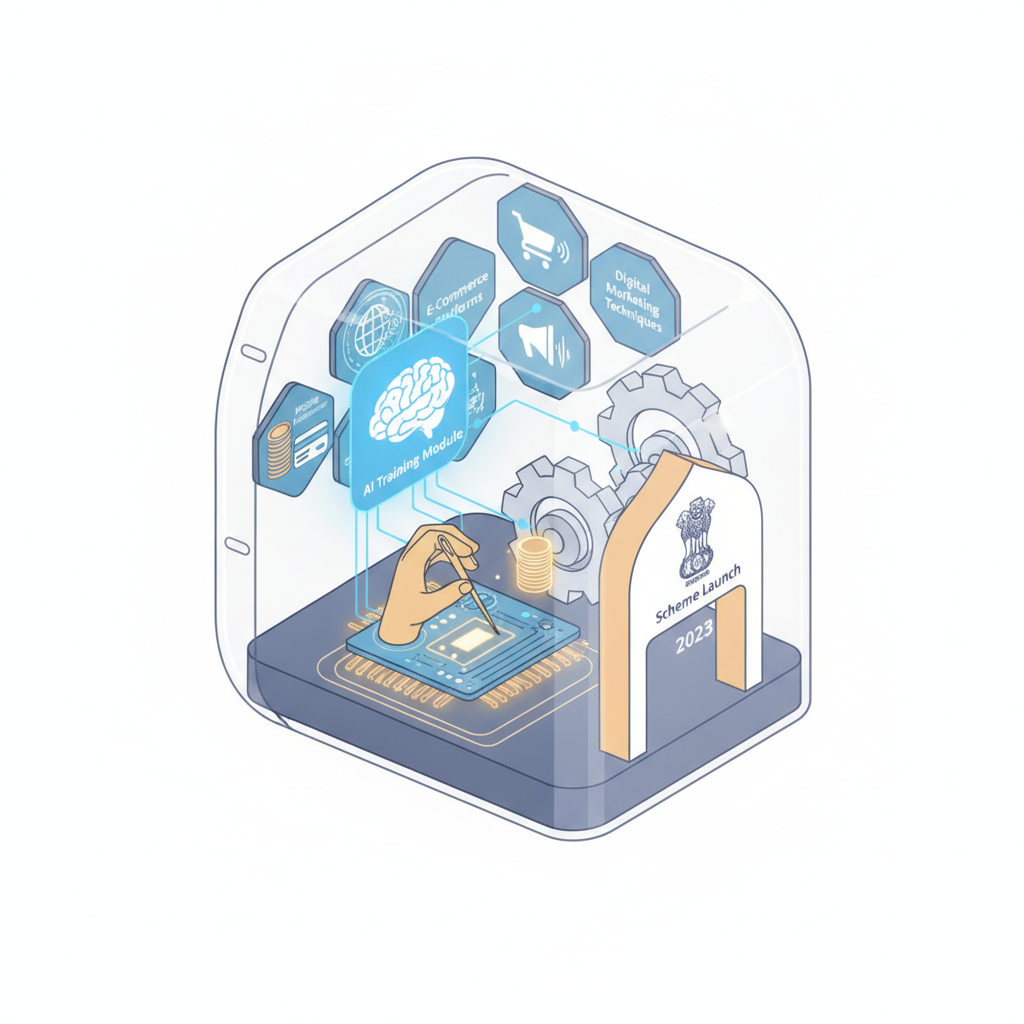
The recent one-day awareness programme organised by the Branch MSME Development and Facilitation Office (MSME-DFO), Mangaluru, in collaboration with the Kushalnagar Taluk Tailors’ Association, has brought attention to the PM Vishwakarma Scheme’s efforts to digitally empower traditional artisans in Kodagu district. The programme focused on equipping beneficiaries with AI tools, e-commerce platforms, and digital marketing techniques to enhance their market reach and competitiveness. This initiative underscores the intersection of government schemes, digital transformation, and MSME development in fostering sustainable livelihoods for artisans.
Background
- The PM Vishwakarma Scheme, launched in 2023, is a central sector scheme aimed at providing holistic support to traditional artisans and craftspeople, including financial assistance, skill upgradation, and market linkages.
- The scheme operates under the Ministry of Micro, Small and Medium Enterprises (MSME) and targets beneficiaries from 18 traditional trades, including tailoring, carpentry, and metalwork.
- The MSME Development and Facilitation Office (MSME-DFO) is a field-level institution under the MSME Ministry, responsible for implementing schemes, facilitating registrations, and providing advisory services to MSMEs.
- Udyam Registration is a mandatory online registration process for MSMEs to avail government benefits, introduced in 2020 to replace the erstwhile Udyog Aadhaar Memorandum (UAM).
- The Prime Minister’s Employment Generation Programme (PMEGP) is a credit-linked subsidy scheme launched in 2008 to generate employment opportunities through the establishment of micro-enterprises in rural and urban areas.
- Kodagu district, located in Karnataka, is renowned for its traditional artisan communities, particularly in tailoring and handloom sectors, which form a significant part of the local economy.
What is the PM Vishwakarma Scheme?
- Launched in September 2023, the PM Vishwakarma Scheme is a central sector initiative under the Ministry of Micro, Small and Medium Enterprises (MSME) to support traditional artisans and craftspeople.
- The scheme provides financial assistance of up to ₹3 lakh in two tranches: ₹1 lakh for toolkit upgradation and ₹2 lakh for business expansion, with a 5% interest subvention for loans.
- Beneficiaries receive skill upgradation training, exposure to digital tools, and market linkages to enhance their competitiveness and income-generating potential.
- The scheme covers 18 traditional trades, including tailoring, carpentry, blacksmithing, pottery, and weaving, among others.
- Eligibility extends to artisans registered as individuals or groups, with a focus on those from marginalised and economically weaker sections.
- The scheme integrates with other government initiatives such as the Udyam Registration, PMEGP, and digital platforms like e-commerce portals to provide a comprehensive support ecosystem.
- The scheme is implemented through a network of MSME-DFOs, District Industries Centres (DICs), and partner organisations to ensure grassroots reach and effectiveness.
- The scheme aligns with the broader objective of promoting ‘Vocal for Local’ and Atmanirbhar Bharat by strengthening traditional industries and local economies.
Key Features
| Feature | Significance |
|---|---|
| PM Vishwakarma Scheme | A centrally sponsored scheme aimed at providing holistic support to traditional artisans and craftspeople, including financial assistance, skill upgradation, and market access. |
| Udyam Registration | Mandatory registration for MSMEs under the Udyam Portal, enabling access to government schemes, subsidies, and financial incentives. |
| AI Tools for Business Promotion | Integration of Artificial Intelligence in marketing strategies to enhance visibility, customer targeting, and competitive advantage for small enterprises. |
| E-Commerce Onboarding | Facilitating artisans’ transition to digital marketplaces to expand reach beyond local markets and improve sales potential. |
| Prime Minister’s Employment Generation Programme (PMEGP) | A credit-linked subsidy programme providing financial assistance to establish and expand micro-enterprises, particularly in rural and semi-urban areas. |
Why it Matters
Economic Empowerment
- Enhances income-generating opportunities for traditional artisans by integrating them with modern digital and e-commerce ecosystems.
- Promotes formalisation of micro-enterprises through Udyam Registration, improving access to institutional credit and government benefits.
- Supports the ‘Vocal for Local’ initiative by strengthening the market presence of indigenous crafts and handloom products.
Digital Transformation
- Exposure to AI-driven marketing tools equips artisans with data-driven decision-making capabilities for business growth.
- Facilitates adoption of e-commerce platforms, reducing dependency on traditional supply chains and intermediaries.
- Encourages the use of QR codes and digital payment systems, aligning with India’s push for a cashless and transparent economy.
Skill and Entrepreneurship Development
- Bridges the digital divide for traditional artisans by providing training in branding, financial literacy, and enterprise management.
- Strengthens the entrepreneurial ecosystem by linking artisans with government schemes like PMEGP for financial and technical support.
- Fosters collaboration between artisans, government agencies, and industry associations for sustainable business models.
Regional Development
- Supports socio-economic upliftment in Kodagu district by enhancing the competitiveness of local tailoring and handicraft industries.
- Promotes inclusive growth by targeting marginalised and informal sector workers, particularly women artisans in rural areas.
- Aligns with the ‘Atmanirbhar Bharat’ vision by reducing reliance on external markets for traditional crafts.
Governance and Policy Integration
- Demonstrates the efficacy of inter-departmental coordination between MSME-DFO, District Industries Centre, and local associations.
- Highlights the role of state-level implementation agencies in translating central schemes into grassroots impact.
- Showcases the potential of public-private-partnerships (PPP) in scaling up skill development and digital adoption initiatives.
Challenges
1. Digital Literacy Gaps
- Limited familiarity with digital tools among traditional artisans may hinder effective adoption of AI and e-commerce platforms.
- Language barriers and low digital penetration in rural areas pose challenges to widespread participation.
- Requires sustained mentorship and hand-holding to ensure long-term digital upskilling.
UPSC Link: GS3: E-governance, Digital Divide
2. Access to Finance
- Despite Udyam Registration, artisans may face difficulties in accessing formal credit due to lack of collateral or credit history.
- High interest rates and bureaucratic hurdles in availing PMEGP loans can deter entrepreneurship.
- Need for innovative financing models, such as microfinance or venture capital for traditional crafts.
UPSC Link: GS3: Credit Access, MSMEs
3. Market Competition
- E-commerce platforms are dominated by mass-produced goods, making it challenging for handmade products to compete on price and visibility.
- Lack of brand recognition for local artisans limits their ability to command premium pricing.
- Requires strategic marketing and government support for niche product positioning.
UPSC Link: GS3: Competition, Startup Ecosystem
4. Infrastructure and Connectivity
- Poor internet connectivity in rural areas (e.g., Kodagu) can restrict participation in digital programmes.
- Inadequate logistics and warehousing facilities for e-commerce fulfilment in remote regions.
- Need for investment in rural digital infrastructure and last-mile delivery systems.
UPSC Link: GS2: Digital Infrastructure, Rural Development
5. Sustainability and Scalability
- Ensuring the economic viability of AI and e-commerce interventions for long-term adoption by artisans.
- Balancing traditional craftsmanship with modern digital trends to preserve cultural heritage.
- Scaling successful models to other regions without diluting their impact or authenticity.
UPSC Link: GS3: Sustainable Development, MSMEs
Challenges — UPSC Perspective
| Issue | Concern |
|---|---|
| Digital Literacy | Low awareness and skill gaps among artisans in adopting AI and e-commerce tools. |
| Financial Inclusion | Difficulty in accessing formal credit despite Udyam Registration and government schemes. |
| Market Access | Competition from mass-produced goods and lack of brand recognition for handmade products. |
| Infrastructure | Poor internet connectivity and logistics challenges in rural areas. |
| Sustainability | Risk of cultural dilution and economic non-viability of digital interventions. |
Government Initiatives — Must-Memorise for Prelims
- PM Vishwakarma Scheme
- Udyam Registration Portal
- Prime Minister’s Employment Generation Programme (PMEGP)
Way Forward
- Strengthen digital literacy programmes through partnerships with NGOs, educational institutions, and local self-help groups.
- Expand financial inclusion by linking artisans with microfinance institutions and simplifying loan application processes.
- Develop regional e-commerce hubs to aggregate supply from local artisans and improve market reach.
- Invest in rural digital infrastructure, including last-mile internet connectivity and mobile payment systems.
- Promote artisan collectives and cooperatives to enhance bargaining power and collective marketing.
- Encourage design innovation and upskilling in traditional crafts to align with contemporary consumer preferences.
- Establish a grievance redressal mechanism for artisans to address implementation gaps in government schemes.
- Conduct periodic impact assessments to evaluate the effectiveness of training programmes and adjust strategies accordingly.
UPSC Value Addition
Keywords for Mains Answer-Writing
PM Vishwakarma Scheme · Skill India Mission · Artificial Intelligence in MSMEs · Digital transformation of traditional artisans · Udyam Registration Portal · E-commerce integration for MSMEs · MSME-DFO Mangaluru · Prime Minister’s Employment Generation Programme · Branding and marketing for traditional crafts · Government schemes for artisans and weavers · AI tools for business promotion · Union Government’s support for MSMEs
Concept Flow
Traditional artisans face market limitations due to lack of digital tools and formalisation. → PM Vishwakarma Scheme provides holistic support, including skill upgradation and financial assistance. → Udyam Registration formalises enterprises, enabling access to government schemes and credit. → Training programmes integrate AI tools and e-commerce platforms to enhance visibility and sales. → PMEGP offers financial support to establish and expand micro-enterprises in rural areas. → Digital transformation improves competitiveness, aligns with ‘Vocal for Local’, and supports ‘Atmanirbhar Bharat’. → Sustainable adoption requires addressing digital literacy, finance, and infrastructure challenges.
Prelims Practice Questions
Q1. Consider the following statements regarding the PM Vishwakarma Scheme:
1. It is a central sector scheme aimed at providing skill training to traditional artisans and craftspeople.
2. The scheme mandates registration on the Udyam Portal for accessing its benefits.
3. Financial assistance under the scheme is provided exclusively through the Prime Minister’s Employment Generation Programme.
4. The scheme includes provisions for training in the use of Artificial Intelligence tools for business promotion.
How many of the above statements are correct?
- Only one
- Only two
- Only three
- All four
Answer: All four — Statements 1, 2, and 4 are correct. Statement 3 is incorrect as the PM Vishwakarma Scheme provides financial assistance through multiple mechanisms, not exclusively through the Prime Minister’s Employment Generation Programme.
Q2. Assertion (A): The Udyam Registration Portal is mandatory for MSMEs to access benefits under various government schemes.
Reason (R): The Udyam Registration Portal was launched to replace the erstwhile Udyog Aadhaar Memorandum (UAM) system and streamline the registration process for MSMEs.
Options:
A. Both A and R are true, and R is the correct explanation of A.
B. Both A and R are true, but R is not the correct explanation of A.
C. A is true, but R is false.
D. A is false, but R is true.
- A
- B
- C
- D
Answer: B — Both the assertion and reason are true, and the reason correctly explains the assertion. The Udyam Registration Portal was introduced to simplify and unify the registration process for MSMEs, making it mandatory for accessing government benefits.
Q3. Match the following initiatives with their respective objectives:
Initiative:
1. PM Vishwakarma Scheme
2. Prime Minister’s Employment Generation Programme (PMEGP)
3. Udyam Registration Portal
4. MSME-DFO Mangaluru
Objective:
A. Providing skill training and financial support to traditional artisans and craftspeople.
B. Facilitating registration and access to benefits for MSMEs.
C. Offering employment generation through micro-enterprise establishment.
D. Acting as a nodal office for MSME development and facilitation in a specific region.
Choose the correct match:
- 1-A, 2-C, 3-B, 4-D
- 1-B, 2-A, 3-D, 4-C
- 1-C, 2-D, 3-A, 4-B
- 1-D, 2-B, 3-C, 4-A
Answer: 1-A, 2-C, 3-B, 4-D — The correct match is: 1-A (PM Vishwakarma Scheme aims to provide skill training and financial support to traditional artisans), 2-C (PMEGP aims to generate employment through micro-enterprise establishment), 3-B (Udyam Registration Portal facilitates registration and access to benefits for MSMEs), 4-D (MSME-DFO Mangaluru acts as a nodal office for MSME development in the region).
Mains Practice Question
✍ The integration of Artificial Intelligence (AI) tools and digital platforms into the operations of traditional artisans represents a transformative shift in India’s Skill India Mission. Critically analyse the potential benefits and challenges of this digital transformation for MSMEs, with reference to the PM Vishwakarma Scheme and related government initiatives. (15 Marks)
Approach: MODEL-ANSWER SKELETON:
1. **Introduction (2 marks)**
– Briefly define the PM Vishwakarma Scheme and its objectives (skill training, financial support, and market access for traditional artisans).
– Highlight the role of digital transformation (AI, e-commerce, branding) in modernising MSMEs.
2. **Benefits of Digital Transformation for MSMEs (5 marks)**
– **Market Expansion**: E-commerce platforms (e.g., Government e-Marketplace, Amazon, Flipkart) and digital marketing increase reach beyond local markets.
– **Operational Efficiency**: AI tools for inventory management, customer engagement, and supply chain optimisation.
– **Financial Inclusion**: Udyam Registration simplifies access to credit, subsidies, and government schemes.
– **Skill Enhancement**: Training in AI and digital tools aligns artisans with contemporary market demands.
– **Branding and Visibility**: QR codes, social media, and AI-driven analytics improve brand recognition and customer engagement.
3. **Challenges and Constraints (5 marks)**
– **Digital Divide**: Limited internet connectivity, low digital literacy, and lack of infrastructure in rural areas.
– **High Initial Costs**: Investment in AI tools, e-commerce setups, and training may be prohibitive for small artisans.
– **Data Privacy and Security**: Risks associated with digital transactions and customer data handling.
– **Competition**: Established e-commerce platforms may dominate, making it difficult for small artisans to compete.
– **Policy Gaps**: Inconsistent implementation of schemes like PM Vishwakarma across states; bureaucratic delays in disbursing benefits.
4. **Way Forward (3 marks)**
– Strengthen public-private partnerships to provide subsidised AI tools and training.
– Expand digital infrastructure in rural areas (e.g., BharatNet, Common Service Centres).
– Simplify compliance and registration processes (e.g., single-window clearance for MSMEs).
– Promote grassroots innovation hubs to develop context-specific AI solutions for artisans.
**Balanced Conclusion**: Digital transformation offers significant opportunities for MSMEs but requires targeted interventions to address structural challenges.
Source: The Hindu
Generated by AanyaAi for educational purpose.

- KWML’s Feasibility Reports for Water Metro in 18 Cities: UPSC & PCS Insights - October 3, 2026
- ओडिशा में वन्यजीव अनुसंधान अनुदान कार्यक्रम शुरू, सिमिलिपाल में 300 कैमरे और बढ़ेंगे - October 3, 2026
- India Summons Pakistan High Commission Official Over Violation - October 3, 2026

No Comments