


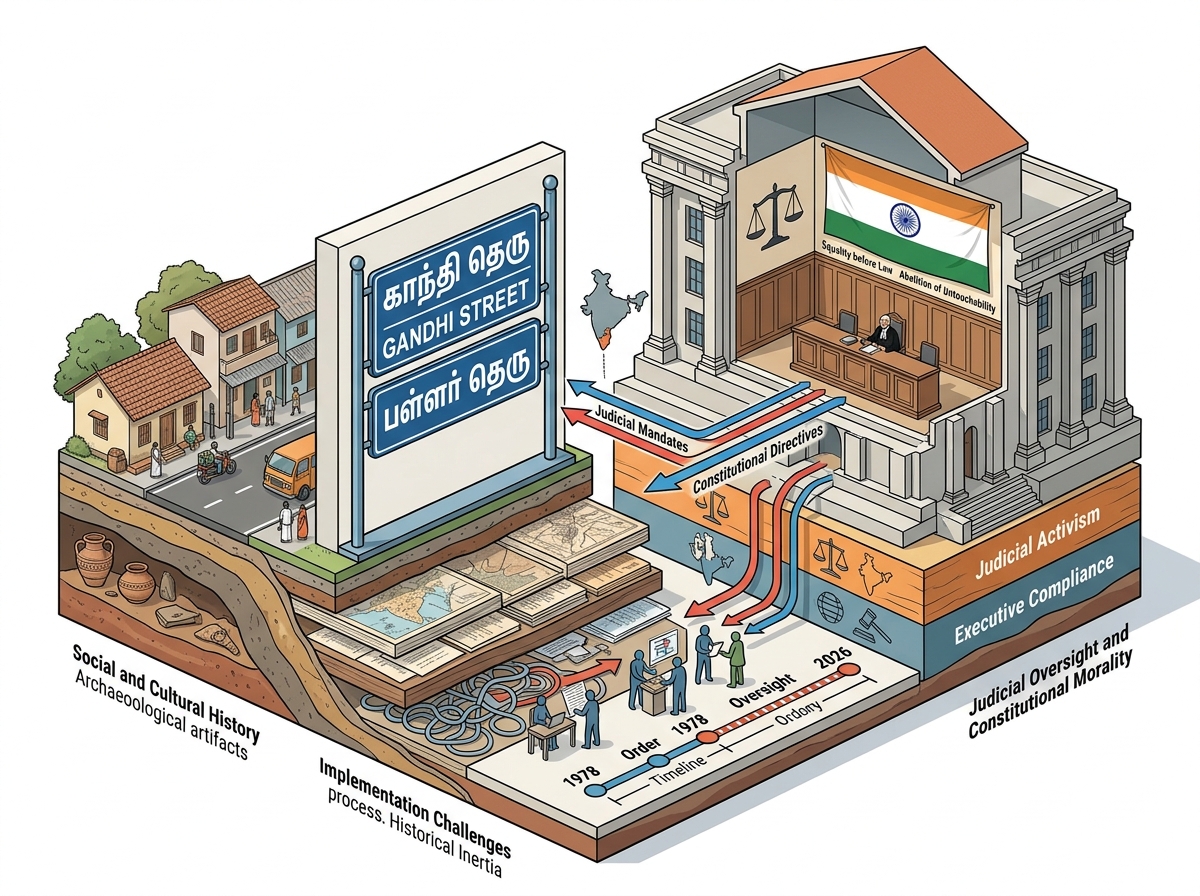
11 Aug Madras HC Slams Tamil Nadu Over Caste-Based Street Names in 2026
Street namesCaste appellationsJudicial directivesExecutive governanceConstitutional mandates✎ The persistent existence of caste-based street names in Tamil Nadu, despite constitutional prohibitions and judicial directives, highlights the need for robust executive compliance, awareness campaigns, and systemic reforms to…
Subject Relevance — Where This Topic Fits
- GS Paper II — Polity and Governance (Constitutional Provisions, Fundamental Rights, Directive Principles) | GS Paper II — Social Justice and Empowerment (Caste-Based Discrimination, Affirmative Action)
- Prelims: Article 15 (Prohibition of discrimination on grounds of religion, race, caste, sex, place of birth), Article 17 (Abolition of Untouchability), Directive Principles of State Policy (Article 38, Article 46), Madras High Court’s suo motu jurisdiction, Government Orders (GOs) on renaming streets, First Information Report (FIR), Aadhaar Act, 2016, Ration Card Rules
- Essay: Caste and the Indian Constitution: A Paradox of Equality and Identity, Judicial Activism vs. Executive Compliance: The Case of Eradicating Caste-Based Street Names
Quick Revision: The persistent existence of caste-based street names in Tamil Nadu, despite constitutional prohibitions and judicial directives, highlights the need for robust executive compliance, awareness campaigns, and systemic reforms to align public nomenclature with the constitutional vision of a casteless society.
Why is this in the news?
The Madras High Court, in August 2026, suo motu took cognisance of the persistent presence of caste appellations in street names in Tamil Nadu, despite judicial and executive directives issued since 1978. The case was triggered by the discovery of ‘Pallar Street’ in an FIR, prompting the court to question the state government’s compliance with constitutional and statutory mandates aimed at creating a casteless society. The issue underscores the interplay between judicial activism, executive governance, and constitutional morality in addressing structural caste-based discrimination.
Background
- The Indian Constitution, through Articles 15 and 17, prohibits discrimination on the basis of caste and abolishes untouchability, respectively, while Directive Principles (Articles 38 and 46) mandate the state to promote social justice and the educational and economic interests of the weaker sections.
- Tamil Nadu has historically been at the forefront of social reform movements, including the Dravidian movement, which sought to dismantle caste hierarchies and promote social equality.
- Since 1978, the Tamil Nadu government has issued multiple Government Orders (GOs) directing local bodies to identify and rename streets, roads, and public institutions bearing caste appellations to align with the constitutional vision of a casteless society.
- Judicial interventions have complemented these executive efforts. In 2018, the Madras High Court issued directions to remove caste references from street names.
- The persistence of caste-based street names despite these measures reflects systemic challenges in governance, including bureaucratic inertia, lack of awareness, and socio-cultural resistance.
- The recent renaming of the Adi Dravidar Welfare Department to the Social Justice Department in Tamil Nadu exemplifies the state’s ongoing efforts to reframe caste-neutral governance.
Caste Appellations in Public Nomenclature: Legal, Constitutional, and Governance Dimensions
- **Constitutional Framework**: Articles 15 and 17 of the Indian Constitution prohibit caste-based discrimination and untouchability, respectively, while Article 38 and Article 46 (Directive Principles) mandate the state to promote social justice and the interests of weaker sections, including through the removal of caste-based nomenclature in public spaces.
- *Judicial Precedents*: The Supreme Court and High Courts have repeatedly underscored the need to eliminate caste-based references in public nomenclature.
- *Executive Directives*: The Tamil Nadu government has issued multiple Government Orders (GOs) since 1978, including GO(Ms) No. 120, Revenue (C&D) Department (1978), and subsequent circulars, directing local bodies to identify and rename streets and roads with caste appellations. These GOs are grounded in the constitutional mandate to create a casteless society.
- *Governance Challenges*: The persistence of caste-based street names despite judicial and executive directives highlights systemic issues such as bureaucratic delays, lack of awareness among local authorities, and socio-cultural resistance to change. The naming of streets often reflects historical caste hierarchies, which are deeply embedded in local traditions.
- *Impact on Identity and Documentation*: Caste-based street names perpetuate caste-based identification in official documents such as ration cards, Aadhaar cards, and driving licences, thereby reinforcing caste consciousness and discrimination in daily life.
- *Judicial Activism and Suo Motu Jurisdiction*: The Madras High Court’s suo motu intervention in 2026 reflects the judiciary’s proactive role in addressing governance lacunae. Suo motu jurisdiction, derived from Article 226 of the Constitution, empowers the High Court to take cognisance of issues affecting public interest, particularly when executive compliance is lacking.
- *Role of Local Bodies*: Panchayati Raj Institutions (PRIs) and Urban Local Bodies (ULBs) are responsible for the naming and renaming of streets and roads. Their compliance with constitutional and statutory directives is critical to achieving the goal of a casteless society, but it is often hindered by resource constraints and competing priorities.
- *Constitutional Morality vs. Socio-Cultural Realities*: The tension between constitutional morality, which mandates the elimination of caste-based nomenclature, and socio-cultural realities, which may resist such changes, presents a complex governance challenge. The judiciary often acts as a bridge between these competing imperatives.
Key Features
| Feature | Significance |
|---|---|
| Caste appellations in street names | Perpetuates social stratification by embedding caste identity in public infrastructure, reinforcing historical inequities in contemporary governance. |
| Judicial direction (2018) | Reinforces constitutional mandate under Article 15(1) to prohibit discrimination and promote equality by mandating removal of caste references. |
| Government Order (1978) | Executive directive to local bodies to identify and rename caste-based street names, aligning with Directive Principles of State Policy (Article 46). |
| Suo motu case registration | Demonstrates judicial activism to ensure compliance with prior orders, addressing systemic inertia in implementation. |
| Renaming of Adi Dravidar Welfare Department | Symbolic shift from caste-based nomenclature to a broader welfare framework, reflecting evolving policy priorities. |
Why it Matters
Constitutional and Legal
- The existence of caste appellations in street names contravenes Article 15(1) of the Constitution, which prohibits discrimination on grounds of religion, race, caste, sex, or place of birth.
- Judicial directions (2018) and executive orders (1978) underscore the state’s obligation to eliminate caste-based identifiers in public records and infrastructure.
- The suo motu registration of the case aligns with the judiciary’s role as a guardian of fundamental rights under Article 32 and Article 226.
Social and Governance
- Caste-based street names perpetuate social hierarchies by embedding caste identity in everyday public life, undermining efforts toward social cohesion.
- The persistence of such names in official documents (e.g., Aadhaar, ration cards) reinforces caste-based identification, contradicting the goal of a casteless society.
- Renaming streets and departments reflects a broader policy shift toward inclusive governance, as seen in the renaming of the Adi Dravidar Welfare Department.
Administrative and Procedural
- The case highlights systemic delays in implementing judicial and executive directives, necessitating stricter monitoring and accountability mechanisms.
- Local bodies’ failure to comply with orders suggests gaps in inter-departmental coordination and lack of awareness among officials.
- The suo motu case may prompt a statewide audit of caste-based names across all public infrastructure, ensuring uniform compliance.
Challenges
1. Systemic Inertia in Implementation
- Local bodies may lack the resources or political will to identify and rename caste-based street names, leading to prolonged non-compliance.
- Absence of a centralized database of caste-based names hampers systematic removal, requiring coordinated efforts across multiple agencies.
- Resistance from local communities or political groups may arise due to perceived loss of historical or cultural identity.
UPSC Link: GS-II: Governance – Challenges in Implementation of Policies
2. Lack of Awareness Among Stakeholders
- Officials and citizens may be unaware of the constitutional and legal imperatives behind renaming, leading to continued use of caste appellations.
- Inadequate sensitization campaigns by the state government may result in low public participation in the renaming process.
UPSC Link: GS-II: Governance – Role of Awareness in Policy Implementation
3. Inter-Departmental Coordination Gaps
- Renaming streets requires coordination between local bodies, revenue departments, and civic authorities, which may be fragmented.
- Delays in updating official records (e.g., Aadhaar, ration cards) post-renaming can lead to discrepancies and confusion.
UPSC Link: GS-II: Governance – Inter-State and Inter-Departmental Coordination
4. Cultural and Historical Sensitivity
- Some caste-based names may have historical or cultural significance, requiring careful handling to avoid alienating communities.
- Balancing the removal of caste appellations with respect for local traditions poses a governance challenge.
UPSC Link: GS-I: Society – Caste and Social Dynamics
5. Legal and Jurisdictional Ambiguities
- Disputes over the ownership of street names (e.g., between local bodies and state agencies) may delay renaming processes.
- Lack of clear guidelines on the process for renaming can lead to ad hoc decisions and inconsistencies.
UPSC Link: GS-II: Governance – Role of Judiciary in Policy Implementation
Challenges — UPSC Perspective
| Issue | Concern |
|---|---|
| Resource constraints | Local bodies may lack funds or personnel to undertake renaming exercises comprehensively. |
| Political resistance | Local political groups may oppose renaming due to perceived loss of cultural or historical identity. |
| Data gaps | Absence of a centralized registry of caste-based street names hinders systematic removal. |
| Public apathy | Lack of awareness among citizens may reduce participation in the renaming process. |
| Inter-departmental delays | Fragmented coordination between agencies can prolong the renaming process. |
| Legal ambiguities | Unclear guidelines on renaming procedures may lead to disputes or inconsistencies. |
Way Forward
- Constitute a high-powered committee under the Chief Secretary to conduct a statewide audit of caste-based street names and prepare a timeline for renaming.
- Launch a public awareness campaign to sensitize citizens and officials about the constitutional and social imperatives of removing caste appellations.
- Develop a centralized digital platform to track progress, resolve disputes, and ensure transparency in the renaming process.
- Mandate regular reviews by local bodies to identify and rename any newly identified caste-based names in public infrastructure.
- Strengthen inter-departmental coordination by assigning nodal officers in each district to oversee the renaming process and resolve grievances.
- Incorporate caste-neutral naming conventions in urban planning guidelines to prevent recurrence of such issues in future infrastructure projects.
- Ensure real-time updating of official records (e.g., Aadhaar, ration cards) post-renaming to avoid discrepancies and maintain data integrity.
UPSC Value Addition
Keywords for Mains Answer-Writing
Caste-based nomenclature in public spaces · Constitutional mandate for a casteless society · Article 15(1) and Article 17 of the Constitution · Madras High Court suo motu jurisdiction · Government Orders for renaming streets · Judicial activism in social reform · Social Justice Department, Tamil Nadu · First Information Report (FIR) and official documents · Administrative reforms and caste neutrality · Constitutional morality and public policy · Historical context of caste-based street names · Judicial directions for caste-neutral governance · Public administration and social equity
Constitutional & Policy Linkages
- Article 15(1): Prohibition of discrimination on grounds of caste.
- Article 46: Promotion of educational and economic interests of weaker sections.
- Article 226: Writ jurisdiction of High Courts to enforce fundamental rights.
- Article 32: Writ jurisdiction of the Supreme Court to enforce fundamental rights.
Concept Flow
Historical prevalence of caste-based street names → Perpetuation of social stratification → Constitutional mandate (Article 15(1)) to eliminate caste discrimination → Judicial directions (2018) and executive orders (1978) to rename streets → Systemic inertia in implementation → Persistence of caste appellations in 2026 → Judicial suo motu intervention → Need for statewide audit and coordinated action → Policy reforms to prevent recurrence.
Prelims Practice Questions
Q1. Consider the following statements regarding the constitutional provisions related to caste in India:
1. Article 15(1) prohibits discrimination on grounds of religion, race, caste, sex, or place of birth.
2. Article 17 abolishes ‘untouchability’ and makes its practice in any form a punishable offence.
3. The Constitution empowers the State to make special provisions for the advancement of socially and educationally backward classes.
How many of the above statements are correct?
- Only one
- Only two
- All
- None
Answer: All — Statements 1 and 2 are correct. Statement 3 is also correct as Article 15(4) empowers the State to make special provisions for the advancement of socially and educationally backward classes.
Q2. Assertion (A): The Madras High Court has suo motu powers to take up cases suo motu (on its own motion) for public interest.
Reason (R): The Constitution of India grants High Courts the power of judicial review under Article 226 to issue directions for enforcement of fundamental rights.
Options:
A. Both A and R are true, and R is the correct explanation of A.
B. Both A and R are true, but R is not the correct explanation of A.
C. A is true, but R is false.
D. A is false, but R is true.
Answer: ? — Both A and R are true. The High Courts possess suo motu jurisdiction under Article 226 of the Constitution to issue directions for enforcement of fundamental rights, which includes public interest litigation.
Q3. Match the following constitutional provisions with their respective articles:
Column I (Provision) | Column II (Article)
———————|——————
1. Abolition of Untouchability | A. Article 16(4)
2. Equality of opportunity in public employment | B. Article 17
3. Special provisions for socially and educationally backward classes | C. Article 15(1)
4. Prohibition of discrimination on grounds of religion, race, caste, sex, or place of birth | D. Article 16(1)
Options:
A. 1-B, 2-D, 3-A, 4-C
B. 1-A, 2-B, 3-C, 4-D
C. 1-C, 2-D, 3-B, 4-A
D. 1-D, 2-A, 3-C, 4-B
Answer: ? — The correct match is: 1-B (Article 17), 2-D (Article 16(1)), 3-A (Article 16(4)), 4-C (Article 15(1)).
Mains Practice Question
✍ The continued existence of caste appellations in the names of streets and roads in Tamil Nadu, despite constitutional provisions and judicial directives, reflects a systemic failure in administrative and judicial implementation. Critically examine the constitutional, legal, and administrative dimensions of this issue. Also, analyse the role of judicial activism in ensuring social equity through suo motu jurisdiction. (15 Marks)
Approach: MODEL-ANSWER SKELETON:
1. **Constitutional Provisions**:
– Article 15(1): Prohibition of discrimination on grounds of caste.
– Article 17: Abolition of untouchability and its implications for caste-based nomenclature.
– Article 14: Right to equality and equal treatment in public spaces.
– Directive Principles of State Policy (Article 38, 39): Promotion of social justice and equality.
2. **Judicial Directions and Government Orders**:
– Madras High Court’s suo motu jurisdiction under Article 226.
– Government Orders (1978) and judicial directions (2018) mandating removal of caste names.
– Recent orders for renaming schools and colleges (e.g., Adi Dravidar Welfare Department to Social Justice Department).
3. **Administrative Challenges**:
– Lack of comprehensive database of caste-based street names.
– Resistance from local bodies and communities due to historical and cultural associations.
– Coordination gaps between state agencies, local bodies, and judicial orders.
4. **Judicial Activism and Suo Motu Powers**:
– Definition and scope of suo motu jurisdiction.
– Role in addressing systemic failures and ensuring accountability.
– Balancing judicial activism with separation of powers.
5. **Way Forward**:
– Institutional mechanisms for periodic review of street names.
– Public awareness campaigns to sensitise communities.
– Strengthening administrative capacity for implementation.
6. **Conclusion**:
– Reiterate the need for a casteless society as envisaged in the Constitution.
– Emphasise the role of judicial activism in bridging gaps between law and implementation.
Source: The Hindu
Generated by AanyaAi for educational purpose.

- KWML’s Feasibility Reports for Water Metro in 18 Cities: UPSC & PCS Insights - October 3, 2026
- ओडिशा में वन्यजीव अनुसंधान अनुदान कार्यक्रम शुरू, सिमिलिपाल में 300 कैमरे और बढ़ेंगे - October 3, 2026
- India Summons Pakistan High Commission Official Over Violation - October 3, 2026

No Comments