


11 Aug Census 2027 to Include Transgender-Headed Households: Key Details for UPSC
Census 2027Transgender-headed householdsSex of headDigital formatSelf-enumerationData security✎ Census 2027 will be India’s first fully digital decennial exercise, recognising transgender-headed households for the first time and including caste enumeration, with provisions for self-enumeration and robust data security.
Subject Relevance — Where This Topic Fits
- GS Paper II — Constitutional and Non-Constitutional Bodies (Role of the Census as a Constitutional Function under Article 246(1) of the Seventh Schedule) | GS Paper III — Science and Technology (Digital Census and Data Security), GS Paper III — Social Justice and Welfare (Inclusive Policies and Marginalised Sections)
- Prelims: Census of India 2027, Transgender-headed households, Self-enumeration in Census, Digital Census, Caste enumeration in Census, House-listing and Housing Census, Population Enumeration Phase, Data security in Census
- Essay: The Role of Data in Inclusive Governance: Challenges and Opportunities, Technology and Social Equity: Balancing Innovation with Inclusion
Quick Revision: Census 2027 will be India’s first fully digital decennial exercise, recognising transgender-headed households for the first time and including caste enumeration, with provisions for self-enumeration and robust data security.
Why is this in the news?
The Rajya Sabha was informed on 11 March 2026 that the upcoming Census of India 2027 will include a novel category for the sex of the head of household—Transgender—thereby recognising transgender-headed households in the decennial data collection process. This marks a significant policy shift towards inclusivity in official statistical enumeration, aligning with constitutional commitments to equality and non-discrimination. The announcement also underscored the Census’s transition to a fully digital format, with provisions for self-enumeration and robust data security measures.
Background
- The Census of India is a constitutional obligation under the Seventh Schedule (Union List) and is conducted decennially under the Census Act, 1948.
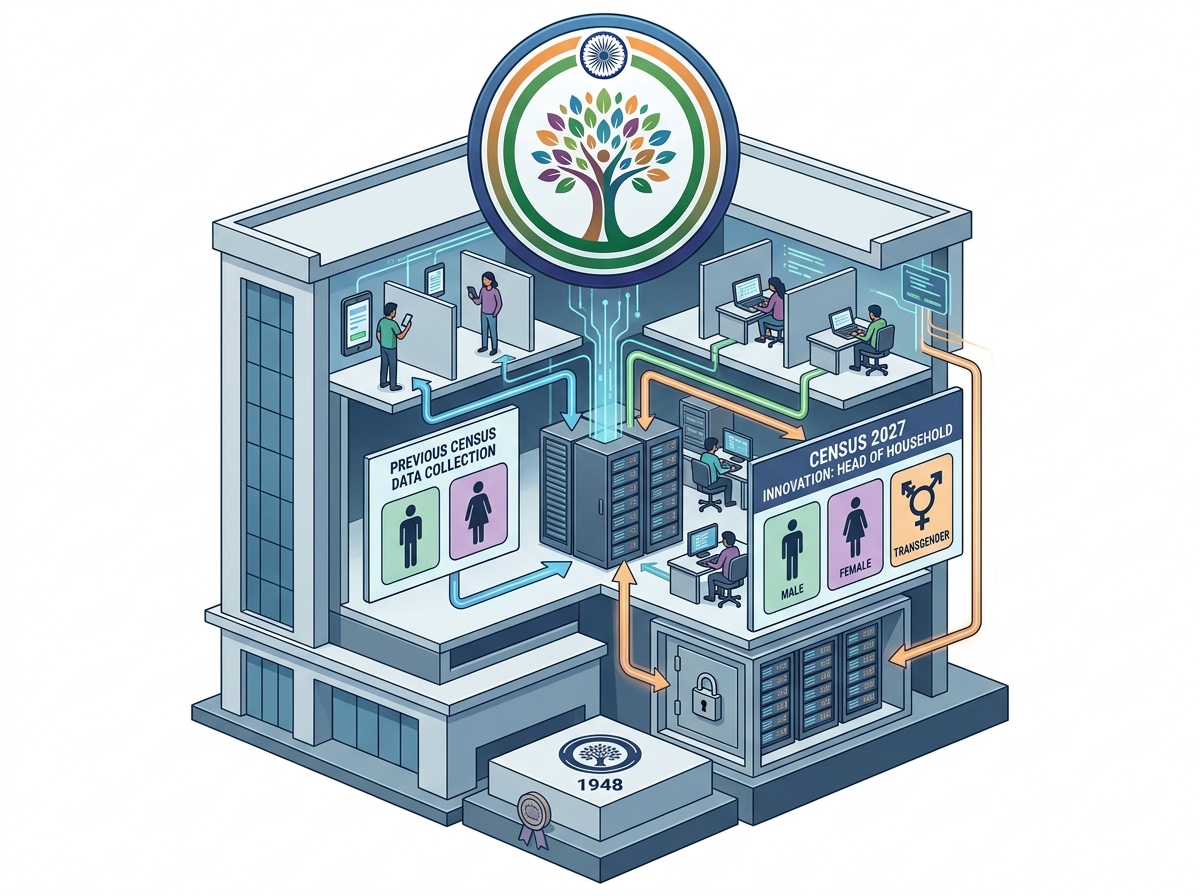
- Previous Censuses have recorded the sex of the head of household as either Male or Female, with no explicit recognition of transgender-headed households.
- The Union Cabinet approved ₹11,718 crore for the Census 2027, including the first-ever caste enumeration since 1931.
- International precedents, such as Australia’s inclusion of optional gender identity questions in its 2021 Census, inform India’s evolving approach to inclusive data collection.
What is the Census of India and its evolving inclusivity?
- The Census of India is the world’s largest single administrative exercise, mandated by the Constitution to enumerate every resident in the country every ten years.
- It is conducted under the Census Act, 1948, and is the primary source of demographic, socio-economic, and housing data for policy formulation and resource allocation.
- The Census 2027 will be the first fully digital Census, utilising mobile applications for data collection, transmission, and validation, replacing traditional paper-based methods.
- Self-enumeration is a new feature in Census 2027, allowing residents to submit their data online, with enumerators verifying the information to ensure accuracy and completeness.
- For the first time, the sex of the head of household will include three categories: Male, Female, and Transgender, reflecting a commitment to recognising gender diversity in official records.
- The inclusion of transgender-headed households addresses a long-standing data gap, enabling evidence-based policies for transgender welfare, housing, and social inclusion.
- The Census 2027 will also include a caste enumeration, the first since 1931, aimed at providing granular data for targeted affirmative action and welfare schemes.
- Data security is a critical component, with encryption during transmission, secure server storage, and validation checks to prevent duplication or errors, ensuring the integrity of the dataset.
Key Features
| Feature | Significance |
|---|---|
| Inclusion of ‘Transgender’ as a category for head of household | Recognises the constitutional principle of non-discrimination and ensures representation of gender minorities in official demographic data, aligning with the Supreme Court’s recognition of transgender persons as a third gender (Nalsa v. Union of India, 2014). |
| House-to-house enumeration by trained enumerators | Minimises exclusion errors and ensures data accuracy through direct engagement with respondents, particularly for marginalised groups who may lack digital access. |
| Self-enumeration portal with FAQs and validation checks | Enhances citizen participation and data reliability by providing a user-friendly digital interface for voluntary data submission. |
| Digital Census with mobile app validation rules | Modernises data collection, transmission, and storage, reducing manual errors and improving real-time monitoring of enumeration quality. |
| Caste enumeration for the first time since 1931 | Provides critical socio-economic data for targeted policy formulation under the Constitution’s Directive Principles of State Policy (Article 46) and the Right to Equality (Article 14). |
Why it Matters
Constitutional and Legal
- Operationalises the constitutional guarantee of equality (Article 14) and non-discrimination (Article 15) by ensuring transgender persons are counted as heads of households, reflecting their social and economic roles.
- Supports the implementation of the Transgender Persons (Protection of Rights) Act, 2019, which mandates recognition of transgender identity in official documents.
- Strengthens the Right to Privacy (Article 21) through secure digital data collection and transmission protocols.
Policy and Governance
- Enables evidence-based policy-making for transgender welfare schemes, including housing, healthcare, and social security, by providing disaggregated demographic data.
- Facilitates targeted interventions under the National Social Assistance Programme (NSAP) and other welfare schemes by identifying households headed by transgender persons.
- Supports the Sustainable Development Goals (SDGs), particularly SDG 1 (No Poverty) and SDG 5 (Gender Equality), by ensuring inclusive data collection.
Socio-Economic
- Provides data to assess the socio-economic status of transgender-headed households, informing budgetary allocations under schemes like the Garima Greh scheme for transgender persons.
- Helps in evaluating the impact of affirmative action policies, such as reservations in education and employment, by identifying underrepresented groups.
- Enables research on intersectional vulnerabilities, such as the overlap between gender identity, caste, and poverty, for holistic policy design.
Technological and Administrative
- Demonstrates India’s capacity to conduct a fully digital census, setting a precedent for future administrative reforms and e-governance initiatives.
- Enhances data integrity through real-time validation checks and supervisor monitoring, reducing errors common in traditional census methods.
- Improves citizen-government interface by offering self-enumeration, reducing the burden on field enumerators and increasing response rates.
Challenges
1. Data Security and Privacy Risks
- Risk of unauthorised access or leakage of sensitive personal data during digital transmission and storage, despite encryption measures.
- Potential misuse of caste and gender data for exclusionary practices or discrimination if not handled with strict confidentiality protocols.
UPSC Link: GS II: Fundamental Rights (Article 21)
2. Enumeration Errors and Exclusion
- Difficulty in accurately identifying transgender-headed households due to social stigma, lack of awareness, or misreporting by respondents.
- Challenges in reaching homeless or transient transgender populations during house-to-house enumeration, risking undercounting.
UPSC Link: GS II: Census and Demographic Data
3. Digital Divide and Accessibility
- Limited digital literacy among marginalised groups, including transgender persons, may hinder effective use of the self-enumeration portal.
- Reliance on mobile apps and digital tools could exclude respondents without smartphones or internet access, particularly in rural areas.
UPSC Link: GS II: Digital India and Inclusive Growth
4. Training and Capacity Building
- Ensuring uniform understanding and sensitivity among enumerators regarding transgender identities and caste enumeration protocols requires rigorous training.
- Supervisors must be adequately trained to monitor data quality and address enumerator biases or errors in real time.
UPSC Link: GS II: Public Administration and Governance
5. Logistical and Financial Constraints
- High costs associated with digital infrastructure, training, and field operations, particularly in remote and difficult terrains.
- Delays in procurement of hardware, software, and personnel due to bureaucratic processes may impact the census timeline.
UPSC Link: GS III: Budget and Fiscal Policy
Challenges — UPSC Perspective
| Issue | Concern |
|---|---|
| Social Stigma and Misreporting | Respondents may conceal or misrepresent transgender-headed households due to societal prejudice or lack of awareness. |
| Digital Literacy Gaps | Marginalised groups, including transgender persons, may struggle to use the self-enumeration portal effectively. |
| Logistical Constraints in Remote Areas | Difficulty in reaching households in hilly, tribal, or conflict-affected regions during enumeration. |
| Data Security Breaches | Risk of unauthorised access to sensitive caste and gender data during transmission or storage. |
| Training Deficiencies Among Enumerators | Inadequate sensitivity training may lead to biased data collection or exclusion errors. |
Government Initiatives — Must-Memorise for Prelims
- Transgender Persons (Protection of Rights) Act, 2019
- Garima Greh Scheme for Transgender Persons
- National Social Assistance Programme (NSAP)
- Pradhan Mantri Awas Yojana (PMAY) – Gramin
Way Forward
- Conduct pilot tests in select districts to identify and address gaps in enumeration protocols, particularly for transgender-headed households.
- Develop multilingual training modules and FAQs for enumerators, supervisors, and respondents to ensure clarity and sensitivity.
- Establish a dedicated grievance redressal mechanism for respondents to report errors or biases during data collection.
- Strengthen data encryption and access controls to mitigate privacy risks, with regular audits of digital infrastructure.
- Collaborate with civil society organisations and transgender advocacy groups to build trust and improve outreach in marginalised communities.
- Integrate real-time data validation tools in the mobile app to flag inconsistencies and reduce manual errors during enumeration.
- Allocate sufficient budgetary provisions for digital infrastructure, training, and logistical support to ensure smooth implementation.
- Publish a detailed methodology report post-census to enhance transparency and enable independent verification of data.
UPSC Value Addition
Keywords for Mains Answer-Writing
Census of India 2027 · transgender-headed households · sex of head of household · Houselisting and Housing Census · Population Enumeration · self-enumeration in Census · data security in Census · digital Census exercise · caste enumeration in Census · house-to-house field visits in Census · enumeration methodology · inclusivity in Census · demographic data collection · Constitution of India and Census
Constitutional & Policy Linkages
- Article 14 (Right to Equality)
- Article 15 (Prohibition of Discrimination)
- Article 21 (Right to Privacy)
- Article 46 (Directive Principles – Promotion of Educational and Economic Interests of Weaker Sections)
Concept Flow
Constitutional recognition of transgender persons (Nalsa v. Union of India, 2014) → Policy mandate for inclusive data collection → Inclusion of ‘Transgender’ as a category in Census 2027 → Digital enumeration with self-reporting options → Data validation and security protocols → Socio-economic policy formulation based on disaggregated data → Targeted welfare schemes for marginalised groups.
Prelims Practice Questions
Q1. Consider the following statements regarding the Census of India 2027:
1. The Census 2027 will be conducted in a single phase.
2. Information on the sex of the head of household will include three categories: Male, Female, and Transgender.
3. The Census 2027 will be a fully digital exercise.
4. The Union Cabinet has approved ₹11,718 crore for conducting the Census of India, 2027.
How many of the above statements are correct?
- Only one
- Only two
- Only three
- All four
Answer: All four — Statements 1 is incorrect as the Census 2027 will be conducted in two phases. Statements 2, 3, and 4 are correct as per the official announcement.
Q2. Assertion (A): The Census of India 2027 will include a caste enumeration for the first time since Independence.
Reason (R): The Union Cabinet has approved ₹11,718 crore for conducting the Census of India, 2027.
In the context of the above two statements, which one of the following is correct?
- Both A and R are true, and R is the correct explanation of A
- Both A and R are true, but R is not the correct explanation of A
- A is true, but R is false
- A is false, but R is true
Answer: A is true, but R is false — Assertion (A) is true as the Census 2027 will include caste enumeration for the first time. Reason (R) is true as the Union Cabinet approved ₹11,718 crore for the Census. However, R does not explain A, as the approval of funds is a separate administrative decision.
Q3. Match the following phases of the Census of India 2027 with their respective activities:
Column I (Phase) | Column II (Activity)
—————–|——————-
1. Houselisting and Housing Census | A. Collection of individual-level data
2. Population Enumeration | B. Collection of household-level data including amenities and assets
3. Self-enumeration | C. Optional facility for respondents to submit data
4. Data security measures | D. Ensuring accuracy and confidentiality during data collection and transmission
Select the correct match:
- 1-B, 2-A, 3-C, 4-D
- 1-A, 2-B, 3-C, 4-D
- 1-C, 2-A, 3-B, 4-D
- 1-D, 2-A, 3-B, 4-C
Answer: 1-B, 2-A, 3-C, 4-D — The correct matches are: 1-B (Houselisting and Housing Census involves household-level data), 2-A (Population Enumeration involves individual-level data), 3-C (Self-enumeration is an optional facility), and 4-D (Data security measures ensure accuracy and confidentiality).
Mains Practice Question
✍ The Census of India 2027 marks a significant evolution in demographic data collection by including transgender-headed households and introducing a fully digital enumeration process. Critically examine the constitutional and administrative implications of these changes. Also, discuss the measures taken to ensure data security and inclusivity in the Census. (15 Marks)
Approach: MODEL-ANSWER SKELETON:
1. **Constitutional and Administrative Implications** (6 points):
– **Inclusivity and Social Justice**: Link to Articles 14, 15, and 21 of the Constitution guaranteeing equality, non-discrimination, and dignity. Discuss how the inclusion of transgender-headed households aligns with constitutional principles and the Supreme Court’s recognition of transgender rights (e.g., NALSA v. Union of India, 2014).
– **Right to Privacy**: Examine the implications of digital data collection under Article 21 (right to privacy) and the need for robust safeguards (Puttaswamy judgment, 2017).
– **Federalism and Decentralisation**: Discuss the role of state governments in Census enumeration and the potential for localised data utilisation in welfare schemes.
– **Administrative Efficiency**: Highlight the shift to a fully digital Census, including the use of mobile apps, self-enumeration portals, and validation checks, and its impact on reducing human error and improving data accuracy.
– **Caste Enumeration**: Briefly discuss the historical context of caste enumeration in the Census and its administrative significance for affirmative action policies (e.g., reservation in education and employment).
– **Challenges in Implementation**: Address potential challenges such as digital divide, training of enumerators, and ensuring participation from marginalised communities.
2. **Data Security and Inclusivity Measures** (6 points):
– **Data Security Framework**: Explain the measures outlined in the news, such as encryption during data transmission, validation rules in the mobile app, and monitoring by supervisors. Link to the Personal Data Protection Bill (2023) and the need for compliance with data localisation norms.
– **Inclusivity Mechanisms**: Discuss the house-to-house field visits to avoid exclusion, the provision of self-enumeration, and the inclusion of FAQs and tooltips to ensure accurate data collection.
– **Training and Capacity Building**: Highlight the importance of training enumerators and supervisors to handle sensitive data and ensure unbiased enumeration.
– **Community Engagement**: Emphasise the role of NGOs, transgender rights organisations, and local leaders in sensitising communities and ensuring their participation.
– **Accountability and Grievance Redressal**: Discuss the establishment of mechanisms for addressing grievances and ensuring accountability in case of data breaches or exclusion.
– **Comparative Perspective**: Briefly compare India’s approach with global best practices (e.g., Australia’s inclusion of gender identity questions in its Census).
3. **Conclusion** (3 points):
– Summarise the transformative potential of the Census 2027 in promoting inclusivity and data-driven governance.
– Acknowledge the challenges and the need for continuous evaluation and improvement.
– Conclude with a balanced view on the balance between administrative efficiency, constitutional obligations, and societal inclusivity.
Source: The Hindu
Generated by AanyaAi for educational purpose.

- KWML’s Feasibility Reports for Water Metro in 18 Cities: UPSC & PCS Insights - October 3, 2026
- ओडिशा में वन्यजीव अनुसंधान अनुदान कार्यक्रम शुरू, सिमिलिपाल में 300 कैमरे और बढ़ेंगे - October 3, 2026
- India Summons Pakistan High Commission Official Over Violation - October 3, 2026

No Comments