


11 Aug UPSC Exam: Maharashtra’s PM-YASASVI Scheme Review & Scholarship Reforms Explained
✎ PM-YASASVI is a multi-component scholarship scheme for OBC, EBC, and DNT students, administered via the National Scholarship Portal, with funding shared between the Centre and States, and a focus on reducing educational…
Subject Relevance — Where This Topic Fits
- GS Paper II — Governance, Welfare Schemes for Vulnerable Sections | GS Paper III — Issues Relating to Development and Management of Social Sector/Services
- Prelims: PM-YASASVI Scheme, National Scholarship Portal, Other Backward Classes (OBC), Economically Backward Classes (EBC), De-notified Nomadic Tribes (DNT), Pre-matric and Post-matric Scholarships, Social Justice and Empowerment Ministry
- Essay: Role of Government in Ensuring Inclusive Education: Challenges and Solutions, Digital Governance and Transparency in Welfare Delivery Systems
Quick Revision: PM-YASASVI is a multi-component scholarship scheme for OBC, EBC, and DNT students, administered via the National Scholarship Portal, with funding shared between the Centre and States, and a focus on reducing educational disparities through timely disbursements and transparent verification.
Why is this in the news?
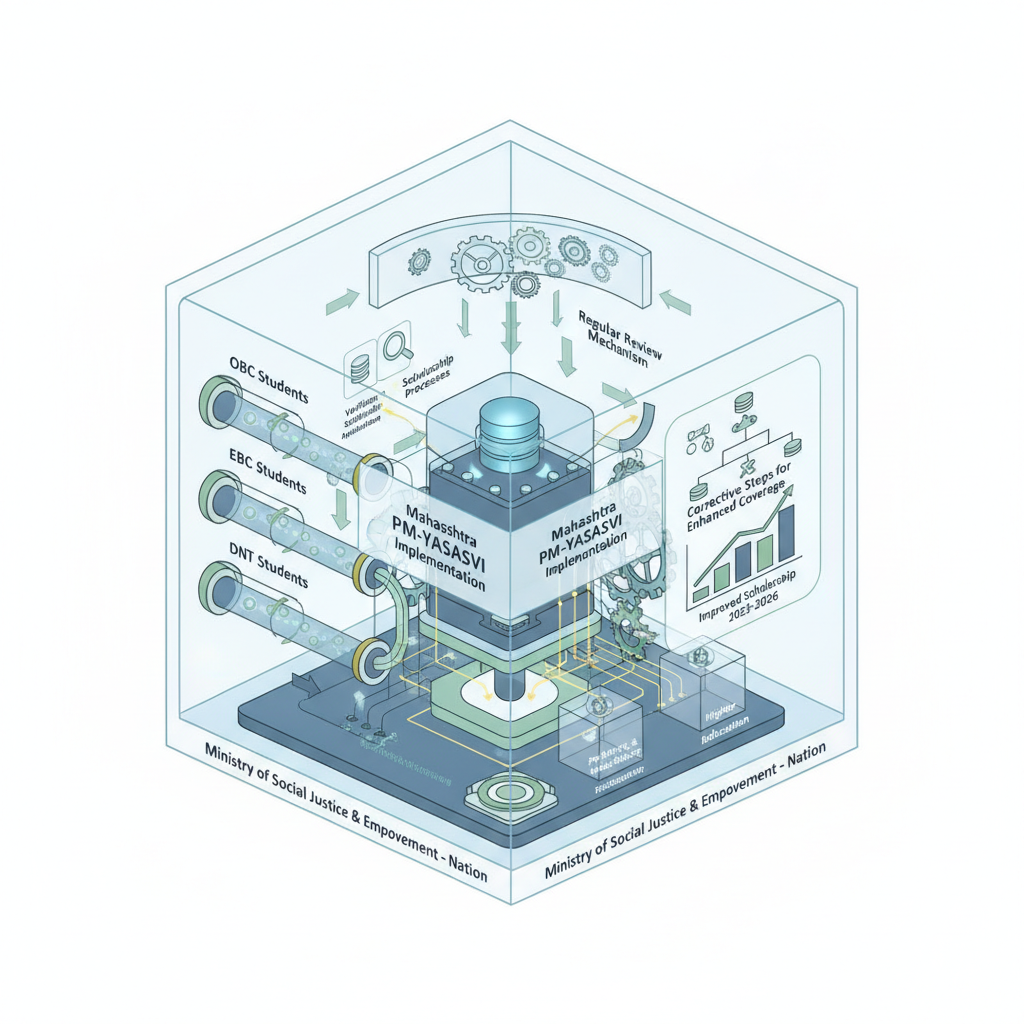
The Union Ministry of Social Justice and Empowerment has highlighted the implementation review mechanisms and corrective measures undertaken under the PM-YASASVI (Pradhan Mantri Young Achievers Scholarship Award Scheme for Vibrant India) for OBC, EBC, and DNT students in Maharashtra. The government has reported enhanced scholarship disbursement, improved verification processes, and systemic reforms to address coverage gaps in the state during the financial years 2023-24 to 2025-26.
Background
- The PM-YASASVI scheme was launched to provide scholarships to students belonging to OBC, EBC, and DNT categories from economically weaker sections, covering pre-matric, post-matric, and higher education levels.
- The scheme operates under the umbrella of the National Scholarship Portal (NSP), ensuring a transparent and centralized application and disbursement mechanism.
- Maharashtra, being a large state with a significant population of OBC, EBC, and DNT students, has faced challenges in scholarship coverage, including low application rates, delayed disbursements, and administrative bottlenecks.
- The Ministry of Social Justice and Empowerment has emphasized regular reviews through monthly video conferences and national-level consultations to monitor implementation and address systemic inefficiencies.
- The scheme aligns with the constitutional mandate under Article 15(4) and 46 to promote educational opportunities for socially and educationally backward classes.
- The National Scholarship Portal serves as a digital public infrastructure to streamline scholarship delivery, reducing leakages and ensuring timely payments to eligible beneficiaries.
What is the PM-YASASVI Scheme?
- The PM-YASASVI scheme is a centrally sponsored scholarship initiative launched under the Ministry of Social Justice and Empowerment to support students from OBC, EBC, and DNT categories.
- It comprises four sub-schemes: Pre-matric Scholarship for OBC and other categories, Post-matric Scholarship for OBC and other categories, Top Class Education for OBC and other categories (Schools), and Top Class Education for OBC and other categories (Colleges).
- The scheme aims to reduce dropout rates, improve educational attainment, and bridge socio-economic disparities by providing financial assistance for tuition fees, maintenance allowances, and other academic expenses.
- Funding is shared between the Central and State Governments, with the Centre releasing funds based on approved national allocations, while states are responsible for identification, verification, and disbursement of scholarships.
- The National Scholarship Portal (NSP) is the digital platform for application, processing, and tracking of scholarships, ensuring transparency and accountability in fund utilization.
- The scheme incorporates a robust grievance redressal mechanism, including helplines and district-level monitoring committees to address beneficiary concerns.
- Regular data analytics and field-level reviews are conducted to assess coverage gaps, streamline processes, and enhance outreach to eligible students.
Key Features
| Feature | Significance |
|---|---|
| Multi-tiered scholarship coverage | Provides financial assistance at pre-matric, post-matric, higher secondary, and higher education levels for OBC, EBC, and DNT students, ensuring continuity of education from school to college. |
| Central-State fund sharing mechanism | Central funds are released to states based on national allocation, while state governments handle beneficiary selection, verification, and disbursement, ensuring fiscal federalism. |
| National Scholarship Portal integration | Mandatory inclusion of Maharashtra in NSP from 2025-26 enhances transparency, reduces leakages, and streamlines application and verification processes. |
| Regular review and monitoring | Monthly video conferences and regional/national conferences ensure timely corrective actions, reducing delays and improving coverage. |
| Awareness and outreach initiatives | Proactive steps to disseminate scheme details among eligible beneficiaries and educational institutions to maximize participation and reduce exclusion errors. |
Why it Matters
Economic
- Reduces financial barriers to education for marginalised communities, potentially improving human capital formation and long-term socio-economic mobility.
- Direct fiscal transfers to students mitigate poverty traps by offsetting opportunity costs of education, particularly for OBC, EBC, and DNT groups.
- Enhanced coverage in Maharashtra may serve as a model for other states, demonstrating the scalability of centrally sponsored schemes.
Social
- Promotes inclusive education by targeting historically disadvantaged groups, aligning with constitutional directives for social justice (Article 46).
- Addresses regional disparities in scholarship disbursement, ensuring equitable access to educational opportunities across districts.
- Supports the Right to Education (RTE) Act’s objectives by providing financial incentives for continued schooling beyond primary levels.
Administrative
- Strengthens inter-governmental coordination between the Centre and states, ensuring efficient fund utilisation and reducing procedural bottlenecks.
- Leverages digital infrastructure (NSP) to enhance transparency, reduce corruption, and improve grievance redressal mechanisms.
- Facilitates data-driven policy adjustments through real-time monitoring of application and disbursement trends.
Challenges
1. Low Awareness and Outreach Deficits
- Eligible beneficiaries often remain unaware of scheme provisions, leading to suboptimal application rates and exclusion errors.
- Institutional apathy or lack of proactive engagement by educational authorities may hinder effective outreach, particularly in rural areas.
- Language barriers and digital illiteracy further exacerbate access issues for marginalised communities.
UPSC Link: GS II: Governance, GS III: Social Sector
2. Operational and Procedural Delays
- Technical glitches in fund disbursement (e.g., state SNA account issues) and prolonged verification processes delay scholarship payments.
- Inconsistent state-level coordination between departments (e.g., social justice, education, and finance) creates bottlenecks in implementation.
- Annual variations in fund releases (e.g., no allocation in 2023-24) disrupt continuity and discourage participation.
UPSC Link: GS II: Governance, GS III: Public Expenditure
3. Data Verification and Leakage Risks
- Inaccurate or incomplete beneficiary data (e.g., Aadhaar mismatches) leads to rejection of applications and delays in disbursement.
- Lack of robust grievance redressal mechanisms may result in systemic exclusion or duplication of beneficiaries.
- Weak monitoring of state-level disbursement processes risks diversion of funds or non-compliance with central guidelines.
UPSC Link: GS II: Governance, GS III: Transparency
4. Regional Disparities in Coverage
- Uneven distribution of scholarships across districts within Maharashtra reflects broader intra-state socio-economic inequalities.
- Urban-rural divide in institutional capacity (e.g., schools/colleges) may limit access to information and application support.
- Cultural and socio-economic factors (e.g., early marriage, child labour) disproportionately affect DNT communities, requiring targeted interventions.
UPSC Link: GS I: Social Issues, GS II: Federalism
5. Fiscal Constraints and Planning Gaps
- Insufficient state proposals for fund utilisation (e.g., 2023-24) indicate gaps in state-level planning and demand forecasting.
- Lack of synchronisation between central allocations and state-level absorptive capacity may lead to underutilisation of funds.
- Competing priorities within state budgets may deprioritise scholarship schemes, particularly during fiscal stress.
UPSC Link: GS III: Public Finance, GS II: Centre-State Relations
Challenges — UPSC Perspective
| Issue | Concern |
|---|---|
| Low application rates | Only 1,079 pre-matric applications received in Maharashtra for 2025-26, indicating poor outreach and awareness. |
| Verification bottlenecks | 575 out of 1,072 verified pre-matric applications in 2025-26 highlight delays in processing and potential exclusion errors. |
| Fund disbursement delays | No central assistance released in 2023-24 and technical issues in 2025-26 disrupted continuity for post-matric scholarships. |
| State-level coordination gaps | Lack of proposals in certain years and pending funds in SNA accounts reflect weak inter-departmental alignment. |
| Digital divide challenges | Rural and marginalised communities face barriers in accessing NSP due to limited internet penetration and digital literacy. |
Government Initiatives — Must-Memorise for Prelims
- National Scholarship Portal (NSP)
Way Forward
- Strengthen multi-channel awareness campaigns using local media, NGOs, and school networks to reach eligible beneficiaries in rural and tribal areas.
- Mandate regular training for state officials and educational institutions on NSP navigation, verification protocols, and grievance redressal.
- Establish a real-time dashboard for tracking application status, disbursement timelines, and beneficiary feedback to identify systemic bottlenecks.
- Simplify application and verification processes by leveraging Aadhaar-based authentication and reducing documentary requirements.
- Enhance inter-departmental coordination at the state level through quarterly review meetings and clear accountability frameworks.
- Conduct periodic sample audits of disbursed funds to detect leakages, duplication, or non-compliance with central guidelines.
- Expand digital infrastructure in underserved districts to improve NSP accessibility, including offline application modes and helpline support.
- Align state-level scholarship schemes with PM-YASASVI to avoid duplication and ensure seamless transition for beneficiaries.
UPSC Value Addition
Keywords for Mains Answer-Writing
PM-YASASVI Scheme · National Scholarship Portal · OBC, EBC and DNT Welfare · Pre-Matric and Post-Matric Scholarships · Social Justice and Empowerment Ministry · Aadhaar-based verification · Union-State fiscal transfers · Scholarship disbursement mechanisms · Inclusive education · Scheduled Castes and Scheduled Tribes (Prevention of Atrocities) Act, 1989
Constitutional & Policy Linkages
- Article 46: Directive Principle for promoting educational and economic interests of weaker sections (OBC, EBC, DNT).
Concept Flow
Identification of socio-economic disparities → Formulation of PM-YASASVI scheme → Allocation of central funds to states → State-level implementation and verification → Disbursement to beneficiaries → Monitoring and corrective actions → Feedback loop for continuous improvement.
Prelims Practice Questions
Q1. Consider the following statements regarding the PM-YASASVI Scheme:
1. It is a centrally sponsored scheme for OBC, EBC and DNT students.
2. The scheme includes Pre-Matric and Post-Matric scholarships.
3. The National Scholarship Portal is used for application and disbursement.
4. The scheme is implemented solely by the central government without state involvement.
How many of the above statements are correct?
- Only one
- Only two
- Only three
- All four
Answer: Only three — Statements 1, 2 and 3 are correct. Statement 4 is incorrect as the scheme involves both central and state governments in implementation and disbursement.
Q2. Assertion (A): The PM-YASASVI Scheme uses Aadhaar-based verification for beneficiary identification.
Reason (R): Aadhaar ensures transparency and reduces duplication in scholarship disbursement.
- Both A and R are true, and R is the correct explanation of A.
- Both A and R are true, but R is not the correct explanation of A.
- A is true, but R is false.
- A is false, but R is true.
Answer: Both A and R are true, but R is not the correct explanation of A. — Both A and R are true, and R correctly explains A as Aadhaar-based verification enhances transparency and reduces duplication in disbursement processes.
Q3. Match the following components of the PM-YASASVI Scheme with their respective categories:
Column I (Component)
A. Pre-Matric Scholarship
B. Post-Matric Scholarship
C. School Education (Higher Level)
D. College Education (Higher Level)
Column II (Category)
1. OBC, EBC and DNT students
2. Only OBC students
3. Only EBC students
4. Only DNT students
- A-1, B-1, C-1, D-1
- A-1, B-2, C-3, D-4
- A-2, B-3, C-4, D-1
- A-4, B-1, C-2, D-3
Answer: A-1, B-1, C-1, D-1 — All components of the PM-YASASVI Scheme are applicable to OBC, EBC and DNT students, hence all match to category 1.
Mains Practice Question
✍ The PM-YASASVI Scheme represents a significant policy intervention aimed at enhancing educational inclusion for marginalised communities. Critically examine the design and implementation architecture of the scheme, with particular reference to the role of the National Scholarship Portal, Aadhaar-based verification, and the federal fiscal transfer mechanism. Also, analyse the challenges in ensuring timely disbursement of scholarships and suggest measures to improve the efficacy of the scheme. (15 Marks)
Approach: MODEL-ANSWER SKELETON:
1. Introduction: Define PM-YASASVI Scheme and its objectives (OBC, EBC, DNT welfare; Pre-Matric and Post-Matric scholarships).
2. Design and Architecture:
– Role of National Scholarship Portal (NSP): Centralised application, tracking, and disbursement platform.
– Aadhaar-based verification: Ensures transparency, reduces duplication, and minimises leakages.
– Federal fiscal transfer mechanism: Centre releases funds to states based on approved allocations; states execute disbursement.
3. Implementation Challenges:
– Delayed state proposals (e.g., Maharashtra 2023-24).
– Technical glitches in fund release (e.g., Maharashtra 2025-26).
– Low awareness and outreach gaps leading to underutilisation.
– Verification bottlenecks and delays in beneficiary identification.
4. Measures for Efficacy:
– Strengthening state-level nodal agencies and district outreach.
– Regular monitoring through video conferences and regional/national reviews.
– Leveraging technology for real-time tracking and grievance redressal.
– Capacity building for institutional stakeholders.
5. Conclusion: Reiterate the scheme’s potential for inclusive education while emphasising the need for coordinated federal action and technological integration.
Source: PIB (Press Information Bureau)
Generated by AanyaAi for educational purpose.

- KWML’s Feasibility Reports for Water Metro in 18 Cities: UPSC & PCS Insights - October 3, 2026
- ओडिशा में वन्यजीव अनुसंधान अनुदान कार्यक्रम शुरू, सिमिलिपाल में 300 कैमरे और बढ़ेंगे - October 3, 2026
- India Summons Pakistan High Commission Official Over Violation - October 3, 2026

No Comments