


11 Aug झारखंड में JPSC-JSSC आंदोलन: ED जांच, सरकार-विपक्ष रणनीति पर UPSC दृष्टिकोण
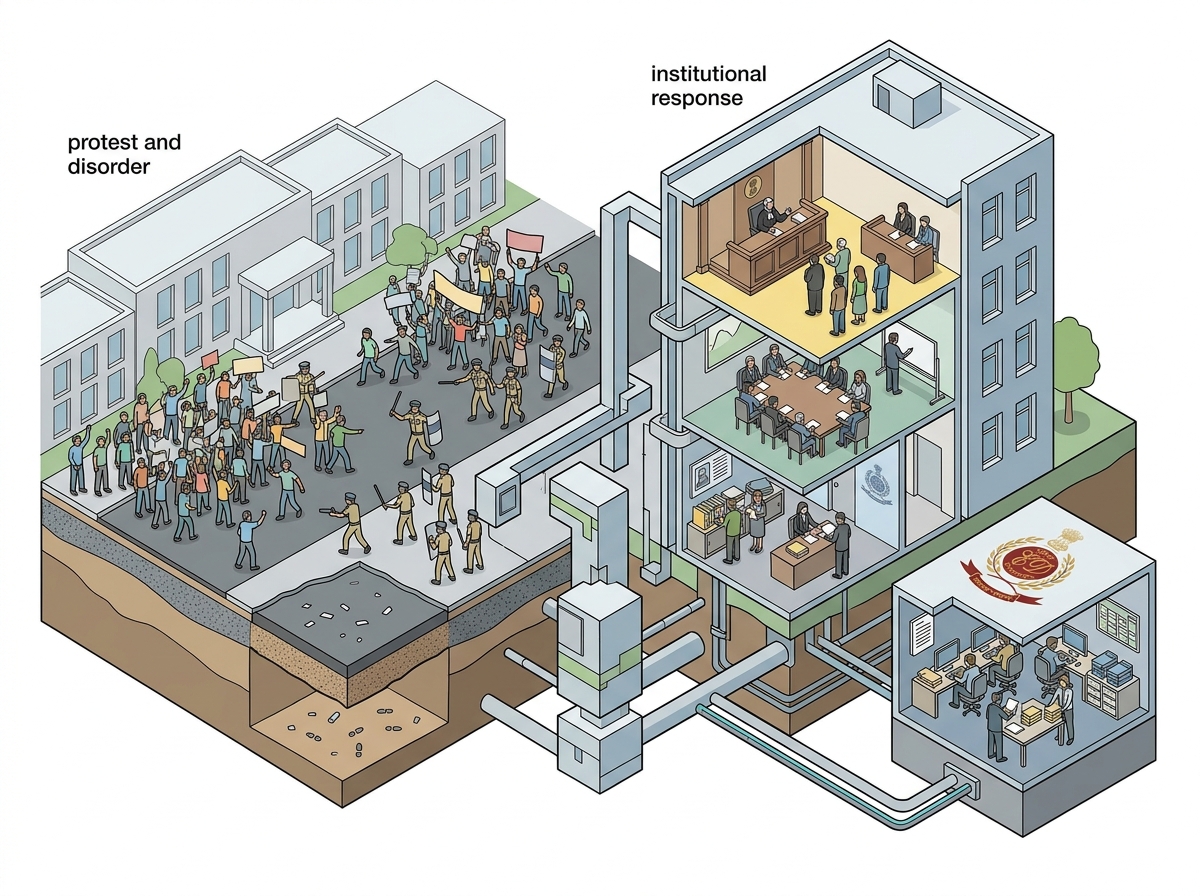
Police lathi-chargeED investigationProtestersGovernment strategy✎ Protests invoking Article 19(1)(a) must adhere to reasonable restrictions under Article 19(2) for public order, with investigative agencies ensuring institutional integrity.
Subject Relevance — Where This Topic Fits
- GS Paper II — Functions and Responsibilities of the Union and the States, Issues and Challenges pertaining to the Federal Structure | GS Paper III — Issues relating to Development and Management of Social Sector/Services relating to Health, Education, Human Resources
- Prelims: Jharkhand Public Service Commission (JPSC), Jharkhand Staff Selection Commission (JSSC), Enforcement Directorate (ED), Fundamental Rights (Article 19), Right to Protest, Administrative Tribunals Act, 1985, Code of Criminal Procedure, 1973
- Essay: Role of Institutions in Upholding Democratic Values, Balancing Public Order and Fundamental Rights in a Welfare State
Quick Revision: Protests invoking Article 19(1)(a) must adhere to reasonable restrictions under Article 19(2) for public order, with investigative agencies ensuring institutional integrity.
Why is this in the news?
The enforcement of law-and-order measures, including lathi-charge, during a sustained protest by competitive examination aspirants in Ranchi, Jharkhand, has brought into focus the governance challenges associated with competitive examination integrity, institutional accountability, and the constitutional balance between public order and fundamental rights. The initiation of an Enforcement Directorate investigation into alleged irregularities in recruitment examinations has further elevated the issue to a multi-institutional governance concern.
Background
- Jharkhand has witnessed prolonged protests by thousands of youth, primarily aspirants for JPSC and JSSC examinations, over alleged irregularities in recruitment processes.
- The protests escalated after an incident of police lathi-charge in Ranchi, drawing parallels with earlier demonstrations at Jantar Mantar in New Delhi against alleged paper leaks in NEET.
- The state administration has cited Section 144 of the Code of Criminal Procedure, 1973, to justify restrictions on assembly, while protesters invoke Article 19(1)(a) of the Constitution guaranteeing freedom of speech and expression.
- The Enforcement Directorate (ED) has initiated an investigation into alleged financial irregularities in recruitment examinations, indicating potential cross-sectoral governance failures.
- The protest has included a legislative assembly siege, with prominent leaders undertaking an indefinite fast, raising concerns about the health and safety of participants.
- The issue intersects with broader debates on transparency in public employment, institutional credibility, and the role of investigative agencies in ensuring administrative probity.
Institutional and Constitutional Framework Governing Competitive Examinations and Protests in India
- Article 19(1)(a) of the Constitution guarantees the right to freedom of speech and expression, which encompasses the right to peaceful protest, subject to reasonable restrictions under Article 19(2) for the maintenance of public order.
- Section 144 of the Code of Criminal Procedure, 1973, empowers district magistrates to prohibit assemblies likely to disrupt public tranquillity, but its application must be proportionate and non-discriminatory.
- The Enforcement Directorate (ED) operates under the Prevention of Money Laundering Act, 2002, investigating financial crimes; its involvement in examination-related irregularities suggests potential money laundering or financial fraud in recruitment processes.
- Institutional integrity in public employment is critical for social justice, as competitive examinations are a primary channel for equitable access to government services and employment.
- Administrative Tribunals, including state public service commissions, function as quasi-judicial bodies with appellate jurisdiction over recruitment disputes, ensuring redressal mechanisms for aggrieved candidates.
- The role of investigative agencies such as the ED, CBI, or state anti-corruption bodies is to ensure that any irregularities in recruitment are investigated without political interference, preserving the sanctity of the selection process.
- Public order management during protests requires a calibrated approach, balancing the right to dissent with the need to prevent violence, damage to property, or obstruction of public services.
UPSC Value Addition
Keywords for Mains Answer-Writing
Civil Service Examination reforms · Enforcement Directorate powers · State Public Service Commission autonomy · Public order and police action · Right to Protest under Article 19(1)(a) · Judicial review of administrative action · Federalism and Centre-State relations · Governance of competitive examinations · Protest and assembly regulation · Rule of law and democratic rights
Prelims Practice Questions
Q1. Consider the following statements regarding the Enforcement Directorate (ED):
1. The ED is a statutory body established under the PMLA, 2002.
2. It has the power to arrest and prosecute individuals for money laundering offences.
3. The ED can only investigate cases referred to it by the Central Bureau of Investigation (CBI).
How many of the above statements are correct?
- Only one
- Only two
- All three
- None
Answer: Only two — Statement 1 is correct: The ED was constituted under the Prevention of Money Laundering Act, 2002. Statement 2 is correct: The ED has powers of arrest and prosecution under the PMLA. Statement 3 is incorrect: The ED can investigate cases suo motu or on referral from other agencies.
Q2. Assertion (A): The Right to Protest is a fundamental right under Article 19(1)(a) of the Indian Constitution.
Reason (R): The State may impose reasonable restrictions on the exercise of this right in the interest of public order, morality, or sovereignty and integrity of India.
- Both A and R are true, and R is the correct explanation of A
- Both A and R are true, but R is not the correct explanation of A
- A is true but R is false
- A is false but R is true
Answer: Both A and R are true, but R is not the correct explanation of A — Assertion (A) is correct as Article 19(1)(a) guarantees the freedom of speech and expression, which includes the right to protest. Reason (R) is also correct and directly explains the constitutional framework under which restrictions can be imposed.
Q3. Match the following institutions with their respective constitutional or statutory provisions:
Column I (Institution) | Column II (Provision)
— | —
A. Union Public Service Commission | 1. Article 324
B. State Public Service Commission | 2. Article 315
C. Election Commission of India | 3. Article 316
D. Finance Commission | 4. Article 280
- A-2, B-3, C-1, D-4
- A-3, B-2, C-1, D-4
- A-2, B-3, C-4, D-1
- A-1, B-2, C-3, D-4
Answer: A-2, B-3, C-1, D-4 — A. Union Public Service Commission is under Article 315. B. State Public Service Commission is under Article 316. C. Election Commission of India is under Article 324. D. Finance Commission is under Article 280.
Mains Practice Question
✍ Examine the constitutional and legal framework governing the regulation of protests and assembly in India. How does this framework balance the right to protest with the maintenance of public order? Also, discuss the role of the police and district administration in ensuring that such regulation does not infringe upon democratic rights. (15 Marks)
Approach: MODEL-ANSWER SKELETON:
1. **Constitutional Basis**:
– Article 19(1)(a) guarantees freedom of speech and expression, which includes the right to protest.
– Article 19(2) allows reasonable restrictions on this right in the interest of public order, morality, or sovereignty.
– Landmark judgments: *Himat Lal K. Shah v. Commissioner of Police* (1973), *Balwant Singh v. State of Punjab* (1995).
2. **Legal Framework**:
– Police Act, 1861: Powers of police to regulate assemblies.
– Code of Criminal Procedure, 1973: Sections 129-132 on dispersal of unlawful assemblies.
– State-specific laws (e.g., Jharkhand Police Act, 2007) and local regulations.
3. **Role of Police and District Administration**:
– Duty to facilitate peaceful protest while preventing violence.
– Use of force must be proportionate and in accordance with *Arnesh Kumar v. State of Bihar* (2014) and *DK Basu v. State of West Bengal* (1997) guidelines.
– Accountability mechanisms: Complaint redressal, FIR registration, and judicial oversight.
4. **Contemporary Challenges**:
– Police action during protests (e.g., lathi charge, use of force) must be justified under law.
– Role of district magistrates in ensuring lawful conduct.
– Balancing public order with democratic rights in competitive examination-related protests.
5. **Conclusion**:
– The framework is robust but requires strict adherence to constitutional and legal principles.
– Any deviation risks undermining democratic rights and eroding public trust in institutions.
Source: amarujala.com
Generated by AanyaAi for educational purpose.

- KWML’s Feasibility Reports for Water Metro in 18 Cities: UPSC & PCS Insights - October 3, 2026
- ओडिशा में वन्यजीव अनुसंधान अनुदान कार्यक्रम शुरू, सिमिलिपाल में 300 कैमरे और बढ़ेंगे - October 3, 2026
- India Summons Pakistan High Commission Official Over Violation - October 3, 2026

No Comments