


11 Aug UN Criticizes Taliban’s Lack of Accountability on Security Abuses in Afghanistan
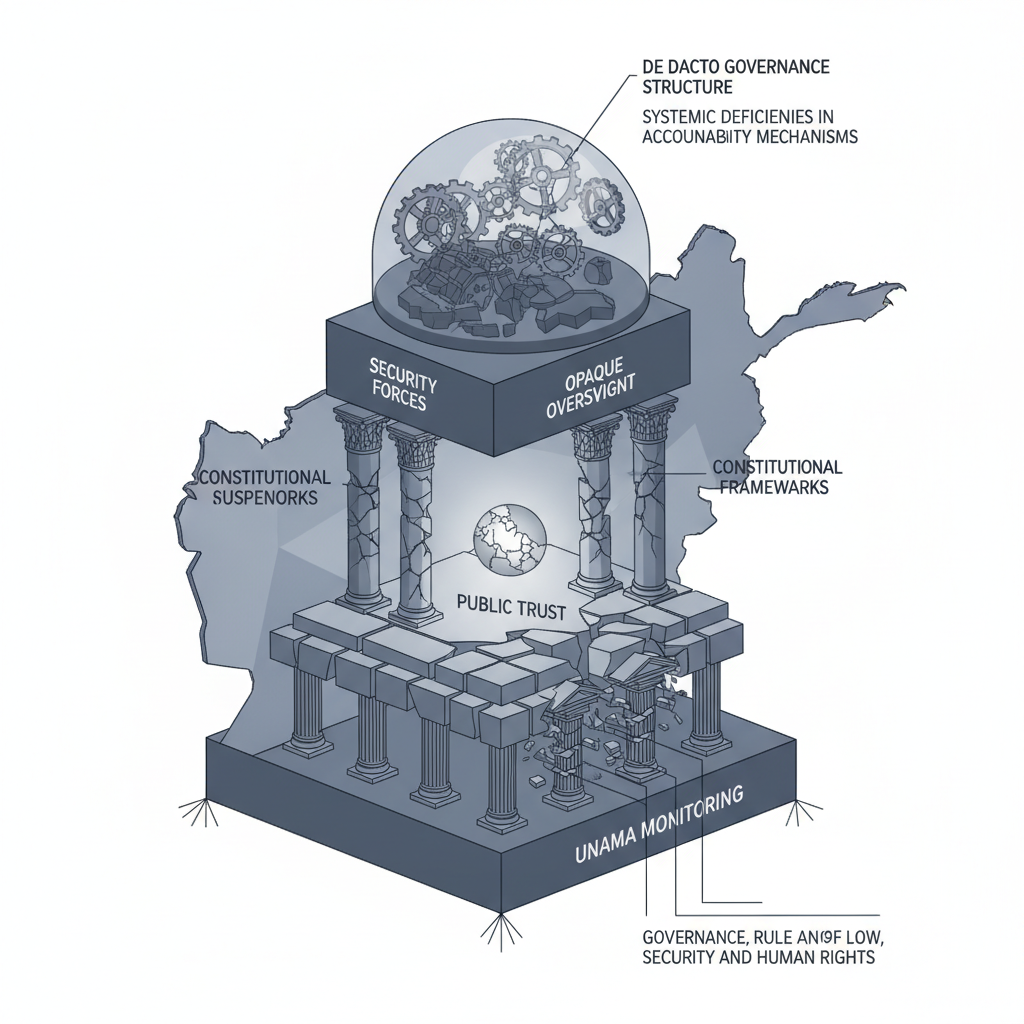
UNAMATaliban security forcesDe facto governanceConstitutional frameworksHuman rights✎ Accountability in Afghanistan’s governance is undermined by opaque oversight, the suspension of constitutional frameworks, and systemic barriers to reporting abuses, necessitating transparent mechanisms to restore public trust…
Subject Relevance — Where This Topic Fits
- GS Paper II — International Relations (Human Rights, International Organisations) | GS Paper III — Internal Security (Accountability Mechanisms, Rule of Law)
- Prelims: UNAMA, Human Rights Violations, Rule of Law, Sharia-based Governance, Accountability Mechanisms
- Essay: The Role of International Organisations in Upholding Human Rights, Accountability as a Pillar of Stable Governance
Quick Revision: Accountability in Afghanistan’s governance is undermined by opaque oversight, the suspension of constitutional frameworks, and systemic barriers to reporting abuses, necessitating transparent mechanisms to restore public trust and comply with international human rights obligations.
Why is this in the news?
The United Nations Assistance Mission in Afghanistan (UNAMA) has highlighted systemic deficiencies in accountability mechanisms within Afghanistan’s de facto governance structure, five years after the Taliban’s assumption of power. The report underscores the erosion of public trust due to opaque oversight of security forces and the suspension of constitutional frameworks, raising concerns over compliance with international human rights obligations.
Background
- The Taliban’s return to power in Afghanistan in 2021 marked a shift from a democratic constitutional framework to a governance model based on their interpretation of Sharia law, replacing former legal and institutional structures.
- UNAMA, established by the UN Security Council in 2002, continues to monitor governance, rule of law, security, and human rights in Afghanistan, despite the absence of formal diplomatic recognition of the de facto authorities.
- The suspension of Afghanistan’s constitution has led to the annulment of existing laws, creating a legal vacuum that complicates accountability for human rights violations and abuses by security forces.
- Institutions such as the Supreme Court and the Ministry of Propagation of Virtue and Prevention of Vice operate under the Taliban’s governance, raising questions about their adherence to international human rights standards.
- Reports from UN agencies, including UN Women, have consistently documented violations such as arbitrary detentions, discrimination against women and girls, and restrictions on fundamental freedoms.
- The lack of transparency in investigations and disciplinary actions against security personnel has undermined public confidence in state institutions and deterred victims from reporting abuses.
What are the Key Accountability Mechanisms in Afghanistan’s Governance?
- UNAMA’s mandate includes monitoring the rule of law, human rights, and accountability mechanisms in Afghanistan, with a focus on the conduct of security forces and judicial institutions.
- The de facto authorities have established bodies such as the Security and Filtration Commission and the Ministry of Propagation of Virtue and Prevention of Vice, which enforce Sharia-based governance but operate with limited transparency.
- Accountability mechanisms in Afghanistan are constrained by the suspension of the constitution, which has nullified existing legal frameworks and hindered the application of standard judicial processes.
- The report highlights that while some investigations into misconduct by security personnel have been conducted, many complaints remain unresolved, and disciplinary actions are not publicly disclosed.
- Fear of reprisals, institutional distrust, and systemic barriers—particularly for women—discourage victims from reporting abuses, exacerbating the culture of impunity.
- UNAMA recommends that the de facto authorities clarify rules governing the use of force, arrest, detention, and crowd policing to strengthen accountability and restore public trust.
- Visible and consistent accountability measures are framed as a legal obligation under international law, essential for Afghanistan’s stability and potential reintegration into the global community.
- The absence of a transparent and independent judiciary further complicates efforts to hold perpetrators accountable, as Taliban military courts lack recognised legal legitimacy under international standards.
Key Features
| Feature | Significance |
|---|---|
| Transparency in oversight mechanisms | Ensures public trust in state institutions and deters human rights abuses by enabling scrutiny of accountability processes. |
| Clarification of rules governing use of force and detention | Provides legal certainty for security forces and victims, reducing arbitrary actions and fostering adherence to international human rights standards. |
| Monitoring by UNAMA | Documents violations, assesses compliance with international obligations, and informs global responses to the situation in Afghanistan. |
| Accountability for security personnel | Mandates equal application of rules to all, including those in authority, to uphold governance and human rights. |
| Protection of victims’ rights | Ensures access to justice, rehabilitation, and reparations, reinforcing the rule of law and societal reconciliation. |
Why it Matters
Human Rights and Rule of Law
- The absence of transparency in accountability mechanisms perpetuates a culture of impunity, undermining the rule of law and eroding public confidence in state institutions.
- Systemic discrimination against women and girls, as highlighted, contravenes Afghanistan’s obligations under international human rights treaties, including CEDAW.
- Visible accountability measures are essential to restore legitimacy to de facto authorities and meet international standards for governance.
Governance and Stability
- Effective oversight and accountability frameworks are prerequisites for political stability, as they address grievances and prevent cycles of violence.
- The suspension of the constitution has created a legal vacuum, complicating efforts to institutionalise human rights protections and due process.
- Strengthening domestic institutions aligns with Afghanistan’s potential reintegration into the international community, contingent on compliance with global norms.
International Relations
- UNAMA’s monitoring role underscores the international community’s interest in Afghanistan’s adherence to human rights and humanitarian law.
- Accountability measures serve as a benchmark for international engagement, including aid, trade, and diplomatic recognition.
- The UN’s recommendations reflect a coordinated approach to address governance deficits while balancing sovereignty concerns.
Challenges
1. Lack of Transparency in Accountability Mechanisms
- Limited public disclosure of complaints, investigations, and disciplinary actions fosters distrust in state institutions.
- Fear of reprisals and institutional barriers, particularly for women, discourage reporting of abuses, perpetuating a cycle of silence.
- The absence of a constitutional framework exacerbates ambiguity in legal processes, complicating accountability efforts.
UPSC Link: GS II: Governance – Challenges to Good Governance
2. Systemic Discrimination Against Women and Girls
- Restrictions on women’s rights, including education, employment, and mobility, contravene international human rights norms.
- The Taliban’s interpretation of Sharia law, as enforced by the Ministry of Propagation of Virtue, marginalises women in public life.
- Such discrimination undermines social cohesion and hinders Afghanistan’s progress toward sustainable development.
UPSC Link: GS I: Social Justice – Gender Equality
3. Legal Vacuum Due to Suspension of Constitution
- The annulment of the 2004 Constitution has left a void in legal protections, enabling arbitrary enforcement of decrees.
- The lack of a codified legal framework complicates efforts to establish clear rules for law enforcement and judicial processes.
- This vacuum challenges the legitimacy of de facto authorities and their ability to govern effectively.
UPSC Link: GS II: Polity – Constitutional Framework
4. Impunity for Security Forces
- Insufficient oversight allows security personnel to act without consequences, fostering a culture of impunity.
- Unresolved complaints and lack of disciplinary actions weaken deterrence and perpetuate human rights violations.
- Visible accountability is critical to restore public trust and ensure adherence to international humanitarian law.
UPSC Link: GS II: Governance – Accountability and Transparency
5. Barriers to Access to Justice
- Institutional distrust, fear of reprisals, and structural barriers, particularly for women, impede victims’ ability to seek redress.
- The absence of independent judicial institutions further complicates the resolution of complaints and grievances.
- Addressing these barriers is essential to uphold victims’ rights and foster a culture of justice.
UPSC Link: GS II: Governance – Access to Justice
Challenges — UPSC Perspective
| Issue | Concern |
|---|---|
| Transparency in oversight | Erodes public trust and enables impunity for human rights violations. |
| Legal vacuum post-constitution suspension | Creates ambiguity in enforcement and undermines rule of law. |
| Systemic discrimination against women | Violates international human rights norms and hinders social progress. |
| Impunity for security forces | Perpetuates cycles of abuse and weakens deterrence mechanisms. |
| Barriers to access to justice | Denies victims redress and reinforces institutional distrust. |
| Lack of clear rules for law enforcement | Leads to arbitrary actions and complicates accountability. |
Way Forward
- UNAMA and de facto authorities should collaborate to establish transparent mechanisms for reporting and investigating human rights violations.
- Clear, codified rules governing the use of force, arrest, detention, and crowd policing must be formulated and publicly disseminated.
- Independent oversight bodies, including judicial and human rights institutions, should be empowered to monitor compliance with these rules.
- Victims’ rights, particularly those of women and girls, must be prioritised through accessible complaint mechanisms and legal aid.
- Capacity-building initiatives for law enforcement and judicial personnel should focus on human rights standards and due process.
- International partners should support Afghanistan’s reintegration by linking aid and engagement to measurable progress in accountability and governance.
- Civil society organisations and human rights defenders must be engaged to ensure grassroots monitoring and advocacy.
- Regular public reporting on investigations, disciplinary actions, and judicial outcomes should be mandated to restore trust.
UPSC Value Addition
Keywords for Mains Answer-Writing
Accountability in governance · Rule of law in conflict zones · Human rights and state obligations · Transparency in security institutions · International human rights law · UN mechanisms for human rights monitoring · Sharia-based governance and legal pluralism · Post-conflict justice and reconciliation · Victim rights and access to justice · State-building and institutional legitimacy
Constitutional & Policy Linkages
- Article 38 (Directive Principles of State Policy) – Promotion of international peace and security
- Article 51(c) – Respect for international law and treaty obligations
Concept Flow
Suspension of Constitution → Legal vacuum → Ambiguity in enforcement → Arbitrary actions by security forces → Arbitrary actions → Human rights violations → Lack of accountability → Culture of impunity → Culture of impunity → Erosion of public trust → Weakened governance legitimacy → Weakened governance legitimacy → Systemic discrimination → Marginalisation of vulnerable groups → Marginalisation of vulnerable groups → Social unrest → Instability and international isolation → Instability → Need for transparency and accountability → International monitoring (UNAMA) → Recommendations for reform
Prelims Practice Questions
Q1. Consider the following statements regarding the United Nations Assistance Mission in Afghanistan (UNAMA):
1. UNAMA was established by the UN Security Council to assist in the rebuilding of Afghanistan.
2. UNAMA’s mandate includes monitoring human rights violations and reporting on accountability mechanisms.
3. UNAMA operates independently of the Taliban’s de facto authorities in Afghanistan.
How many of the above statements are correct?
- Only one
- Only two
- All three
- None
Answer: All three — Statement 1 is correct as UNAMA was established by the UN Security Council in 2002 to assist Afghanistan. Statement 2 is correct as UNAMA’s mandate includes monitoring human rights violations and reporting on accountability. Statement 3 is incorrect because UNAMA engages with the Taliban’s de facto authorities as part of its monitoring role.
Q2. Assertion (A): The suspension of a constitution in a state typically results in the annulment of all existing laws.
Reason (R): The Taliban’s suspension of Afghanistan’s constitution led to the replacement of former laws with Sharia-based legal frameworks.
In the context of the above statements, which of the following is correct?
- Both A and R are true, and R is the correct explanation of A.
- Both A and R are true, but R is not the correct explanation of A.
- A is true, but R is false.
- A is false, but R is true.
Answer: A is true, but R is false. — The assertion (A) is true as the suspension of a constitution often leads to legal voids, though not necessarily the annulment of all laws. The reason (R) is true but does not fully explain the assertion, as the replacement of laws depends on the state’s legal framework and political context.
Q3. Match the following UN bodies with their primary functions in the context of human rights monitoring:
Column I (UN Body) | Column II (Primary Function)
1. UNAMA | A. Investigates human rights violations globally
2. UN Women | B. Monitors and reports on human rights in Afghanistan
3. UN Human Rights Council | C. Promotes gender equality and women’s rights
4. Office of the UN High Commissioner for Human Rights (OHCHR) | D. Addresses human rights violations through resolutions and investigations
Select the correct match:
- 1-B, 2-C, 3-D, 4-A
- 1-A, 2-B, 3-C, 4-D
- 1-D, 2-C, 3-B, 4-A
- 1-B, 2-D, 3-C, 4-A
Answer: 1-B, 2-C, 3-D, 4-A — 1-B: UNAMA (UN Assistance Mission in Afghanistan) monitors human rights in Afghanistan. 2-C: UN Women promotes gender equality. 3-D: UN Human Rights Council addresses violations through resolutions. 4-A: OHCHR investigates human rights violations globally.
Mains Practice Question
✍ ‘The absence of transparency in accountability mechanisms within security institutions undermines public trust and the rule of law in conflict-affected states.’ Critically examine this proposition with reference to the situation in Afghanistan under Taliban rule. (15 Marks)
Approach: MODEL-ANSWER SKELETON:
1. **Introduction (2 marks)**
– Define accountability in governance and its importance for the rule of law.
– Contextualise Afghanistan: Taliban’s de facto rule, suspension of the constitution, and Sharia-based legal frameworks.
2. **Accountability Mechanisms in Afghanistan (4 marks)**
– Discuss UNAMA’s role in monitoring human rights violations and accountability.
– Highlight the lack of transparency in institutions like the Security and Filtration Commission and the Ministry of Propagation of Virtue and Prevention of Vice.
– Reference the suspension of laws and the absence of public information on investigations.
3. **Consequences of Lack of Transparency (4 marks)**
– Explain how opacity erodes public trust and weakens deterrence against human rights abuses.
– Discuss the impact on victims, particularly women and girls, who face barriers to reporting abuses.
– Link to broader issues of governance legitimacy and international reintegration.
4. **Legal and Institutional Obligations (3 marks)**
– Reference Afghanistan’s obligations under international human rights law (e.g., ICCPR, CEDAW).
– Discuss the role of Sharia in governance and its compatibility with international standards.
– Mention the UN’s recommendations for strengthening accountability.
5. **Conclusion (2 marks)**
– Summarise the need for transparent, equitable accountability mechanisms.
– Emphasise that without these, state-building and reconciliation remain elusive.
Source: news.un.org
Generated by AanyaAi for educational purpose.

- KWML’s Feasibility Reports for Water Metro in 18 Cities: UPSC & PCS Insights - October 3, 2026
- ओडिशा में वन्यजीव अनुसंधान अनुदान कार्यक्रम शुरू, सिमिलिपाल में 300 कैमरे और बढ़ेंगे - October 3, 2026
- India Summons Pakistan High Commission Official Over Violation - October 3, 2026

No Comments