


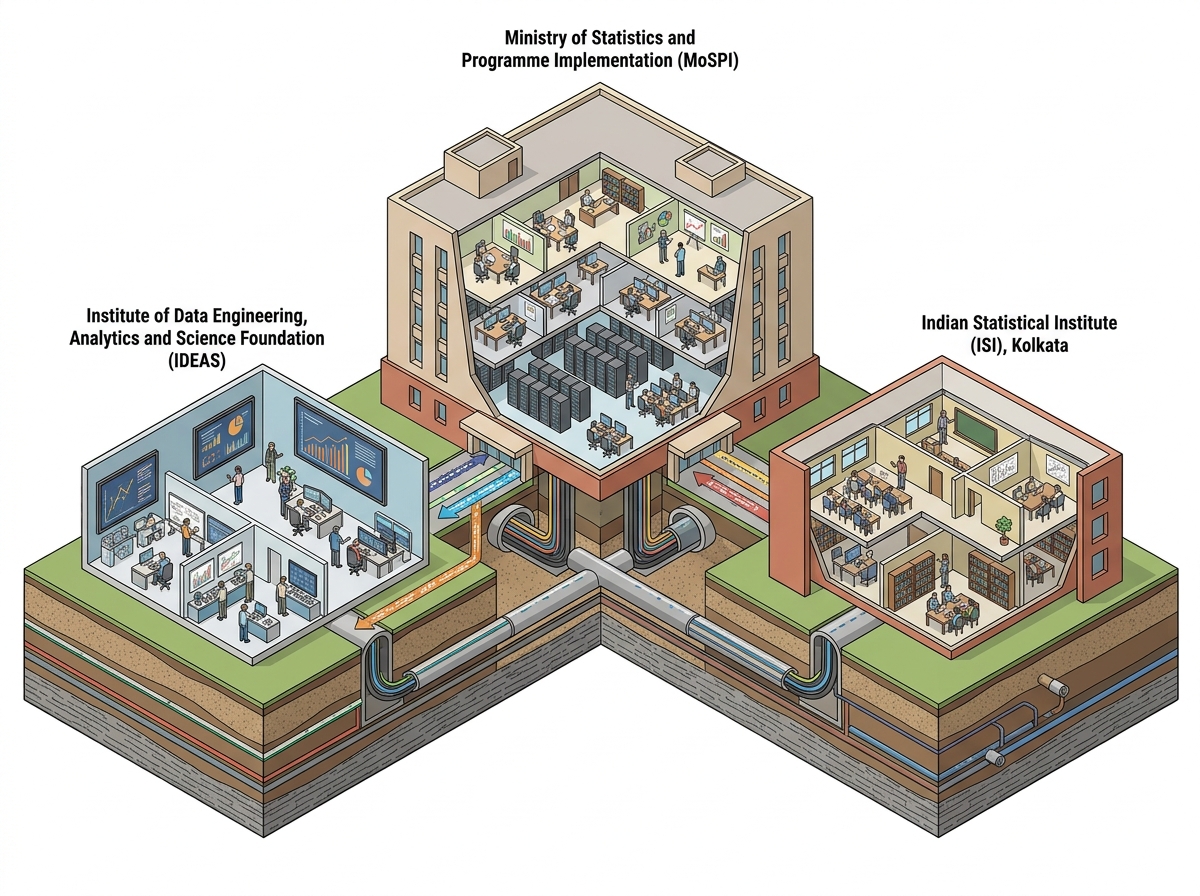
11 Aug MoSPI Collaborates with IDEAS-ISI Kolkata for GDP Nowcasting & Data Analytics
Ministry of StatisticsIDEAS FoundationIndian Statistical InstituteMemoranda of UnderstandingCollaborative researchData accuracy✎ The MoUs between MoSPI, IDEAS, and ISI Kolkata aim to enhance India’s statistical system by introducing real-time GDP estimation (nowcasting) and integrating administrative and survey data for evidence-based policymaking under…
Subject Relevance — Where This Topic Fits
- GS Paper II — Governance, Constitution, Polity, Social Justice and International Relations (Data Governance, Institutional Collaborations) | GS Paper III — Indian Economy (Data-Driven Economic Policies, GDP Estimation, Statistical Systems)
- Prelims: National Statistical Commission (NSC), GDP Nowcasting, Administrative Data, National Sample Survey (NSS), Data Governance Framework, Ministry of Statistics and Programme Implementation (MoSPI), Indian Statistical Institute (ISI), Statistical Reforms, Evidence-Based Policymaking
- Essay: The Role of Data in National Development: From Evidence to Action, Institutional Synergy in Governance: Bridging Academia and Policy
Quick Revision: The MoUs between MoSPI, IDEAS, and ISI Kolkata aim to enhance India’s statistical system by introducing real-time GDP estimation (nowcasting) and integrating administrative and survey data for evidence-based policymaking under the ‘Viksit Bharat @2047’ vision.
Why is this in the news?
The Ministry of Statistics and Programme Implementation (MoSPI) has signed two Memoranda of Understanding (MoUs) with the Institute of Data Engineering, Analytics and Science Foundation (IDEAS) and the Indian Statistical Institute (ISI), Kolkata, to conduct collaborative research studies aimed at enhancing the accuracy and timeliness of economic and social data. This initiative aligns with the government’s broader vision of leveraging data for informed decision-making under the ‘Viksit Bharat @2047’ framework, particularly in the domains of GDP estimation, health, nutrition, and welfare schemes.
Background
- The Ministry of Statistics and Programme Implementation (MoSPI) is the nodal agency responsible for the collection, compilation, and dissemination of official statistics in India, including GDP estimates, price indices, and socio-economic surveys.
- The Indian Statistical Institute (ISI), established in 1931, is a premier academic institution renowned for its contributions to statistical theory, econometrics, and data science, with a legacy of collaboration with government agencies.
- The Institute of Data Engineering, Analytics and Science Foundation (IDEAS) is a non-profit organisation focused on advancing data-driven research, artificial intelligence, and statistical methodologies for public policy applications.
- India’s statistical system faces challenges such as delays in GDP data releases, the need for real-time economic indicators, and the integration of administrative and survey data for holistic policy analysis.
- The ‘Viksit Bharat @2047’ initiative underscores the government’s commitment to achieving developed nation status by 2047, with data governance and evidence-based policymaking as critical enablers.
What are the key components of the MoUs between MoSPI, IDEAS, and ISI Kolkata?
- The MoUs formalise a collaborative framework between MoSPI and the academic institutions to conduct joint research on statistical methodologies, data integration, and policy-relevant analytics.
- One of the primary deliverables is the development of a **desktop-based software tool for GDP Nowcasting**, enabling real-time or near-real-time estimation of economic growth, which addresses the lag in traditional GDP reporting.
- The initiative includes the creation of a **harmonised indicator framework** that integrates administrative data from health, nutrition, and welfare schemes with household-level data from the National Sample Survey (NSS), enhancing the granularity and reliability of socio-economic indicators.
- The collaboration aims to deepen the analysis of MoSPI’s statistical outputs by cross-referencing them with alternative data sources, thereby improving the robustness of policy-relevant metrics.
- The partnership leverages the expertise of ISI Kolkata in statistical theory and econometrics, alongside IDEAS’ strengths in data engineering and analytics, to develop scalable and replicable data governance tools.
- The initiative aligns with global best practices in statistical reform, such as the adoption of **nowcasting techniques** (used by institutions like the IMF and World Bank) to provide timely economic insights.
- The research outputs are expected to inform policymaking bodies, ensuring that data-driven decisions are grounded in rigorous methodological foundations.
- The MoUs also envisage capacity-building initiatives, including training programmes for MoSPI officials in advanced statistical tools and data governance frameworks.
Key Features
| Feature | Significance |
|---|---|
| Collaborative MoUs between MOSPI and IDEAS-ISI Kolkata | Establishes a formal framework for joint research initiatives in statistical analytics and data governance. |
| Real-time GDP nowcasting tool (desktop-based) | Enables high-frequency, evidence-based economic policy formulation by providing timely GDP estimates. |
| Harmonised indicator framework for health, nutrition, and welfare schemes | Integrates administrative data with National Sample Survey (NSS) data to improve policy targeting and outcome assessment. |
| Financial and data support from MOSPI to IDEAS | Facilitates resource allocation for advanced statistical research and tool development. |
| Focus on ‘Viksit Bharat @ 2047’ data-driven governance | Aligns statistical research with long-term national development goals and SDG monitoring. |
Why it Matters
Economic Policy and Planning
- Enhances the accuracy and timeliness of macroeconomic indicators, reducing lags in policy response.
- Supports evidence-based decision-making for fiscal and monetary authorities through nowcasting models.
- Strengthens the statistical foundation for India’s medium-term development strategy, including the ‘Viksit Bharat @ 2047’ vision.
Data Governance and Institutional Capacity
- Promotes collaboration between government statistical agencies (MOSPI) and premier academic institutions (IDEAS-ISI Kolkata).
- Advances the use of administrative data in conjunction with survey data, improving data integrity and granularity.
- Fosters innovation in statistical methodologies, particularly in real-time economic measurement.
Public Service Delivery
- Improves the design and evaluation of welfare schemes by integrating multi-source data for targeted interventions.
- Enables evidence-based assessment of health, nutrition, and social welfare outcomes at sub-national levels.
Academic and Research Ecosystem
- Bridges the gap between theoretical statistical research and applied policy needs.
- Provides a platform for interdisciplinary collaboration in data science and public policy.
Challenges
1. Data Quality and Integration
- Ensuring consistency and comparability between administrative datasets and survey data (e.g., NSS).
- Addressing gaps in coverage, timeliness, and granularity across diverse data sources.
UPSC Link: GS-III: Data Governance
2. Methodological Rigour in Nowcasting
- Developing robust statistical models that account for structural breaks and external shocks in real-time data.
- Balancing the need for speed with the requirement for accuracy in high-frequency economic estimates.
UPSC Link: GS-III: Economic Statistics
3. Institutional Coordination
- Aligning priorities and workflows between government agencies (MOSPI) and academic partners (IDEAS-ISI).
- Ensuring sustained funding and resource allocation for long-term research collaborations.
UPSC Link: GS-II: Centre-State Relations
4. Privacy and Ethical Concerns
- Safeguarding individual data privacy while enabling granular data integration for policy analysis.
- Compliance with data protection frameworks (e.g., Digital Personal Data Protection Act, 2023).
UPSC Link: GS-II: Governance
5. Capacity Building
- Training statisticians and policymakers in advanced data analytics and nowcasting techniques.
- Developing a cadre of professionals capable of interpreting and utilising real-time economic indicators.
UPSC Link: GS-II: Skill Development
Challenges — UPSC Perspective
| Issue | Concern |
|---|---|
| Data heterogeneity | Lack of standardisation across administrative and survey datasets hinders integration. |
| Real-time data reliability | High-frequency data may suffer from measurement errors or delays in reporting. |
| Inter-agency trust | Historical silos between government departments may impede data sharing. |
| Model interpretability | Complex nowcasting models may lack transparency for policymakers. |
| Resource constraints | Limited budgetary allocations for sustained research and tool development. |
Way Forward
- Establish a dedicated inter-ministerial task force to oversee data integration and harmonisation efforts.
- Develop a phased roadmap for rolling out the nowcasting tool, including pilot testing and stakeholder feedback.
- Invest in capacity-building programmes for statisticians and policymakers in advanced data analytics.
- Strengthen data governance frameworks to ensure compliance with privacy and ethical standards.
- Enhance collaboration with state governments to improve sub-national data quality and granularity.
- Publish periodic reports on methodological improvements and limitations of the nowcasting model.
- Integrate the harmonised indicator framework into existing monitoring and evaluation mechanisms for welfare schemes.
UPSC Value Addition
Keywords for Mains Answer-Writing
Ministry of Statistics and Programme Implementation (MoSPI) · Indian Statistical Institute (ISI) · Institute of Data Engineering, Analytics and Science Foundation (IDEAS) · GDP Nowcasting · Real-time economic indicators · Administrative data harmonisation · National Sample Survey (NSS) data · Data governance framework · Developed India @ 2047 · Statistical data harmonisation · Evidence-based policymaking · Statistical capacity building
Concept Flow
Collaborative MoUs signed between MOSPI and IDEAS-ISI Kolkata → → Framework for joint research in statistical analytics and data governance established → → MOSPI provides financial and data support to IDEAS → → IDEAS develops real-time GDP nowcasting tool and harmonised indicator framework → → Integration of administrative and survey data enhances policy targeting → → Evidence-based decision-making for ‘Viksit Bharat @ 2047’ and SDG monitoring strengthened → → Long-term institutional capacity in data-driven governance built.
Prelims Practice Questions
Q1. Consider the following statements regarding the Ministry of Statistics and Programme Implementation (MoSPI):
1. MoSPI is responsible for the conduct of the National Sample Survey (NSS).
2. MoSPI releases the GDP estimates in India.
3. MoSPI is the nodal agency for the development of statistical capacity in India.
How many of the above statements are correct?
- Only one
- Only two
- All three
- None
Answer: All three — Statement 1 and 2 are correct as MoSPI conducts the NSS and releases GDP estimates. Statement 3 is also correct as MoSPI is the nodal agency for statistical capacity building.
Q2. Assertion (A): GDP Nowcasting provides real-time estimates of GDP growth.
Reason (R): Nowcasting relies on high-frequency data and statistical models to project current economic conditions.
- Both A and R are true, and R is the correct explanation of A.
- Both A and R are true, but R is not the correct explanation of A.
- A is true, but R is false.
- A is false, but R is true.
Answer: Both A and R are true, and R is the correct explanation of A. — GDP Nowcasting indeed provides real-time estimates of GDP growth by leveraging high-frequency data and statistical models, making both A and R true, with R correctly explaining A.
Q3. Match the following initiatives with their respective objectives:
Column I
A. GDP Nowcasting
B. Administrative data harmonisation
C. Developed India @ 2047
D. Statistical capacity building
Column II
1. Aligning administrative data with household-level survey data
2. Real-time GDP growth estimation
3. Enhancing statistical infrastructure and skills
4. Achieving a developed nation status by 2047
Options:
A-2, B-1, C-4, D-3
- A-2, B-1, C-4, D-3
- A-1, B-2, C-3, D-4
- A-3, B-4, C-1, D-2
- A-4, B-3, C-2, D-1
Answer: A-2, B-1, C-4, D-3 — A. GDP Nowcasting aligns with real-time GDP growth estimation (2). B. Administrative data harmonisation aligns with aligning administrative data with household-level survey data (1). C. Developed India @ 2047 aligns with achieving developed nation status by 2047 (4). D. Statistical capacity building aligns with enhancing statistical infrastructure and skills (3).
Mains Practice Question
✍ The collaboration between the Ministry of Statistics and Programme Implementation (MoSPI) and academic institutions like the Indian Statistical Institute (ISI) and the Institute of Data Engineering, Analytics and Science Foundation (IDEAS) represents a paradigm shift towards evidence-based policymaking in India. Critically examine the significance of this partnership in the context of GDP Nowcasting and administrative data harmonisation. Also, analyse how such initiatives contribute to the vision of ‘Developed India @ 2047’. (15 Marks)
Approach: MODEL-ANSWER SKELETON:
1. **Introduction (2 marks)**: Define MoSPI’s role in statistical governance and the importance of evidence-based policymaking in India’s developmental trajectory.
2. **GDP Nowcasting (4 marks)**:
– Explain GDP Nowcasting as a real-time economic indicator tool.
– Highlight its significance in providing timely policy inputs, reducing lags in GDP estimation, and aiding the Reserve Bank of India (RBI) and government in monetary and fiscal decisions.
– Reference the collaboration with IDEAS/ISI in developing a desktop-based software tool for this purpose.
3. **Administrative Data Harmonisation (4 marks)**:
– Define administrative data and its challenges (fragmentation, lack of standardisation).
– Explain the need to harmonise administrative data (e.g., health, nutrition, welfare schemes) with household-level NSS data for robust policy formulation.
– Discuss the technical and institutional challenges in achieving this harmonisation, such as data privacy, interoperability, and capacity constraints.
4. **Contribution to ‘Developed India @ 2047’ (3 marks)**:
– Link the initiative to the broader goal of achieving developed nation status by 2047.
– Discuss how real-time economic indicators and harmonised data improve policy responsiveness, reduce inefficiencies, and enhance governance.
– Highlight the role of statistical capacity building in ensuring long-term sustainability of such initiatives.
5. **Conclusion (2 marks)**: Summarise the transformative potential of this partnership while acknowledging the challenges in implementation. Emphasise the need for continued investment in statistical infrastructure and inter-institutional collaboration.
Source: PIB (Press Information Bureau)
Generated by AanyaAi for educational purpose.

- KWML’s Feasibility Reports for Water Metro in 18 Cities: UPSC & PCS Insights - October 3, 2026
- ओडिशा में वन्यजीव अनुसंधान अनुदान कार्यक्रम शुरू, सिमिलिपाल में 300 कैमरे और बढ़ेंगे - October 3, 2026
- India Summons Pakistan High Commission Official Over Violation - October 3, 2026

No Comments