


11 Aug NABL Launches India’s First Mobile Food Testing Lab Accreditation Scheme for UPSC 2026
✎ NABL’s accreditation scheme for mobile food testing laboratories, launched under the Integrated Assessment Framework (IAF), ensures third-party validation of on-site food safety testing, enhancing regulatory efficiency and…
Subject Relevance — Where This Topic Fits
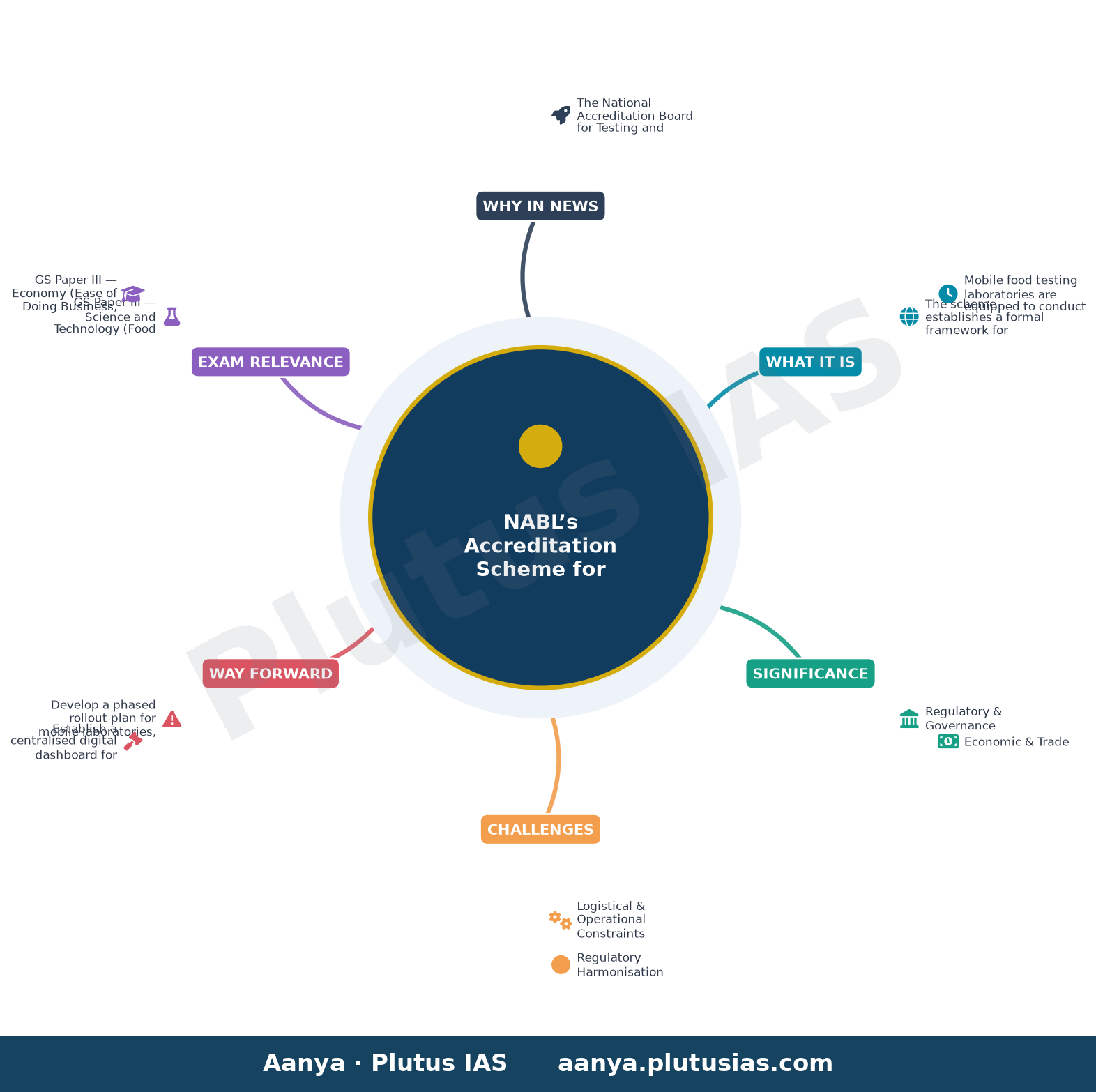
- GS Paper III — Science and Technology (Food Safety Standards, Accreditation Mechanisms) | GS Paper III — Economy (Ease of Doing Business, Quality Infrastructure) | GS Paper II — Governance, Constitution, Polity, Social Justice and International Relations (Regulatory Frameworks, Consumer Protection)
- Prelims: NABL, Food Safety and Standards Authority of India (FSSAI), ISO/IEC 17025, Accreditation, Mobile Food Testing Laboratories, Quality Infrastructure, Commodity Boards, Department for Promotion of Industry and Internal Trade (DPIIT), Quality Council of India (QCI), Mutual Recognition Agreements (MRAs), Integrated Assessment Framework (IAF)
- Essay: The Role of Quality Infrastructure in India’s Development Trajectory, Regulatory Convergence and Ease of Doing Business: A Case for Mobile Testing Laboratories
Quick Revision: NABL’s accreditation scheme for mobile food testing laboratories, launched under the Integrated Assessment Framework (IAF), ensures third-party validation of on-site food safety testing, enhancing regulatory efficiency and consumer trust in India’s quality infrastructure.
Why is this in the news?
The National Accreditation Board for Testing and Calibration Laboratories (NABL), a constituent board of the Quality Council of India (QCI), has launched India’s first accreditation scheme for mobile food testing laboratories. This initiative, unveiled during the ‘Quality Coordination – Multilateral MoU Exchange Ceremony’ in New Delhi, aims to expand reliable, quality-assured, and internationally compliant food testing services closer to communities. The scheme is expected to strengthen food safety monitoring, improve access to quality testing, facilitate swift regulatory interventions, and enhance consumer trust through a robust accreditation framework.
Background
- Traditional fixed food testing laboratories often face challenges in reaching remote and underserved areas, leading to delays in regulatory compliance and consumer grievance redressal.
- NABL, as the national accreditation body for testing and calibration laboratories, operates under the Quality Council of India (QCI), which is an autonomous body established by the Government of India.
- The Integrated Assessment Framework (IAF) promotes regulatory convergence, mutual recognition of conformity assessment results, and reduces duplication in compliance procedures across sectors.
- India’s quality infrastructure, including accreditation, certification, and standards, is pivotal for enhancing ease of doing business and aligning with global best practices.
- The Department for Promotion of Industry and Internal Trade (DPIIT) plays a key role in policy formulation to strengthen India’s quality ecosystem and facilitate trade facilitation.
What is the NABL Accreditation Scheme for Mobile Food Testing Laboratories?
- The scheme establishes a formal framework for accrediting mobile food testing laboratories, ensuring they meet international standards such as ISO/IEC 17025 for testing and calibration laboratories.
- Mobile food testing laboratories are equipped to conduct on-site testing of food samples, enabling timely detection of adulteration, contamination, and non-compliance with food safety standards.
- Accreditation under this scheme provides third-party assurance of the competence, impartiality, and consistency of mobile laboratories, thereby enhancing their credibility and regulatory acceptance.
- The scheme aligns with the Integrated Assessment Framework (IAF), which fosters mutual recognition of accreditation results, reduces regulatory duplication, and promotes harmonised compliance across jurisdictions.
- The accreditation process involves rigorous assessment of the mobile laboratory’s technical competence, quality management systems, and adherence to standard operating procedures (SOPs).
- The initiative underscores India’s commitment to strengthening its quality infrastructure, a key enabler for achieving the vision of a self-reliant and globally competitive economy by 2047.
Key Features
| Feature | Significance |
|---|---|
| First-of-its-kind accreditation scheme for mobile food testing laboratories | Establishes a formal framework for accrediting mobile laboratories, ensuring adherence to international quality standards (ISO/IEC 17025) for food testing. |
| Integration with Integrated Assessment Framework (IAF) | Facilitates harmonised regulatory oversight, reducing duplication in assessment processes across multiple agencies. |
| Multi-lateral Memorandum of Understanding (MoU) exchange | Strengthens regulatory convergence among stakeholders, promoting mutual recognition of test results and enhancing trust in food safety systems. |
| Focus on community-level access to food testing | Enables rapid, on-site testing in remote or underserved areas, improving food safety surveillance and consumer confidence. |
| Alignment with global best practices | Ensures compatibility with Codex Alimentarius standards, supporting India’s commitments under WTO agreements. |
Why it Matters
Regulatory & Governance
- Enhances the credibility of food testing services by subjecting mobile laboratories to third-party accreditation, thereby reducing risks of regulatory arbitrage.
- Promotes a unified quality infrastructure through the IAF, streamlining compliance for businesses and reducing transaction costs.
- Strengthens India’s compliance with international quality assurance frameworks, facilitating smoother trade in agri-food products.
Economic & Trade
- Supports the ‘One District, One Product’ (ODOP) initiative by ensuring localised quality testing, thereby enhancing the marketability of regional food products.
- Reduces post-harvest losses by enabling faster detection of contaminants, thereby improving supply chain efficiency.
- Facilitates exports by providing internationally recognised test reports, reducing non-tariff barriers in global trade.
Consumer & Public Health
- Improves food safety outcomes by enabling real-time, decentralised testing, particularly in areas with limited access to fixed laboratories.
- Builds consumer trust through transparent, accredited testing processes, reducing health risks from adulterated or unsafe food.
- Supports the implementation of the Food Safety and Standards Act, 2006, by providing a robust mechanism for compliance verification.
Institutional Capacity
- Leverages the existing NABL infrastructure, ensuring scalability and cost-effectiveness in deploying mobile laboratories.
- Encourages collaboration between regulatory bodies, industry, and academia to strengthen India’s quality ecosystem.
- Demonstrates India’s commitment to global quality standards, positioning it as a leader in food safety governance.
Challenges
1. Logistical & Operational Constraints
- Ensuring consistent power, internet connectivity, and calibration of mobile laboratories in remote or rural areas.
- Maintaining the integrity of samples during transit, especially in high-temperature or high-humidity conditions.
- Training and retaining skilled personnel for mobile laboratory operations, given the specialised nature of food testing.
UPSC Link: GS-III: Food Processing & Supply Chain
2. Regulatory Harmonisation
- Achieving uniformity in accreditation standards across states, given the federal structure of food safety governance.
- Resolving conflicts between national accreditation (NABL) and state-level food safety authorities (e.g., FSSAI’s state wings).
UPSC Link: GS-II: Federalism & Governance
3. Financial Sustainability
- Balancing the cost of accreditation and operation of mobile laboratories with affordability for small food businesses and local governments.
- Ensuring long-term funding mechanisms for scaling the initiative without over-reliance on public exchequer.
UPSC Link: GS-III: Public Expenditure & Financial Management
4. Public Awareness & Trust
- Educating consumers and local vendors about the benefits of accredited mobile food testing to drive adoption and demand.
- Addressing scepticism or resistance from traditional food testing laboratories due to perceived competition.
UPSC Link: GS-II: Citizen Centric Governance
Challenges — UPSC Perspective
| Issue | Concern |
|---|---|
| Standardisation across states | Variations in state-level food safety regulations may hinder seamless accreditation. |
| Data security & privacy | Ensuring confidentiality of test data, especially when mobile labs operate in public spaces. |
| Supply chain dependencies | Reliance on imported reagents or calibration tools may pose risks to operational continuity. |
| Public-private partnership models | Designing equitable revenue-sharing or cost-recovery mechanisms for private operators. |
| Monitoring & evaluation | Developing real-time tracking systems to assess the impact of mobile labs on food safety outcomes. |
Way Forward
- Develop a phased rollout plan for mobile laboratories, prioritising high-risk food clusters (e.g., dairy, spices, street food).
- Establish a centralised digital dashboard for tracking accredited mobile labs, sample results, and regulatory actions in real time.
- Launch targeted capacity-building programmes for state food safety officers, lab technicians, and local entrepreneurs.
- Formulate a public-private partnership (PPP) framework to attract investment in mobile lab infrastructure while ensuring affordability.
- Integrate the accreditation scheme with existing FSSAI compliance portals to streamline reporting and reduce administrative burden.
- Conduct periodic impact assessments to measure improvements in food safety metrics (e.g., reduction in adulteration cases).
- Collaborate with academic institutions (e.g., IITs, ICAR) to innovate in portable testing technologies and AI-driven quality checks.
UPSC Value Addition
Keywords for Mains Answer-Writing
National Accreditation Board for Testing and Calibration Laboratories (NABL) · Food Safety and Standards Authority of India (FSSAI) · Mobile Food Testing Laboratories · Quality infrastructure · Accreditation scheme · Integrated Assessment Framework (IAF) · Regulatory convergence · Consumer trust · Food safety monitoring · Global standards compliance · Quality assurance · Multilateral Memorandum of Understanding (MoU) · Quality Council of India (QCI) · Department for Promotion of Industry and Internal Trade (DPIIT) · Food safety ecosystem
Constitutional & Policy Linkages
- [‘Article 21: Right to Health (food safety as a public health measure).’]
- [‘Article 47: Duty of State to raise nutrition levels and public health standards.’]
- [‘Article 39(b): Directive Principle on minimising inequalities in access to essential services.’]
Concept Flow
Rising demand for decentralised food safety testing → Identification of gaps in traditional lab-based systems → NABL’s accreditation scheme for mobile labs → Multi-stakeholder MoUs for regulatory convergence → Integrated Assessment Framework (IAF) for harmonised oversight → Enhanced food safety surveillance and consumer trust → Contribution to India’s global trade competitiveness.
Prelims Practice Questions
Q1. Consider the following statements regarding the National Accreditation Board for Testing and Calibration Laboratories (NABL):
1. NABL is a constituent board of the Quality Council of India (QCI).
2. NABL operates under the Ministry of Health and Family Welfare.
3. NABL provides accreditation for mobile food testing laboratories.
4. NABL’s accreditation ensures compliance with international standards.
How many of the above statements are correct?
- Only one
- Only two
- Only three
- All four
Answer: All four — Statements 1, 3, and 4 are correct. Statement 2 is incorrect as NABL operates under the Department for Promotion of Industry and Internal Trade (DPIIT), Ministry of Commerce and Industry.
Q2. Assertion (A): The Integrated Assessment Framework (IAF) aims to reduce duplication in assessment processes.
Reason (R): The IAF promotes mutual recognition among regulatory authorities, thereby enhancing regulatory efficiency.
Options:
A. Both A and R are true, and R is the correct explanation of A.
B. Both A and R are true, but R is not the correct explanation of A.
C. A is true, but R is false.
D. A is false, but R is true.
Answer: ? — Both the assertion and reason are true, and the reason correctly explains the assertion. The IAF seeks to reduce duplication by promoting mutual recognition and regulatory efficiency.
Q3. Match the following columns:
Column I (Initiative/Scheme)
A. NABL Accreditation for Mobile Food Testing Laboratories
B. Multilateral MoU for Regulatory Convergence
C. Integrated Assessment Framework (IAF)
D. Quality Council of India (QCI)
Column II (Purpose/Function)
1. Strengthening food safety monitoring and consumer trust
2. Promoting mutual recognition and reducing duplication in assessments
3. Establishing a unified quality infrastructure
4. Facilitating accreditation of mobile food testing services
Options:
A-4, B-2, C-1, D-3
A-4, B-2, C-3, D-1
A-1, B-3, C-2, D-4
A-3, B-1, C-4, D-2
- A-4, B-2, C-1, D-3
- A-4, B-2, C-3, D-1
- A-1, B-3, C-2, D-4
- A-3, B-1, C-4, D-2
Answer: A-4, B-2, C-3, D-1 — Correct matches: A-4 (NABL accreditation for mobile food testing laboratories), B-2 (Multilateral MoU for regulatory convergence), C-1 (IAF for strengthening food safety monitoring), D-3 (QCI for establishing a unified quality infrastructure).
Mains Practice Question
✍ The launch of India’s first accreditation scheme for mobile food testing laboratories by the National Accreditation Board for Testing and Calibration Laboratories (NABL) marks a significant step toward strengthening the country’s food safety ecosystem. In this context, critically examine the role of accreditation in enhancing food safety and regulatory efficiency in India. (15 Marks)
Approach: MODEL-ANSWER SKELETON:
1. **Definition and Purpose of Accreditation** (2 Marks):
– Define accreditation as a third-party attestation of conformity assessment bodies (CABs) like testing laboratories.
– Highlight its role in ensuring competence, impartiality, and consistency in testing processes.
2. **Relevance to Food Safety** (3 Marks):
– Link accreditation to the Food Safety and Standards Authority of India (FSSAI) regulations and the Food Safety and Standards Act, 2006.
– Explain how accredited mobile food testing laboratories can improve on-site testing, reduce delays in regulatory interventions, and enhance consumer trust.
– Cite the role of NABL as a signatory to international mutual recognition agreements (e.g., ILAC MRA), ensuring global standards compliance.
3. **Regulatory Efficiency and Convergence** (4 Marks):
– Discuss the Integrated Assessment Framework (IAF) and its role in reducing duplication in assessments across regulatory authorities.
– Explain how multilateral MoUs (e.g., with state food safety departments, commodity boards) facilitate regulatory convergence and harmonized compliance.
– Highlight the role of the Department for Promotion of Industry and Internal Trade (DPIIT) and the Quality Council of India (QCI) in fostering a unified quality infrastructure.
4. **Challenges and Limitations** (3 Marks):
– Acknowledge challenges such as limited awareness among stakeholders, infrastructure gaps in rural areas, and the need for continuous capacity building.
– Discuss the role of technology (e.g., IoT, AI) in enhancing the efficacy of mobile food testing laboratories.
5. **Conclusion and Way Forward** (3 Marks):
– Summarize the transformative potential of the accreditation scheme in building a robust food safety ecosystem.
– Suggest measures such as public-private partnerships, digital integration with FSSAI’s FoSCoS portal, and capacity-building programs for sustained impact.
– Conclude with a forward-looking statement on India’s journey toward becoming a global leader in food safety standards.
Source: PIB (Press Information Bureau)
Generated by AanyaAi for educational purpose.

- KWML’s Feasibility Reports for Water Metro in 18 Cities: UPSC & PCS Insights - October 3, 2026
- ओडिशा में वन्यजीव अनुसंधान अनुदान कार्यक्रम शुरू, सिमिलिपाल में 300 कैमरे और बढ़ेंगे - October 3, 2026
- India Summons Pakistan High Commission Official Over Violation - October 3, 2026

No Comments