


11 Aug NABL Launches India’s First Accreditation Scheme for Mobile Food Testing Labs
✎ NABL’s accreditation scheme for mobile food testing laboratories enhances food safety by enabling on-site, quality-assured testing, regulatory convergence, and consumer trust through compliance with ISO/IEC 17025 standards.
Subject Relevance — Where This Topic Fits
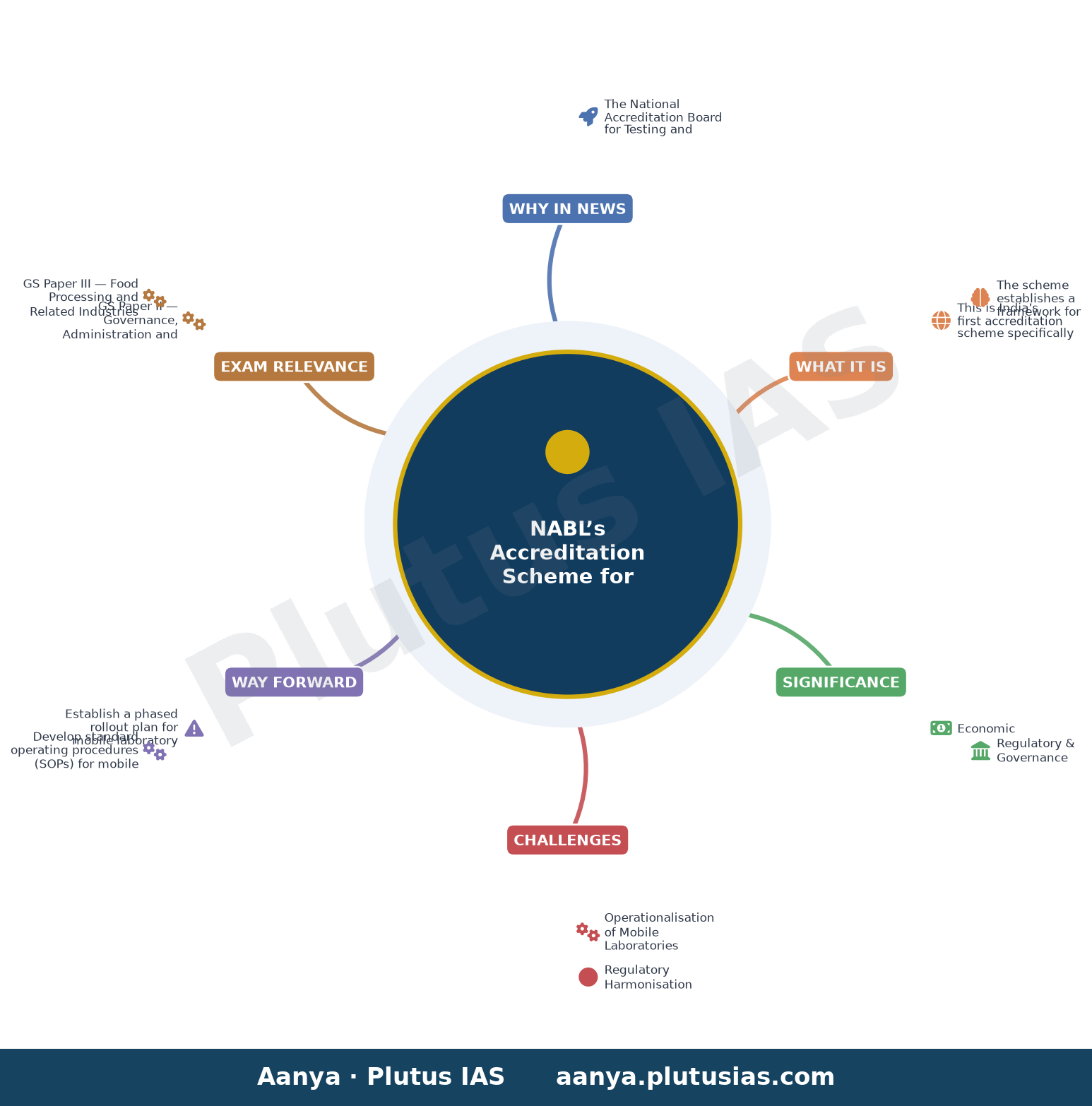
- GS Paper II — Governance, Administration and Challenges (Regulatory Mechanisms) | GS Paper III — Food Processing and Related Industries
- Prelims: NABL, Food Safety and Standards Authority of India (FSSAI), ISO/IEC 17025, Quality Council of India (QCI), Mobile Food Testing Laboratories, Accreditation, Regulatory Convergence, Mutual Recognition Agreements (MRAs), Integrated Assessment Framework (IAF)
- Essay: The Role of Accreditation in Enhancing Public Trust in Food Safety, Regulatory Reforms and Quality Infrastructure: A Pathway to Sustainable Development
Quick Revision: NABL’s accreditation scheme for mobile food testing laboratories enhances food safety by enabling on-site, quality-assured testing, regulatory convergence, and consumer trust through compliance with ISO/IEC 17025 standards.
Why is this in the news?
The National Accreditation Board for Testing and Calibration Laboratories (NABL), a constituent board of the Quality Council of India (QCI), has launched India’s first accreditation scheme for mobile food testing laboratories. This initiative aims to expand reliable, quality-assured, and internationally compliant food testing services closer to communities, thereby strengthening food safety monitoring, improving access to quality testing, and enhancing consumer confidence through regulatory convergence and collaborative frameworks.
Background
- Traditional static food testing laboratories often face challenges in reaching remote or underserved areas, leading to delays in regulatory interventions and consumer grievances.
- NABL, under the Quality Council of India (QCI), operates as the national accreditation body for testing and calibration laboratories, ensuring compliance with international standards such as ISO/IEC 17025.
- The Integrated Assessment Framework (IAF) promotes regulatory harmonization by facilitating mutual recognition of conformity assessment results among member bodies.
- India’s quality infrastructure, including accreditation, certification, and standardization, is pivotal for enhancing global trade competitiveness and consumer protection.
- The launch aligns with the government’s vision of ‘Quality for India’ and its commitment to achieving sustainable development goals through robust regulatory mechanisms.
What is the NABL Accreditation Scheme for Mobile Food Testing Laboratories?
- This is India’s first accreditation scheme specifically designed for mobile food testing laboratories, enabling them to provide on-site, reliable, and internationally compliant food safety testing services.
- The scheme establishes a framework for assessing the competence of mobile laboratories, ensuring they meet stringent quality and technical requirements as per ISO/IEC 17025 standards.
- Mobile laboratories will facilitate faster regulatory interventions by conducting real-time testing in communities, thereby reducing delays in addressing food safety violations.
- The accreditation ensures traceability, accuracy, and consistency in testing results, thereby enhancing consumer trust in food safety measures.
- The scheme is part of the broader Integrated Assessment Framework (IAF), which promotes regulatory convergence and mutual recognition of conformity assessment results among national and international bodies.
- The scheme also fosters collaboration among regulators, industry stakeholders, and accreditation bodies to streamline processes and reduce duplication in testing and certification.
- This initiative underscores the importance of a robust quality infrastructure in achieving India’s developmental goals, including the vision of a ‘Viksit Bharat’ by 2047.
Key Features
| Feature | Significance |
|---|---|
| First-of-its-kind accreditation scheme for mobile food testing laboratories | Establishes a formal framework for quality-assured, community-centric food safety testing, aligning with international standards. |
| Framework developed by NABL under QCI | Ensures technical competence, impartiality, and consistency in mobile food testing services, reinforcing India’s quality infrastructure. |
| Multi-lateral Memorandum of Understanding (MoU) exchange | Fosters regulatory convergence, reduces duplication in assessments, and promotes mutual recognition among stakeholders. |
| Integration with Integrated Assessment Framework (IAF) | Enables harmonised evaluation processes across regulatory authorities, enhancing efficiency and compliance. |
| Focus on decentralised testing services | Expands access to reliable food safety testing in remote and underserved areas, improving public health outcomes. |
Why it Matters
Economic
- Enhances ease of doing business by streamlining food safety compliance through accredited mobile laboratories, reducing regulatory burden on enterprises.
- Supports agricultural and food processing sectors by ensuring adherence to national and international food safety standards, thereby boosting export competitiveness.
- Promotes investment in food safety infrastructure by validating the credibility of mobile testing services through a robust accreditation mechanism.
Regulatory & Governance
- Strengthens the regulatory ecosystem by embedding accredited testing within food safety governance, ensuring evidence-based enforcement.
- Facilitates regulatory convergence through MoUs, reducing fragmentation in compliance requirements across jurisdictions.
- Promotes transparency and accountability in food safety monitoring by standardising assessment criteria for mobile laboratories.
Public Health & Consumer Protection
- Improves food safety surveillance by enabling timely, on-site testing, particularly in rural and peri-urban areas where static laboratories are inaccessible.
- Enhances consumer trust by ensuring food products meet prescribed safety standards through accredited testing mechanisms.
- Reduces foodborne illnesses and associated economic losses by enabling proactive detection and intervention in the food supply chain.
Institutional & Structural
- Demonstrates the role of QCI and NABL as apex bodies in standardising quality infrastructure, aligning with global best practices.
- Encourages collaboration among regulatory authorities, commodity boards, and testing laboratories to achieve unified quality objectives.
- Sets a precedent for accreditation of other decentralised testing services (e.g., water, air quality), expanding the scope of quality assurance in public services.
Challenges
1. Operationalisation of Mobile Laboratories
- Ensuring consistent availability of accredited mobile testing units across diverse geographical regions, including remote and hilly terrains.
- Maintaining operational efficiency and reliability of mobile labs under varied environmental and logistical conditions.
- Training and capacity-building of personnel to handle mobile laboratory operations, data management, and compliance reporting.
UPSC Link: GS-III: Food processing industries
2. Regulatory Harmonisation
- Aligning accreditation standards with existing food safety regulations under FSSAI, PFA, and other relevant frameworks to avoid duplication.
- Ensuring mutual recognition of accreditation results among states and union territories to prevent regulatory arbitrage.
- Addressing inter-state coordination challenges in monitoring and enforcement of mobile laboratory-based testing.
UPSC Link: GS-II: Centre-State relations
3. Cost and Resource Allocation
- Balancing the financial sustainability of mobile laboratories with affordability for small and medium enterprises (SMEs) in the food sector.
- Securing adequate funding for procurement, maintenance, and upgradation of mobile lab infrastructure and technology.
- Optimising resource utilisation to prevent underutilisation of mobile testing facilities in high-demand areas.
UPSC Link: GS-III: Infrastructure financing
4. Public Awareness and Trust
- Educating stakeholders, including farmers, food processors, and consumers, about the benefits and credibility of accredited mobile testing services.
- Addressing scepticism or resistance to mobile-based testing due to perceived limitations in accuracy or scope compared to static laboratories.
- Ensuring transparency in reporting and dissemination of test results to build public confidence in the system.
UPSC Link: GS-III: Consumer protection
5. Technological and Data Management
- Integrating digital tools for real-time data collection, analysis, and reporting to enhance the efficiency of mobile laboratory operations.
- Ensuring cybersecurity and data integrity in digital platforms used for storing and transmitting food safety test results.
- Developing interoperable systems to facilitate seamless data exchange between mobile labs, regulatory authorities, and FSSAI.
UPSC Link: GS-III: Science and Technology
Challenges — UPSC Perspective
| Issue | Concern |
|---|---|
| Geographical coverage | Limited reach of mobile labs in remote or conflict-affected areas due to logistical constraints. |
| Standardisation vs. flexibility | Balancing uniform accreditation standards with the need for customised testing protocols for regional food products. |
| Stakeholder coordination | Ensuring seamless collaboration between NABL, FSSAI, state authorities, and private operators for effective implementation. |
| Cost-effectiveness | High initial investment in mobile lab infrastructure may deter participation from smaller food businesses. |
| Public perception | Overcoming distrust in mobile-based testing due to lack of awareness about accreditation and quality assurance mechanisms. |
| Regulatory overlap | Potential duplication of efforts between mobile lab accreditation and existing FSSAI compliance mechanisms. |
Way Forward
- Establish a phased rollout plan for mobile laboratory accreditation, prioritising high-risk food clusters and underserved regions.
- Develop standard operating procedures (SOPs) for mobile lab operations, including calibration, sample collection, and data reporting protocols.
- Launch targeted awareness campaigns to educate food businesses, farmers, and consumers about the benefits of accredited mobile testing.
- Strengthen digital infrastructure for real-time data sharing between mobile labs, FSSAI, and state food safety authorities.
- Institutionalise regular audits and reviews of accredited mobile laboratories to ensure sustained compliance with international standards.
- Foster public-private partnerships to expand the network of mobile testing units and reduce operational costs.
- Integrate mobile lab accreditation with existing food safety schemes (e.g., Agri-Export Zones) to enhance export competitiveness.
- Conduct impact assessments to measure improvements in food safety outcomes, consumer trust, and regulatory efficiency post-implementation.
UPSC Value Addition
Keywords for Mains Answer-Writing
NABL accreditation scheme · Mobile food testing laboratories · Food Safety and Standards Authority of India (FSSAI) · Integrated Assessment Framework (IAF) · Quality infrastructure · Regulatory convergence · Mutual recognition agreements · Consumer confidence in food safety · Food Safety and Standards Act, 2006 · National Accreditation Board for Testing and Calibration Laboratories (NABL) · Quality Council of India (QCI) · Food Safety Management System (FSMS) · International standards (ISO/IEC 17025) · Food adulteration and surveillance
Concept Flow
Food Safety Governance → Need for Decentralised Testing → Accreditation Framework Development by NABL/QCI → Regulatory Convergence via MoUs → Integrated Assessment Framework (IAF) for Harmonised Evaluation → Mobile Laboratory Deployment → Community-Centric Testing → Enhanced Public Health Outcomes → Accreditation & Quality Assurance → Consumer Trust & Export Competitiveness → Economic Growth → Feedback Loop → Continuous Improvement in Infrastructure & Processes → Sustainable Quality Ecosystem
Prelims Practice Questions
Q1. Consider the following statements regarding the National Accreditation Board for Testing and Calibration Laboratories (NABL):
1. NABL is a constituent board of the Quality Council of India (QCI).
2. NABL provides accreditation to mobile food testing laboratories under its newly launched scheme.
3. NABL operates under the administrative control of the Ministry of Health and Family Welfare.
4. NABL’s accreditation is based on international standards such as ISO/IEC 17025.
How many of the above statements are correct?
- Only one
- Only two
- Only three
- All four
Answer: Only three — Statements 1, 2, and 4 are correct. NABL is indeed a constituent board of QCI, it has launched a scheme for accrediting mobile food testing laboratories, and its accreditation is based on ISO/IEC 17025. Statement 3 is incorrect as NABL operates under the Department for Promotion of Industry and Internal Trade (DPIIT), Ministry of Commerce and Industry.
Q2. Assertion (A): The Integrated Assessment Framework (IAF) aims to reduce duplication in assessment processes and promote mutual recognition among regulatory authorities.
Reason (R): IAF facilitates regulatory convergence and harmonisation of quality infrastructure across sectors.
Options:
A. Both A and R are true, and R is the correct explanation of A.
B. Both A and R are true, but R is NOT the correct explanation of A.
C. A is true, but R is false.
D. A is false, but R is true.
Answer: ? — Both Assertion (A) and Reason (R) are true, and Reason (R) correctly explains Assertion (A). The IAF is designed to streamline assessment processes, reduce duplication, and enhance mutual recognition among regulatory bodies, thereby promoting regulatory convergence.
Q3. Match the following organisations with their respective roles in the context of food safety and quality infrastructure in India:
Organisation | Role
1. NABL | A. Formulates food safety standards and regulations
2. FSSAI | B. Provides accreditation to testing and calibration laboratories
3. QCI | C. Oversees the implementation of quality infrastructure initiatives
4. DPIIT | D. Promotes ease of doing business through regulatory reforms
Options:
A. 1-B, 2-A, 3-C, 4-D
B. 1-A, 2-B, 3-C, 4-D
C. 1-C, 2-A, 3-B, 4-D
D. 1-D, 2-B, 3-A, 4-C
- A
- B
- C
- D
Answer: A — The correct match is: 1-B (NABL provides accreditation to laboratories), 2-A (FSSAI formulates food safety standards), 3-C (QCI oversees quality infrastructure initiatives), and 4-D (DPIIT promotes ease of doing business).
Mains Practice Question
✍ The launch of India’s first accreditation scheme for mobile food testing laboratories by the National Accreditation Board for Testing and Calibration Laboratories (NABL) represents a significant step towards strengthening food safety governance and consumer trust. Critically analyse the institutional, regulatory, and technological dimensions of this initiative. Also, examine how this scheme aligns with the broader objectives of the Integrated Assessment Framework (IAF) and the Food Safety and Standards Act, 2006. (15 Marks)
Approach: MODEL-ANSWER SKELETON:
1. **Institutional Dimension (4 Marks)**
– Role of NABL as a constituent board of the Quality Council of India (QCI) and its mandate under the Department for Promotion of Industry and Internal Trade (DPIIT).
– Collaboration with FSSAI, state food authorities, and international bodies for regulatory convergence.
– Governance structure: Accreditation process, peer review, and compliance monitoring.
2. **Regulatory Dimension (5 Marks)**
– Alignment with the Food Safety and Standards Act, 2006: Objectives of ensuring food safety, preventing adulteration, and protecting consumer interests.
– Role of FSSAI in setting standards and monitoring compliance; how mobile labs enhance surveillance in remote areas.
– Regulatory convergence through IAF: Reduction of duplication, mutual recognition, and harmonisation of quality infrastructure.
– Legal and procedural safeguards: Accreditation criteria (ISO/IEC 17025), proficiency testing, and corrective actions.
3. **Technological and Operational Dimension (3 Marks)**
– Deployment of mobile laboratories: Equipment, personnel, and logistical challenges in rural and peri-urban areas.
– Integration with digital platforms for real-time data reporting and analysis.
– Capacity building: Training of personnel, standardisation of testing protocols, and quality assurance mechanisms.
4. **Challenges and Critique (3 Marks)**
– Limitations: Funding, maintenance of mobile units, and ensuring consistent quality across diverse geographical regions.
– Potential conflicts with state-level food safety authorities and overlapping jurisdictions.
– Need for periodic review and adaptation to emerging food safety threats (e.g., new adulterants, climate-induced risks).
5. **Conclusion (1 Mark)**
– Reiterate the significance of the scheme in enhancing food safety governance, consumer confidence, and India’s compliance with international standards (e.g., Codex Alimentarius).
– Emphasise the role of IAF in creating a unified quality infrastructure ecosystem.
Source: PIB (Press Information Bureau)
Generated by AanyaAi for educational purpose.

- KWML’s Feasibility Reports for Water Metro in 18 Cities: UPSC & PCS Insights - October 3, 2026
- ओडिशा में वन्यजीव अनुसंधान अनुदान कार्यक्रम शुरू, सिमिलिपाल में 300 कैमरे और बढ़ेंगे - October 3, 2026
- India Summons Pakistan High Commission Official Over Violation - October 3, 2026

No Comments