


11 Aug Tamil Nadu Assembly Opposes FCRA Amendment Bill 2026: Key UPSC Analysis
✎ The FCRA Amendment Bill, 2026, seeks to regulate the management and disposal of assets of organisations whose FCRA registration is cancelled or surrendered, raising critical questions about the balance between national security…
Subject Relevance — Where This Topic Fits
- GS Paper II — Governance, Constitution and Polity — Role of State Governments in Policy Implementation | GS Paper II — Governance, Constitution and Polity — Federalism and Centre-State Relations | GS Paper III — Economy — Role of Non-Governmental Organisations and Civil Society in Development
- Prelims: Foreign Contribution (Regulation) Act, 2010, FCRA Amendment Bill 2026, Article 246(3) of the Constitution of India, Doctrine of Pith and Substance, Natural Justice, Proportionality, Legitimate Expectation, Federalism, Cooperative Federalism, Charitable Organisations, Minority Institutions
- Essay: The Tension Between National Security and Fundamental Rights: A Case Study of Foreign Contribution Regulation, Federalism in India: The Centre-State Dialogue on Policy Implementation
Quick Revision: The FCRA Amendment Bill, 2026, seeks to regulate the management and disposal of assets of organisations whose FCRA registration is cancelled or surrendered, raising critical questions about the balance between national security imperatives and the constitutional rights of charitable organisations.
Why is this in the news?
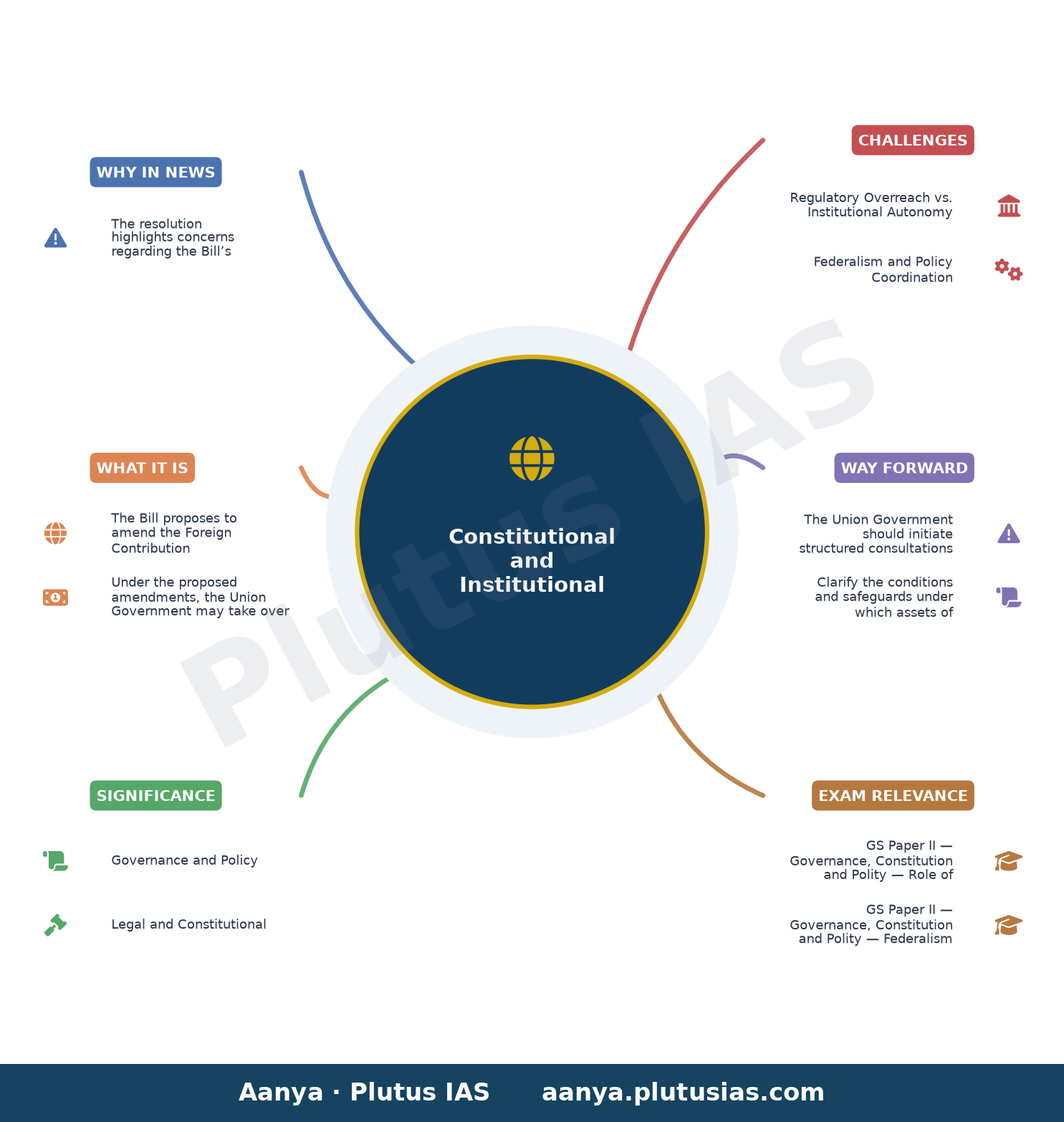
The resolution highlights concerns regarding the Bill’s provisions on the transfer, management, disposal, and sale of assets of charitable organisations, particularly those run by minorities, and calls for comprehensive stakeholder consultations to ensure alignment with constitutional principles such as natural justice, proportionality, and federalism.
Background
- The Foreign Contribution (Regulation) Act (FCRA), 2010, regulates the acceptance and utilisation of foreign contributions or foreign hospitality by individuals, associations, and companies in India to ensure that such contributions do not compromise national security or public interest.
- The FCRA was amended in 2020, introducing stricter provisions such as reduced utilisation of foreign funds for administrative expenses, mandatory opening of FCRA accounts in the State Bank of India, and enhanced scrutiny of foreign contributions.
- The proposed FCRA Amendment Bill, 2026, seeks to further amend the Act, with provisions that allow the Union Government to take over the management and disposal of assets of organisations whose FCRA registration is cancelled, expired, or surrendered.
- The Tamil Nadu Assembly’s resolution reflects broader concerns among State governments and civil society organisations regarding the potential erosion of institutional autonomy and the rights of charitable organisations.
- The Bill has been framed in the context of national security imperatives, but its provisions raise questions about the balance between regulation and the protection of constitutional rights.
- The issue underscores the federal dimension, as State governments and civil society organisations seek greater consultation and alignment with constitutional principles in the formulation of such legislation.
What is the Foreign Contribution (Regulation) Amendment Bill, 2026?
- The Bill proposes to amend the Foreign Contribution (Regulation) Act, 2010, to introduce provisions for the transfer, management, disposal, and sale of assets of organisations whose FCRA registration is cancelled, expired, or surrendered.
- Under the proposed amendments, the Union Government may take over the management of such organisations’ assets, including immovable property, and dispose of them in a manner prescribed by rules, with proceeds credited to the Consolidated Fund of India.
- The Bill seeks to enhance transparency and accountability in the utilisation of foreign contributions, particularly in light of concerns over the misuse of foreign funds for activities detrimental to national security.
- The provisions apply to all organisations registered under FCRA, including educational, medical, religious, cultural, and social welfare institutions, with potential implications for minority-run institutions.
- The Bill has been criticised for its potential to infringe upon the autonomy of charitable organisations and the rights of stakeholders, particularly in the absence of adequate safeguards or comprehensive stakeholder consultations.
- The Bill has been referred to as a measure to prevent the diversion of foreign funds for anti-national activities, but its provisions raise questions about the balance between regulation and the protection of fundamental rights.
- The Bill has been tabled in Parliament, and its passage would require the assent of both Houses, followed by the President’s assent, before it becomes law.
- The Bill has been framed in the context of evolving geopolitical dynamics and the need for robust regulatory frameworks to safeguard national interests.
Key Features
| Feature | Significance |
|---|---|
| Provisions on asset transfer | Empowers the Union Government to take over assets of charitable organisations upon FCRA registration expiry, non-renewal, cancellation, or surrender, raising concerns over autonomy of such entities. |
| Stakeholder consultations | The resolution emphasises the necessity of comprehensive consultations with State governments, NGOs, and sectoral organisations to ensure policy coherence and inclusivity. |
| Principles of natural justice | The resolution underscores the need for adherence to principles such as proportionality, protection of property rights, and legitimate expectations in regulatory amendments. |
| Federalism considerations | Highlights the role of State governments in policy formulation, particularly in matters affecting local charitable and educational institutions. |
| Transparency and accountability | Balances the requirement for oversight of foreign contributions with safeguards to prevent misuse while protecting lawful operations of organisations. |
Why it Matters
Governance and Policy
- Demonstrates the role of State Legislatures in scrutinising Union legislation that impacts decentralised governance and institutional autonomy.
- Highlights the tension between regulatory oversight of foreign contributions and the operational independence of non-profit entities.
- Reflects the evolving discourse on federalism in India, particularly in matters concerning social sector institutions managed by States or minority groups.
Legal and Constitutional
- Examines the balance between regulatory powers of the Union under Entry 18 of the Union List (Foreign Affairs) and the rights of entities under Articles 19(1)(g) (right to carry on business) and 26 (freedom to manage religious affairs).
- Raises questions on the application of the doctrine of proportionality in regulatory amendments affecting property rights of charitable organisations.
Social Sector Implications
- Impacts educational and social welfare institutions, particularly those managed by minorities, which rely on foreign contributions for sustainability.
- May influence the operational viability of NGOs and voluntary organisations engaged in healthcare, education, and poverty alleviation.
International Relations
- Underscores the need for India’s regulatory framework on foreign contributions to align with international best practices while safeguarding national interests.
- May prompt discussions on the compatibility of FCRA provisions with India’s commitments under international conventions on human rights and civil society.
Challenges
1. Regulatory Overreach vs. Institutional Autonomy
- Risk of excessive centralisation in the regulation of foreign contributions, potentially stifling the autonomy of State-managed or minority-run institutions.
- Lack of clarity on safeguards against arbitrary or politically motivated cancellations of FCRA registrations.
- Potential chilling effect on foreign funding for legitimate social sector activities due to perceived regulatory uncertainty.
UPSC Link: GS2: Federal Structure
2. Federalism and Policy Coordination
- Need for robust mechanisms to ensure Union-State coordination in the implementation of FCRA provisions, particularly for institutions operating across jurisdictions.
- Possibility of policy divergence between the Union and States, leading to operational challenges for national-level NGOs.
UPSC Link: GS2: Centre-State Relations
3. Legal and Procedural Safeguards
- Ensuring that provisions for asset transfer upon FCRA cancellation or expiry adhere to principles of natural justice and proportionality.
- Addressing concerns over the potential misuse of regulatory powers to target specific organisations or sectors.
UPSC Link: GS2: Judiciary and Legal Framework
4. Impact on Civil Society
- Risk of reduced foreign funding for NGOs, particularly those working in sensitive or politically contentious areas.
- Potential erosion of public trust in charitable organisations due to perceived regulatory scrutiny.
UPSC Link: GS1: Social Empowerment
5. International Compliance and Reputation
- Need to ensure that FCRA amendments do not contravene international norms on freedom of association and civil society operations.
- Risk of reputational damage to India’s image as a destination for foreign investment in social sector initiatives.
UPSC Link: GS2: International Organisations
Challenges — UPSC Perspective
| Issue | Concern |
|---|---|
| Asset transfer provisions | Potential violation of property rights and institutional autonomy of charitable organisations. |
| Lack of stakeholder consultations | Risk of policy formulation without adequate input from affected sectors, leading to implementation challenges. |
| Federalism implications | Possible conflict between Union and State governments over jurisdiction and implementation of FCRA provisions. |
| Legal ambiguities | Unclear safeguards against arbitrary cancellations or non-renewals of FCRA registrations. |
| Impact on civil society | Chilling effect on foreign funding for NGOs, particularly those managed by minorities or operating in sensitive areas. |
Way Forward
- The Union Government should initiate structured consultations with State governments, NGOs, and sectoral experts to address concerns raised in the resolution.
- Clarify the conditions and safeguards under which assets of charitable organisations may be transferred to the Government, ensuring alignment with constitutional principles.
- Establish an independent review mechanism to examine cancellations or non-renewals of FCRA registrations, with provisions for appeal and redressal.
- Enhance transparency in the administration of FCRA by publishing detailed guidelines and criteria for registration, renewal, and cancellation.
- Conduct a comprehensive impact assessment of the proposed amendments on the operational viability of educational, healthcare, and social welfare institutions.
- Strengthen federal coordination mechanisms to ensure that FCRA provisions are implemented in a manner consistent with State-level governance structures.
- Review the alignment of FCRA amendments with international best practices and India’s obligations under relevant human rights conventions.
UPSC Value Addition
Keywords for Mains Answer-Writing
Foreign Contribution Regulation Act (FCRA), 2010 · FCRA Amendment Bill 2026 · Federalism and Centre-State relations · Autonomy of charitable organisations · Natural justice and proportionality · Foreign funding of NGOs and associations · Right to property and legitimate expectations · Transparency and accountability in foreign contributions · Constitutional provisions on federalism · Judicial review of executive actions
Constitutional & Policy Linkages
- Article 19(1)(g): Right to carry on business or profession
- Article 26: Freedom to manage religious affairs
- Article 29: Protection of interests of minorities
- Seventh Schedule: Union List (Entry 18: Foreign Affairs)
Concept Flow
Foreign Contribution (Regulation) Act (FCRA) amendments proposed by Union Government → Provisions on asset transfer upon FCRA registration expiry/cancellation/surrender → Concerns raised by Tamil Nadu Assembly over autonomy of charitable organisations → Unanimous resolution demanding withdrawal of the Bill in its present form → Emphasis on principles of natural justice, proportionality, and federalism → Potential impact on educational, healthcare, and social welfare institutions → Need for comprehensive consultations and legal safeguards
Prelims Practice Questions
Q1. Consider the following statements regarding the Foreign Contribution (Regulation) Act (FCRA), 2010:
1. The Act regulates the acceptance and utilisation of foreign contributions by individuals, associations, and companies.
2. The Act empowers the Union Government to cancel the registration of an organisation if it violates the provisions of the Act.
3. The Act prohibits foreign contributions to political parties and candidates for elections.
4. The Act mandates that 50% of the foreign contributions must be utilised for administrative expenses.
How many of the above statements are correct?
- Only one
- Only two
- Only three
- All four
Answer: All four — Statements 1, 2, and 3 are correct. Statement 4 is incorrect as the Act does not mandate a specific percentage for administrative expenses but imposes caps on such utilisation.
Q2. Assertion (A): The Foreign Contribution (Regulation) Amendment Bill, 2026 seeks to empower the Union Government to take over the assets of organisations whose FCRA registration is cancelled.
Reason (R): The Bill aims to enhance transparency and accountability in the utilisation of foreign contributions.
In the context of the above two statements, which one of the following is correct?
- Both A and R are true, and R is the correct explanation of A.
- Both A and R are true, but R is not the correct explanation of A.
- A is true, but R is false.
- A is false, but R is true.
Answer: A is true, but R is false. — Both A and R are true, but R is not the correct explanation of A. The Bill does seek to empower the Government to take over assets, but this is not directly aimed at enhancing transparency; rather, it is a measure to ensure compliance with FCRA provisions.
Q3. Match the following provisions of the Foreign Contribution (Regulation) Act (FCRA), 2010 with their respective descriptions:
Column I (Provision) | Column II (Description)
1. Section 12 | A. Prohibition on acceptance of foreign contributions by political parties
2. Section 17 | B. Registration of associations to receive foreign contributions
3. Section 33 | C. Maintenance of separate account and utilisation of foreign contributions
4. Section 35 | D. Power of the Union Government to prohibit receipt of foreign contributions
Select the correct match:
- 1-B, 2-C, 3-D, 4-A
- 1-B, 2-D, 3-C, 4-A
- 1-C, 2-B, 3-A, 4-D
- 1-D, 2-A, 3-B, 4-C
Answer: 1-B, 2-D, 3-C, 4-A — The correct match is: 1-B (Section 12: Registration of associations), 2-C (Section 17: Maintenance of separate account), 3-D (Section 33: Power to prohibit receipt), 4-A (Section 35: Prohibition for political parties).
Mains Practice Question
✍ The Foreign Contribution (Regulation) Amendment Bill, 2026 seeks to introduce stringent provisions for the transfer, management, disposal, and sale of assets of charitable organisations in the event of cancellation or non-renewal of their FCRA registration. Critically examine the constitutional validity of these provisions in the context of federalism, natural justice, and the autonomy of voluntary organisations. Also, analyse the balance between transparency in foreign funding and the protection of legitimate expectations of lawfully functioning institutions. (15 Marks)
Approach: MODEL-ANSWER SKELETON:
1. **Introduction**: Briefly introduce the FCRA, 2010, and the key provisions of the Amendment Bill, 2026, focusing on asset transfer clauses.
2. **Constitutional Validity – Federalism**: Discuss the distribution of powers under the Seventh Schedule (Union List Entry 18 – Foreign affairs; State List Entry 1 – Public order). Argue that asset seizure powers encroach upon State domain (e.g., education, health) and may violate the federal structure. Cite the Sarkaria Commission (1988) and Punchhi Commission (2010) on Centre-State relations.
3. **Constitutional Validity – Natural Justice**: Examine if the provisions comply with Articles 14 (equality), 19(1)(g) (right to carry on business), and 21 (right to property, post-Kesavananda Bharati). Discuss the principles of proportionality and legitimate expectations (e.g., W.P. Singh v. Union of India, 2020).
4. **Autonomy of Voluntary Organisations**: Analyse the impact on NGOs, educational institutions, and social welfare organisations, citing Article 30 (rights of minorities) and the role of civil society in governance (e.g., 2nd ARC Report on Citizen-Centric Administration).
5. **Balance Between Transparency and Legitimate Expectations**: Discuss the need for transparency in foreign funding (e.g., FCRA 2010, Supreme Court’s stance in Indian Social Action Forum v. Union of India, 2014) while protecting the rights of lawfully functioning institutions. Highlight the role of judicial review in striking this balance.
6. **Conclusion**: Summarise the constitutional tensions and suggest a middle path (e.g., graduated penalties, prior notice, and appeals mechanism).
Source: The Hindu
Generated by AanyaAi for educational purpose.

- KWML’s Feasibility Reports for Water Metro in 18 Cities: UPSC & PCS Insights - October 3, 2026
- ओडिशा में वन्यजीव अनुसंधान अनुदान कार्यक्रम शुरू, सिमिलिपाल में 300 कैमरे और बढ़ेंगे - October 3, 2026
- India Summons Pakistan High Commission Official Over Violation - October 3, 2026

No Comments