


11 Aug Centre tables bill to bar state taxes on minerals; Opposition demands review
✎ The Mines and Minerals (Development and Regulation) Amendment Bill, 2026, seeks to prohibit state taxes on mineral rights by amending the MMDR Act, 1957, thereby centralising regulatory control over the mineral sector and…
Subject Relevance — Where This Topic Fits
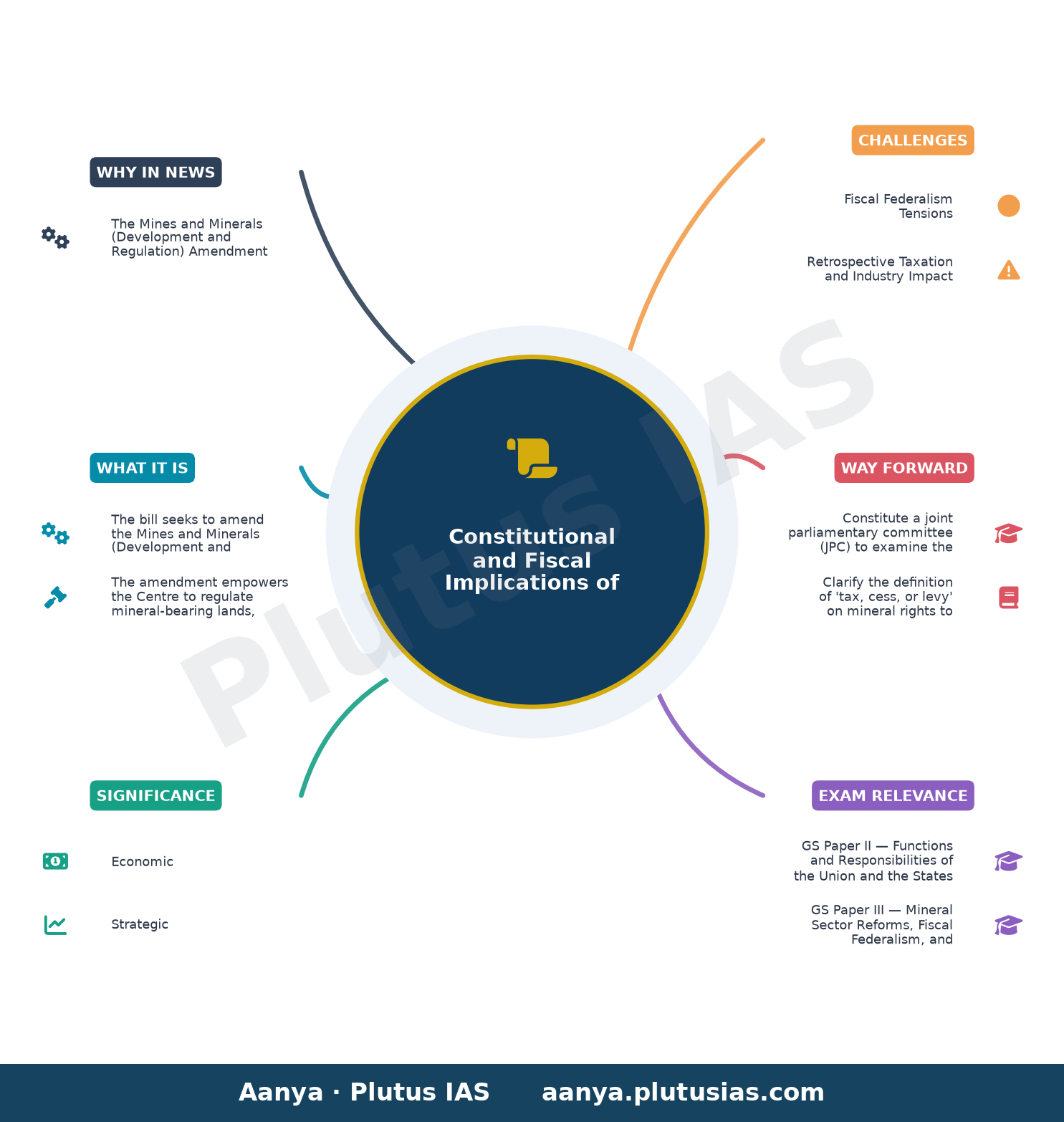
- GS Paper II — Functions and Responsibilities of the Union and the States (Federalism) | GS Paper III — Mineral Sector Reforms, Fiscal Federalism, and Regulatory Governance
- Prelims: Mines and Minerals (Development and Regulation) Act, 1957, Article 246 of the Constitution, Article 268A, Royalty vs Tax distinction, Fiscal Federalism, Parliamentary Standing Committee on Mines, Union List vs State List under Seventh Schedule, Retrospective Taxation, Commercial Viability of Mining Sector
- Essay: Federalism in India: Balancing Autonomy and Uniformity, The Role of Judiciary in Resolving Centre-State Fiscal Disputes
Quick Revision: The Mines and Minerals (Development and Regulation) Amendment Bill, 2026, seeks to prohibit state taxes on mineral rights by amending the MMDR Act, 1957, thereby centralising regulatory control over the mineral sector and challenging the Supreme Court’s 2024 ruling upholding states’ fiscal powers.
Why is this in the news?
The Mines and Minerals (Development and Regulation) Amendment Bill, 2026, introduced in the Lok Sabha on August 11, 2026, seeks to prohibit state governments from imposing taxes, cesses, or levies on mineral rights and mineral-bearing lands, thereby centralising regulatory control over the mineral sector. This legislative initiative follows the Supreme Court’s July 2024 ruling upholding states’ power to levy such taxes, which has significant implications for fiscal federalism, sectoral viability, and the Centre-State financial relationship. The bill’s introduction amid opposition protests underscores the constitutional and economic tensions inherent in mineral governance.
Background
- The Mines and Minerals (Development and Regulation) Act, 1957 (MMDR Act) governs the regulation and development of minerals in India, with royalties payable to the Centre and states under its provisions.
- The ruling enabled mineral-rich states such as Jharkhand, Odisha, Chhattisgarh, and Rajasthan to impose retrospective taxes on mineral rights from April 1, 2005, potentially generating revenue of ₹1.5–2 lakh crore, with public sector undertakings facing a burden of approximately ₹70,000 crore.
- The proposed amendment bill aims to override the Supreme Court’s interpretation by explicitly barring states from levying taxes, cesses, or levies on mineral rights, thereby centralising regulatory authority over the mineral sector.
What is the Mines and Minerals (Development and Regulation) Amendment Bill, 2026?
- The bill seeks to amend the Mines and Minerals (Development and Regulation) Act, 1957, to introduce a new provision explicitly prohibiting state governments from imposing taxes, cesses, or levies on mineral rights and mineral-bearing lands, irrespective of nomenclature.
- The amendment empowers the Centre to regulate mineral-bearing lands, expanding its jurisdiction beyond the existing framework of the MMDR Act, which primarily governs the grant of mineral concessions and royalty collection.
- The bill’s stated objective is to ensure the sustainable and uniform development of the mineral sector, citing the need to prevent excessive and unpredictable taxation that could render mining operations commercially unviable.
- The proposed legislation reflects a shift towards greater centralisation of regulatory control over the mineral sector, potentially altering the fiscal landscape for mineral-rich states.
- The bill’s introduction follows the Supreme Court’s 2024 ruling, which affirmed states’ constitutional authority to levy taxes on mineral rights, creating a legal and fiscal conflict that the amendment seeks to resolve.
- The amendment bill is part of a broader policy discourse on balancing fiscal federalism with sectoral viability, particularly in resource-rich states where mineral extraction constitutes a significant revenue source.
- The bill’s provisions may have retrospective implications, as the Supreme Court’s 2024 ruling allowed states to recover past dues, and the amendment could seek to nullify such levies.
- The legislative process involves parliamentary scrutiny, with opposition parties demanding a committee review to assess the bill’s implications on federalism and state fiscal autonomy.
Key Features
| Feature | Significance |
|---|---|
| Prohibition of state taxes on mineral rights and mineral-bearing lands | Ensures uniformity in mineral taxation by centralising regulatory authority, preventing state-level fiscal fragmentation in the mining sector. |
| Expansion of Centre’s regulatory command over mines | Enhances the Union Government’s ability to frame uniform policies for sustainable mineral development across states. |
| Retrospective validation of state levies (pre-2024) | Acknowledges states’ constitutional right to tax mineral rights, aligning with the Supreme Court’s July 2024 judgment. |
| Exclusion of royalty from state tax ambit | Clarifies that royalty under the MMDR Act (1957) is not a tax, maintaining a clear distinction between statutory levies and state-imposed charges. |
| Prohibition of retrospective penalties and interest | Provides partial relief to mining entities by barring additional financial burdens beyond the principal tax dues. |
Why it Matters
Economic
- Facilitates a predictable and stable fiscal environment for mineral-based industries by eliminating state-level tax unpredictability.
- Potentially reduces compliance costs for mining firms operating across multiple states, enhancing ease of doing business.
- May increase Centre’s revenue share from mineral-rich states, though fiscal federalism implications are contested.
- Supports long-term investment in mineral exploration and extraction by mitigating retrospective tax liabilities.
Strategic
- Strengthens the Union’s control over critical mineral resources, aligning with national priorities for resource security.
- Enhances policy coherence in mineral governance, crucial for sectors like defence, energy, and electronics manufacturing.
- Supports India’s transition to a green economy by ensuring stable supply chains for minerals like lithium, cobalt, and rare earths.
Legal
- Resolves ambiguity in the interpretation of the MMDR Act (1957) regarding the scope of state taxation powers.
- Affirms the Supreme Court’s role in delineating the boundaries between Union and state legislative competencies.
- Clarifies the distinction between royalty (a statutory levy) and state taxes, reducing litigation risks for stakeholders.
Federalism
- Raises questions about the balance of fiscal autonomy between the Centre and states, particularly for mineral-rich states.
- Highlights the tension between uniform national policy and regional economic interests in resource-rich regions.
- May necessitate constitutional amendments or further judicial interpretation to resolve federal disputes.
Challenges
1. Fiscal Federalism Tensions
- States with significant mineral endowments may perceive the bill as an encroachment on their fiscal autonomy.
- Mineral-rich states like Jharkhand, Odisha, and Chhattisgarh may resist the loss of revenue from mineral taxes.
- Potential legal challenges from states arguing violation of constitutional provisions on taxation powers (Article 246 and Seventh Schedule).
UPSC Link: GS-II: Federalism
2. Retrospective Taxation and Industry Impact
- Mining companies face financial strain due to retrospective tax demands, despite partial relief from penalties and interest.
- Uncertainty over tax liabilities for the period 2005–2026 may deter future investments in the sector.
- Legal disputes over the validity of retrospective levies could prolong litigation, affecting sectoral stability.
UPSC Link: GS-III: Taxation
3. Policy Coherence vs. Regional Disparities
- Uniform mineral taxation may not account for regional disparities in mineral endowment and economic dependence on mining.
- States with diverse economic structures may find the centralised approach less responsive to local needs.
- Risk of policy rigidity that does not accommodate state-specific developmental priorities.
UPSC Link: GS-II: Cooperative Federalism
4. Judicial and Legislative Overlap
- The bill seeks to override the Supreme Court’s 2024 judgment, raising questions about the separation of powers.
- Potential for judicial review if the bill is perceived as encroaching on judicial independence or constitutional interpretation.
- Need for clear legislative drafting to avoid ambiguity in the prohibition of state taxes.
UPSC Link: GS-II: Separation of Powers
5. Sectoral Competitiveness
- Excessive state taxes had already made India’s mining sector less competitive globally, deterring FDI in mineral exploration.
- Centralisation may improve competitiveness by reducing tax arbitrage but could also reduce state incentives for local development.
- Risk of reduced state investment in infrastructure and social welfare linked to mineral revenues.
UPSC Link: GS-III: Industrial Policy
Challenges — UPSC Perspective
| Issue | Concern |
|---|---|
| State revenue loss | Mineral-rich states may face significant fiscal shortfalls, affecting their ability to fund developmental projects. |
| Industry compliance burden | Mining firms may struggle with retroactive tax assessments, leading to financial and operational disruptions. |
| Legal ambiguity | Unclear drafting in the bill could lead to prolonged litigation over the scope of prohibited levies. |
| Policy rigidity | Centralised control may not address the unique economic and social needs of mineral-dependent regions. |
| Investor uncertainty | Retrospective tax demands and policy changes could deter long-term investments in the mining sector. |
| Federalism disputes | States may challenge the bill’s constitutionality, leading to prolonged legal and political conflicts. |
Way Forward
- Constitute a joint parliamentary committee (JPC) to examine the bill’s implications on fiscal federalism and sectoral competitiveness, as suggested by the Opposition.
- Clarify the definition of ‘tax, cess, or levy’ on mineral rights to avoid ambiguity and potential litigation.
- Engage with mineral-rich states to explore compensatory mechanisms for revenue shortfalls, ensuring equitable fiscal federalism.
- Strengthen the grievance redressal mechanism for mining firms to address retrospective tax disputes efficiently.
- Undertake a comprehensive review of the MMDR Act (1957) to align it with contemporary economic and environmental needs.
- Formulate a national mineral policy that balances Centre’s regulatory authority with state-level developmental priorities.
- Enhance transparency in mineral auction processes to build investor confidence and reduce regulatory arbitrage.
- Initiate capacity-building programmes for state officials to ensure smooth implementation of centralised mineral governance.
UPSC Value Addition
Keywords for Mains Answer-Writing
Mines and Minerals (Development and Regulation) Act, 1957 · federalism and taxation powers · Supreme Court judgment on mineral rights taxation · MMDR Amendment Bill, 2026 · royalty vs. tax on minerals · retrospective taxation in mining sector · Centre-State financial relations · Article 246 and Seventh Schedule · fiscal federalism in India · sustainable mineral development · mineral-bearing lands · public sector undertakings in mining · competitive federalism
Constitutional & Policy Linkages
- Article 246: Distribution of legislative powers between Union and States (Seventh Schedule).
- Article 268: Duties levied by the Union but collected and appropriated by the States.
- Article 286: Restrictions on imposition of taxes on sale or purchase of goods in the course of inter-State trade.
- Entry 54 (Union List): Regulation of mines and mineral development under Union jurisdiction.
Concept Flow
Supreme Court’s July 2024 judgment upholds states’ power to tax mineral rights → Industry challenges retrospective levies → Centre introduces amendment bill to bar state taxes → Opposition raises federalism concerns → Bill referred to committee review → Need for policy coherence and legal clarity → Long-term impact on mineral governance and investment.
Prelims Practice Questions
Q1. Consider the following statements regarding the Mines and Minerals (Development and Regulation) Act, 1957:
1. The Act empowers the Central Government to exclusively levy taxes on mineral rights.
2. Royalty under the Act is considered a tax under the Constitution.
3. The Act regulates the grant of mineral concessions for major minerals.
4. The Act does not apply to minor minerals.
How many of the above statements are correct?
- Only one
- Only two
- Only three
- All four
Answer: Only three — Statements 3 and 4 are correct. The MMDR Act, 1957 regulates the grant of mineral concessions for major minerals and explicitly excludes minor minerals from its purview. Statements 1 and 2 are incorrect: the Act does not empower the Centre to levy taxes on mineral rights exclusively, and royalty is not treated as a tax under the Constitution.
Q2. Assertion (A): The Supreme Court in its July 2024 judgment held that royalty under the MMDR Act, 1957 is not a tax.
Reason (R): The MMDR Act, 1957 does not limit the legislative power of States to tax mineral rights and mineral-bearing lands.
- Both A and R are true, and R is the correct explanation of A
- Both A and R are true, but R is not the correct explanation of A
- A is true, but R is false
- A is false, but R is true
Answer: Both A and R are true, but R is not the correct explanation of A — Both the Assertion and Reason are correct. The Supreme Court in its July 2024 judgment clarified that royalty under the MMDR Act is not a tax and that the Act does not restrict the State’s power to levy taxes on mineral rights and mineral-bearing lands. The Reason correctly explains the Assertion.
Q3. Which of the following pairs is correctly matched with reference to the constitutional division of taxation powers between the Centre and the States in India?
- Entry 50, List I (Union List) — Taxes on mineral rights
- Entry 49, List II (State List) — Taxes on income other than agricultural income
- Entry 54, List I (Union List) — Taxes on the sale or purchase of goods in the course of inter-State trade
- Entry 26, List II (State List) — Taxes on mineral rights
Answer: ? — Entry 26 in the State List (List II) of the Seventh Schedule of the Constitution empowers State Legislatures to levy taxes on mineral rights. Entry 50 in the Union List pertains to taxes on mineral rights but is not the correct match for the question context. Entry 49 in the State List pertains to taxes on land and buildings, and Entry 54 in the Union List pertains to taxes on the sale or purchase of goods in the course of inter-State trade.
Mains Practice Question
✍ Critically examine the constitutional and legal dimensions of the proposed bar on State taxes on mineral rights and mineral-bearing lands under the Mines and Minerals (Development and Regulation) Amendment Bill, 2026. In your answer, elucidate the implications for fiscal federalism in India and the balance of powers between the Centre and the States. (15 Marks)
Approach: MODEL-ANSWER SKELETON:
1. **Constitutional Framework**:
– Reference Entry 26 (State List) and Entry 50 (Union List) of the Seventh Schedule.
– Article 246 and the doctrine of federalism in India.
– Judicial precedents on Centre-State financial relations (e.g., State of West Bengal v. Union of India, 1963).
2. **Supreme Court Judgment (July 2024)**:
– Clarification that royalty under MMDR Act, 1957 is not a tax.
– Affirmation of State power to levy taxes on mineral rights and mineral-bearing lands.
– Impact on mineral-rich States (e.g., Odisha, Jharkhand, Chhattisgarh).
3. **Proposed Amendment (MMDR Amendment Bill, 2026)**:
– Prohibition of State taxes, cesses, or levies on mineral rights.
– Expansion of Central regulatory command over mines and mineral-bearing lands.
– Rationale: Preventing excessive and unpredictable taxation to ensure commercial viability.
4. **Fiscal Federalism Implications**:
– Potential erosion of State fiscal autonomy.
– Revenue implications for mineral-rich States.
– Competitive federalism dynamics: Centre’s role in ensuring uniform mineral development.
5. **Balancing Centre-State Powers**:
– Need for cooperative federalism in resource governance.
– Role of NITI Aayog and Inter-State Council in resolving disputes.
– Judicial review and the doctrine of pith and substance.
6. **Conclusion**:
– The amendment seeks to centralise regulatory control but risks undermining fiscal federalism.
– A balanced approach is required to reconcile Centre’s developmental goals with State fiscal autonomy.
Source: Hindustan Times
Generated by AanyaAi for educational purpose.

- KWML’s Feasibility Reports for Water Metro in 18 Cities: UPSC & PCS Insights - October 3, 2026
- ओडिशा में वन्यजीव अनुसंधान अनुदान कार्यक्रम शुरू, सिमिलिपाल में 300 कैमरे और बढ़ेंगे - October 3, 2026
- India Summons Pakistan High Commission Official Over Violation - October 3, 2026

No Comments