


11 Aug NABL Launches India’s First Accreditation Scheme for Mobile Food Testing Labs
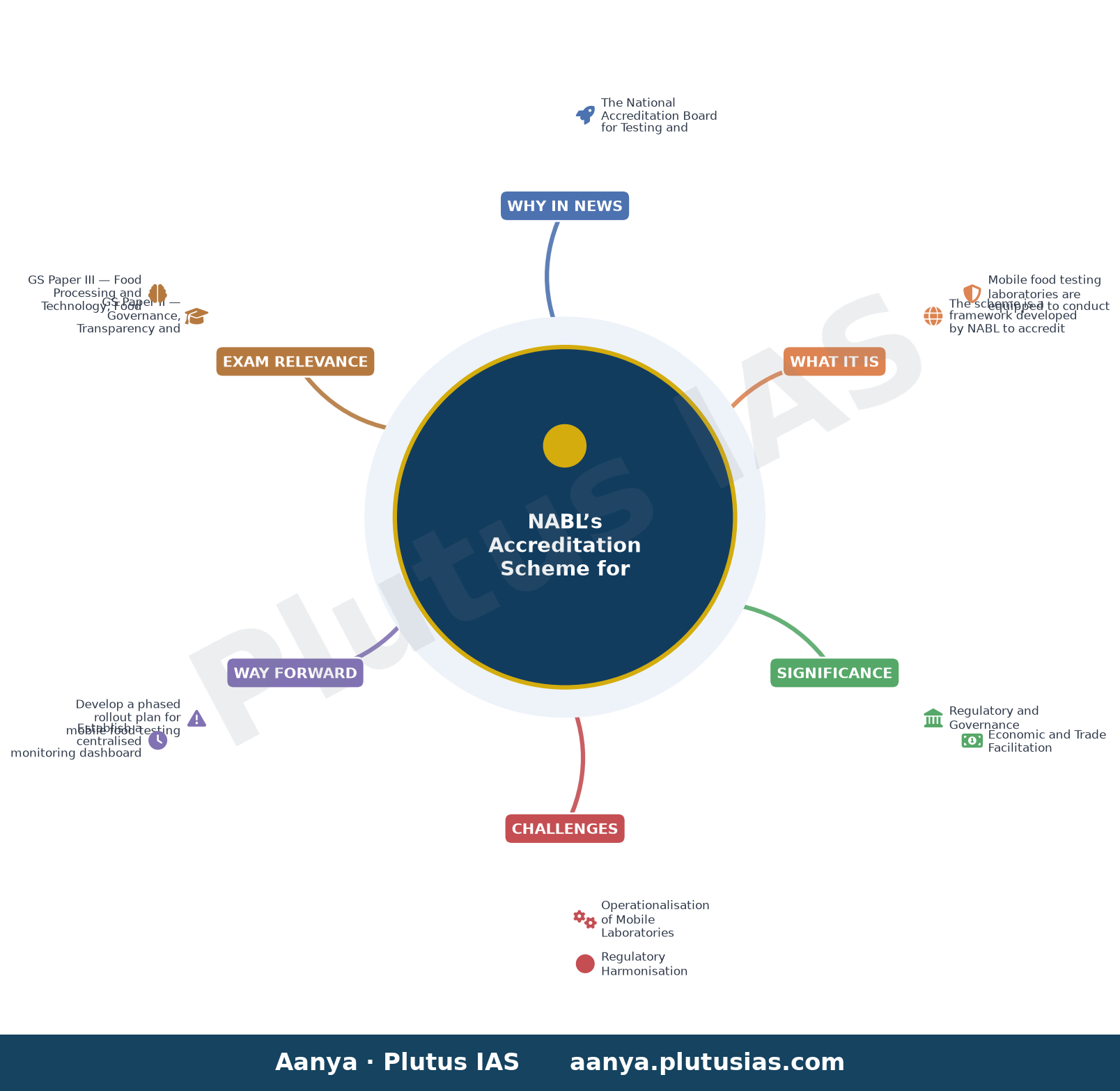
✎ NABL’s accreditation scheme for mobile food testing laboratories ensures on-site, quality-assured food safety assessments, aligning with ISO/IEC 17025 and promoting regulatory convergence under the Integrated Assessment Framework…
Subject Relevance — Where This Topic Fits
- GS Paper II — Governance, Transparency and Accountability | GS Paper III — Food Processing and Technology, Food Safety
- Prelims: NABL, Food Safety and Standards Authority of India (FSSAI), ISO/IEC 17025, Quality Council of India (QCI), Mobile Food Testing Laboratories, Accreditation Schemes, Commodity Boards, Department for Promotion of Industry and Internal Trade (DPIIT), Mutual Recognition Agreements (MRAs), Integrated Assessment Framework (IAF)
- Essay: The Role of Accreditation in Building Trust in Public Systems, Innovation in Governance: Leveraging Technology for Public Service Delivery
Quick Revision: NABL’s accreditation scheme for mobile food testing laboratories ensures on-site, quality-assured food safety assessments, aligning with ISO/IEC 17025 and promoting regulatory convergence under the Integrated Assessment Framework (IAF).
Why is this in the news?
The National Accreditation Board for Testing and Calibration Laboratories (NABL), a constituent board of the Quality Council of India (QCI), launched India’s first accreditation scheme for mobile food testing laboratories. This initiative aims to enhance food safety monitoring, improve access to quality testing services, and foster regulatory convergence through multilateral Memoranda of Understanding (MoUs) under the Integrated Assessment Framework (IAF). The scheme is significant for its potential to integrate quality assurance in the food supply chain and strengthen consumer confidence.
Background
- Food safety is a critical public health concern in India, governed by the Food Safety and Standards Act, 2006, and regulated by the Food Safety and Standards Authority of India (FSSAI).
- Traditional static food testing laboratories face limitations in reaching remote and rural communities, necessitating innovative solutions like mobile testing units.
- The Integrated Assessment Framework (IAF) is a collaborative initiative to harmonise regulatory processes, reduce duplication in assessments, and promote mutual recognition among accreditation bodies.
- India’s food processing sector is a key driver of economic growth, contributing to employment, exports, and rural development, but requires robust quality infrastructure to meet global standards.
- The initiative aligns with the government’s vision of achieving a ‘Viksit Bharat’ by 2047, emphasising quality-driven practices across sectors.
What is the NABL Accreditation Scheme for Mobile Food Testing Laboratories?
- The scheme is a framework developed by NABL to accredit mobile food testing laboratories, ensuring they meet international standards such as ISO/IEC 17025 for competence in testing and calibration.
- Mobile food testing laboratories are equipped to conduct on-site food safety assessments, reducing the need for sample transportation and enabling faster regulatory interventions.
- Accreditation under this scheme validates the technical competence of mobile laboratories, ensuring reliability, accuracy, and compliance with regulatory requirements.
- The scheme aims to expand the reach of quality-assured food testing services to underserved communities, particularly in rural and remote areas, thereby enhancing food safety monitoring.
- It promotes regulatory convergence by aligning with the Integrated Assessment Framework (IAF), facilitating mutual recognition of test results among participating bodies.
- The scheme is expected to improve business ease by reducing duplication in testing processes, streamlining compliance, and enhancing consumer trust in food products.
Key Features
| Feature | Significance |
|---|---|
| First-of-its-kind accreditation scheme for mobile food testing laboratories | Establishes a formal framework for quality assurance of food testing services delivered at community level, aligning with international standards. |
| Integration with Integrated Assessment Framework (IAF) | Facilitates coordinated regulatory oversight, reduces duplication in assessment processes, and promotes mutual recognition among accreditation bodies. |
| Multi-lateral Memorandum of Understanding (MoU) exchange | Strengthens regulatory convergence, harmonises standards, and builds trust among stakeholders in the quality infrastructure ecosystem. |
| Focus on community proximity | Enables rapid deployment of accredited testing services in remote or underserved areas, enhancing food safety surveillance and consumer protection. |
| Emphasis on international standards compliance | Ensures that accredited mobile laboratories meet ISO/IEC 17025 and related criteria, fostering global equivalence and trade facilitation. |
Why it Matters
Regulatory and Governance
- Introduces a structured accreditation mechanism for mobile food testing laboratories, enhancing the credibility and reliability of food safety monitoring systems.
- Promotes regulatory convergence through the Integrated Assessment Framework (IAF), reducing fragmentation in compliance assessment across jurisdictions.
- Strengthens the National Quality Infrastructure by integrating mobile testing units into the formal accreditation ecosystem.
Economic and Trade Facilitation
- Facilitates compliance with international food safety standards, reducing non-tariff barriers and enhancing India’s export competitiveness in agri-food products.
- Supports the ease of doing business by streamlining conformity assessment processes, thereby reducing time and cost for food businesses.
- Encourages investment in mobile testing infrastructure, creating opportunities for private sector participation in quality assurance services.
Public Health and Consumer Protection
- Expands access to accredited food testing services in rural and peri-urban areas, enabling early detection of contaminants and adulterants.
- Enhances consumer confidence by ensuring that food products in the market meet prescribed safety and quality standards.
- Supports evidence-based regulatory interventions, reducing the risk of foodborne illnesses and public health emergencies.
Institutional Collaboration
- Demonstrates the role of the Quality Council of India (QCI) and its constituent boards (NABL) in strengthening the national quality ecosystem.
- Fosters multi-stakeholder partnerships among regulators, accreditation bodies, and commodity boards to achieve harmonised quality outcomes.
- Serves as a model for extending accredited testing services to other sectors (e.g., water, air, pharmaceuticals) through mobile units.
Challenges
1. Operationalisation of Mobile Laboratories
- Ensuring consistent calibration and maintenance of mobile testing units across diverse geographical and climatic conditions.
- Managing logistical challenges such as transportation, power supply, and connectivity in remote areas.
- Training and capacity-building of personnel for operating accredited mobile food testing laboratories.
UPSC Link: GS-III: Science & Tech (Quality Infrastructure)
2. Regulatory Harmonisation
- Aligning state-level food safety regulations with the Integrated Assessment Framework (IAF) to avoid conflicts and duplication.
- Ensuring seamless coordination between central and state authorities for accreditation and enforcement.
- Addressing discrepancies in interpretation of standards across different regulatory bodies.
UPSC Link: GS-II: Governance (Regulatory Convergence)
3. Resource Mobilisation
- Securing sustained funding for procurement, operation, and maintenance of mobile testing infrastructure.
- Balancing public and private sector roles to ensure affordability and scalability of the initiative.
- Leveraging technology (e.g., IoT, AI) for real-time data transmission and remote monitoring of testing processes.
UPSC Link: GS-III: Economy (Public-Private Partnerships)
4. Public Awareness and Trust
- Educating stakeholders (farmers, traders, consumers) about the benefits and credibility of accredited mobile testing services.
- Addressing scepticism or resistance to adoption due to unfamiliarity with the accreditation process.
- Ensuring transparency in reporting and dissemination of test results to build public confidence.
UPSC Link: GS-II: Governance (Citizen Engagement)
Challenges — UPSC Perspective
| Issue | Concern |
|---|---|
| Standardisation across regions | Variations in state-level food safety norms may hinder uniform accreditation and testing outcomes. |
| High initial capital expenditure | Cost of procuring mobile labs, equipment, and technology may pose financial constraints. |
| Skilled workforce shortage | Limited availability of trained personnel for operating sophisticated testing equipment in mobile units. |
| Data security and integrity | Risk of tampering or loss of test data during transit or storage in remote locations. |
| Inter-agency coordination gaps | Potential delays or inefficiencies due to lack of synchronisation between NABL, FSSAI, and state authorities. |
Way Forward
- Develop a phased rollout plan for mobile food testing laboratories, prioritising high-risk areas and export hubs.
- Establish a centralised monitoring dashboard to track the performance, utilisation, and compliance of mobile labs in real time.
- Conduct capacity-building programmes for state food safety officers, lab technicians, and accreditation auditors.
- Strengthen the Integrated Assessment Framework (IAF) by integrating it with the FSSAI’s compliance monitoring system.
- Promote public-private partnerships to share costs and leverage private sector expertise in mobile lab operations.
- Launch awareness campaigns to educate stakeholders about the accreditation process and its benefits for food safety.
- Explore the use of blockchain for tamper-proof data recording and transparent reporting of test results.
- Collaborate with international accreditation bodies (e.g., ILAC, APAC) to ensure global recognition of mobile lab certifications.
UPSC Value Addition
Keywords for Mains Answer-Writing
National Accreditation Board for Testing and Calibration Laboratories (NABL) · Food Safety and Standards Authority of India (FSSAI) · Mobile food testing laboratories · Quality infrastructure · Mutual Recognition Agreements (MRAs) · Conformity Assessment · Food Safety Act, 2006 · International Organization for Standardization (ISO/IEC 17025) · Quality Council of India (QCI) · Integrated Assessment Framework (IAF) · Regulatory convergence · Consumer confidence in food safety
Concept Flow
Food safety surveillance gaps in remote areas → Recognition of need for decentralised testing → Development of mobile food testing laboratories → Accreditation by NABL under IAF → Regulatory convergence via MoUs → Enhanced consumer trust and export competitiveness → Strengthened national quality infrastructure.
Prelims Practice Questions
Q1. Consider the following statements regarding the National Accreditation Board for Testing and Calibration Laboratories (NABL):
1. NABL is a constituent board of the Quality Council of India (QCI).
2. NABL provides accreditation for mobile food testing laboratories under ISO/IEC 17025 standards.
3. NABL operates under the administrative control of the Ministry of Health and Family Welfare.
4. NABL’s accreditation is mandatory for all food testing laboratories in India.
How many of the above statements are correct?
- Only one
- Only two
- Only three
- All four
Answer: Only three — Statements 1 and 2 are correct. NABL is indeed a constituent board of QCI and has launched accreditation for mobile food testing laboratories under ISO/IEC 17025. Statement 3 is incorrect as NABL operates under the Department for Promotion of Industry and Internal Trade (DPIIT). Statement 4 is incorrect as NABL’s accreditation is voluntary, not mandatory.
Q2. Assertion (A): The Integrated Assessment Framework (IAF) aims to reduce duplication in conformity assessment processes.
Reason (R): The IAF promotes mutual recognition of conformity assessment results among regulatory authorities.
Select the correct answer using the code below:
- Both A and R are true, and R is the correct explanation of A.
- Both A and R are true, but R is not the correct explanation of A.
- A is true, but R is false.
- A is false, but R is true.
Answer: Both A and R are true, but R is not the correct explanation of A. — Both the Assertion (A) and Reason (R) are true. The Integrated Assessment Framework (IAF) is designed to streamline conformity assessment processes by reducing duplication and promoting mutual recognition of results, thereby enhancing regulatory efficiency.
Q3. Match the following columns:
Column I (Initiatives/Schemes)
A. Mobile Food Testing Laboratories Accreditation
B. Integrated Assessment Framework (IAF)
C. Food Safety and Standards Act, 2006
D. Mutual Recognition Agreements (MRAs)
Column II (Purpose/Objective)
1. Ensures compliance with food safety standards through accredited testing
2. Facilitates harmonization of regulatory practices across jurisdictions
3. Provides a framework for accreditation of testing and calibration laboratories
4. Establishes standards and guidelines for food safety in India
Select the correct match:
- A-1, B-2, C-4, D-3
- A-3, B-2, C-4, D-1
- A-1, B-3, C-4, D-2
- A-2, B-1, C-3, D-4
Answer: A-1, B-2, C-4, D-3 — The correct matches are: A (Mobile Food Testing Laboratories Accreditation) – 1 (Ensures compliance with food safety standards through accredited testing), B (Integrated Assessment Framework) – 2 (Facilitates harmonization of regulatory practices), C (Food Safety and Standards Act, 2006) – 4 (Establishes standards and guidelines for food safety), D (Mutual Recognition Agreements) – 3 (Provides a framework for accreditation of testing and calibration laboratories).
Mains Practice Question
✍ The introduction of India’s first accreditation scheme for mobile food testing laboratories by the National Accreditation Board for Testing and Calibration Laboratories (NABL) represents a significant advancement in the country’s food safety governance. Critically examine the institutional, regulatory, and consumer-centric dimensions of this initiative. Also, assess its potential to strengthen India’s quality infrastructure in alignment with global standards. (15 Marks)
Approach: MODEL-ANSWER SKELETON:
1. **Institutional Dimension (4 Marks)**
– Role of NABL as a constituent board of the Quality Council of India (QCI) and its autonomy under DPIIT.
– Collaboration with FSSAI, commodity boards, and international bodies (e.g., IAF, ISO/IEC 17025).
– Institutional capacity: Accreditation process, technical competence, and quality assurance mechanisms.
– Contrast with traditional static laboratories: Flexibility, reach, and real-time testing.
2. **Regulatory Dimension (5 Marks)**
– Alignment with the Food Safety and Standards Act, 2006: Objectives and gaps addressed by mobile labs.
– Regulatory convergence: How the scheme promotes Mutual Recognition Agreements (MRAs) and reduces duplication (e.g., through IAF).
– Role of DPIIT and QCI in ensuring policy coherence and stakeholder coordination.
– Challenges: Regulatory arbitrage, enforcement gaps, and coordination among states.
3. **Consumer-Centric Dimension (3 Marks)**
– Enhancing consumer confidence: Transparency, accessibility, and timely testing.
– Impact on small businesses and rural communities: Bridging the urban-rural divide in food safety monitoring.
– Limitations: Coverage, affordability, and public awareness.
4. **Global Standards and Quality Infrastructure (3 Marks)**
– Compliance with ISO/IEC 17025: International benchmarks for testing and calibration laboratories.
– Integration with India’s broader quality infrastructure (e.g., BIS, NABL, QCI).
– Potential to position India as a leader in food safety governance in South Asia.
Balance of views:
– Optimistic: Highlight the scheme’s potential to revolutionize food safety monitoring and consumer protection.
– Critical: Address challenges such as scalability, funding, and the need for sustained political will.
Source: PIB (Press Information Bureau)
Generated by AanyaAi for educational purpose.

- KWML’s Feasibility Reports for Water Metro in 18 Cities: UPSC & PCS Insights - October 3, 2026
- ओडिशा में वन्यजीव अनुसंधान अनुदान कार्यक्रम शुरू, सिमिलिपाल में 300 कैमरे और बढ़ेंगे - October 3, 2026
- India Summons Pakistan High Commission Official Over Violation - October 3, 2026

No Comments