


11 Aug RBI Governor Urges Banks to Speed Up AI Adoption with Caution
✎ AI adoption in Indian banking must prioritise explainability, data privacy, and cybersecurity, with RBI’s guidelines mandating human oversight and vendor risk management to mitigate systemic vulnerabilities.
Subject Relevance — Where This Topic Fits
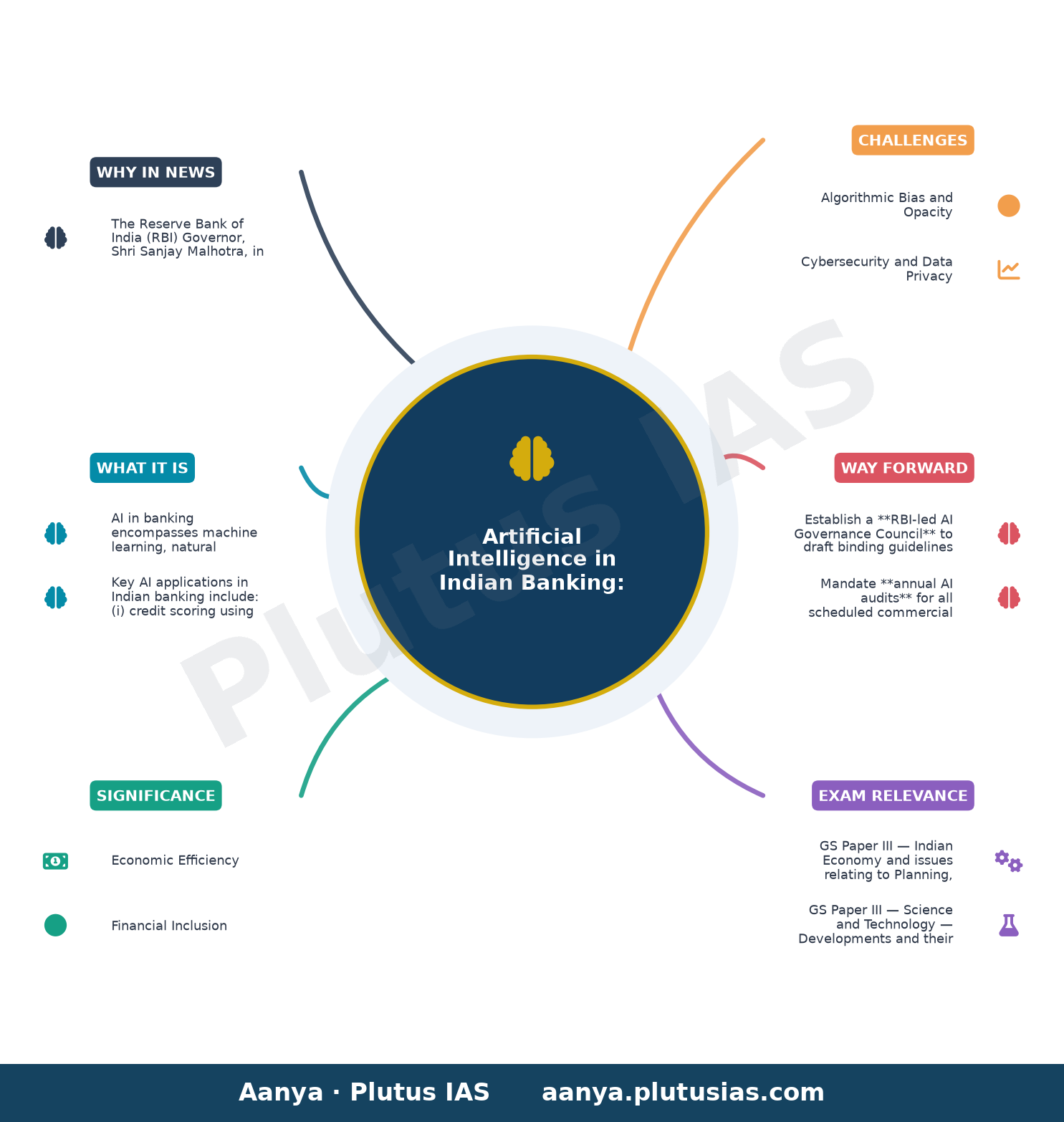
- GS Paper III — Indian Economy and issues relating to Planning, Mobilisation of Resources, Growth, Development and Employment | GS Paper III — Science and Technology — Developments and their Applications and Effects in Everyday Life
- Prelims: Artificial Intelligence (AI), Regulatory Sandbox, Digital Lending, RBI Guidelines on IT Governance, Cybersecurity in Banking, Financial Stability Report, NPA Management, Credit Growth
- Essay: The Role of Technology in Transforming Governance: Opportunities and Ethical Dilemmas, Balancing Innovation and Risk: The Case of AI in Financial Systems
Quick Revision: AI adoption in Indian banking must prioritise explainability, data privacy, and cybersecurity, with RBI’s guidelines mandating human oversight and vendor risk management to mitigate systemic vulnerabilities.
Why is this in the news?
The Reserve Bank of India (RBI) Governor, Shri Sanjay Malhotra, in a public address on 11 August 2026, urged Indian lenders to accelerate investments in artificial intelligence (AI) infrastructure, workforce upskilling, and governance frameworks. While acknowledging AI’s potential to enhance efficiency and customer service in banking, the Governor highlighted critical risks such as algorithmic bias, opacity in decision-making, data privacy breaches, and heightened exposure to cyber threats. His remarks reflect a broader policy concern: the need to balance rapid technological adoption with robust risk mitigation to safeguard financial stability.
Background
- The Indian banking sector has witnessed a surge in AI adoption post-2020, driven by initiatives like the RBI’s Regulatory Sandbox (2020) and the Digital India programme, aimed at improving credit underwriting, fraud detection, and customer personalisation.
- As of 2026, AI-driven solutions such as chatbots, automated loan approvals, and predictive analytics are operational in over 60% of scheduled commercial banks, with public sector banks (PSBs) lagging behind private banks in deployment.
- Global regulatory bodies, including the European Central Bank (ECB) and the US Federal Reserve, have issued guidelines on AI governance in finance, emphasising transparency, explainability, and human oversight.
- India’s digital public infrastructure (DPI), including the Account Aggregator Framework and the Unified Payments Interface (UPI), has created a data-rich environment, increasing both the opportunities and vulnerabilities for AI integration in banking.
Artificial Intelligence in Banking: Strategic Adoption, Risks, and Governance
- AI in banking encompasses machine learning, natural language processing (NLP), and robotic process automation (RPA) to automate routine tasks, enhance credit risk assessment, detect fraud, and personalise customer interactions.
- Key AI applications in Indian banking include: (i) credit scoring using alternative data (e.g., utility payments, GST filings), (ii) chatbots for customer service (e.g., HDFC Bank’s EVA, SBI’s SIA), (iii) real-time fraud detection using anomaly detection algorithms, and (iv) algorithmic trading and portfolio management.
- AI adoption is uneven across the banking sector: private banks (e.g., HDFC Bank, ICICI Bank) lead in deployment, while PSBs face challenges due to legacy IT systems, data silos, and lower digital literacy among staff.
- Regulatory frameworks governing AI in banking include: (i) the Digital Personal Data Protection Act, 2023 (DPDP Act).
- Core risks identified by RBI include: (a) algorithmic bias (e.g., discriminatory lending practices), (b) opacity in AI decision-making (black-box models), (c) data privacy violations under the DPDP Act, (d) third-party vendor risks (e.g., concentration in cloud services), and (e) cyber threats (e.g., adversarial attacks on AI models).
- The RBI’s stance emphasises a ‘risk-based approach’: banks must conduct AI impact assessments, ensure explainability of models, and maintain human oversight for critical decisions (e.g., loan approvals, fraud escalation).
- Global best practices include the EU’s AI Act (2024), which classifies AI systems in finance as ‘high-risk’ and mandates transparency and human oversight, and the US Fed’s SR 11-7 guidance on model risk management.
- The RBI Governor’s remarks align with the broader policy objective of fostering ‘responsible AI’ in finance, balancing innovation with financial stability and consumer protection.
Key Features
| Feature | Significance |
|---|---|
| Accelerated AI Adoption in Banking | Enhances operational efficiency, reduces costs, and improves customer service through automation and data-driven decision-making. |
| AI Governance Framework | Ensures responsible deployment of AI by mandating risk assessment, transparency, and accountability in financial institutions. |
| Cybersecurity Protocols | Strengthens defences against AI-enabled cyber threats, including phishing, deepfake fraud, and system breaches. |
| Vendor Risk Management | Mitigates over-reliance on third-party AI models or vendors to prevent systemic errors and operational failures. |
| Human Oversight Mechanisms | Integrates human review in critical AI-driven processes to prevent biased, opaque, or erroneous outcomes. |
Why it Matters
Economic Efficiency
- AI integration in banking can reduce transaction processing time by up to 40%, improving liquidity management and credit delivery.
- Automated fraud detection systems powered by AI can save the banking sector an estimated ₹5,000–₹7,000 crore annually in fraud-related losses.
- Enhanced risk assessment models improve loan disbursement accuracy, reducing non-performing assets (NPAs) and boosting financial stability.
Financial Inclusion
- AI-driven chatbots and virtual assistants enable 24/7 customer support, particularly benefiting rural and underserved populations.
- Predictive analytics can identify creditworthy borrowers in unbanked segments, expanding access to formal credit.
- Real-time credit scoring using alternative data (e.g., utility payments) can reduce dependency on traditional collateral.
Global Competitiveness
- AI adoption aligns India’s banking sector with global best practices, attracting foreign investment and fostering fintech innovation.
- Resilient AI systems can withstand geopolitical shocks, ensuring continuity in cross-border transactions and trade finance.
- India’s leadership in AI governance (e.g., RBI’s regulatory sandbox) positions it as a model for emerging economies.
Regulatory Leadership
- RBI’s proactive stance on AI regulation sets a precedent for other central banks, particularly in emerging markets.
- A robust AI governance framework can pre-empt systemic risks, ensuring financial stability amid technological disruption.
- Collaboration with international bodies (e.g., BIS, IMF) can harmonise AI standards, reducing regulatory arbitrage.
Challenges
1. Algorithmic Bias and Opacity
- AI models trained on biased historical data may perpetuate discriminatory lending practices, violating the principle of fair access to credit.
- Lack of explainability in AI decisions (e.g., loan rejections) undermines customer trust and regulatory compliance under the RBI’s Fair Practices Code.
- The RBI’s emphasis on transparency necessitates the adoption of interpretable AI (e.g., SHAP values, LIME) and regular audits of models.
UPSC Link: GS3: Technology, GS3: Financial Inclusion
2. Cybersecurity and Data Privacy
- AI systems are vulnerable to adversarial attacks (e.g., data poisoning, model inversion), which can compromise customer data and disrupt operations.
- The Personal Data Protection Bill (PDPB) mandates strict data localisation and consent requirements, adding compliance burdens for banks.
- RBI’s directives on IT governance (e.g., Master Direction on Cyber Resilience) require banks to implement AI-specific cybersecurity measures.
UPSC Link: GS3: Cybersecurity, GS2: Fundamental Rights
3. Vendor and Third-Party Risks
- Over-reliance on a few AI vendors (e.g., cloud providers, fintech partners) creates single points of failure, increasing systemic risk.
- The RBI’s warning on vendor lock-in highlights the need for multi-vendor strategies and open-source alternatives where feasible.
- Contractual safeguards (e.g., SLAs, data ownership clauses) are essential to mitigate risks of vendor negligence or malfeasance.
UPSC Link: GS3: Financial Markets, GS2: Governance
4. Operational and Reputational Risks
- AI-driven errors (e.g., incorrect credit scoring, fraud alerts) can lead to financial losses, regulatory penalties, and reputational damage.
- The RBI’s emphasis on human oversight underscores the need for fallback mechanisms in case of AI system failures.
- Banks must balance automation with manual review in high-stakes decisions (e.g., loan approvals, dispute resolution).
UPSC Link: GS3: Banking Regulation, GS4: Ethics
5. Geopolitical and Trade Uncertainties
- Global supply chain disruptions (e.g., semiconductor shortages) can delay AI infrastructure deployment, particularly for hardware-dependent solutions.
- Trade restrictions on AI chips (e.g., US-China tensions) may limit access to cutting-edge technology for Indian banks.
- RBI’s assessment of geopolitical risks aligns with the need for domestic AI chip manufacturing (e.g., Semicon India Programme).
UPSC Link: GS2: International Relations, GS3: Economic Development
Challenges — UPSC Perspective
| Issue | Concern |
|---|---|
| Bias in Training Data | Perpetuation of historical discrimination in lending and hiring decisions. |
| Explainability Deficit | Inability to justify AI-driven decisions, leading to regulatory and customer disputes. |
| Adversarial Attacks | Manipulation of AI systems to extract sensitive data or trigger erroneous outputs. |
| Vendor Lock-in | Over-dependence on a single AI provider, increasing costs and reducing flexibility. |
| Regulatory Gaps | Lack of harmonised AI governance frameworks across jurisdictions, creating compliance challenges. |
| Skill Gaps | Shortage of AI-literate professionals in banking, hindering effective implementation and oversight. |
Way Forward
- Establish a **RBI-led AI Governance Council** to draft binding guidelines on transparency, accountability, and bias mitigation in banking AI systems.
- Mandate **annual AI audits** for all scheduled commercial banks, covering model performance, data quality, and cybersecurity resilience.
- Promote **open-source AI frameworks** in banking to reduce vendor dependency and foster innovation (e.g., RBI’s regulatory sandbox for AI models).
- Invest in **upskilling programmes** for bank employees, focusing on AI literacy, ethical considerations, and cybersecurity best practices.
- Strengthen **cross-border collaboration** with global regulators (e.g., BIS, FSB) to harmonise AI standards and share threat intelligence.
- Develop **domestic AI chip manufacturing** under the Semicon India Programme to reduce reliance on foreign semiconductor supply chains.
- Implement **real-time threat intelligence sharing** among banks, facilitated by the RBI, to pre-empt AI-enabled cyberattacks.
- Enhance **customer grievance redressal mechanisms** for AI-driven decisions, ensuring transparency and recourse in case of disputes.
UPSC Value Addition
Keywords for Mains Answer-Writing
Artificial Intelligence in banking sector · Reserve Bank of India guidelines on AI adoption · Cybersecurity risks in financial services · Ethical AI frameworks for lenders · AI governance and financial stability · Data privacy in banking technology · Regulatory oversight of AI models · Operational risks in banking technology · AI-driven financial inclusion · Vendors and third-party risks in AI deployment · RBI Governor’s policy address on AI · Systemic risks in AI adoption
Constitutional & Policy Linkages
- Article 14 (Equality before Law) – Ensures non-discriminatory AI-driven lending practices.
- Article 21 (Right to Life and Personal Liberty) – Protects against AI-enabled privacy violations.
Concept Flow
RBI Governor’s directive on AI adoption → → Banks accelerate AI integration for efficiency gains → → Increased reliance on AI models and vendors → → Emergence of risks: bias, opacity, cyber threats → → RBI’s emphasis on governance, oversight, and safeguards → → Need for regulatory frameworks, audits, and human oversight → → Long-term outcome: resilient, inclusive, and competitive banking sector
Prelims Practice Questions
Q1. Consider the following statements regarding the Reserve Bank of India’s (RBI) stance on Artificial Intelligence (AI) in the banking sector:
1. The RBI Governor has urged banks to accelerate AI adoption to enhance efficiency.
2. The RBI has explicitly warned against the risks of biased or opaque AI decisions.
3. The RBI mandates that banks must use only domestically developed AI models to avoid cyber threats.
How many of the above statements are correct?
- Only one
- Only two
- All three
- None
Answer: Only two — Statements 1 and 2 are correct as per the RBI Governor’s address. Statement 3 is incorrect because the RBI has not mandated the use of only domestically developed AI models; it has emphasized caution regarding vendor dependence and third-party risks.
Q2. Assertion (A): The Reserve Bank of India (RBI) has highlighted the need for stronger safeguards and human oversight in the deployment of Artificial Intelligence (AI) by banks.
Reason (R): AI adoption in banking introduces vulnerabilities such as biased decisions, data privacy concerns, and cybersecurity threats.
- Both A and R are true, and R is the correct explanation of A
- Both A and R are true, but R is not the correct explanation of A
- A is true, but R is false
- A is false, but R is true
Answer: Both A and R are true, and R is the correct explanation of A — Both the assertion and reason are true. The RBI’s emphasis on safeguards and human oversight (A) is directly linked to the risks posed by AI adoption (R), including biases, privacy issues, and cyber threats.
Q3. Which of the following is NOT a risk identified by the RBI Governor in the context of AI adoption by banks?
- Biased or opaque decision-making
- Data privacy violations
- Increased operational transparency
- Cybersecurity threats
Answer: Increased operational transparency — The RBI Governor explicitly warned against risks such as biased decisions, data privacy violations, and cybersecurity threats. Increased operational transparency is not a risk but a potential benefit of AI adoption.
Mains Practice Question
✍ Artificial Intelligence (AI) is transforming the banking sector by enhancing efficiency and customer service, but it also introduces significant risks. Critically examine the RBI Governor’s observations on AI adoption by Indian banks, highlighting the regulatory challenges and the balance between innovation and risk mitigation. Also, discuss the role of human oversight in ensuring financial stability. (15 Marks)
Approach: MODEL-ANSWER SKELETON:
1. **Introduction (2 Marks)**
– Define AI in the banking context and its potential benefits (e.g., fraud detection, credit scoring, customer service automation).
– Contextualize RBI Governor Sanjay Malhotra’s remarks on accelerating AI adoption while emphasizing risks.
2. **RBI Governor’s Observations (4 Marks)**
– **Accelerating AI adoption**: Need for investment in technology, infrastructure, and workforce upskilling.
– **Identified risks**: Biased or opaque AI decisions, data privacy concerns, cybersecurity threats, and over-reliance on third-party vendors.
– **Regulatory concerns**: Systemic risks, financial stability, and the dilemma between innovation and safeguards.
3. **Regulatory Challenges (4 Marks)**
– **Governance frameworks**: RBI’s role in setting guidelines for AI adoption (e.g., transparency, accountability, and explainability in AI models).
– **Third-party risks**: Dependence on vendors and potential exposure to errors or cyber threats.
– **Data privacy and cybersecurity**: Compliance with the Digital Personal Data Protection Act, 2023, and RBI’s cybersecurity guidelines.
4. **Human Oversight and Financial Stability (3 Marks)**
– **Role of human oversight**: Ensuring that AI systems are auditable, explainable, and subject to human review to mitigate risks.
– **Principles of responsible AI**: RBI’s emphasis on ‘understanding what is deployed’ and avoiding blind reliance on technology.
– **Financial stability**: How human oversight can prevent systemic risks arising from widespread AI adoption.
5. **Conclusion (2 Marks)**
– Summarize the need for a balanced approach: fostering innovation while mitigating risks through robust governance, oversight, and regulatory frameworks.
– Highlight the RBI’s role in shaping a resilient and ethical AI ecosystem in banking.
Source: Business Standard
Generated by AanyaAi for educational purpose.

- KWML’s Feasibility Reports for Water Metro in 18 Cities: UPSC & PCS Insights - October 3, 2026
- ओडिशा में वन्यजीव अनुसंधान अनुदान कार्यक्रम शुरू, सिमिलिपाल में 300 कैमरे और बढ़ेंगे - October 3, 2026
- India Summons Pakistan High Commission Official Over Violation - October 3, 2026

No Comments