


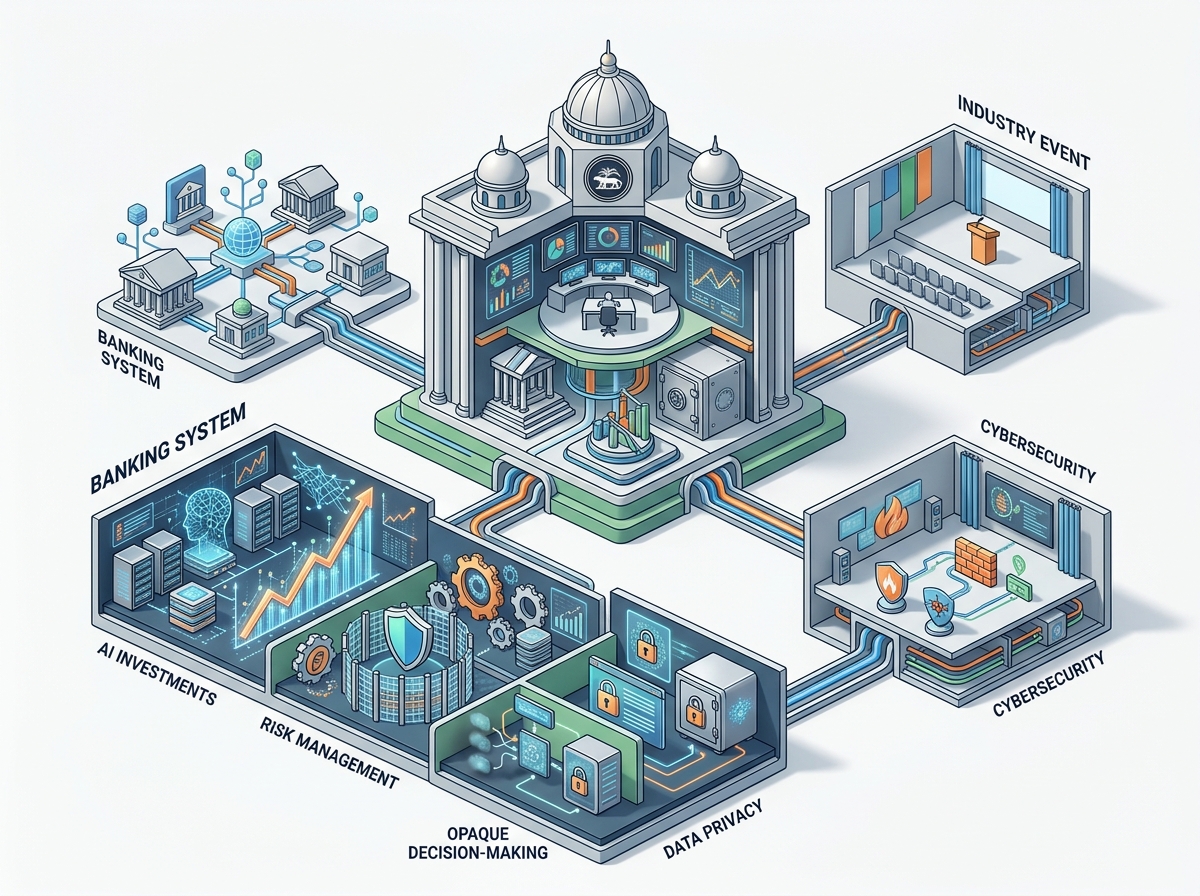
11 Aug RBI Governor Urges Banks to Accelerate AI Adoption with Caution
RBI GovernorIndian banksAI investmentsData privacyCybersecurity systems✎ The RBI Governor’s remarks highlight the dual imperative for Indian banks: accelerate AI adoption to enhance efficiency and competitiveness, while simultaneously embedding robust governance, transparency, and cybersecurity…
Subject Relevance — Where This Topic Fits
- GS Paper III — Science and Technology (Applications of AI) | GS Paper III — Economy (Banking Sector Reforms and Digital Economy) | GS Paper III — Economy (Financial Stability and Risk Management)
- Prelims: Artificial Intelligence (AI), Regulatory Sandbox, RBI Guidelines on IT Systems in Banks, Cybersecurity in Banking, Financial Stability Board (FSB), Basel Committee on Banking Supervision (BCBS), Digital Lending Guidelines, Data Localisation, Reserve Bank of India (RBI), NPCI, UPI, Credit Information Companies (CICs), Fraud Detection in Banking
- Essay: The Dual-Edged Sword of AI: Balancing Innovation with Ethical and Security Imperatives in the Financial Sector, Governance in the Digital Age: The Role of Regulators in Ensuring Stability and Trust in AI-Driven Financial Systems
Quick Revision: The RBI Governor’s remarks highlight the dual imperative for Indian banks: accelerate AI adoption to enhance efficiency and competitiveness, while simultaneously embedding robust governance, transparency, and cybersecurity frameworks to mitigate systemic risks.
Why is this in the news?
The Governor of the Reserve Bank of India (RBI), Shri Sanjay Malhotra, emphasised the urgent need for Indian banks to accelerate investments in artificial intelligence (AI) while simultaneously cautioning against the associated risks of opaque decision-making, data privacy breaches, and cybersecurity vulnerabilities. The remarks were delivered at an industry event in Mumbai and reflect the RBI’s growing focus on ensuring that AI adoption in banking is both strategic and risk-aware, in alignment with global regulatory trends.
Background
- The Reserve Bank of India (RBI) is the central bank and primary regulator of India’s banking sector, responsible for maintaining monetary stability, financial stability, and consumer protection.
- India’s banking sector has witnessed rapid digitisation, with AI applications increasingly deployed in credit underwriting, fraud detection, customer service (e.g., chatbots), risk management, and algorithmic trading.
- The RBI has, in recent years, issued multiple guidelines to strengthen the cybersecurity and IT infrastructure of banks, including the ‘Master Direction on Information Technology Governance, Risk, Controls and Assurance Practices’ (2023) and the ‘Guidelines on Digital Lending’ (2022).
- Global regulatory bodies such as the Financial Stability Board (FSB) and the Basel Committee on Banking Supervision (BCBS) have highlighted AI-related risks, including model risk, third-party dependency, and systemic vulnerabilities, prompting coordinated policy responses.
- The RBI’s Financial Stability Report (2025) underscored the resilience of India’s banking sector despite geopolitical and trade uncertainties, citing robust credit growth, low non-performing assets (NPAs), and strong liquidity buffers.
- The Finance Minister of India, Smt. Nirmala Sitharaman, in April 2026, had warned of ‘unprecedented AI-related risks to banks’ and called for pre-emptive measures to secure IT systems, protect customer data, and enable real-time threat intelligence sharing.
Artificial Intelligence in Banking: Strategic Adoption, Risks, and Regulatory Framework
- Artificial Intelligence (AI) refers to the simulation of human intelligence processes by machines, particularly computer systems, enabling tasks such as learning, reasoning, problem-solving, perception, and decision-making. In banking, AI applications include credit scoring, fraud detection, algorithmic trading, customer relationship management (CRM), and regulatory compliance automation.
- The RBI’s emphasis on AI adoption stems from its potential to enhance operational efficiency, reduce costs, improve customer experience, and strengthen risk management through predictive analytics and automation.
- However, AI adoption in banking introduces significant risks: (a) **Model Risk**: AI models may produce biased, opaque, or inaccurate decisions due to flawed data, algorithmic bias, or lack of interpretability (e.g., ‘black-box’ models). (b) **Data Privacy and Security**: AI systems rely on vast datasets, increasing exposure to data breaches, unauthorised access, and misuse of sensitive customer information.
- c) **Cybersecurity Threats**: AI-powered cyberattacks (e.g., deepfake fraud, synthetic identity theft) and the weaponisation of AI by malicious actors pose existential risks to financial institutions. (d) **Third-Party Dependency**: Over-reliance on a limited number of AI vendors or cloud service providers may create systemic vulnerabilities and operational risks.
- The RBI’s stance aligns with global regulatory trends, including the European Union’s AI Act (2024), which classifies AI systems by risk level, and the US Federal Reserve’s supervisory guidance on model risk management (SR 11-7).
- To mitigate risks, the RBI has advocated for: (i) **Human Oversight**: Ensuring that AI-driven decisions are subject to human review, particularly in high-stakes areas like credit approvals and fraud investigations. (ii) **Transparency and Explainability**: Requiring banks to document AI model inputs, outputs, and decision-making processes to enhance accountability. (iii) **Robust IT Infrastructure**: Investing in secure, scalable, and interoperable systems to support AI deployment while complying with data localisation norms.
- The RBI’s ‘Regulatory Sandbox’ framework allows banks and fintech firms to test AI-based innovations in a controlled environment, enabling regulators to assess their efficacy and risks before full-scale deployment.
- India’s digital public infrastructure (DPI), including the Unified Payments Interface (UPI) and Aadhaar-enabled services, provides a robust foundation for AI adoption in banking, but also necessitates stringent data governance frameworks to prevent misuse.
Key Features
| Feature | Significance |
|---|---|
| Accelerated AI adoption in banking | Enhances operational efficiency, reduces manual errors, and enables real-time decision-making in lending, risk assessment, and customer service. |
| Investment in AI infrastructure | Requires substantial capital expenditure for cloud computing, data centres, and AI platforms, but improves scalability and innovation capacity. |
| Workforce upskilling | Mandates training of employees to handle AI tools, ensuring seamless integration and reducing resistance to technological change. |
| Human oversight in AI deployment | Ensures accountability, reduces bias in automated decisions, and maintains regulatory compliance in financial transactions. |
| Vendor risk management | Demands rigorous evaluation of third-party AI models to prevent over-dependence, errors, and potential systemic vulnerabilities. |
Why it Matters
Financial Stability and Efficiency
- AI integration in banking can significantly reduce transaction costs and processing times, thereby improving the overall efficiency of financial intermediation.
- Enhanced risk modelling through AI can lead to more accurate credit assessments, reducing non-performing assets (NPAs) and improving asset quality.
- Automated fraud detection systems powered by AI can mitigate financial losses due to cyber fraud, a growing concern in digital banking.
Regulatory and Governance Implications
- The Reserve Bank of India’s emphasis on AI governance reflects a proactive approach to managing systemic risks in an increasingly digitised financial sector.
- Regulatory oversight must evolve to address challenges such as algorithmic bias, data privacy, and third-party dependencies in AI systems.
- Centralised frameworks for AI audits and transparency can ensure that banks adhere to ethical and legal standards in AI deployment.
Macroeconomic and Sectoral Resilience
- AI-driven financial services can enhance financial inclusion by enabling faster and more accessible credit for underserved segments.
- The adoption of AI in banking aligns with India’s broader digital transformation agenda, fostering innovation and global competitiveness.
- Robust AI systems can improve the resilience of the banking sector against geopolitical and trade-related shocks, as highlighted by the RBI Governor.
Cybersecurity and Data Governance
- AI systems, while powerful, can also be exploited by malicious actors for sophisticated cyberattacks, necessitating robust cybersecurity frameworks.
- Data privacy concerns arise from the extensive use of customer data in AI models, requiring compliance with regulations such as the Digital Personal Data Protection Act, 2023.
- Banks must implement encryption, access controls, and real-time threat intelligence sharing to safeguard against data breaches.
Challenges
1. Algorithmic Bias and Opaque Decision-Making
- AI models trained on biased historical data can perpetuate discriminatory lending practices, disproportionately affecting marginalised communities.
- Lack of transparency in AI decision-making processes can erode customer trust and lead to regulatory scrutiny.
- Mitigation requires diverse training datasets, regular audits, and explainable AI (XAI) techniques to ensure fairness and accountability.
UPSC Link: GS III: Science & Tech – Ethical AI
2. Data Privacy and Cybersecurity Risks
- Banks handle vast amounts of sensitive customer data, making them prime targets for cyberattacks, including ransomware and phishing schemes.
- Third-party AI vendors may introduce vulnerabilities, necessitating stringent due diligence and contractual safeguards.
- Compliance with data protection laws, such as the Digital Personal Data Protection Act, 2023, is critical to avoid legal and reputational risks.
UPSC Link: GS III: Internal Security – Cyber Threats
3. Vendor Lock-in and Systemic Dependencies
- Over-reliance on a limited number of AI technology providers can create single points of failure, increasing systemic risks.
- Banks must diversify their technology partnerships and maintain in-house capabilities to reduce dependency on external vendors.
- Regulatory guidelines should mandate periodic reviews of third-party AI systems to ensure resilience and adaptability.
UPSC Link: GS III: Economy – Financial Sector Reforms
4. Workforce Displacement and Skill Gaps
- AI adoption may lead to job displacement in traditional banking roles, necessitating reskilling and upskilling initiatives.
- The banking sector faces a shortage of professionals with expertise in AI, machine learning, and data science, requiring collaboration with educational institutions.
- Inclusive workforce policies must be implemented to ensure equitable access to AI-driven career opportunities.
UPSC Link: GS II: Social Justice – Skill Development
5. Regulatory and Compliance Challenges
- Existing regulatory frameworks may not fully address the unique risks posed by AI in banking, necessitating updates to guidelines.
- Banks must balance innovation with compliance, ensuring that AI deployments adhere to prudential norms and consumer protection laws.
- International coordination is required to address cross-border AI-related risks, particularly in the context of global financial stability.
UPSC Link: GS III: Economy – Financial Regulation
Challenges — UPSC Perspective
| Issue | Concern |
|---|---|
| Algorithmic Bias | Risk of perpetuating discriminatory lending practices due to biased training data. |
| Data Privacy | Exposure of sensitive customer data to cyber threats and unauthorised access. |
| Vendor Dependence | Over-reliance on third-party AI models leading to systemic vulnerabilities. |
| Cybersecurity Threats | Increased risk of sophisticated cyberattacks exploiting AI systems. |
| Regulatory Gaps | Lack of comprehensive frameworks to govern AI deployment in banking. |
| Workforce Displacement | Potential job losses in traditional banking roles due to automation. |
Way Forward
- Banks should establish dedicated AI governance committees to oversee deployment, audits, and compliance with ethical standards.
- Regulatory authorities must develop clear guidelines for AI use in banking, including mandatory bias audits and transparency requirements.
- Enhance cybersecurity infrastructure by investing in AI-driven threat detection, encryption, and real-time monitoring systems.
- Promote public-private partnerships to bridge the skill gap in AI and data science, ensuring a steady pipeline of talent for the banking sector.
- Encourage banks to diversify their AI technology partners to avoid vendor lock-in and reduce systemic risks.
- Strengthen data protection frameworks by ensuring compliance with the Digital Personal Data Protection Act, 2023, and other relevant regulations.
- Foster innovation through sandboxes and pilot projects to test AI applications in a controlled environment before large-scale deployment.
- Implement continuous training programs for banking professionals to adapt to AI-driven workflows and maintain operational efficiency.
UPSC Value Addition
Keywords for Mains Answer-Writing
Artificial Intelligence in Banking · Regulatory Oversight of AI in Financial Sector · Cybersecurity Risks in Digital Banking · Data Privacy in Financial Services · Responsible AI Deployment in Finance · RBI Guidelines on AI Adoption · Bias and Opaqueness in AI Models · Financial Stability and Technological Risks · Human Oversight in AI Systems · Digital Transformation of Indian Banking · RBI Governor Sanjay Malhotra’s Address on AI · AI Governance and Regulatory Safeguards · Third-Party Risks in AI Adoption · Cyber Threats to Financial Institutions · AI-Driven Efficiency in Lending
Concept Flow
RBI Governor’s call for AI adoption in banking → → Banks invest in AI infrastructure and upskill workforce → → Increased efficiency and risk management in financial services → → Emergence of new vulnerabilities (cybersecurity, bias, vendor dependence) → → Need for robust regulatory oversight and human oversight → → Development of AI governance frameworks and compliance mechanisms → → Enhanced financial stability and systemic resilience
Prelims Practice Questions
Q1. Consider the following statements regarding the Reserve Bank of India’s (RBI) stance on Artificial Intelligence (AI) in the banking sector:
1. The RBI Governor has urged lenders to accelerate AI adoption to enhance efficiency and customer service.
2. The RBI has warned against the risks of biased or opaque AI decisions in banking operations.
3. The RBI mandates that banks must completely phase out third-party AI models by 2027.
4. The RBI has highlighted cybersecurity threats as a critical risk associated with widespread AI use in banking.
How many of the above statements are correct?
- Only one
- Only two
- Only three
- All four
Answer: Only three — Statements 1, 2, and 4 are correct as per the RBI Governor’s address. Statement 3 is incorrect; the RBI has not mandated a phase-out of third-party AI models but has cautioned against over-dependence on them.
Q2. Assertion (A): The Reserve Bank of India (RBI) has emphasized the need for human oversight in the deployment of AI systems by banks.
Reason (R): AI systems in banking are prone to biases, opaqueness, and cybersecurity vulnerabilities, which can undermine financial stability.
In the context of the above two statements, which one of the following is correct?
- Both A and R are true, and R is the correct explanation of A.
- Both A and R are true, but R is not the correct explanation of A.
- A is true, but R is false.
- A is false, but R is true.
Answer: Both A and R are true, and R is the correct explanation of A. — Both the assertion and reason are true. The RBI Governor has explicitly warned against biases, opaqueness, and cybersecurity risks in AI systems, necessitating human oversight to mitigate these vulnerabilities.
Q3. Match the following risks associated with AI adoption in banking with their respective descriptions:
Column I
A. Bias in AI decisions
B. Opaqueness in AI models
C. Cybersecurity threats
D. Third-party vendor risks
Column II
1. Difficulty in interpreting how AI models arrive at decisions, leading to lack of transparency
2. Exposure to errors or failures due to reliance on external technology providers
3. Algorithmic decisions that disproportionately affect certain customer groups
4. Increased vulnerability to cyberattacks targeting AI-driven financial systems
Select the correct match:
- A-3, B-1, C-4, D-2
- A-1, B-3, C-2, D-4
- A-4, B-2, C-1, D-3
- A-2, B-4, C-3, D-1
Answer: A-3, B-1, C-4, D-2 — The correct matches are: A-3 (Bias in AI decisions), B-1 (Opaqueness in AI models), C-4 (Cybersecurity threats), and D-2 (Third-party vendor risks).
Mains Practice Question
✍ The Reserve Bank of India (RBI) has recently underscored the dual imperative of accelerating Artificial Intelligence (AI) adoption in the banking sector while simultaneously addressing its associated risks. Critically analyse the rationale behind this dual approach, with reference to the governance mechanisms required to ensure responsible AI deployment in Indian banks. (15 Marks)
Approach: MODEL-ANSWER SKELETON:
1. **Introduction (2 Marks)**
– Briefly define AI in banking and its significance for efficiency, customer service, and innovation.
– Mention RBI Governor Sanjay Malhotra’s recent address urging banks to accelerate AI adoption while acknowledging risks.
2. **Rationale for Accelerating AI Adoption (4 Marks)**
– **Operational Efficiency**: AI-driven automation in loan processing, fraud detection, and customer service (e.g., chatbots, credit scoring).
– **Enhanced Customer Experience**: Personalised financial products, real-time analytics, and predictive banking.
– **Competitive Advantage**: Banks leveraging AI to differentiate services and reduce costs.
– **Regulatory Support**: RBI’s push for digital transformation in line with global trends (e.g., Basel III, G20 principles on AI governance).
3. **Associated Risks and RBI’s Concerns (4 Marks)**
– **Bias and Opaqueness**: AI models may perpetuate historical biases in lending, leading to discriminatory outcomes (e.g., gender or caste bias in credit approvals).
– **Cybersecurity Threats**: Increased attack surface for cybercriminals targeting AI systems (e.g., adversarial attacks on fraud detection models).
– **Third-Party Risks**: Over-reliance on external vendors for AI models may expose banks to operational failures or data breaches.
– **Financial Stability**: Systemic risks from widespread AI adoption, such as cascading failures due to model errors or market manipulations.
4. **Governance Mechanisms for Responsible AI (4 Marks)**
– **Regulatory Frameworks**: RBI’s guidelines on AI governance, including principles for transparency, accountability, and human oversight (e.g., akin to the EU AI Act or NIST AI Risk Management Framework).
– **Internal Controls**: Banks must establish AI ethics committees, conduct regular audits, and ensure explainability of AI decisions (e.g., using SHAP/LIME techniques).
– **Data Governance**: Strict adherence to data privacy laws (e.g., DPDP Act 2023) and RBI’s data localisation norms to mitigate privacy risks.
– **Human-in-the-Loop**: Mandating human oversight for high-stakes decisions (e.g., loan approvals, fraud investigations) to mitigate opaqueness and bias.
– **Collaborative Ecosystems**: Partnerships with academia, fintech firms, and global standard-setting bodies (e.g., BIS, World Bank) to develop best practices.
5. **Conclusion (1 Mark)**
– Reiterate the need for a balanced approach: leveraging AI’s benefits while mitigating risks through robust governance.
– Emphasise the RBI’s role as a facilitator and regulator to ensure a stable and inclusive financial ecosystem.
Source: Business Standard
Generated by AanyaAi for educational purpose.

- KWML’s Feasibility Reports for Water Metro in 18 Cities: UPSC & PCS Insights - October 3, 2026
- ओडिशा में वन्यजीव अनुसंधान अनुदान कार्यक्रम शुरू, सिमिलिपाल में 300 कैमरे और बढ़ेंगे - October 3, 2026
- India Summons Pakistan High Commission Official Over Violation - October 3, 2026

No Comments