


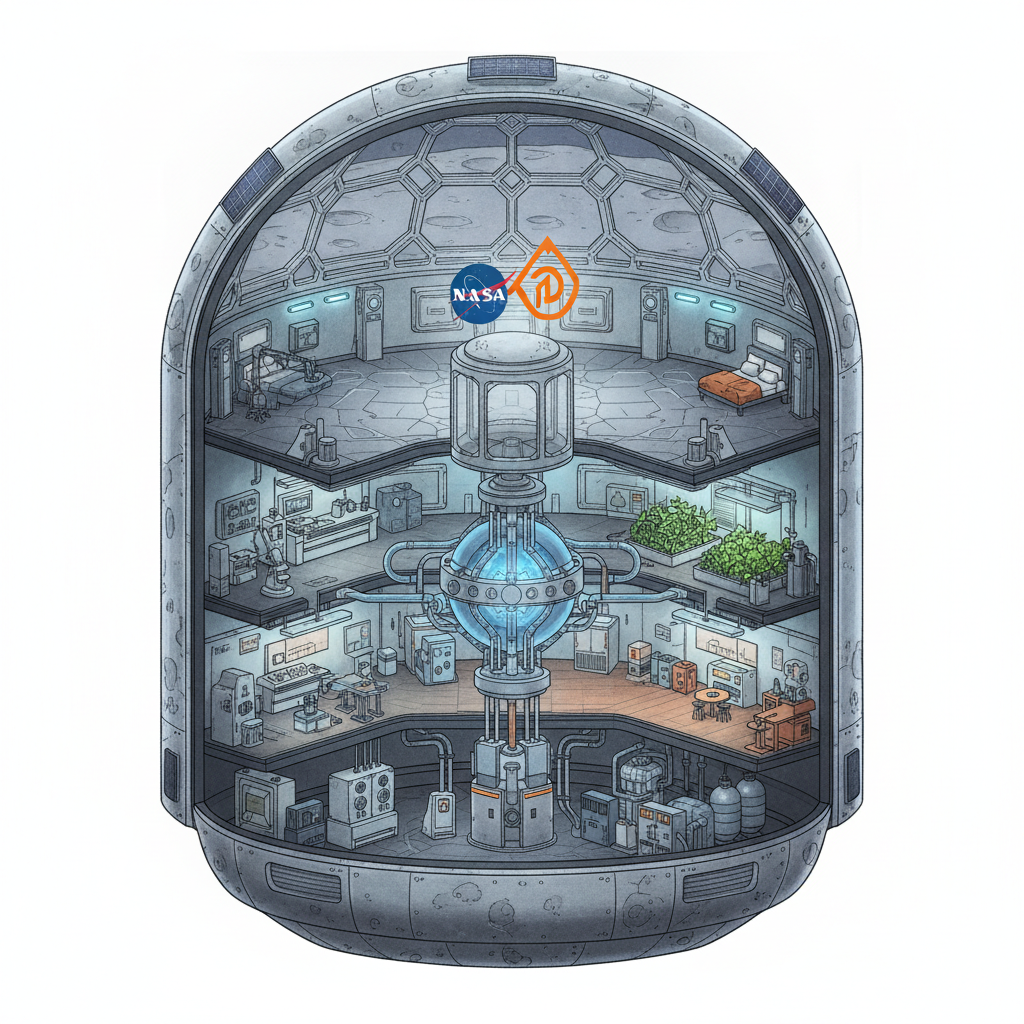
11 Aug NASA Invites ISRO to Join Moon Base Programme: UPSC & State PCS Analysis
✎ NASA's Moon Base programme is a collaborative, multi-phase initiative to establish a sustainable human presence on the lunar South Pole, with India's participation poised to strengthen both nations' space exploration capabilities…
Subject Relevance — Where This Topic Fits
- GS Paper II — International Relations | GS Paper III — Science and Technology
- Prelims: Artemis Accords, ISRO-NASA collaboration, Lunar South Pole, NISAR mission, UN COPUOS, Artemis programme
- Essay: Technological collaboration in space exploration as a catalyst for global scientific progress
Quick Revision: NASA’s Moon Base programme is a collaborative, multi-phase initiative to establish a sustainable human presence on the lunar South Pole, with India’s participation poised to strengthen both nations’ space exploration capabilities under the Artemis Accords framework.
Why is this in the news?
The invitation extended by NASA to ISRO to join its Moon Base programme marks a significant milestone in India-U.S. space cooperation. This development underscores the growing strategic partnership in civil space activities, particularly in lunar exploration, and aligns with India’s expanding role in global space governance. The formal offer was made during the ninth meeting of the India-U.S. Civil Space Joint Working Group in Bengaluru, reflecting a deepening collaboration under the Artemis Accords and the U.S.-India TRUST Initiative.
Background
- The India-U.S. space partnership has evolved from initial cooperation in satellite launches to joint missions and now to collaborative lunar exploration.
- The Artemis Accords, a multilateral agreement led by NASA, aim to establish norms for sustainable and peaceful exploration of the Moon, Mars, and beyond, with 40+ signatory nations as of 2026.
- India formally joined the Artemis Accords in June 2023, signalling its commitment to international lunar exploration frameworks.
- The U.S.-India TRUST Initiative, launched in 2025, seeks to enhance strategic technology collaboration, including space science and human spaceflight.
- The NISAR mission, a joint NASA-ISRO Earth observation satellite, exemplifies the technical synergy between the two agencies and serves as a precursor to deeper lunar cooperation.
What is NASA’s Moon Base Programme?
- The lunar South Pole is targeted due to the presence of permanently shadowed regions containing water ice, which is critical for life support and fuel production.
- The programme emphasises international collaboration, with NASA inviting space agencies from allied nations, including ISRO, to contribute to its objectives.
- Key components include lunar landers, habitats, power systems, and in-situ resource utilisation technologies, many of which will be developed through public-private partnerships.
- The programme aligns with the Artemis Accords, which provide a legal and ethical framework for cooperative lunar exploration, including data sharing, transparency, and resource utilisation guidelines.
- India’s participation would enhance the programme’s scientific and technological robustness, given ISRO’s expertise in cost-effective space missions and lunar exploration (e.g., Chandrayaan missions).
- The collaboration is expected to advance India’s capabilities in human spaceflight, lunar science, and deep-space exploration while contributing to global efforts for sustainable space exploration.
Key Features
| Feature | Significance |
|---|---|
| Collaborative Moon Base Programme | Represents a pioneering international effort to establish humanity’s first permanent outpost on the lunar South Pole, leveraging shared technological and scientific expertise. |
| Artemis Accords Framework | Provides a structured legal and policy foundation for international cooperation in lunar and deep-space missions, ensuring alignment with principles of peaceful exploration and resource utilisation. |
| NISAR Mission Precedent | Demonstrates the operational feasibility of joint Indo-U.S. space missions, particularly in Earth observation and synthetic aperture radar technologies, which can be scaled for lunar applications. |
| TRUST Initiative Alignment | Facilitates strategic technology collaboration under a bilateral framework, reinforcing the geopolitical and scientific synergy between India and the United States in space exploration. |
| UN COPUOS Guidelines Integration | Ensures adherence to global norms for the sustainable utilisation of outer space, addressing concerns such as debris mitigation and equitable resource distribution. |
Why it Matters
Strategic and Geopolitical
- Enhances India’s standing as a key player in global space exploration, aligning with its long-term goal of achieving self-reliance (Atmanirbhar Bharat) in critical technologies.
- Strengthens the Indo-U.S. strategic partnership, particularly in high-technology sectors, which may influence broader bilateral agreements in defence, commerce, and climate science.
- Positions India to influence the governance of lunar resources, ensuring equitable access and preventing monopolistic practices by dominant space-faring nations.
- Demonstrates India’s capability to contribute to multi-national space missions, thereby elevating its diplomatic leverage in international forums such as the UN and COPUOS.
Scientific and Technological
- Provides ISRO access to advanced lunar habitat technologies, including life-support systems, radiation shielding, and in-situ resource utilisation (ISRU) techniques.
- Enables joint research in lunar geology, exobiology, and planetary science, contributing to India’s existing expertise in remote sensing and robotic exploration.
- Facilitates technology transfer and capacity-building, particularly in areas like cryogenic propulsion, autonomous navigation, and long-duration human spaceflight.
- Supports ISRO’s future missions, such as the Gaganyaan programme and Chandrayaan-4, by integrating lunar infrastructure into India’s space exploration roadmap.
Economic
- Opens avenues for private sector participation in space technology, fostering innovation and job creation in India’s burgeoning space economy.
- Potential for commercial utilisation of lunar resources (e.g., helium-3, water ice) through collaborative ventures, aligning with India’s push for a space-based blue economy.
- Encourages investment in India’s space sector, including startups and research institutions, by positioning the country as a hub for lunar and deep-space missions.
Institutional and Governance
- Reinforces the role of international cooperation in addressing the challenges of space exploration, particularly in mitigating risks such as space debris and orbital congestion.
- Provides a model for future Indo-U.S. collaborations in space, which could extend to Mars missions, asteroid mining, and interplanetary habitats.
- Highlights the importance of multilateral frameworks (e.g., Artemis Accords, COPUOS) in regulating space activities and ensuring equitable benefits for all nations.
Challenges
1. Technological and Operational Challenges
- Development of life-support systems capable of sustaining human presence on the Moon for extended periods, including radiation protection and closed-loop environmental control.
- Integration of diverse technological standards between ISRO and NASA, necessitating harmonisation of protocols for habitat construction, power generation, and communication.
- Ensuring the reliability of autonomous systems for lunar operations, given the harsh environmental conditions and the absence of real-time human intervention.
- Addressing the logistical challenges of transporting heavy payloads to the lunar surface, which may require advancements in heavy-lift launch capabilities.
UPSC Link: GS Paper 3: Science & Technology
2. Policy and Legal Constraints
- Navigating the legal ambiguities surrounding the extraction and utilisation of lunar resources, particularly under the Outer Space Treaty and the Artemis Accords.
- Ensuring compliance with international space law, including the principles of non-appropriation and peaceful use, while participating in a programme led by a single nation.
- Balancing bilateral cooperation with multilateral obligations, particularly in the context of India’s commitments to the UN COPUOS and other global space governance bodies.
- Addressing intellectual property rights and data-sharing protocols to ensure equitable access to scientific findings and technological innovations.
UPSC Link: GS Paper 2: International Relations
3. Financial and Resource Allocation
- Securing adequate funding for India’s participation in the Moon Base programme, which may require reallocation of resources from other ISRO projects or increased budgetary allocations.
- Managing the economic risks associated with long-term investments in space technology, including the potential for cost overruns and delays.
- Ensuring that the benefits of the collaboration are distributed equitably across India’s space sector, including public institutions, private enterprises, and academia.
- Balancing the programme’s priorities with India’s domestic space missions, such as Gaganyaan and Chandrayaan, to avoid resource dilution.
UPSC Link: GS Paper 3: Economic Development
4. Geopolitical and Diplomatic Considerations
- Mitigating potential concerns from other space-faring nations about the Indo-U.S. collaboration, particularly regarding the militarisation of space and technology transfer restrictions.
- Ensuring that India’s participation does not compromise its strategic autonomy or align it too closely with one geopolitical bloc, particularly in the context of rising global tensions.
- Addressing the implications of the programme’s leadership by NASA, which may raise questions about India’s role in decision-making and governance structures.
- Managing public perception and expectations, particularly in light of the programme’s long-term timeline and the uncertainties surrounding its success.
UPSC Link: GS Paper 2: International Relations
5. Ethical and Environmental Concerns
- Minimising the environmental impact of lunar activities, including the potential contamination of pristine lunar environments and the generation of space debris.
- Ensuring that the programme adheres to ethical standards in space exploration, particularly in the context of human presence on celestial bodies and the potential for extraterrestrial life.
- Addressing the ethical implications of resource extraction on the Moon, including the equitable distribution of benefits and the prevention of exploitation by dominant nations.
UPSC Link: GS Paper 4: Ethics
Challenges — UPSC Perspective
| Issue | Concern |
|---|---|
| Technological Integration | Harmonisation of ISRO-NASA systems for lunar habitat construction and operations. |
| Resource Governance | Ambiguities in the legal framework governing lunar resource utilisation under the Artemis Accords. |
| Budgetary Constraints | Potential diversion of funds from domestic space missions to the Moon Base programme. |
| Geopolitical Alignment | Balancing India’s strategic autonomy with participation in a U.S.-led initiative. |
| Ethical Compliance | Ensuring adherence to international norms on peaceful and sustainable space exploration. |
Way Forward
- Constitute a dedicated inter-ministerial task force under the Department of Space to oversee India’s participation in the Moon Base programme, ensuring alignment with national priorities.
- Accelerate indigenous development of critical technologies, such as life-support systems and lunar habitat modules, to reduce dependence on foreign partners.
- Engage with the Artemis Accords’ signatory nations to advocate for a multilateral governance framework for lunar resource utilisation, ensuring India’s equitable access.
- Strengthen public-private partnerships to mobilise additional funding and expertise for the programme, leveraging India’s growing space economy.
- Enhance India’s diplomatic outreach to non-Artemis nations to mitigate geopolitical concerns and build a broader coalition for collaborative space exploration.
- Invest in advanced research in lunar geology and exobiology to position India as a leader in scientific contributions to the Moon Base programme.
- Develop a phased roadmap for India’s involvement, prioritising low-risk, high-impact contributions such as data-sharing and robotic missions before human participation.
- Establish a robust monitoring and evaluation mechanism to assess the programme’s progress, risks, and benefits, ensuring transparency and accountability.
UPSC Value Addition
Keywords for Mains Answer-Writing
Artemis Accords · NASA-ISRO collaboration · Moon Base programme · Lunar South Pole exploration · India-U.S. Civil Space Joint Working Group · Artemis programme · United Nations Committee on the Peaceful Uses of Outer Space (COPUOS) · Long-term sustainability of outer space activities · NISAR mission · U.S.-India TRUST Initiative · International space cooperation · Human spaceflight technology · Scientific data sharing in space
Concept Flow
NASA’s Moon Base programme announcement → Formal invitation to ISRO during India-U.S. Civil Space Joint Working Group meeting → Assessment of collaboration feasibility by ISRO and government of India. → Artemis Accords as the legal framework → India’s accession to the Accords → Alignment with UN COPUOS guidelines on sustainable space activities. → Technological integration between ISRO and NASA → Joint development of lunar habitat systems and life-support technologies → Potential spin-offs for India’s Gaganyaan and Chandrayaan missions. → Geopolitical implications of Indo-U.S. collaboration → Balancing strategic autonomy with participation in a U.S.-led initiative → Diplomatic outreach to mitigate concerns from other space-faring nations. → Economic considerations → Budgetary allocations for the programme → Public-private partnerships to mobilise resources and expertise. → Long-term sustainability of the Moon Base programme → Adherence to international norms on resource utilisation and environmental protection → Ethical governance of lunar exploration.
Prelims Practice Questions
Q1. Consider the following statements regarding the Artemis Accords:
1. The Artemis Accords are a set of principles guiding international cooperation in lunar exploration.
2. India is a signatory to the Artemis Accords.
3. The Accords aim to establish a sustainable presence on the Moon.
4. The Artemis programme is exclusively led by NASA without international collaboration.
How many of the above statements are correct?
- Only one
- Only two
- Only three
- All
Answer: Only three — Statements 1, 2, and 3 are correct as the Artemis Accords outline principles for lunar exploration, India is a signatory, and the programme aims for sustainability. Statement 4 is incorrect as the programme encourages international collaboration.
Q2. Assertion (A): The United Nations Committee on the Peaceful Uses of Outer Space (COPUOS) is responsible for ensuring the long-term sustainability of outer space activities.
Reason (R): COPUOS formulates guidelines and treaties to prevent the militarisation of space and promote peaceful uses of outer space.
Options:
A. Both A and R are true, and R is the correct explanation of A.
B. Both A and R are true, but R is not the correct explanation of A.
C. A is true, but R is false.
D. A is false, but R is true.
Answer: ? — Both Assertion (A) and Reason (R) are true. COPUOS does ensure long-term sustainability of outer space activities, and it formulates guidelines and treaties to prevent militarisation and promote peaceful uses of space. R correctly explains A.
Q3. Match the following missions with their respective space agencies:
Column I
1. NISAR mission
2. Artemis programme
3. Chandrayaan-3
4. Mars Orbiter Mission
Column II
A. ISRO
B. NASA
C. Joint mission (NASA-ISRO)
D. JAXA
Options:
1. 1-C, 2-B, 3-A, 4-D
2. 1-A, 2-B, 3-C, 4-D
3. 1-C, 2-A, 3-B, 4-D
4. 1-B, 2-C, 3-A, 4-D
Answer: ? — 1. NISAR mission is a joint NASA-ISRO mission (Column I-1 matches Column II-C). 2. Artemis programme is led by NASA (Column I-2 matches Column II-B). 3. Chandrayaan-3 is an ISRO mission (Column I-3 matches Column II-A). 4. Mars Orbiter Mission is an ISRO mission (Column I-4 matches Column II-A, but Column II-D is JAXA, which is incorrect; hence the correct match is Column I-4 with Column II-A). The correct option is 1.
Mains Practice Question
✍ The collaboration between NASA and ISRO under the Artemis Accords represents a significant milestone in India’s space diplomacy. Critically examine the strategic, scientific, and geopolitical implications of India’s participation in the Moon Base programme. Also, assess the role of multilateral frameworks such as the United Nations Committee on the Peaceful Uses of Outer Space (COPUOS) in regulating such international space ventures. (15 Marks)
Approach: MODEL-ANSWER SKELETON:
1. **Strategic Implications**:
– Enhancement of India’s global standing in space technology and diplomacy.
– Strengthening of India-U.S. strategic partnership in high-technology sectors.
– Alignment with India’s ‘Atmanirbhar Bharat’ and ‘Make in India’ initiatives.
– Access to advanced lunar exploration technologies and data.
2. **Scientific Implications**:
– Participation in cutting-edge lunar South Pole exploration, including resource utilisation (e.g., water ice).
– Contribution to ISRO’s Gaganyaan and future human spaceflight programmes.
– Joint scientific research and data sharing under the Artemis Accords.
– Advancement of India’s remote sensing and synthetic aperture radar capabilities (e.g., NISAR mission).
3. **Geopolitical Implications**:
– Counterbalance to China’s lunar exploration ambitions (e.g., Chang’e programme).
– Strengthening of the Quadrilateral Security Dialogue (QUAD) through space cooperation.
– Promotion of a rules-based international order in space, as envisaged under the Artemis Accords.
– Potential for India to emerge as a leading voice in global space governance.
4. **Role of COPUOS and Multilateral Frameworks**:
– COPUOS as the primary UN body for promoting peaceful uses of outer space (established in 1959).
– Key guidelines: Long-term sustainability of outer space activities (e.g., debris mitigation, space traffic management).
– India’s adherence to COPUOS guidelines ensures compliance with international space law.
– COPUOS’s role in preventing the weaponisation of space and promoting transparency.
– Limitations: COPUOS’s recommendations are non-binding; effectiveness depends on voluntary compliance.
5. **Challenges and Balances**:
– Ensuring equitable access to lunar resources and technologies.
– Balancing national interests with international cooperation.
– Addressing concerns over data sovereignty and intellectual property rights in joint missions.
– Ensuring alignment with India’s domestic space policy and regulatory frameworks.
6. **Conclusion**:
– India’s participation in the Moon Base programme is a strategic move that enhances its space capabilities and global influence.
– Multilateral frameworks like COPUOS provide a necessary regulatory backbone but require strengthening to address emerging challenges in space governance.
Source: The Hindu
Generated by AanyaAi for educational purpose.

- KWML’s Feasibility Reports for Water Metro in 18 Cities: UPSC & PCS Insights - October 3, 2026
- ओडिशा में वन्यजीव अनुसंधान अनुदान कार्यक्रम शुरू, सिमिलिपाल में 300 कैमरे और बढ़ेंगे - October 3, 2026
- India Summons Pakistan High Commission Official Over Violation - October 3, 2026

No Comments