


31 Aug Nirmala Sitharaman Leads India at G20 Finance Meet in US 2026
✎ The G20 Finance Ministers’ Meeting is a critical platform for coordinating global economic policies, with India playing an active role in shaping discussions on growth, debt sustainability, and supply chain resilience.
Subject Relevance — Where This Topic Fits
- GS Paper II — International Organisations | GS Paper III — Indian Economy and Issues Relating to Planning, Mobilisation of Resources, Growth, Development and Employment
- Prelims: G20, sovereign debt, global economic imbalances, supply chain resilience, Strait of Hormuz, Iran conflict, US Treasury Secretary, Federal Reserve Chair, India-US economic ties
- Essay: Global Economic Governance in the 21st Century: Challenges and Opportunities, Multilateralism in a Fragmented World: The Role of G20
Quick Revision: The G20 Finance Ministers’ Meeting is a critical platform for coordinating global economic policies, with India playing an active role in shaping discussions on growth, debt sustainability, and supply chain resilience.
Why is this in the news?
Union Finance Minister Nirmala Sitharaman’s participation in the G20 Finance Ministers’ and Central Bank Governors’ Meeting in Asheville, North Carolina (USA) on 1–2 September 2026 is significant as it provides India an opportunity to engage with global economic policymakers on issues of mutual concern, including global growth, sovereign debt sustainability, supply chain resilience, and the economic fallout of geopolitical conflicts such as the Iran conflict. The meeting assumes importance in the context of India’s evolving role in global economic governance and its efforts to position itself as a manufacturing and innovation hub for global supply chains.
Background
- The G20, established in 1999, is an international forum comprising 19 countries and the European Union, representing around 80% of global GDP, 75% of global trade, and 60% of the world’s population. It serves as a platform for coordinating policies on global economic issues.
- The G20 Finance Track, led by finance ministers and central bank governors, focuses on macroeconomic policies, financial regulation, international financial architecture, and sustainable finance.
- India has been an active participant in the G20, advocating for inclusive growth, sustainable development, and reforms in global financial institutions such as the IMF and World Bank.
- The ongoing Iran conflict has led to disruptions in global energy markets and trade routes, particularly through the Strait of Hormuz, which is a critical chokepoint for global oil supply.
- India’s engagement in the G20 aligns with its broader economic diplomacy, including efforts to attract foreign direct investment (FDI), promote manufacturing through initiatives like ‘Make in India,’ and enhance technological innovation.
What is the G20 Finance Ministers’ Meeting?
- The G20 Finance Ministers’ and Central Bank Governors’ Meeting is a high-level forum where senior policymakers from major economies discuss and coordinate actions on global economic and financial issues.
- The meeting is part of the broader G20 process, which includes summits at the leaders’ level, working groups, and ministerial meetings across various domains such as trade, climate, and health.
- Key agenda items typically include global economic growth, financial stability, international taxation, sovereign debt sustainability, and reforms to the global financial architecture.
- The meeting also serves as a platform for bilateral and multilateral discussions on issues of mutual interest, including trade, investment, and geopolitical risks affecting the global economy.
- The G20 operates on the basis of consensus, though differences in national priorities and policy approaches can lead to non-binding declarations rather than legally enforceable agreements.
- The Finance Track is one of the most influential tracks within the G20, given its focus on macroeconomic policies and financial regulation, which directly impact global economic stability.
- The outcomes of the G20 Finance Track often influence the policies of international financial institutions (IFIs) such as the IMF, World Bank, and Financial Stability Board (FSB).
- India’s participation in the G20 Finance Track is guided by its commitment to multilateralism, inclusive growth, and sustainable development, while also advancing its national economic interests.
Key Features
| Feature | Significance |
|---|---|
| G20 Finance Track Presidency (United States, 2026) | Sets the thematic agenda for global economic coordination, prioritising growth-oriented policies and addressing structural imbalances. |
| Sovereign Debt Challenges | High debt levels in emerging and developed economies constrain fiscal space, risking growth and macroeconomic stability. |
| Supply Chain Resilience | Examines vulnerabilities exposed by geopolitical conflicts and pandemics, aiming to diversify and secure critical supply chains. |
| Energy Price Volatility (Iran Conflict) | Disruptions in Strait of Hormuz elevate energy costs, impacting inflation, trade, and macroeconomic stability globally. |
| India’s Manufacturing Ambitions | Promotes India as a hub for global manufacturing and technology, aligning with ‘Make in India’ and export-oriented growth strategies. |
Why it Matters
Global Economic Governance
- The G20 Finance Track serves as a premier forum for coordinating macroeconomic policies among major economies, accounting for over 80% of global GDP.
- Focus on growth prioritisation reflects a shift from austerity to expansionary fiscal policies post-pandemic, balancing inflation risks.
- Sovereign debt discussions underscore the need for multilateral debt restructuring mechanisms to address unsustainable debt burdens.
Geopolitical-Economic Interface
- Energy security concerns, particularly the Iran conflict, highlight the intersection of geopolitics and economic stability, affecting trade and inflation.
- Supply chain resilience discussions aim to reduce over-dependence on single regions, enhancing economic security.
India’s Strategic Positioning
- India’s participation underscores its role as a key voice in global economic governance, balancing strategic autonomy with multilateral engagement.
- Focus on manufacturing and technology aligns with domestic industrial policy goals, positioning India as a viable alternative to China-centric supply chains.
- Bilateral engagements in Chicago reflect India’s outreach to global investors to attract capital and technology for domestic industrialisation.
Challenges
1. Global Economic Imbalances
- Persistent current account surpluses and deficits among major economies distort trade flows and exchange rates.
- Excessive reliance on debt-financed growth in some economies risks financial instability and sovereign debt crises.
UPSC Link: GS3: Balance of Payments
2. Sovereign Debt Sustainability
- High debt-to-GDP ratios in advanced and emerging economies limit fiscal policy flexibility, constraining growth and public investment.
- Debt restructuring negotiations are politically sensitive, often requiring multilateral coordination to avoid contagion risks.
UPSC Link: GS3: Fiscal Policy
3. Geopolitical Risks and Energy Security
- Escalation in the Iran conflict could disrupt global oil supplies, exacerbating energy price volatility and inflation.
- Trade disruptions through critical chokepoints (e.g., Strait of Hormuz) pose systemic risks to global supply chains.
UPSC Link: GS2: International Relations
4. Supply Chain Fragmentation
- Over-concentration of supply chains in specific regions (e.g., East Asia) creates vulnerabilities to geopolitical shocks.
- Reshoring and friend-shoring strategies may reduce efficiency but enhance resilience, raising costs for consumers.
UPSC Link: GS3: Industrial Policy
5. Policy Coordination Challenges
- Divergent national priorities (e.g., growth vs. inflation control) complicate consensus-building in multilateral forums.
- Sanctions regimes and trade tariffs (e.g., US-China tensions) undermine cooperative economic governance.
UPSC Link: GS2: Multilateral Institutions
Challenges — UPSC Perspective
| Issue | Concern |
|---|---|
| Current Account Imbalances | Distortions in global trade flows leading to persistent deficits/surpluses, requiring coordinated policy responses. |
| Debt Overhang | High sovereign debt levels limiting fiscal space, risking growth and macroeconomic stability in multiple economies. |
| Energy Price Volatility | Geopolitical conflicts disrupting oil supplies, causing inflation and trade imbalances globally. |
| Supply Chain Fragmentation | Over-reliance on single regions for critical inputs, exposing economies to geopolitical and logistical shocks. |
| Policy Divergence | National economic priorities conflicting, hindering consensus on global growth and stability measures. |
| Sanctions and Trade Barriers | Unilateral economic measures (e.g., tariffs, sanctions) undermining multilateral trade and cooperation. |
Way Forward
- Strengthen multilateral frameworks for sovereign debt restructuring to address unsustainable debt burdens in low- and middle-income countries.
- Enhance coordination among G20 members to address global imbalances through exchange rate management and fiscal policy alignment.
- Develop resilient supply chain networks by diversifying sourcing regions and investing in critical infrastructure.
- Promote dialogue on energy security to mitigate risks from geopolitical conflicts affecting oil supply routes.
- Encourage policy coherence between national industrial strategies and global trade rules to reduce fragmentation.
- Facilitate technology transfer and innovation partnerships to support India’s manufacturing and export ambitions.
- Advocate for inclusive growth policies that balance expansionary fiscal measures with inflation control.
- Leverage G20 platforms to advocate for reforms in international financial institutions to better reflect emerging economies’ needs.
UPSC Value Addition
Keywords for Mains Answer-Writing
G20 Finance Track 2026 · Global economic governance · Sovereign debt challenges · Supply chain resilience · Iran conflict economic impact · US Treasury Secretary’s role in G20 · Federal Reserve Chair’s participation in G20 · India’s manufacturing and innovation diplomacy · Plurilateral economic forums · Economic imbalances in global trade
Concept Flow
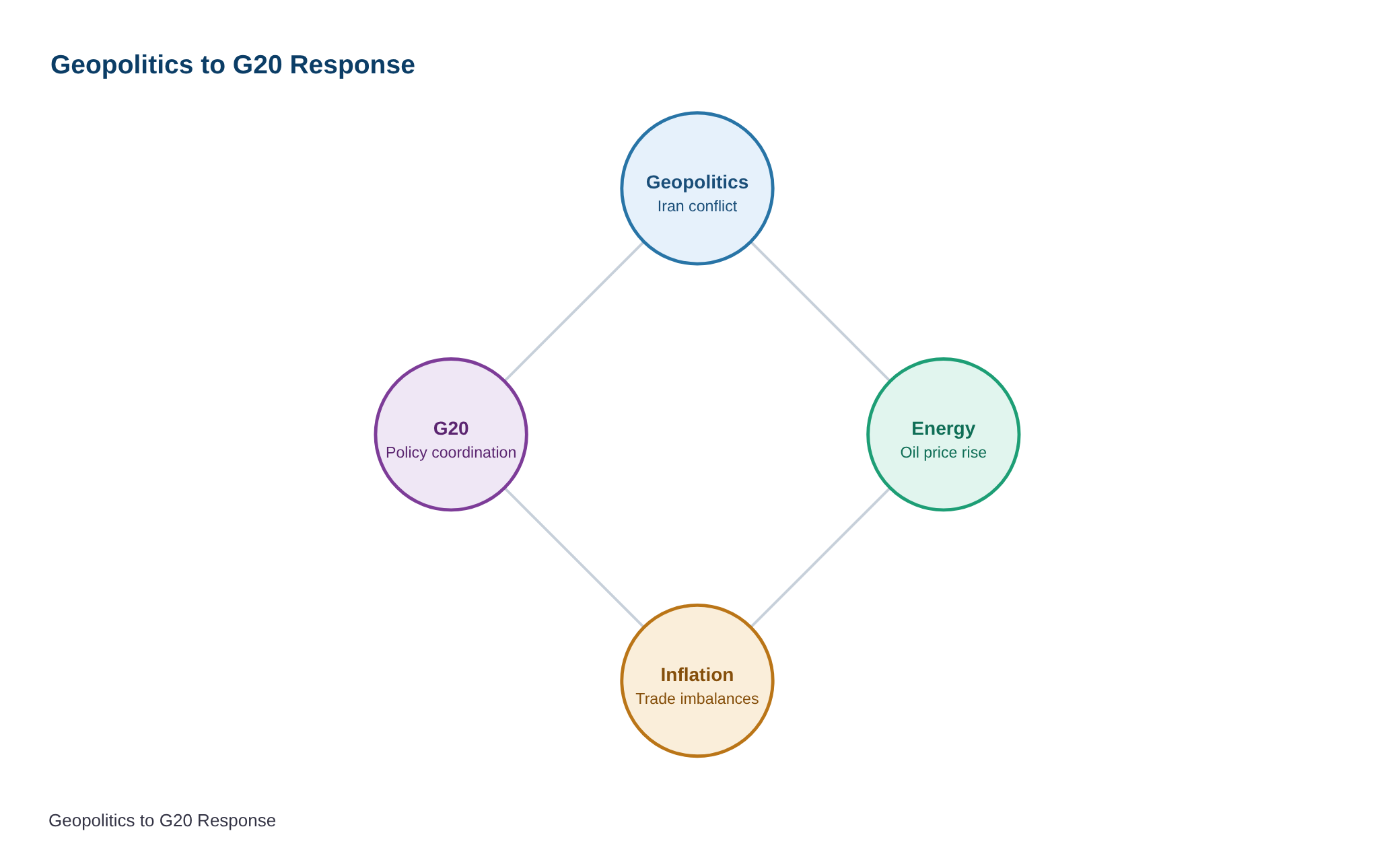
Geopolitical tensions (e.g., Iran conflict) → Disruptions in energy supplies → Increase in global oil prices → Inflationary pressures → Trade imbalances → G20 discussions on energy security and supply chain resilience → Persistent global economic imbalances → Current account deficits/surpluses → Exchange rate volatility → Trade disputes → G20 focus on policy coordination and structural reforms → High sovereign debt levels → Fiscal constraints → Reduced public investment → Growth slowdown → G20 deliberations on debt sustainability and restructuring mechanisms → Over-reliance on single supply chains → Geopolitical shocks → Production disruptions → Inflation and shortages → G20 emphasis on supply chain diversification and resilience → National industrial policies (e.g., India’s manufacturing push) → Attraction of FDI and technology → Export-led growth → Integration into global value chains → G20 discussions on trade facilitation and industrialisation
Prelims Practice Questions
Q1. Consider the following statements regarding the G20 Finance Track:
1. The G20 Finance Track is chaired by the host country’s Finance Minister.
2. The G20 Finance Track includes the European Union as a member.
3. The African Union is represented in the G20 Finance Track.
4. The G20 Finance Track meetings are exclusively attended by finance ministers and central bank governors.
How many of the above statements are correct?
- Only one
- Only two
- Only three
- All four
Answer: Only three — Statements 1, 2, and 3 are correct. Statement 4 is incorrect as representatives of international financial institutions and invited organisations also participate in G20 Finance Track meetings.
Q2. Assertion (A): The G20 Finance Track 2026, chaired by the United States, prioritises economic growth as its central agenda.
Reason (R): The United States has historically led the G20’s focus on economic growth during its presidency.
Options:
A. Both A and R are true, and R is the correct explanation of A.
B. Both A and R are true, but R is not the correct explanation of A.
C. A is true, but R is false.
D. A is false, but R is true.
Answer: ? — Assertion (A) is true as the United States has placed stronger economic growth at the centre of its G20 Finance Track presidency in 2026. Reason (R) is false because the United States has not historically led the G20’s focus on economic growth in all its presidencies.
Q3. Match the following pairs related to global economic governance:
Column I
1. G20 Finance Track 2026 host country
2. Issue discussed under G20 Finance Track
3. Institution represented in G20 Finance Track
4. Geopolitical factor affecting G20 discussions
Column II
A. United States
B. Sovereign debt challenges
C. African Union
D. Iran conflict
- 1-A, 2-B, 3-C, 4-D
- 1-B, 2-A, 3-D, 4-C
- 1-C, 2-D, 3-A, 4-B
- 1-D, 2-C, 3-B, 4-A
Answer: 1-A, 2-B, 3-C, 4-D — Correct matching: 1-A (United States is the host), 2-B (sovereign debt challenges are discussed), 3-C (African Union is represented), 4-D (Iran conflict is a geopolitical factor).
Mains Practice Question
✍ The G20 Finance Track serves as a critical platform for addressing global economic imbalances and fostering resilient supply chains. Critically examine the role of plurilateral economic forums like the G20 in shaping global economic governance, with reference to contemporary challenges such as sovereign debt crises and geopolitical conflicts. (15 Marks)
Approach: MODEL-ANSWER SKELETON:
1. **Introduction (2 marks)**: Define plurilateral economic forums (e.g., G20) and their significance in global economic governance. Highlight their voluntary, non-binding nature and inclusivity (e.g., G20 includes 19 countries + EU and AU).
2. **Role in Global Economic Governance (5 marks)**:
– **Coordination**: Facilitate dialogue among major economies to address systemic risks (e.g., 2008 financial crisis response).
– **Policy Harmonisation**: Promote convergence on standards (e.g., Basel III norms for banking).
– **Crisis Management**: Provide a platform for coordinated responses to sovereign debt crises (e.g., Greece bailout debates).
– **Supply Chain Resilience**: Address disruptions (e.g., COVID-19, Suez Canal blockage) through policy frameworks.
3. **Contemporary Challenges (5 marks)**:
– **Sovereign Debt**: Discuss the role of G20 in addressing debt vulnerabilities (e.g., Common Framework for Debt Treatment).
– **Geopolitical Conflicts**: Examine how conflicts (e.g., Iran tensions) impact energy prices and trade routes (Strait of Hormuz), and the G20’s limited role in resolving such disputes.
– **Limits of Plurilateralism**: Critique the lack of enforceability and consensus-building challenges (e.g., US-China trade tensions).
4. **Critique and Way Forward (3 marks)**:
– **Strengths**: Inclusivity, flexibility, and agenda-setting power (e.g., G20’s role in climate finance).
– **Weaknesses**: Absence of binding commitments and over-reliance on informal diplomacy.
– **Suggestions**: Strengthen institutional linkages with Bretton Woods institutions (IMF, World Bank) and enhance transparency.
**Balanced View Required**: Acknowledge both the G20’s achievements (e.g., post-2008 reforms) and its constraints (e.g., inability to resolve trade wars).
Source: orissapost.com
Generated by AanyaAi for educational purpose.
Related guides on our sites
- Best PSIR optional coaching for upsc
- Best economics optional coaching for upsc
- Best PSIR optional teacher for upsc
- Best teacher of PSIR optional for upsc

- India-Australia AUSTRAHIND 2026 Exercise: Key Highlights for UPSC & State PCS - October 22, 2026
- एससीओ बैठक में भारत का आतंकवाद विरोध: क्षेत्रीय सहयोग पर जोर - October 22, 2026
- SEC Directs Strict SC Order Compliance for Andhra ULB Polls - October 22, 2026

No Comments