


31 Aug AI Job Losses: Gates & Sanders Warn of Automation Crisis for UPSC
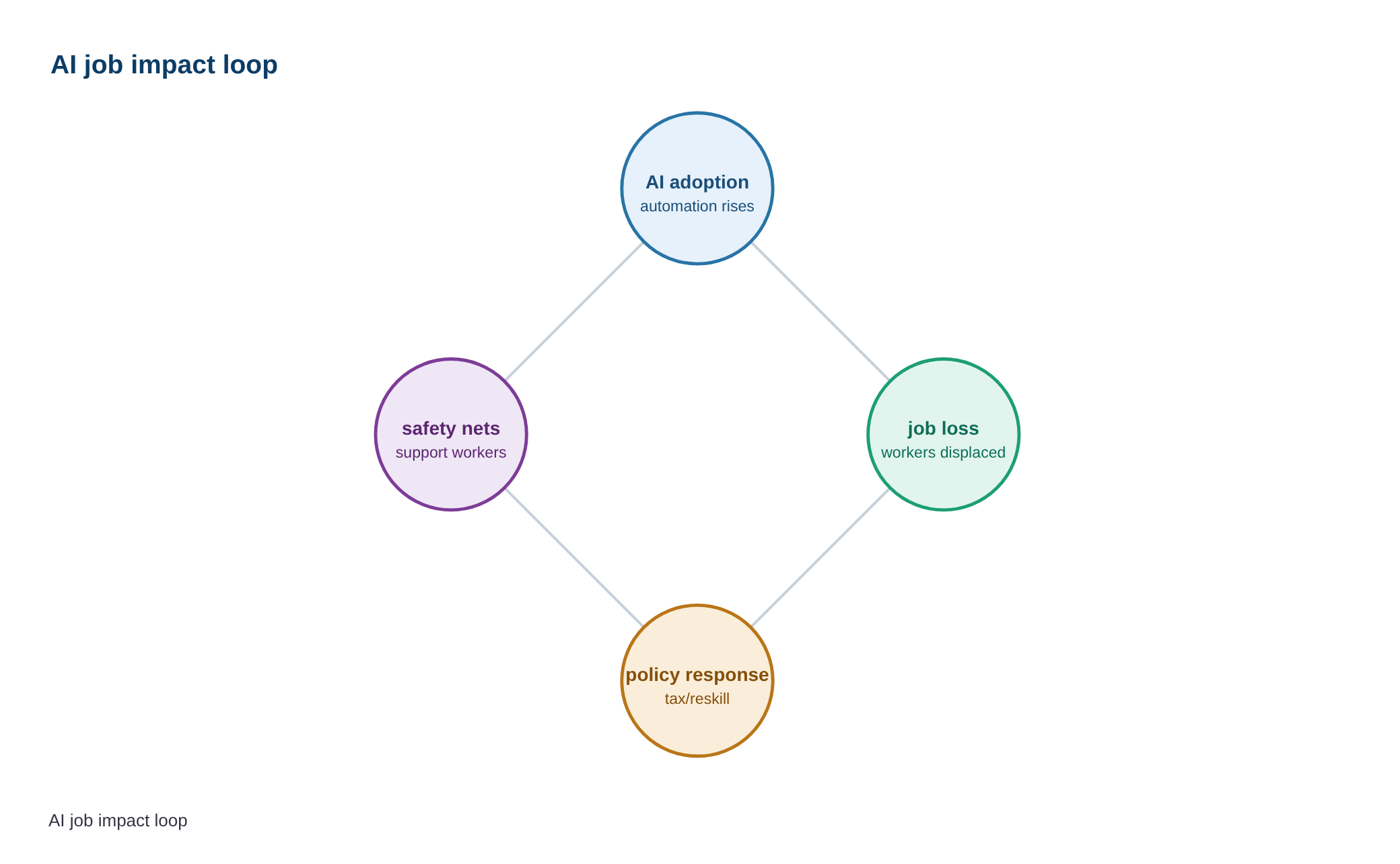
✎ AI-driven labour displacement necessitates a multi-pronged governance approach: taxation of automation to fund reskilling, categorisation of 'Human Reserved' professions for social cohesion, and robust international regulatory…
Subject Relevance — Where This Topic Fits
- GS Paper II — International Relations (Global Governance, Technological Sovereignty) | GS Paper III — Science and Technology (AI Policy, Labour Economics, Regulatory Frameworks) | GS Paper III — Economy (Automation, Taxation, Social Safety Nets)
- Prelims: Artificial Intelligence (AI), Automation, Labour Displacement, Universal Basic Income (UBI), Robot Tax, Frontier AI, AI Governance, Digital Public Infrastructure
- Essay: The Ethical and Economic Implications of Artificial Intelligence: Balancing Innovation and Human Dignity, Governance in the Age of Disruptive Technologies: Lessons from AI and Automation
Quick Revision: AI-driven labour displacement necessitates a multi-pronged governance approach: taxation of automation to fund reskilling, categorisation of ‘Human Reserved’ professions for social cohesion, and robust international regulatory frameworks to ensure equitable and ethical AI deployment.
Why is this in the news?
The remarks by Bill Gates and US Senator Bernie Sanders highlight the escalating global discourse on the socio-economic risks posed by artificial intelligence, particularly its potential to disrupt labour markets through large-scale job displacement. Their statements underscore the urgency for policymakers to address governance gaps in AI regulation, taxation of automation, and the strengthening of social safety nets to mitigate adverse impacts on workers.
Background
- Artificial Intelligence (AI) has transitioned from a theoretical concept to a transformative force across industries, with applications in healthcare, finance, manufacturing, and services.
- The advent of generative AI models (e.g., LLMs, diffusion models) has accelerated automation capabilities, enabling machines to perform tasks previously deemed exclusive to human labour.
- Historically, technological disruptions such as the Industrial Revolution and the digital revolution have precipitated structural changes in labour markets, necessitating adaptive policy responses.
- Governments worldwide are grappling with the dual challenge of fostering innovation while safeguarding employment and social equity, as evidenced by debates on AI taxation, reskilling initiatives, and regulatory sandboxes.
What is Artificial Intelligence (AI)-Driven Labour Displacement?
- AI-driven labour displacement refers to the phenomenon wherein intelligent systems, including machine learning models and robotic process automation (RPA), replace human labour in routine, repetitive, or cognitively complex tasks.
- The displacement is not uniform; sectors such as manufacturing, customer service, and data processing are more susceptible, while healthcare, education, and creative professions may experience augmentation rather than replacement.
- The economic rationale for AI adoption by firms includes cost reduction, efficiency gains, and scalability, but it often leads to short-term job losses, particularly for low-skilled and middle-skilled workers.
- Taxation of automation, or ‘robot tax,’ is a proposed fiscal measure to offset the loss of payroll tax revenue when machines replace human workers, with proceeds directed towards retraining programmes and social welfare systems.
- The psychological and social impacts of job displacement include increased unemployment, deskilling, and mental health challenges, necessitating psychological support systems and community-based interventions.
- AI governance frameworks must balance innovation incentives with worker protections, incorporating principles of transparency, accountability, and equitable access to technological benefits.
- The global nature of AI development and deployment requires international cooperation to harmonise regulatory standards, prevent a ‘race to the bottom’ in labour standards, and ensure equitable technological diffusion.
UPSC Value Addition
Keywords for Mains Answer-Writing
Artificial Intelligence · Technological Unemployment · AI Governance · Automation Taxation · Human-Reserved Occupations · AI Safety and Regulation · Frontier AI Models · Reskilling and Upskilling · Social Safety Nets · Ethical Concerns in AI
Prelims Practice Questions
Q1. Consider the following statements regarding the risks posed by Artificial Intelligence (AI) as highlighted by Bill Gates and Bernie Sanders:
1. AI could lead to permanent job losses across sectors.
2. AI-enabled bioterrorism and cyberattacks are identified as significant risks.
3. The use of AI companions for children is considered a low-risk area by Gates.
4. Gates proposes a tax on AI tokens and robots to fund retraining and safety nets.
How many of the above statements are correct?
- Only one
- Only two
- Only three
- All four
Answer: Only three — Statements 1, 2, and 4 are correct. Statement 3 is incorrect as Gates explicitly highlights the risks of AI companions for children.
Q2. Assertion (A): Bill Gates advocates for a global slowdown in AI development to mitigate risks.
Reason (R): Gates believes that the geopolitical and commercial pressures make a global slowdown unlikely.
In the context of the above statements, which of the following is correct?
- Both A and R are true, and R is the correct explanation of A.
- Both A and R are true, but R is not the correct explanation of A.
- A is true, but R is false.
- A is false, but R is true.
Answer: ? — Assertion (A) is false because Gates does not advocate for a global slowdown; he supports structural measures like taxation and reserved occupations. Reason (R) is true as Gates acknowledges the unlikelihood of a slowdown due to geopolitical and commercial pressures.
Q3. Match the following proposals made by Bill Gates with their respective objectives:
Column I (Proposal)
A. Token tax on AI and robots
B. Human Reserved Occupations
C. Retraining and safety nets
Column II (Objective)
1. To address the disparity in tax treatment between human labor and machines
2. To ensure certain jobs remain reserved for humans
3. To fund reskilling programs and expand social safety nets
Select the correct match:
- A-1, B-2, C-3
- A-2, B-1, C-3
- A-3, B-1, C-2
- A-1, B-3, C-2
Answer: A-1, B-2, C-3 — A matches with 1 (token tax addresses tax disparity), B matches with 2 (reserved occupations ensure human roles), and C matches with 3 (funding retraining and safety nets).
Mains Practice Question
✍ The rapid advancement of Artificial Intelligence (AI) presents unprecedented challenges to labour markets, governance, and societal structures. Critically analyse the governance mechanisms proposed by Bill Gates to mitigate the risks of AI-induced job losses and other existential threats. Also, evaluate the feasibility of implementing such mechanisms in the Indian context. (15 Marks)
Approach: MODEL-ANSWER SKELETON:
1. **Introduction** (2 marks): Define AI-induced job losses and existential risks (e.g., bioterrorism, cyberattacks) as highlighted by Gates and Sanders. Mention the global urgency for governance.
2. **Gates’ Proposals** (5 marks):
– **Token Tax on AI and Robots**: Explain the rationale (payroll tax parity between human labor and machines) and cite Gates’ example of taxing automation to fund retraining.
– **Human Reserved Occupations**: Define the concept (e.g., caregiving) and its purpose (preserving human dignity and social cohesion).
– **Retraining and Safety Nets**: Link to the need for expanded welfare systems (e.g., universal basic income, skill development programs).
3. **Critique of Proposals** (4 marks):
– **Feasibility Challenges**: Discuss geopolitical competition, corporate resistance, and the difficulty of defining ‘reserved occupations’.
– **Alternatives**: Mention other governance models (e.g., EU AI Act, India’s AI Mission) and their limitations.
– **Ethical Concerns**: Address potential misuse of reserved occupations or tax mechanisms.
4. **Indian Context** (4 marks):
– **Existing Frameworks**: Reference India’s AI Mission, Skill India Mission, and labour laws (e.g., Code on Social Security, 2020).
– **Implementation Barriers**: Highlight India’s fiscal constraints, informal sector dominance, and digital divide.
– **Opportunities**: Leverage India’s demographic dividend for reskilling and global AI leadership (e.g., G20 AI Principles).
5. **Conclusion** (1 mark): Balance the need for proactive governance with pragmatic constraints, emphasizing multi-stakeholder collaboration.
Source: Times of India
Generated by AanyaAi for educational purpose.
Related guides on our sites
- Best PSIR optional coaching for upsc
- Best PSIR optional teacher for upsc
- Best teacher of PSIR optional for upsc
- Best PSIR optional coaching in delhi for UPSC

- UPSC Alert: India Launches National Action Plan for Inland Small Fisheries - October 24, 2026
- विशेष अभियान 6: कपड़ा आयुक्त कार्यालय ने सफाई और दक्षता में बढ़ाया योगदान - October 24, 2026
- Inter-Caste Marriage Scheme: UPSC Exam Polity & Governance Insight - October 24, 2026

No Comments