


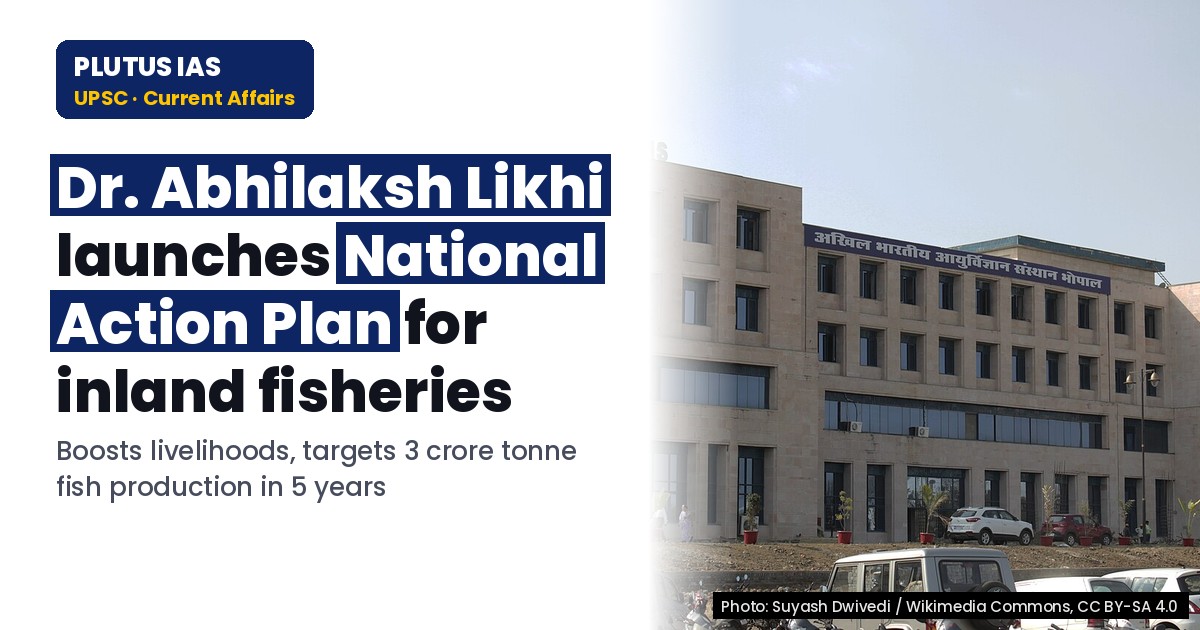
24 Oct UPSC Alert: India Launches National Action Plan for Inland Small Fisheries
✎ The National Action Plan for Inland Small-Scale Fisheries (NPOA-ISSF) is a governance framework developed under FAO guidelines to enhance livelihoods, ensure sustainable resource management, and build climate resilience in…
Subject Relevance — Where This Topic Fits
- GS Paper III — Environment, Ecology, Biodiversity and Climate Change | GS Paper III — Agriculture and Allied Activities | GS Paper III — Fisheries and Aquaculture
- Prelims: Inland fisheries, Small-scale fisheries, Sustainable aquaculture, FAO Code of Conduct for Responsible Fisheries, Blue Economy, National Fisheries Development Board, Biodiversity conservation, Climate-resilient fisheries
- Essay: Sustainable development and livelihood security in rural India, Balancing economic growth with environmental conservation in natural resource management
Quick Revision: The National Action Plan for Inland Small-Scale Fisheries (NPOA-ISSF) is a governance framework developed under FAO guidelines to enhance livelihoods, ensure sustainable resource management, and build climate resilience in India’s freshwater fisheries sector.
Why is this in the news?
The Union Ministry of Fisheries, Animal Husbandry and Dairying has initiated the development phase of a dedicated National Action Plan for Inland Small-Scale Fisheries (NPOA-ISSF), aimed at enhancing livelihoods, improving coordination, and strengthening the management of freshwater resources. The plan is being developed in collaboration with the Bay of Bengal Programme Inter-Governmental Organisation (BOBP-IGO) and the Food and Agriculture Organisation (FAO) framework, with a target to increase India’s fish production to 30 million tonnes over the next five years while ensuring climate resilience and equitable growth in the sector.
Background
- Inland fisheries contribute approximately three-fourths of India’s annual fish production of 19.7 million tonnes, with small-scale operations forming the backbone of the sector.
- India’s fish production has grown significantly, with exports of marine products exceeding ₹70,000 crore in recent years, and a target set to reach ₹1.25 lakh crore within five years.
- The sector faces critical challenges such as declining water quality, oxygen depletion in water bodies, and vulnerability to climate change, necessitating a structured governance response.
- Small-scale fisheries employ millions of marginalised communities, particularly in rural and tribal regions, making livelihood security a key policy priority.
- The FAO’s Code of Conduct for Responsible Fisheries (1995) provides an international framework for sustainable fisheries management, which India is aligning with through this plan.
- The BOBP-IGO, an inter-governmental organisation under the Bay of Bengal Initiative, supports regional cooperation in sustainable fisheries management and climate adaptation.
What is the National Action Plan for Inland Small-Scale Fisheries (NPOA-ISSF)?
- The NPOA-ISSF is a strategic framework being developed by the Government of India to govern inland small-scale fisheries, covering rivers, canals, reservoirs, lakes, floodplains, wetlands, ponds, and cold-water systems.
- The plan aims to integrate livelihood enhancement, resource management, gender equity, and climate resilience into a single governance instrument for the sector.
- It is being developed under the FAO’s framework, ensuring alignment with international best practices for responsible and sustainable fisheries.
- The plan emphasises stakeholder consultation, including fishers, local communities, and institutional experts, to ensure contextual relevance and ownership.
- Key thematic areas include resource rights and management, employment and decent work, gender equality, value chain strengthening, post-harvest trade, disaster risk reduction, and climate adaptation.
- The plan seeks to address systemic challenges such as declining oxygen levels in water bodies, pollution, and the socio-economic marginalisation of fishing communities.
- A mission-based outreach programme is proposed to disseminate the plan’s provisions and ensure practical improvements in livelihoods across fishing communities.
- The plan will be finalised through multi-stakeholder consultations before public release, followed by phased implementation with periodic reviews.
Key Features
| Feature | Significance |
|---|---|
| Development Phase of National Plan for Inland Small-Scale Fisheries | Initiates structured policy formulation for sustainable inland fisheries management, aligning with global frameworks such as the FAO. |
| Target of 3 Crore Tonnes Fish Production in 5 Years | Aims to enhance food security, boost rural livelihoods, and strengthen India’s position in global fish trade. |
| Stakeholder Consultation Framework | Ensures inclusive policy design by integrating inputs from fishing communities, experts, and institutions across diverse ecosystems. |
| Mission-Based Outreach Programme | Facilitates grassroots-level implementation and adoption of the plan by directly engaging beneficiary communities. |
| Integration of Climate Resilience Measures | Prioritizes adaptation strategies to mitigate impacts of climate change on inland fisheries, such as declining oxygen levels in water bodies. |
Why it Matters
Economic
- Enhances rural livelihoods by improving income opportunities for small-scale fishers and allied sectors.
- Boosts fish production to meet domestic demand and expand export earnings (target: ₹1.25 lakh crore from seafood exports).
- Strengthens value chains to increase profitability and reduce post-harvest losses in inland fisheries.
Environmental
- Promotes sustainable management of inland water bodies, including rivers, lakes, and wetlands, to preserve biodiversity.
- Addresses climate-induced challenges such as oxygen depletion and habitat degradation in freshwater ecosystems.
- Supports FAO’s global initiatives for responsible fisheries by aligning with international sustainability standards.
Social
- Ensures gender inclusivity and equitable access to resources within fishing communities.
- Empowers marginalized groups by integrating their traditional knowledge into policy formulation.
- Improves working conditions and dignity for small-scale fishers through structured resource management.
Institutional
- Fosters inter-ministerial and inter-state coordination for holistic fisheries governance.
- Leverages expertise from organizations like BOBP-IGO and FAO to enhance technical and policy capacity.
- Establishes a robust monitoring and evaluation framework for tracking progress and outcomes.
Challenges
1. Climate Change and Environmental Degradation
- Rising temperatures and pollution reduce oxygen levels in inland water bodies, threatening fish survival and biodiversity.
- Increased frequency of extreme weather events disrupts fishing cycles and damages infrastructure.
- Salinization of freshwater systems due to changing monsoon patterns and groundwater depletion.
UPSC Link: GS3: Climate Change Impacts on Agriculture
2. Resource Management and Governance Gaps
- Lack of clear property rights and overlapping jurisdictions hinder effective management of shared water bodies.
- Inadequate enforcement of existing regulations leads to overfishing and habitat destruction.
- Limited technical and financial capacity at the local level to implement sustainable practices.
UPSC Link: GS2: Governance and Policy Implementation
3. Economic Vulnerability of Small-Scale Fishers
- Dependence on monsoon-dependent water bodies makes livelihoods precarious.
- Limited access to credit, technology, and markets constrains productivity and profitability.
- Post-harvest losses due to inadequate cold storage and processing facilities.
UPSC Link: GS3: Agricultural Marketing and Supply Chain
4. Biodiversity Loss and Invasive Species
- Introduction of invasive species disrupts native fish populations and ecosystem balance.
- Overfishing of commercially valuable species leads to ecological imbalance.
- Pollution from agricultural runoff and industrial effluents degrades water quality.
UPSC Link: GS3: Biodiversity Conservation
5. Data Gaps and Monitoring Challenges
- Insufficient disaggregated data on fish stocks, catch composition, and socio-economic conditions of fishers.
- Lack of real-time monitoring systems to assess the health of inland water bodies.
- Inadequate research on climate-resilient fish species and farming techniques.
UPSC Link: GS3: Science and Technology in Agriculture
Challenges — UPSC Perspective
| Issue | Concern |
|---|---|
| Oxygen Depletion in Water Bodies | Directly threatens fish survival and reduces biodiversity in inland fisheries. |
| Overlapping Jurisdictions in Water Resource Management | Leads to fragmented governance and ineffective enforcement of regulations. |
| Limited Access to Financial Resources for Fishers | Restricts adoption of modern technologies and sustainable practices. |
| Post-Harvest Losses Due to Poor Infrastructure | Reduces profitability and contributes to food waste in the supply chain. |
| Climate-Induced Disruptions in Fishing Cycles | Increases vulnerability of fishers to income instability and food insecurity. |
Way Forward
- Finalize the National Plan for Inland Small-Scale Fisheries through multi-stakeholder consultations and pilot testing in select regions.
- Strengthen institutional capacity by training local authorities, fishers, and extension workers on sustainable practices and climate resilience.
- Develop and deploy real-time monitoring systems for water quality, fish stocks, and ecosystem health in inland water bodies.
- Expand access to credit, insurance, and technology for small-scale fishers through partnerships with banks, NGOs, and agri-tech startups.
- Integrate gender-sensitive policies to ensure equitable participation and benefits for women in fishing communities.
- Promote research on climate-resilient fish species, polyculture techniques, and low-impact aquaculture methods.
- Establish a dedicated fund for inland fisheries development, with transparent allocation and monitoring mechanisms.
- Enhance collaboration with international organizations like FAO and BOBP-IGO to adopt best practices and secure technical support.
UPSC Value Addition
Keywords for Mains Answer-Writing
National Plan of Action for Inland Small-scale Fisheries · Blue Economy · Sustainable Fisheries Management · FAO Framework for Fisheries · Inland Fisheries Resources · Livelihood Security in Fisheries · Climate Resilient Fisheries · Value Chain Development in Fisheries · Intergovernmental Organization for Fisheries · Mission-based Outreach for Fisheries · Gender Equality in Fisheries · Disaster Risk Reduction in Fisheries · National Fisheries Development Board · Pradhan Mantri Matsya Sampada Yojana · Fisheries Co-management
Concept Flow
Inland small-scale fisheries face multi-dimensional challenges → Government initiates National Plan for Inland Small-Scale Fisheries → Stakeholder consultations and FAO alignment → Development of climate-resilient, inclusive, and sustainable policies → Mission-based outreach for grassroots implementation → Enhanced fish production, livelihoods, and ecosystem health.
Prelims Practice Questions
Q1. Consider the following statements regarding the National Plan of Action for Inland Small-scale Fisheries in India:
1. The plan is being developed under the framework of the United Nations Food and Agriculture Organization (FAO).
2. The plan aims to achieve a fish production target of 3 crore tonnes within the next five years.
3. The plan includes provisions for disaster risk reduction and climate change adaptation in inland fisheries.
How many of the above statements are correct?
- Only one
- Only two
- All three
- None
Answer: All three — Statements 1 and 3 are correct as the plan is being developed under the FAO framework and includes disaster risk reduction and climate change adaptation. Statement 2 is incorrect because the target of 3 crore tonnes is for total fish production, not specifically for inland fisheries.
Q2. Assertion (A): The National Plan of Action for Inland Small-scale Fisheries emphasizes the need for mission-based outreach programs to improve livelihoods.
Reason (R): The plan aims to ensure that the benefits of fisheries development reach fishing communities across the country.
Options:
A. Both A and R are true, and R is the correct explanation of A.
B. Both A and R are true, but R is NOT the correct explanation of A.
C. A is true, but R is false.
D. A is false, but R is true.
Answer: ? — Both the Assertion (A) and Reason (R) are true, and R correctly explains A. The plan indeed emphasizes mission-based outreach to ensure practical improvements in livelihoods for fishing communities.
Q3. Match the following institutions with their roles in the development of the National Plan of Action for Inland Small-scale Fisheries:
Column I (Institution)
1. Ministry of Fisheries, Animal Husbandry and Dairying
2. Blue Economy Programme Inter-Governmental Organization (BOBP-IGO)
3. National Fisheries Development Board
4. Food and Agriculture Organization (FAO)
Column II (Role)
A. Provides technical and financial support for the development of the plan
B. Leads the development of the plan in collaboration with BOBP-IGO
C. Facilitates international cooperation and framework for the plan
D. Implements the plan at the grassroots level through schemes and programs
Options:
1-B, 2-A, 3-D, 4-C
1-A, 2-B, 3-C, 4-D
1-C, 2-A, 3-D, 4-B
1-D, 2-C, 3-A, 4-B
Answer: ? — 1-B: The Ministry of Fisheries, Animal Husbandry and Dairying leads the development of the plan. 2-A: BOBP-IGO provides technical and financial support. 3-D: The National Fisheries Development Board implements the plan at the grassroots level. 4-C: FAO provides the international framework for the plan.
Mains Practice Question
✍ Critically analyse the significance of the National Plan of Action for Inland Small-scale Fisheries in the context of India’s blue economy and sustainable development goals. How far does the plan address the challenges of livelihood security, climate resilience, and gender equality in inland fisheries? (15 Marks)
Approach: MODEL-ANSWER SKELETON:
1. **Introduction**: Define the blue economy and its relevance to India, highlighting the role of inland fisheries in food security, employment, and export earnings (reference: India’s fish production of 19.7 million tonnes annually, with inland fisheries contributing ~75%).
2. **Significance of the Plan**:
– **Livelihood Security**: Discuss the plan’s focus on improving the socio-economic conditions of small-scale fishers through mission-based outreach and value chain strengthening (reference: Dr. Abhilaksh Likhi’s statement on practical livelihood improvements).
– **Climate Resilience**: Analyse the plan’s provisions for addressing climate change impacts (e.g., declining oxygen levels in water bodies, biodiversity loss) and disaster risk reduction (reference: FAO framework and BOBP-IGO collaboration).
– **Gender Equality**: Examine the inclusion of gender-sensitive approaches in resource management and employment (reference: Dr. P. Krishnan’s statement on addressing gender equality in the plan).
3. **Challenges Addressed**:
– **Resource Management**: Discuss the plan’s emphasis on sustainable management of inland water bodies (rivers, lakes, wetlands) and co-management models.
– **Value Chain Development**: Highlight the need to strengthen post-harvest infrastructure and market linkages to enhance fishers’ income (reference: target of increasing export earnings to ₹1.25 lakh crore).
4. **Critical Analysis**:
– **Strengths**: Evaluate the plan’s alignment with global frameworks (FAO) and its multi-stakeholder approach (e.g., workshops in Bhopal, consultations with fishers).
– **Limitations**: Discuss potential challenges such as implementation gaps, funding constraints, and the need for stronger institutional coordination (reference: role of the National Fisheries Development Board and state-level agencies).
5. **Conclusion**: Summarize the plan’s potential to transform inland fisheries while emphasizing the need for continuous monitoring, stakeholder engagement, and adaptive management to achieve sustainable development goals.
Source: PIB (Press Information Bureau)
Generated by AanyaAi for educational purpose.
Related guides on our sites
- Best PSIR optional coaching for upsc
- Best PSIR optional teacher for upsc
- Best teacher of PSIR optional for upsc
- Best PSIR optional coaching in delhi for UPSC

- Inflation’s Second-Round Effects: RBI Policy & Economic Impact Analysis - October 24, 2026
- ISRO का NVS-03 उपग्रह: NavIC को पुनः सक्रिय करेगा, जानिए कैसे? - October 24, 2026
- UPSC Alert: India Launches National Action Plan for Inland Small Fisheries - October 24, 2026

No Comments