


31 Aug Depalpur’s Mission Zero: UPSC’s Guide to Heritage Waste Management Success
✎ Depalpur’s Zero Legacy Waste Mission demonstrates how scientific landfill remediation, source segregation, and community participation under SBM-U 2.0 can transform urban waste management from a liability into a sustainable civic…
Subject Relevance — Where This Topic Fits
- GS Paper II — Governance, Transparency and Accountability in Urban Local Bodies | GS Paper III — Environmental Pollution and Degradation, Waste Management
- Prelims: Swachh Bharat Mission-Urban 2.0, Solid Waste Management Rules 2016, Scientific landfill remediation, Waste-to-Energy (RDF), Urban Local Bodies (ULBs), Source segregation, Circular economy in waste management
- Essay: Sustainable Urban Development: Balancing Growth and Environmental Stewardship, The Role of Community Participation in Public Service Delivery
Quick Revision: Depalpur’s Zero Legacy Waste Mission demonstrates how scientific landfill remediation, source segregation, and community participation under SBM-U 2.0 can transform urban waste management from a liability into a sustainable civic asset.
Why is this in the news?
The Press Information Bureau (PIB) released a case study on 31 August 2026 highlighting Depalpur’s successful implementation of a zero legacy waste mission under the Swachh Bharat Mission-Urban 2.0, demonstrating a model of scientific urban waste management through source segregation, landfill remediation, and community engagement. The initiative, supported by Indore Municipal Corporation under the ‘Swachh City Pair’ programme, achieved the complete scientific disposal of 1,250 metric tonnes of legacy waste and established a replicable framework for other urban local bodies.
Background
- The Solid Waste Management Rules, 2016, mandate source segregation of waste into four categories (wet, dry, domestic hazardous, and plastic waste) and prohibit open dumping of legacy waste.
- Swachh Bharat Mission-Urban (SBM-U) 2.0, launched in 2020, aims to make all urban local bodies (ULBs) garbage-free and ensure scientific management of waste, including legacy waste remediation.
- The ‘Swachh City Pair’ initiative under SBM-U 2.0 fosters peer learning and capacity-building between mentor and mentee cities to accelerate best practices in urban waste management.
- Legacy waste refers to accumulated solid waste in dumpsites over years, often containing non-biodegradable and hazardous materials, requiring scientific remediation to prevent environmental and public health hazards.
- Indore has been a frontrunner in urban solid waste management, recognised for achieving 100% source segregation and scientific processing of waste.
- The 4-bin segregation system aligns with the ‘Circular Economy’ approach, promoting resource recovery and reducing landfill dependency.
What is the Zero Legacy Waste Mission in Depalpur?
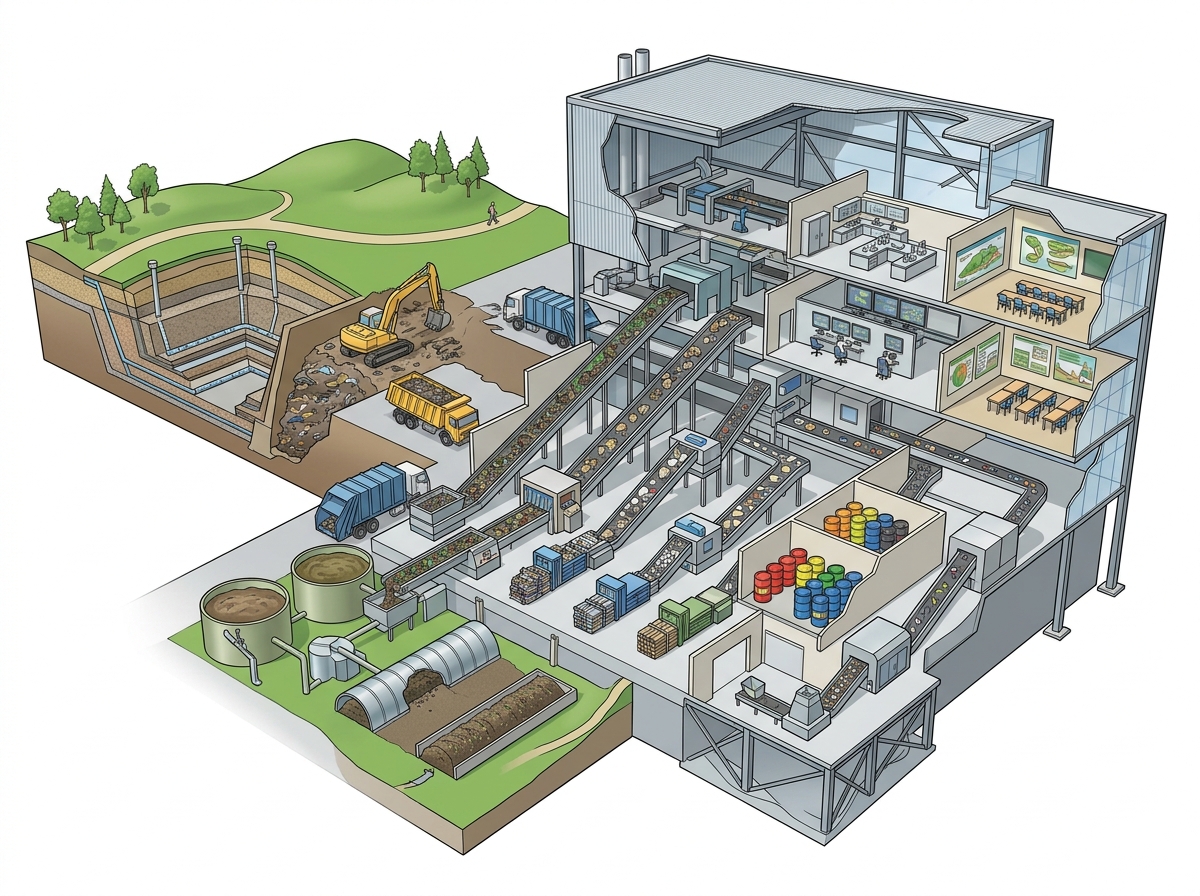
- A targeted urban waste management initiative under SBM-U 2.0 to scientifically remediate 1,250 metric tonnes of legacy waste accumulated over five years in Depalpur’s dumpsite.
- Implemented through a rigorous 4-bin source segregation system (wet, dry, domestic hazardous, and plastic waste) to ensure waste is processed according to its category.
- Involved the deployment of heavy machinery (dumpers, JCBs, loaders) and a workforce of over 500 waste collectors from Indore Municipal Corporation to systematically excavate, segregate, and transport waste.
- Scientific processing included the recovery of 4.5 tonnes of recyclables (plastic, metal, glass) for authorised recycling and 50–60 tonnes of waste-derived fuel (RDF) sent to Indore’s NEPRA plant for co-processing in cement kilns.
- The remediation process adhered to the ‘Circular Economy’ principles by prioritising waste reduction, reuse, recycling, and energy recovery over landfilling.
- Post-remediation, the site was transformed into a green public space with tree plantation drives and community engagement activities, symbolising urban rejuvenation.
- The mission exemplifies the integration of technological precision, administrative efficiency, and community ownership in achieving sustainable urban development goals.
- Depalpur’s success is attributed to the ‘Swachh City Pair’ model, where Indore (mentor city) guided Depalpur (mentee city) through knowledge transfer, best practices, and collaborative implementation.
Key Features
| Feature | Significance |
|---|---|
| Four-bin waste segregation system | Ensures source-level separation of waste into recyclables, biodegradables, domestic hazardous, and inert materials, reducing contamination and enhancing processing efficiency. |
| Scientific processing of legacy waste (1,250 metric tonnes) | Involves mechanical segregation, recovery of recyclables (4.5 tonnes), and conversion of non-recyclables into Refuse-Derived Fuel (RDF) for co-processing in cement plants, ensuring zero landfill disposal. |
| Community engagement through ‘Poha Party’ and tree plantation | Fosters collective ownership, celebrates milestones, and integrates environmental restoration with social cohesion. |
| Adoption of ‘Ek Sikhaya Ek’ model under Swachh Shauchalaya Jodi | Facilitates structured knowledge transfer between mentor (Indore) and mentee (Depalpur) cities, scaling best practices in urban waste management. |
| Restoration of heritage site (Suryakund Baoli) | Demonstrates integration of waste management with cultural heritage conservation, aligning with urban rejuvenation goals under SBM-U 2.0. |
Why it Matters
Environmental Sustainability
- Eliminates open dumping of legacy waste, reducing methane emissions and groundwater contamination.
- Promotes circular economy by recovering recyclables (4.5 tonnes) and converting non-recyclables into RDF for energy recovery.
- Restores degraded land for public use, enhancing urban biodiversity and aesthetic value.
Institutional Capacity Building
- Demonstrates scalability of the ‘Swachh Shauchalaya Jodi’ model, where mentor cities (e.g., Indore) guide mentee cities (e.g., Depalpur) in waste management practices.
- Strengthens inter-city cooperation through MoUs, facilitating knowledge exchange and standardised protocols.
- Showcases the role of municipal corporations in implementing scientific waste management at scale.
Policy Alignment with SBM-U 2.0
- Aligns with the ‘Garbage Free Cities’ mission under SBM-U 2.0, targeting 100% source segregation and scientific processing of waste.
- Demonstrates progress toward ‘Zero Legacy Waste’ goals, a key pillar of SBM-U 2.0.
- Highlights the integration of waste management with urban rejuvenation and heritage conservation.
Community Participation and Social Equity
- Engages citizens through door-to-door waste collection and awareness campaigns, ensuring universal coverage.
- Transforms a former dumping site into a community asset (e.g., public space for sports and events), fostering civic pride.
- Promotes gender-inclusive participation, as waste collection roles are often filled by women in urban areas.
Challenges
1. Legacy Waste Management
- Accumulated waste over decades poses technical challenges in segregation, processing, and safe disposal.
- Requires heavy machinery, skilled labour, and financial resources for scientific processing.
- Risk of secondary pollution if processing is not conducted with environmental safeguards.
UPSC Link: Environmental Pollution (Control)
2. Behavioural Change in Waste Segregation
- Ensuring consistent source-level segregation across all households remains a persistent challenge.
- Requires sustained behavioural change campaigns and incentives to overcome ingrained habits.
- Monitoring and enforcement mechanisms are essential to maintain compliance.
UPSC Link: Urban Local Governance
3. Infrastructure and Resource Gaps
- Limited availability of processing facilities (e.g., RDF plants) in smaller cities may hinder scalability.
- High capital and operational costs for scientific waste processing may strain municipal budgets.
- Need for continuous capacity-building of municipal staff in waste management technologies.
UPSC Link: Urban Infrastructure
4. Inter-Agency Coordination
- Effective waste management requires coordination between municipal bodies, state agencies, and private operators.
- Delays in approvals, land allocation, or procurement can stall project timelines.
- Ensuring accountability across multiple stakeholders is critical for sustained impact.
UPSC Link: Cooperative Federalism
5. Post-Processing Market Linkages
- Sustainable recycling and RDF utilisation depend on stable market demand and pricing.
- Fluctuations in commodity prices or policy changes can impact the economic viability of waste processing.
- Need for long-term agreements with authorised recyclers and cement plants.
UPSC Link: Circular Economy
Challenges — UPSC Perspective
| Issue | Concern |
|---|---|
| High capital expenditure for scientific processing | Municipal budgets may lack funds for heavy machinery and technology adoption. |
| Low public awareness on waste segregation | Households may resist separating waste due to lack of understanding or convenience. |
| Limited availability of RDF plants | Smaller cities may lack nearby facilities for converting waste into fuel. |
| Land acquisition delays for processing sites | Legal and bureaucratic hurdles can stall project implementation. |
| Seasonal fluctuations in waste generation | Variations in waste volume may disrupt processing plant operations. |
Government Initiatives — Must-Memorise for Prelims
- Swachh Bharat Mission-Urban 2.0 (SBM-U 2.0)
Way Forward
- Scale up the ‘Ek Sikhaya Ek’ model to additional mentor-mentee city pairs to replicate Depalpur’s success.
- Strengthen monitoring mechanisms using GIS-based tracking systems to ensure 100% source segregation and scientific processing.
- Expand public-private partnerships (PPP) for setting up RDF plants and recycling units in tier-2 and tier-3 cities.
- Launch targeted awareness campaigns in local languages, leveraging community leaders and schools.
- Develop standardised SOPs for legacy waste processing, including safety protocols for workers and environmental safeguards.
- Integrate waste management with urban planning by designating ‘zero-waste zones’ in city master plans.
- Establish a national fund for scientific waste management to support smaller municipalities with limited resources.
- Promote research and innovation in low-cost waste-to-energy technologies suitable for Indian urban contexts.
UPSC Value Addition
Keywords for Mains Answer-Writing
Swachh Bharat Mission-Urban 2.0 · Solid Waste Management · Legacy Waste Management · Urban Local Bodies · Zero Legacy Waste · Scientific Waste Processing · Waste-to-Energy (RDF) · Swachh Shakti 2025 · Capacity Building in Municipal Governance · Sustainable Urban Development · Plastic Waste Management · Circular Economy in Waste Management
Concept Flow
Urban waste generation → Accumulation of legacy waste → Environmental degradation (land, water, air pollution) → Policy intervention (SBM-U 2.0) → Adoption of scientific waste management (four-bin segregation, RDF processing) → Capacity building (Swachh Shauchalaya Jodi) → Community engagement and behavioural change → Restoration of degraded land → Creation of public assets (parks, heritage sites) → Sustainable urban development.
Prelims Practice Questions
Q1. Consider the following statements regarding the Swachh Bharat Mission-Urban 2.0:
1. It aims to achieve ‘Zero Legacy Waste’ in all urban local bodies by 2026.
2. The mission promotes the use of Waste-to-Energy (RDF) plants for processing non-recyclable waste.
3. Under the mission, only the Ministry of Housing and Urban Affairs is responsible for implementation.
How many of the above statements are correct?
- Only one
- Only two
- All
- None
Answer: Only two — Statements 1 and 2 are correct. Statement 3 is incorrect as multiple stakeholders, including state governments and urban local bodies, are involved in implementation.
Q2. Assertion (A): The ‘Swachh Shakti 2025’ initiative focuses on capacity building and peer learning among urban local bodies.
Reason (R): The initiative mandates that every urban local body must adopt a single waste management model without customization.
- Both A and R are true, and R is the correct explanation of A
- Both A and R are true, but R is not the correct explanation of A
- A is true, but R is false
- A is false, but R is true
Answer: A is true, but R is false — Assertion (A) is true as ‘Swachh Shakti 2025’ emphasizes capacity building and peer learning. Reason (R) is false because the initiative encourages customization and adaptation of best practices rather than mandating a single model.
Q3. Match the following pairs related to waste management initiatives in India:
Column I (Initiative/Programme)
A. Swachh Bharat Mission-Urban 2.0
B. Swachh Shakti 2025
C. Waste-to-Energy (RDF) Plants
D. Legacy Waste Management
Column II (Objective/Feature)
1. Focuses on peer learning and capacity building among urban local bodies
2. Aims to achieve 100% door-to-door waste collection and segregation
3. Converts non-recyclable waste into energy through scientific processing
4. Addresses the challenge of accumulated waste in urban areas over several years
- A-2, B-1, C-3, D-4
- A-1, B-2, C-3, D-4
- A-3, B-1, C-2, D-4
- A-4, B-2, C-1, D-3
Answer: A-2, B-1, C-3, D-4 — A-2 (Swachh Bharat Mission-Urban 2.0 aims for 100% door-to-door waste collection and segregation), B-1 (Swachh Shakti 2025 focuses on peer learning and capacity building), C-3 (Waste-to-Energy plants convert non-recyclable waste into energy), D-4 (Legacy waste management addresses accumulated waste).
Mains Practice Question
✍ The achievement of ‘Zero Legacy Waste’ in urban local bodies, as demonstrated by Deopalpur, is a testament to the convergence of scientific precision, institutional capacity, and community participation in solid waste management. Critically examine the institutional, technological, and socio-economic dimensions of this success. Also, assess the scalability of such models across diverse urban contexts in India. (15 Marks)
Approach: MODEL-ANSWER SKELETON:
1. **Institutional Dimensions (4 Marks)**:
– Role of the Ministry of Housing and Urban Affairs (MoHUA) in framing policies like Swachh Bharat Mission-Urban 2.0 and Swachh Shakti 2025.
– Functioning of Urban Local Bodies (ULBs) as implementing agencies, with Deopalpur and Indore as case studies.
– Collaborative governance: MoUs between ‘Guide Cities’ (e.g., Indore) and ‘Trainee Cities’ (e.g., Deopalpur) for knowledge transfer.
– Institutional challenges: Limited financial autonomy of ULBs, need for trained personnel, and bureaucratic delays.
2. **Technological Dimensions (4 Marks)**:
– Scientific waste processing: Four-bin segregation system, mechanical sorting, and Waste-to-Energy (RDF) plants.
– Legacy waste remediation: Use of heavy machinery (JCB, loaders) and site-specific techniques for dumpsite rehabilitation.
– Technological gaps: High initial costs, maintenance challenges, and the need for continuous monitoring.
3. **Socio-Economic Dimensions (4 Marks)**:
– Community participation: Role of ‘Swachhagrahis’ (sanitation workers), awareness campaigns, and public engagement (e.g., ‘Poha Party’).
– Economic viability: Revenue generation from recycling (4.5 tonnes of recyclable materials) and sale of RDF.
– Socio-economic barriers: Resistance to behavioral change, informal waste sector dynamics, and lack of incentives for segregation.
4. **Scalability and Challenges (3 Marks)**:
– Factors enabling scalability: Political will, availability of funds (SFC/15th FC grants), and replicable models (e.g., Indore’s success).
– Contextual barriers: Varying urban densities, financial constraints in smaller ULBs, and regional disparities in waste composition.
– Policy recommendations: Strengthening ULB capacities, incentivizing segregation, and integrating informal waste pickers into formal systems.
Balance of views: Highlight both the success of the model and the structural constraints that may hinder its universal adoption.
Source: PIB (Press Information Bureau)
Generated by AanyaAi for educational purpose.
Related guides on our sites
- Best PSIR optional coaching for upsc
- Best PSIR optional teacher for upsc
- Best teacher of PSIR optional for upsc
- Best PSIR optional coaching in delhi for UPSC

- UPSC Alert: India Launches National Action Plan for Inland Small Fisheries - October 24, 2026
- विशेष अभियान 6: कपड़ा आयुक्त कार्यालय ने सफाई और दक्षता में बढ़ाया योगदान - October 24, 2026
- Inter-Caste Marriage Scheme: UPSC Exam Polity & Governance Insight - October 24, 2026

No Comments