


31 Aug India Rejects Indus Waters Treaty Award by Illegally Constituted Court
✎ The Indus Waters Treaty (1960) allocates the Western Rivers (Indus, Jhelum, Chenab) to Pakistan and the Eastern Rivers (Ravi, Beas, Sutlej) to India, with dispute resolution mechanisms ranging from the Permanent Indus Commission…
Subject Relevance — Where This Topic Fits
- GS Paper II — International Relations (Dispute Resolution Mechanisms, Bilateral Treaties) | GS Paper II — India and its Neighbourhood (Indo-Pak Relations, Water Diplomacy)
- Prelims: Indus Waters Treaty (IWT), 1960, Permanent Indus Commission (PIC), World Bank’s role in IWT dispute resolution, Neutral Expert vs Court of Arbitration (CoA), Western Rivers (Indus, Jhelum, Chenab), Eastern Rivers (Ravi, Beas, Sutlej), Ratle Hydro-Electric Project (RHEP), Pahalgam terror attack (2025), Suspension of IWT obligations, Article IX of IWT (Arbitration Provisions)
- Essay: The Role of International Law in Bilateral Disputes: A Case Study of the Indus Waters Treaty, Sovereignty vs. International Obligations: Balancing National Security and Treaty Compliance
Quick Revision: The Indus Waters Treaty (1960) allocates the Western Rivers (Indus, Jhelum, Chenab) to Pakistan and the Eastern Rivers (Ravi, Beas, Sutlej) to India, with dispute resolution mechanisms ranging from the Permanent Indus Commission to Neutral Experts and, if necessary, a Court of Arbitration (CoA).
Why is this in the news?
India has formally rejected the ‘award’ issued by the Court of Arbitration (CoA) regarding interim measures and the ‘status’ of the Indus Waters Treaty (IWT), asserting that the CoA was illegally constituted by the World Bank in violation of the treaty’s provisions. This development underscores the ongoing legal and diplomatic friction between India and Pakistan over the interpretation and implementation of the IWT, particularly in the context of India’s suspension of treaty obligations following cross-border terrorism incidents.
Background
- The Indus Waters Treaty (IWT), signed on 19 September 1960 between India and Pakistan, governs the sharing of the waters of the Indus River system, allocating the Western Rivers (Indus, Jhelum, Chenab) to Pakistan and the Eastern Rivers (Ravi, Beas, Sutlej) to India.
- The treaty established the Permanent Indus Commission (PIC) as a bilateral mechanism for dispute resolution, with provisions for neutral experts and, in case of unresolved disputes, for arbitration through a Court of Arbitration (CoA).
- The World Bank, as a signatory to the treaty’s dispute resolution framework, plays a facilitative role in constituting the CoA when invoked by either party.
- India has historically maintained that the CoA’s jurisdiction is contingent upon the strict adherence to the treaty’s dispute resolution clauses, particularly Article IX, which outlines the conditions for arbitration.
- The Court of Arbitration’s latest order pertains to the Ratle Hydro-Electric Project (RHEP) on the Chenab River, directing India to comply with treaty obligations regarding the design and operation of hydro-electric projects on the Western Rivers.
What is the Indus Waters Treaty (IWT)?
- The IWT is a bilateral water-sharing agreement between India and Pakistan, mediated by the World Bank, aimed at regulating the utilisation of the Indus River system’s waters.
- It allocates the Western Rivers (Indus, Jhelum, Chenab) to Pakistan and the Eastern Rivers (Ravi, Beas, Sutlej) to India, with specific usage and development rights for each party.
- The treaty establishes the Permanent Indus Commission (PIC) as a standing bilateral body for the exchange of data, inspection of works, and resolution of disputes.
- Dispute resolution under the IWT follows a tiered structure: initial consultations through the PIC, referral to a Neutral Expert if unresolved, and, if necessary, arbitration via a Court of Arbitration (CoA).
- The CoA’s jurisdiction is strictly limited to disputes that cannot be resolved through the Neutral Expert mechanism, and its composition must adhere to the treaty’s provisions and the World Bank’s procedural guidelines.
- The treaty includes provisions for ‘interim measures’ to prevent harm during disputes, though these are subject to the CoA’s interpretation of the treaty’s obligations.
- The legal validity of the CoA’s awards hinges on the treaty’s interpretation of ‘dispute’ and the procedural correctness of its constitution, which India has challenged as ‘illegally constituted’ in the current case.
Key Features
| Feature | Significance |
|---|---|
| Indus Waters Treaty (IWT) 1960 | A bilateral water-sharing agreement between India and Pakistan, governed by the World Bank, regulating the use of the Indus River system’s waters. |
| Court of Arbitration (CoA) | An arbitral body constituted under the IWT to resolve disputes; India alleges its formation violated treaty terms, rendering its awards legally untenable. |
| Interim Measures & Status Award | Recent CoA ruling on obligations under the IWT, including design and operation of hydroelectric projects on Western Rivers, which India rejects as non-binding. |
| Suspension of IWT | India’s decision to place the treaty in abeyance in response to cross-border terrorism, invoking sovereign rights under international law. |
| Western Rivers (Indus, Jhelum, Chenab) | Designated for Pakistan’s exclusive use under the IWT, with India permitted limited non-consumptive uses like hydroelectric projects. |
Why it Matters
Geopolitical
- The IWT is a cornerstone of India-Pakistan water diplomacy, with implications for regional stability and bilateral relations.
- India’s rejection of the CoA’s award underscores the primacy of sovereign decisions in matters of national security and resource utilisation.
- The dispute tests the efficacy of international arbitration mechanisms in resolving bilateral conflicts, particularly when treaty interpretations diverge.
Legal & Institutional
- The dispute highlights the tension between treaty-based arbitration and national sovereignty, raising questions about the enforceability of international awards.
- India’s stance challenges the World Bank’s role in constituting arbitral bodies, potentially impacting future multilateral dispute resolution frameworks.
- The case exemplifies the limitations of international law in resolving disputes where political and security considerations override legal obligations.
Strategic & Resource Management
- Control over the Indus River system is critical for India’s hydroelectric and irrigation projects, particularly in Jammu & Kashmir and Ladakh.
- The suspension of the IWT reflects India’s prioritisation of national security over water-sharing commitments, signalling a potential shift in its approach to transboundary water governance.
- The dispute may influence India’s future negotiations on other water-sharing agreements, such as those with China and Bangladesh.
Challenges
1. Legitimacy of Arbitral Awards
- India’s rejection of the CoA’s award raises questions about the enforceability of international arbitral decisions when one party disputes the tribunal’s jurisdiction.
- The World Bank’s role in constituting the CoA is contested, with India alleging a breach of the IWT’s terms, leading to a crisis of confidence in the arbitral process.
- The dispute may discourage other nations from relying on international arbitration for resolving bilateral conflicts, favouring bilateral negotiations or unilateral actions.
UPSC Link: International Dispute Resolution
2. Sovereignty vs. Treaty Obligations
- India’s decision to suspend the IWT challenges the principle of pacta sunt servanda (treaties must be obeyed), raising debates about the limits of sovereign rights in international law.
- The case underscores the difficulty of balancing treaty obligations with national security imperatives, particularly in the context of cross-border terrorism.
- Future disputes may see nations invoking sovereign rights to justify non-compliance with international agreements, eroding the predictability of treaty-based governance.
UPSC Link: International Law
3. Water Security & Hydroelectric Development
- The dispute over the Ratle Hydro-Electric Plant (RHEP) highlights the competing demands for water utilisation between India’s developmental needs and Pakistan’s water security concerns.
- India’s suspension of the IWT may accelerate the development of hydroelectric projects on the Western Rivers, potentially altering the river system’s flow and ecosystem.
- The case raises concerns about the long-term sustainability of the Indus River system, given the increasing demand for water in both countries.
UPSC Link: Water Resources
4. Diplomatic Strain & Regional Stability
- The dispute exacerbates existing tensions between India and Pakistan, with potential implications for regional stability and cooperation in South Asia.
- The breakdown of the IWT’s dispute resolution mechanism may lead to a reliance on unilateral actions, further eroding trust between the two nations.
- The case may influence other regional water-sharing agreements, particularly those involving China and Bangladesh, where India is a key stakeholder.
UPSC Link: India-Pakistan Relations
Challenges — UPSC Perspective
| Issue | Concern |
|---|---|
| Jurisdictional Dispute | India alleges the CoA was constituted in violation of the IWT, rendering its awards legally invalid and non-binding. |
| Sovereignty vs. Treaty Obligations | India’s suspension of the IWT challenges the enforceability of international agreements in matters of national security. |
| Water Utilisation Rights | Competing claims over the Western Rivers’ waters between India’s developmental needs and Pakistan’s water security concerns. |
| Arbitral Process Credibility | The crisis of confidence in international arbitration, with potential long-term implications for dispute resolution mechanisms. |
| Regional Stability | The dispute’s potential to exacerbate India-Pakistan tensions, with implications for South Asian geopolitics. |
Way Forward
- India must articulate a clear, legally defensible position on the IWT’s suspension, balancing national security with international obligations.
- Engage in diplomatic negotiations with Pakistan to address the root causes of the dispute, including cross-border terrorism, without compromising sovereign rights.
- Strengthen domestic water resource management frameworks to mitigate the impact of potential disruptions to the IWT.
- Explore alternative dispute resolution mechanisms, such as bilateral negotiations or neutral third-party mediation, to resolve the current impasse.
- Conduct a comprehensive review of India’s approach to transboundary water governance, including the development of hydroelectric projects and their environmental impact.
- Enhance diplomatic outreach to international partners to garner support for India’s position on the IWT, while avoiding perceptions of unilateralism.
- Invest in research and development to improve water-use efficiency and explore alternative water sources, reducing dependence on the Indus River system.
UPSC Value Addition
Keywords for Mains Answer-Writing
Indus Waters Treaty (IWT) 1960 · Permanent Indus Commission · Court of Arbitration under IWT · World Bank’s role in IWT disputes · Sovereignty and international water disputes · Interim measures in international arbitration · Ratle Hydro-Electric Project (RHEP) · Suspension of treaties in response to terrorism · Vienna Convention on the Law of Treaties 1969 · Indus Basin System rivers · Western Rivers (Indus, Jhelum, Chenab) · Eastern Rivers (Ravi, Beas, Sutlej) · Permanent Court of Arbitration · International water law principles
Concept Flow
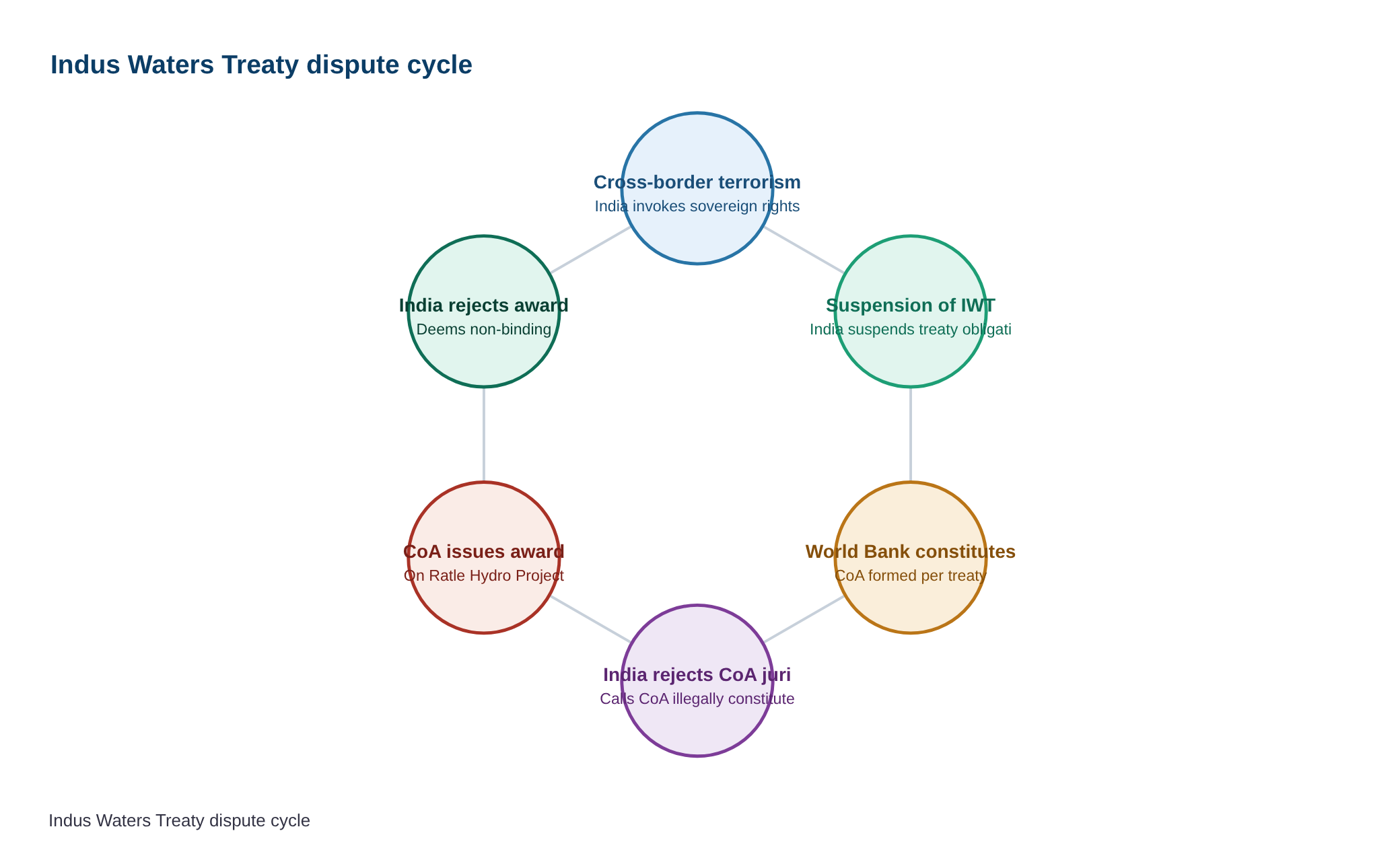
Cross-border terrorism → India invokes sovereign rights → Suspension of IWT → World Bank constitutes CoA → India rejects CoA’s jurisdiction → CoA issues award → India rejects award as non-binding → Diplomatic and legal stalemate
Prelims Practice Questions
Q1. Consider the following statements regarding the Indus Waters Treaty (IWT) 1960:
1. The IWT allocates the waters of the Indus, Jhelum, and Chenab rivers to Pakistan and those of the Ravi, Beas, and Sutlej to India.
2. The Permanent Indus Commission is tasked with resolving disputes under the IWT.
3. The Court of Arbitration (CoA) under the IWT can issue binding awards enforceable under international law.
4. India has never recognised the jurisdiction of the Court of Arbitration (CoA) under the IWT.
How many of the above statements are correct?
- Only one
- Only two
- Only three
- All
Answer: All — Statements 1, 2, and 4 are correct. Statement 3 is incorrect because the IWT does not provide for binding awards by the CoA; the treaty’s dispute resolution mechanism is non-binding and relies on technical experts.
Q2. Assertion (A): The World Bank played a role in constituting the Court of Arbitration (CoA) under the Indus Waters Treaty (IWT).
Reason (R): The IWT explicitly empowers the World Bank to appoint arbitrators and constitute tribunals for dispute resolution.
Options:
A. Both A and R are true, and R is the correct explanation of A.
B. Both A and R are true, but R is not the correct explanation of A.
C. A is true, but R is false.
D. A is false, but R is true.
Answer: ? — Assertion (A) is true as the World Bank has historically facilitated the constitution of the CoA. However, Reason (R) is false because the IWT does not explicitly empower the World Bank to appoint arbitrators; the treaty’s dispute resolution mechanism is governed by its own provisions and does not rely on the World Bank’s authority.
Q3. Which of the following rivers is NOT classified as a Western River under the Indus Waters Treaty (IWT) 1960?
A. Indus
B. Jhelum
C. Ravi
D. Chenab
- A
- B
- C
- D
Answer: C — The Western Rivers under the IWT are the Indus, Jhelum, and Chenab, while the Eastern Rivers are the Ravi, Beas, and Sutlej. Therefore, the Ravi is not a Western River.
Mains Practice Question
✍ The Indus Waters Treaty (IWT) 1960 has been described as a ‘model’ of international water-sharing agreements. Critically examine the legal and institutional framework of the IWT, with particular reference to the dispute resolution mechanism and the recent controversy surrounding the Court of Arbitration (CoA). Also analyse the implications of India’s decision to place the IWT in abeyance in response to cross-border terrorism. (15 Marks)
Approach: MODEL-ANSWER SKELETON:
1. **Introduction (2 marks)**: Briefly outline the IWT 1960, its objectives, and the division of rivers between India and Pakistan (Western Rivers: Indus, Jhelum, Chenab to Pakistan; Eastern Rivers: Ravi, Beas, Sutlej to India). Mention the Permanent Indus Commission as the primary dispute resolution body.
2. **Dispute Resolution Mechanism (5 marks)**:
– Explain the IWT’s dispute resolution framework: bilateral consultations, neutral experts, and the Court of Arbitration (CoA) as a last resort.
– Discuss the role of the World Bank in facilitating the CoA and the legal basis for its involvement.
– Highlight the non-binding nature of the CoA’s awards under the IWT and the principle of state sovereignty in international law.
– Reference the Vienna Convention on the Law of Treaties 1969 (Art. 65-66) on treaty interpretation and dispute resolution.
3. **Recent Controversy and Legal Issues (4 marks)**:
– Analyse India’s rejection of the CoA’s award, citing the claim that the CoA was ‘illegally constituted’ and violated the IWT’s terms.
– Discuss the legal arguments: whether the World Bank’s role in constituting the CoA is consistent with the IWT’s provisions.
– Reference the principle of pacta sunt servanda (treaties must be observed) and the concept of treaty suspension under international law (Vienna Convention, Art. 60-62).
4. **IWT in Abeyance and Implications (4 marks)**:
– Explain India’s decision to place the IWT in abeyance, linking it to cross-border terrorism and the exercise of sovereign rights under international law.
– Discuss the legal validity of suspending a treaty under the Vienna Convention (Art. 60-62) and the conditions for such suspension.
– Analyse the potential consequences for water-sharing, bilateral relations, and India’s international obligations.
– Conclude with a balanced view on the legal and political dimensions of the issue.
Source: orissapost.com
Generated by AanyaAi for educational purpose.
Related guides on our sites
- Best PSIR optional coaching for upsc
- Best PSIR optional teacher for upsc
- Best teacher of PSIR optional for upsc
- Best PSIR optional coaching in delhi for UPSC

- India-Australia AUSTRAHIND 2026 Exercise: Key Highlights for UPSC & State PCS - October 22, 2026
- एससीओ बैठक में भारत का आतंकवाद विरोध: क्षेत्रीय सहयोग पर जोर - October 22, 2026
- SEC Directs Strict SC Order Compliance for Andhra ULB Polls - October 22, 2026

No Comments