


31 Aug FY27 Fiscal Deficit Hits 26.8% of Target by July: CGA Data Insights
✎ The Controller General of Accounts (CGA) has released data indicating that India’s central government’s fiscal deficit for FY 2026-27 reached 26.8% of the annual target by the end of July 2026.
Subject Relevance — Where This Topic Fits
- GS Paper III — Indian Economy: Issues relating to Fiscal Policy
- Prelims: Fiscal Deficit, Controller General of Accounts (CGA), Budget Estimates (BE), Gross Domestic Product (GDP), Devolution of Taxes, Revenue Receipts, Capital Expenditure, Revenue Expenditure
Why is this in the news?
The Controller General of Accounts (CGA) has released data indicating that India’s central government’s fiscal deficit for FY 2026-27 reached 26.8% of the annual target by the end of July 2026. This early trend in deficit accumulation, coupled with a 29.5% realisation of net tax revenues and a 32.9% utilisation of total expenditure against Budget Estimates, signals the need for a closer examination of fiscal governance, revenue mobilisation efficiency, and expenditure prioritisation in the current financial year.
Background
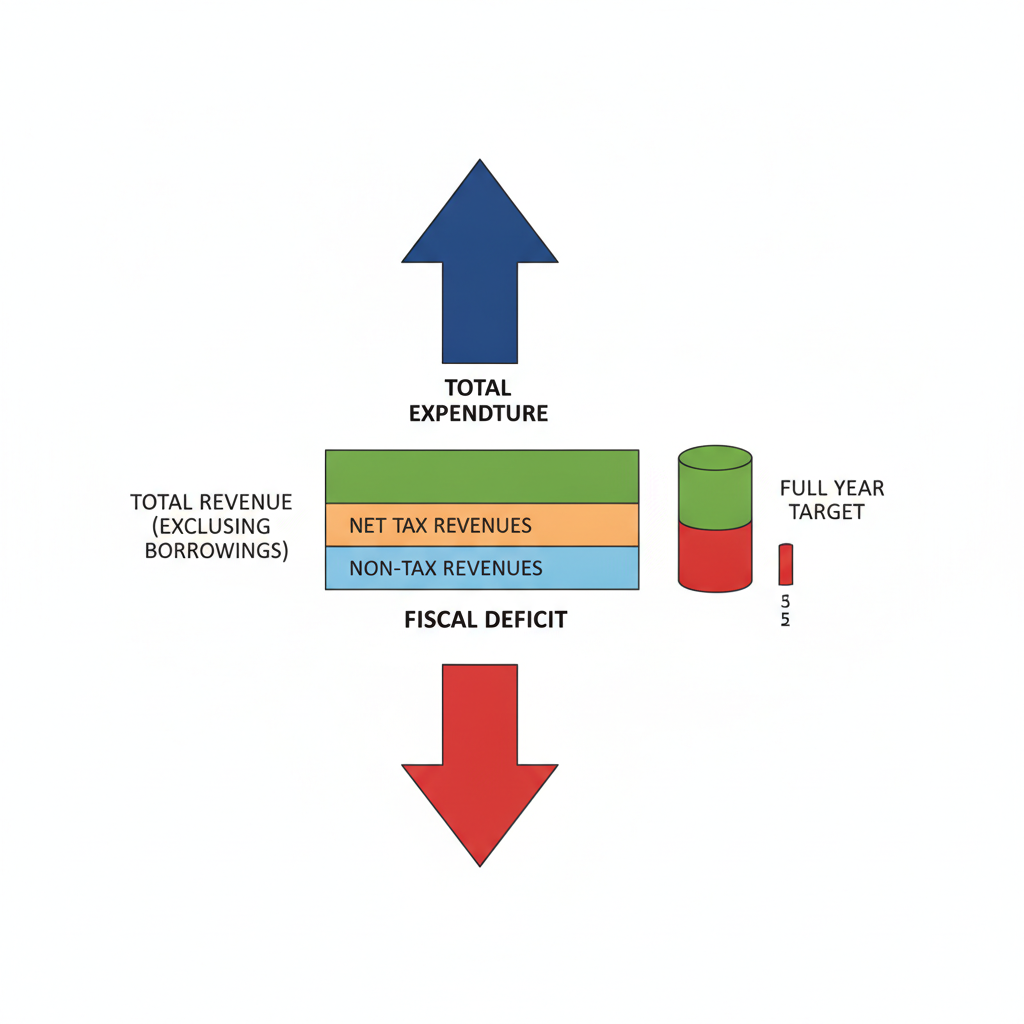
- The fiscal deficit represents the gap between the government’s total expenditure and its total revenue, excluding borrowings. It is a critical indicator of fiscal health and macroeconomic stability.
- The Union Budget for FY 2026-27 sets a fiscal deficit target of 4.3% of GDP, amounting to approximately ₹16.96 lakh crore, aimed at balancing growth imperatives with fiscal prudence.
- The Controller General of Accounts (CGA), under the Ministry of Finance, is responsible for compiling and disseminating monthly and annual fiscal data of the Union government.
- Fiscal deficit trends in the initial months of a financial year are closely monitored as they provide early signals of fiscal pressure, revenue shortfalls, or expenditure overruns.
- The devolution of taxes to state governments forms a significant component of the Union government’s expenditure, with constitutional provisions (Article 270) mandating the distribution of tax proceeds between the Centre and states.
- Revenue receipts, particularly net tax revenues, are the primary source of funding for the government’s non-debt capital and revenue expenditures.
What is Fiscal Deficit and How is it Managed?
- Fiscal deficit is the difference between the total expenditure and total revenue (excluding borrowings) of the government in a financial year. It reflects the extent to which the government relies on borrowing to finance its operations.
- The fiscal deficit is expressed as a percentage of GDP, allowing for comparison across years and economies. A lower fiscal deficit indicates better fiscal health and reduced dependence on borrowing.
- The Union Budget outlines the fiscal deficit target for the year, which is approved by Parliament. The target is set after considering macroeconomic conditions, growth objectives, and fiscal consolidation goals.
- Fiscal deficit is financed through government borrowings, including market borrowings, small savings, and other liabilities. Excessive borrowing can lead to higher interest payments, crowding out private investment, and inflationary pressures.
- [‘The management of fiscal deficit involves balancing revenue mobilisation (tax and non-tax receipts) with expenditure prioritisation (revenue and capital expenditure). Revenue receipts include tax revenues (direct and indirect taxes) and non-tax revenues (dividends, interest, fees, etc.).’]
- Capital expenditure, which includes investments in infrastructure and asset creation, is critical for long-term growth but must be balanced with fiscal sustainability.
- The fiscal deficit target is aligned with the Fiscal Responsibility and Budget Management (FRBM) Act, 2003, which mandates the government to progressively reduce the fiscal deficit and debt levels to ensure macroeconomic stability.
- [‘The CGA compiles monthly fiscal data, including receipts, expenditure, and fiscal deficit, to provide real-time insights into the government’s fiscal performance. This data is essential for policymakers, analysts, and investors to assess fiscal trends and risks.’]
Key Features
| Feature | Significance |
|---|---|
| Fiscal Deficit at 26.8% of FY27 Target (July 2026) | Indicates early-year expenditure acceleration relative to revenue generation, raising concerns over fiscal prudence and sustainability. |
| Net Tax Revenue at 29.5% of BE (April-July 2026) | Exceeds prior-year performance (23.3%), suggesting improved tax compliance or buoyancy but also potential revenue-side risks if growth slows. |
| Total Expenditure at 32.9% of BE (April-July 2026) | Higher than prior-year (30.9%), reflecting front-loaded spending, which may impact fiscal space later in the year. |
| Devolution to States at ₹3,72,354 crore (₹56,190 crore lower YoY) | Reduced transfers may strain state finances, particularly for fiscally weaker states reliant on central devolution. |
| FY27 Deficit Target of 4.3% of GDP (₹16.96 lakh crore) | Benchmark for fiscal consolidation; deviation risks undermining credibility of medium-term fiscal policy framework. |
Why it Matters
Macroeconomic Stability
- Early-year fiscal slippage may signal expansionary bias, potentially influencing inflation expectations and monetary policy calibration.
- High expenditure front-loading could crowd out private investment if fiscal space tightens later in the year, impacting growth sustainability.
- Deviation from deficit targets may erode investor confidence in India’s fiscal discipline, particularly in global capital markets sensitive to sovereign risk.
Fiscal Federalism
- Reduced devolution to states may exacerbate vertical fiscal imbalances, especially for states with high revenue deficits or developmental needs.
- Front-loaded central spending could distort intergovernmental fiscal transfers, affecting the predictability of state-level resource flows.
- Potential strain on state finances may necessitate adjustments in state-level fiscal strategies, including borrowing limits and expenditure prioritisation.
Revenue Performance
- Higher net tax revenue (29.5% of BE) suggests improved GST compliance or economic activity, but sustainability depends on sustained growth and policy stability.
- Corporate tax buoyancy remains a key variable; any slowdown could widen the deficit gap despite front-loaded spending.
- Non-tax revenue streams (e.g., disinvestment, spectrum auctions) may need to compensate for any shortfall in tax collections to meet deficit targets.
Policy Credibility
- Consistent adherence to fiscal deficit targets is critical for maintaining India’s sovereign credit ratings and attracting long-term capital inflows.
- Deviation risks undermining the credibility of the FRBM Act’s fiscal consolidation roadmap, particularly if repeated across multiple years.
- Market reactions to fiscal slippage could lead to higher borrowing costs, constraining the government’s ability to finance developmental expenditures.
Challenges
1. Fiscal Slippage Risk
- Early-year deficit at 26.8% of BE leaves limited headroom for counter-cyclical spending in Q3-Q4, especially if growth slows.
- Higher expenditure front-loading may lead to fiscal fatigue later in the year, necessitating expenditure compression or revenue augmentation.
- Risk of exceeding the 4.3% deficit target, which could trigger automatic stabilisers (e.g., FRBM escape clauses) and necessitate corrective measures.
UPSC Link: FRBM Act 2003 – Fiscal Responsibility and Budget Management
2. Revenue Mobilisation Constraints
- Dependence on tax buoyancy for deficit containment is vulnerable to external shocks (e.g., global slowdown, commodity price volatility).
- Non-tax revenue sources (e.g., disinvestment) are unpredictable and may not materialise as planned, exacerbating fiscal stress.
- GST compliance improvements are necessary but insufficient alone to offset structural revenue gaps in direct taxes.
UPSC Link: GST Council – Revenue Sharing Mechanism
3. Intergovernmental Fiscal Imbalances
- Reduced devolution to states (₹56,190 crore lower YoY) may widen horizontal fiscal disparities, particularly for resource-deficient states.
- States with high committed expenditures (e.g., salaries, pensions) may face liquidity constraints, leading to delayed payments or increased borrowing.
- Potential for fiscal stress in states to spill over into the banking sector via higher NPAs in state government-guaranteed loans.
UPSC Link: Article 279A – GST Council
4. Inflation and Monetary Policy Dilemma
- Expansionary fiscal stance in Q1-Q2 may conflict with RBI’s inflation targeting mandate, complicating monetary policy decisions.
- Higher fiscal deficits could lead to demand-pull inflationary pressures, especially if supply-side constraints persist.
- Risk of a pro-cyclical fiscal stance if growth slows, exacerbating macroeconomic instability.
UPSC Link: RBI Act 1934 – Monetary Policy Framework
5. Investor Sentiment and Capital Flows
- Fiscal slippage may trigger rating agency downgrades, leading to higher borrowing costs for both the Centre and states.
- Foreign portfolio investors (FPIs) may reassess India’s fiscal risk premium, reducing capital inflows to debt and equity markets.
- Long-term capital (e.g., FDI) could be deterred if fiscal sustainability concerns dominate investment decisions.
UPSC Link: SEBI Regulations – Foreign Investment in Government Securities
Challenges — UPSC Perspective
| Issue | Concern |
|---|---|
| Early-year fiscal slippage | Limited fiscal space for counter-cyclical measures in later quarters. |
| Revenue buoyancy uncertainty | Dependence on tax collections may not align with expenditure commitments. |
| State fiscal stress | Reduced devolution may force states to cut developmental expenditures or increase borrowing. |
| Inflationary pressures | Expansionary fiscal stance could conflict with RBI’s inflation targeting objectives. |
| Investor confidence erosion | Fiscal slippage may lead to higher borrowing costs and reduced capital inflows. |
| FRBM compliance risk | Deviation from deficit targets may undermine the credibility of fiscal consolidation efforts. |
Way Forward
- Monitor and rationalise front-loaded expenditure to ensure fiscal space is preserved for Q3-Q4, particularly for developmental and welfare schemes.
- Enhance tax compliance through digitalisation (e.g., faceless assessments, e-invoicing) and expand the tax base via formalisation of the economy.
- Diversify non-tax revenue streams by expediting strategic disinvestment and monetising idle assets (e.g., land, PSU stakes).
- Strengthen intergovernmental fiscal transfers by ensuring predictable and timely devolution, possibly via formula-based adjustments for states in distress.
- Coordinate with RBI to align fiscal and monetary policies, ensuring that expansionary fiscal measures do not undermine inflation control objectives.
- Conduct mid-year fiscal reviews to assess slippage risks and implement corrective measures (e.g., expenditure compression, revenue augmentation).
- Communicate fiscal strategy transparently to markets and stakeholders to maintain investor confidence and pre-empt rating downgrades.
- Leverage technology (e.g., AI-driven tax analytics) to improve revenue forecasting accuracy and reduce fiscal surprises.
UPSC Value Addition
Keywords for Mains Answer-Writing
Fiscal Deficit · Fiscal Responsibility and Budget Management Act · Union Budget · Controller General of Accounts · Fiscal Consolidation · Revenue Expenditure · Capital Expenditure · Gross Fiscal Deficit · Budgetary Process · Public Debt Management · Fiscal Policy · Nominal GDP · Tax Devolution · Fiscal Federalism · Expenditure Management Commission
Concept Flow
Fiscal Deficit (Gap between Expenditure and Revenue) → Early-Year Acceleration (26.8% of BE) → Revenue Performance (29.5% of BE) → Expenditure Front-Loading (32.9% of BE) → Devolution to States (₹3,72,354 crore) → FRBM Target (4.3% of GDP) → Macroeconomic Stability Risks → Policy Corrective Measures.
Prelims Practice Questions
Q1. Consider the following statements regarding the Fiscal Deficit in India:
1. Fiscal Deficit is the difference between the government’s total expenditure and its total revenue.
2. The Fiscal Responsibility and Budget Management (FRBM) Act, 2003 mandates the government to maintain a fiscal deficit of 3% of GDP.
3. The Controller General of Accounts (CGA) releases monthly fiscal deficit data.
4. A higher fiscal deficit always indicates a stronger economy.
How many of the above statements are correct?
- Only one
- Only two
- Only three
- All four
Answer: Only three — Statements 1, 2, and 3 are correct. Statement 4 is incorrect as a higher fiscal deficit does not necessarily indicate a stronger economy; it may reflect higher borrowing and debt levels.
Q2. Assertion (A): The Fiscal Deficit target for the year 2026-27 is set at 4.3% of GDP.
Reason (R): The Fiscal Responsibility and Budget Management (FRBM) Act, 2003, prescribes a fiscal deficit target of 3% of GDP for all years.
Options:
A. Both A and R are true, and R is the correct explanation of A.
B. Both A and R are true, but R is not the correct explanation of A.
C. A is true, but R is false.
D. A is false, but R is true.
Answer: ? — Assertion (A) is true as the fiscal deficit target for 2026-27 is indeed 4.3% of GDP. Reason (R) is false because the FRBM Act allows for deviations from the 3% target under exceptional circumstances, as per the provisions of the Act.
Q3. Match the following terms related to fiscal management in India with their correct descriptions:
Column I
1. Fiscal Deficit
2. Revenue Deficit
3. Primary Deficit
4. Effective Revenue Deficit
Column II
A. Difference between revenue receipts and revenue expenditure
B. Difference between total expenditure and total receipts excluding borrowings
C. Difference between revenue deficit and grants for creation of capital assets
D. Difference between fiscal deficit and interest payments
- 1-B, 2-A, 3-D, 4-C
- 1-A, 2-B, 3-C, 4-D
- 1-D, 2-C, 3-B, 4-A
- 1-C, 2-D, 3-A, 4-B
Answer: 1-B, 2-A, 3-D, 4-C — 1-B: Fiscal Deficit is the difference between total expenditure and total receipts excluding borrowings. 2-A: Revenue Deficit is the difference between revenue receipts and revenue expenditure. 3-D: Primary Deficit is the difference between fiscal deficit and interest payments. 4-C: Effective Revenue Deficit is the difference between revenue deficit and grants for creation of capital assets.
Mains Practice Question
✍ Critically examine the significance of the Fiscal Deficit target in India’s fiscal policy framework. How does the current fiscal deficit trajectory align with the objectives of the Fiscal Responsibility and Budget Management (FRBM) Act, 2003? Also, analyse the implications of the observed fiscal deficit for the Union Government’s expenditure management and intergovernmental fiscal relations. (15 Marks)
Approach: MODEL-ANSWER SKELETON:
1. **Definition and Significance of Fiscal Deficit**: Define Fiscal Deficit as the difference between total expenditure and total receipts excluding borrowings. Explain its significance as a key indicator of fiscal health, reflecting the government’s borrowing requirements and long-term sustainability.
2. **FRBM Act, 2003 Framework**: Outline the salient features of the FRBM Act, including the prescribed fiscal deficit target of 3% of GDP, the escape clause provisions, and the Medium-Term Fiscal Policy Statement. Highlight the rationale behind setting fiscal deficit targets (e.g., debt sustainability, inflation control, and investor confidence).
3. **Current Fiscal Deficit Trajectory**: Analyse the current fiscal deficit data (26.8% of the annual target as of July 2026) in the context of the FRBM Act. Discuss the reasons for the deviation (e.g., higher capital expenditure, revenue shortfalls, or economic slowdown) and its alignment with the FRBM objectives.
4. **Expenditure Management Implications**: Examine the implications of the fiscal deficit trajectory for the Union Government’s expenditure management. Discuss the balance between revenue and capital expenditure, the efficiency of public spending, and the potential crowding-out effects on private investment.
5. **Intergovernmental Fiscal Relations**: Analyse the impact of the fiscal deficit on intergovernmental fiscal relations, particularly the devolution of taxes to state governments. Discuss the observed reduction in tax devolution (Rs 56,190 crore lower than the previous year) and its implications for state finances and cooperative federalism.
6. **Balanced View and Way Forward**: Present a balanced view by discussing the counterarguments (e.g., the need for counter-cyclical fiscal policy during economic downturns) and propose measures to align the fiscal deficit with the FRBM targets (e.g., rationalising subsidies, enhancing tax buoyancy, and improving expenditure efficiency).
7. **Conclusion**: Summarise the key insights and provide a reasoned conclusion on the alignment of the current fiscal deficit trajectory with the FRBM Act’s objectives and the broader implications for India’s fiscal policy framework.
Source: orissapost.com
Generated by AanyaAi for educational purpose.
Related guides on our sites
- Current affairs for upsc 2026
- Best economics optional coaching for upsc
- Best economics optional teacher for upsc
- How to prepare for GS paper 1 for UPSC CSE mains exam


No Comments