


01 Sep Supreme Court Grants Bail to Aarti Vasnik in CGPSC Scam Case
✎ The Supreme Court’s bail order in the CGPSC scam case reinforces the constitutional principle that prolonged detention without trial violates Article 21, necessitating judicial scrutiny of investigative timelines.
Subject Relevance — Where This Topic Fits
- GS Paper II — Polity and Governance (Judicial Process, Fundamental Rights) | GS Paper III — Internal Security (CBI, Corruption Cases)
- Prelims: CBI, Judicial Custody, Anticipatory Bail, Fundamental Rights (Article 21), Lok Sabha Service Commission, Recruitment Scam
- Essay: Judicial Independence vs. Executive Accountability in Governance, Ethical Dimensions of Public Service Recruitment
Quick Revision: The Supreme Court’s bail order in the CGPSC scam case reinforces the constitutional principle that prolonged detention without trial violates Article 21, necessitating judicial scrutiny of investigative timelines.
Why is this in the news?
The Supreme Court’s order granting bail to Aarti Vasnik and Lalit Ganvir in the Chhattisgarh Public Service Commission (CGPSC) recruitment scam case underscores the judiciary’s role in safeguarding individual liberty during prolonged investigations. The decision highlights the balance between investigative thoroughness and the constitutional right to a speedy trial, particularly in cases involving allegations of institutional corruption.
Background
- The CGPSC recruitment scam pertains to alleged irregularities in the selection process for state civil services examinations conducted between 2020 and 2022.
- The Central Bureau of Investigation (CBI) was entrusted with the investigation following a request from the Chhattisgarh government, indicating the gravity of the allegations.
- Key accused include former CGPSC officials, such as Aarti Vasnik (Examination Controller) and Lalit Ganvir (Deputy Examination Controller).
- The CBI’s charge sheet, filed after extensive evidence collection, implicates the accused in manipulating the recruitment process to favour certain candidates.
- The Supreme Court’s intervention follows prolonged judicial custody, raising concerns about the prolonged detention of accused persons pending trial.
- The case exemplifies the challenges in balancing investigative efficiency with the constitutional guarantee of a fair and expeditious trial under Article 21 of the Constitution.
What is the CGPSC Recruitment Scam?
- The CGPSC recruitment scam refers to systemic irregularities in the selection process for state civil services examinations conducted by the Chhattisgarh Public Service Commission.
- Allegations include the manipulation of examination papers, biased interview processes, and preferential treatment extended to candidates with influential connections.
- The CBI’s investigation revealed evidence of procedural lapses, including irregularities in document verification and the manipulation of merit lists.
- The scam has eroded public trust in the integrity of state-level recruitment processes, necessitating stringent oversight and accountability mechanisms.
- The case has led to multiple arrests, including those of senior officials, and has prompted calls for systemic reforms in public service commission operations.
- The Supreme Court’s bail order underscores the judiciary’s role in ensuring that investigative processes do not violate the fundamental rights of accused persons.
- The case also highlights the challenges in prosecuting white-collar crimes, where evidence collection and witness testimonies often prolong judicial proceedings.
Key Features
| Feature | Significance |
|---|---|
| Supreme Court’s interim relief on bail | Upholds the principle of ‘bail as the rule, jail as the exception’ under Article 21, ensuring personal liberty while balancing judicial scrutiny. |
| Judicial scrutiny of CBI’s evidence | Highlights the judiciary’s role in examining the sufficiency of evidence in high-profile corruption cases before denying bail. |
| CBI’s investigation mandate | Demonstrates the Central Bureau of Investigation’s jurisdiction over state-level corruption cases referred by state governments under Section 6 of the Delhi Special Police Establishment Act, 1946. |
| Procedural delays in trials | Exposes systemic bottlenecks in the judicial process, particularly in cases involving multiple witnesses and voluminous evidence. |
| Allegations of procedural irregularities in CGPSC recruitment | Underscores the need for transparent and merit-based public service commission examinations to maintain institutional integrity. |
Why it Matters
Judicial & Legal
- Reinforces the constitutional guarantee of personal liberty (Article 21) by granting bail despite serious allegations, provided the accused does not pose a flight risk or tamper with evidence.
- Demonstrates the judiciary’s function as a check on investigative agencies, ensuring that detention is not used as a punitive measure prior to conviction.
- Sets a precedent for future bail applications in high-stakes corruption cases, balancing the presumption of innocence with the gravity of charges.
Governance & Institutional Integrity
- Exposes vulnerabilities in recruitment processes of State Public Service Commissions, necessitating stricter oversight and anti-corruption measures.
- Highlights the role of investigative agencies (CBI) in maintaining public trust in competitive examinations for civil services.
- Emphasizes the need for transparent mechanisms to prevent undue influence in recruitment, including digital monitoring of examination processes.
Procedural & Administrative
- Reveals systemic inefficiencies in trial proceedings, particularly in cases involving large-scale documentary evidence and multiple witnesses.
- Underscores the importance of expeditious trial completion to prevent prolonged pre-trial detention, which can violate constitutional rights.
- Illustrates the challenges faced by judicial systems in managing high-profile cases without compromising fairness or due process.
Challenges
1. Delays in Judicial Proceedings
- Prolonged pre-trial detention due to judicial backlog and multi-witness testimonies, risking violation of Article 21 (right to speedy trial).
- Increases the burden on undertrials, who may face social and professional stigma despite being presumed innocent.
UPSC Link: Constitutional provisions on speedy trial (Article 21)
2. Procedural Irregularities in Recruitment Examinations
- Risk of manipulation in competitive examinations, undermining meritocracy and public trust in civil services.
- Need for robust digital surveillance and third-party audits to prevent malpractices in examination centers.
UPSC Link: Role of Public Service Commissions (Part XIVA, Article 315-323)
3. Balancing Personal Liberty and Public Interest
- Judicial dilemma in granting bail in high-profile corruption cases, where public perception of justice may conflict with legal principles.
- Ensuring that bail conditions (e.g., surrender of passport, regular reporting) are stringent enough to prevent flight risk without being punitive.
UPSC Link: Fundamental Rights vs. State Interest (Article 19, 21)
4. Investigative Challenges for CBI
- Difficulty in gathering conclusive evidence in cases involving complex financial transactions and multiple stakeholders.
- Coordination challenges with state agencies, particularly when state governments refer cases to the CBI under Section 6 of the DSPE Act.
UPSC Link: Functions and jurisdiction of CBI (DSPE Act, 1946)
Challenges — UPSC Perspective
| Issue | Concern |
|---|---|
| Prolonged judicial proceedings | Violation of Article 21 (right to speedy trial) and increased burden on undertrials. |
| Allegations of recruitment irregularities | Erosion of public trust in civil services and meritocracy. |
| High-profile corruption cases | Risk of judicial overreach or underreach in granting bail. |
| CBI’s investigative constraints | Challenges in securing evidence and coordinating with state agencies. |
| Procedural delays in trials | Potential for pre-trial detention to become punitive rather than preventive. |
Way Forward
- Strengthen digital surveillance and third-party audits in competitive examinations conducted by State Public Service Commissions to prevent malpractices.
- Streamline judicial processes to ensure speedy trials in high-profile cases, possibly through dedicated fast-track courts or special benches.
- Enhance coordination between state agencies and central investigative bodies (e.g., CBI) to expedite evidence collection and reduce procedural delays.
- Implement stricter eligibility criteria and background checks for officials involved in recruitment processes to minimize corruption risks.
- Promote transparency in investigation and trial proceedings by publishing periodic status reports on high-profile cases.
- Conduct periodic reviews of recruitment processes to identify systemic vulnerabilities and introduce corrective measures.
- Sensitize judicial officers on the principles of bail jurisprudence to ensure consistent application of legal standards in granting relief.
UPSC Value Addition
Keywords for Mains Answer-Writing
Judicial discretion in bail jurisprudence · Supreme Court powers under Article 142 · CBI investigation and constitutional safeguards · Judicial custody vs. remand: legal distinctions · Procedural justice in criminal trials · Constitutional provisions on personal liberty (Article 21) · Bail jurisprudence in economic offences · Role of Central Bureau of Investigation (CBI) · Judicial review of investigative agencies · Pre-trial detention and its constitutional limits
Constitutional & Policy Linkages
- Article 21: Protection of life and personal liberty (right to speedy trial and bail).
- Article 14: Equality before law (ensuring fair treatment in bail applications).
- Article 32: Writ jurisdiction of the Supreme Court (enforcement of fundamental rights).
- Part XIVA: Public Service Commissions (Article 315-323) — governance of recruitment processes.
Concept Flow
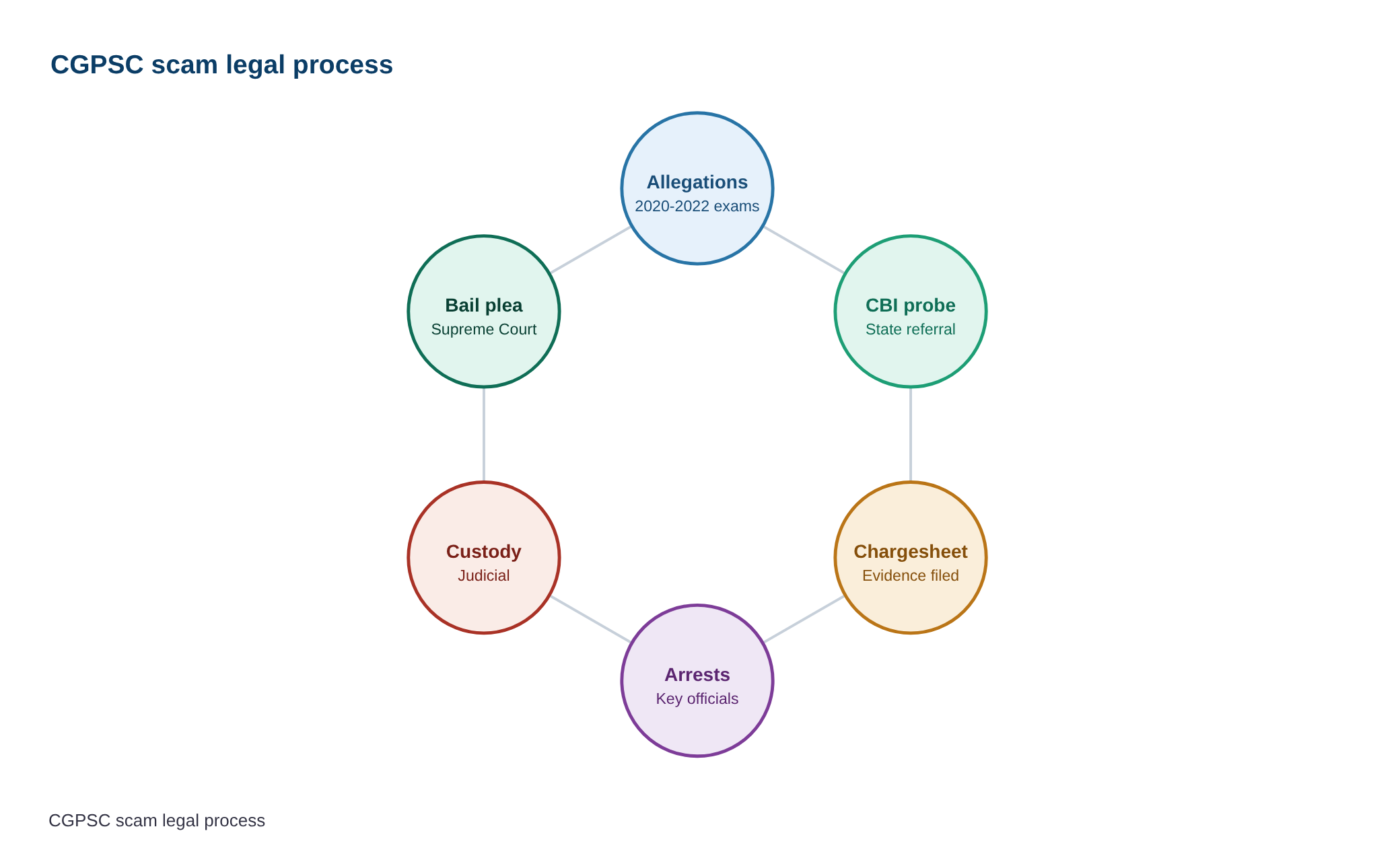
Allegations of irregularities in CGPSC recruitment examinations (2020-2022) → State government refers case to CBI → CBI investigates and files chargesheet → Arrests of key officials (e.g., Aarti Vasnik, Lalit Ganvir) → Prolonged judicial custody → Supreme Court examines bail pleas → Grant of bail on grounds of procedural delays and lack of direct evidence → Reinforcement of bail jurisprudence under Article 21.
Prelims Practice Questions
Q1. Consider the following statements regarding bail jurisprudence in India:
1. The Supreme Court can grant bail under Article 142 of the Constitution even if the accused is in judicial custody.
2. The Code of Criminal Procedure, 1973, empowers magistrates to grant bail in all cases except those punishable with death.
3. The principle of ‘bail not jail’ is explicitly enshrined in the Constitution of India.
How many of the above statements are correct?
- Only one
- Only two
- All three
- None
Answer: Only two — Statement 1 is correct as the Supreme Court can exercise its inherent powers under Article 142 to grant bail. Statement 2 is incorrect because magistrates cannot grant bail in cases punishable with death or life imprisonment without prior approval. Statement 3 is incorrect as the principle of ‘bail not jail’ is a judicial principle, not a constitutional provision.
Q2. Assertion (A): The Central Bureau of Investigation (CBI) is a constitutional body established under Article 312 of the Constitution of India.
Reason (R): The CBI derives its investigative powers from the Delhi Special Police Establishment Act, 1946, and operates under the administrative control of the Department of Personnel and Training, Government of India.
Options:
A. Both A and R are true, and R is the correct explanation of A.
B. Both A and R are true, but R is not the correct explanation of A.
C. A is true, but R is false.
D. A is false, but R is true.
- A
- B
- C
- D
Answer: D — Assertion (A) is false because the CBI is not a constitutional body; it is a statutory body established under the Delhi Special Police Establishment Act, 1946. Reason (R) is true as it correctly describes the legal framework and administrative control of the CBI.
Q3. Match the following provisions of the Code of Criminal Procedure, 1973, with their correct descriptions:
Column I (Provisions) | Column II (Descriptions)
———————|———————–
1. Section 436 | A. Power of magistrate to grant bail in certain cases
2. Section 437 | B. Bail in case of non-bailable offences
3. Section 438 | C. Anticipatory bail
4. Section 439 | D. Bail in case of bailable offences
Options:
A. 1-D, 2-B, 3-C, 4-A
B. 1-B, 2-D, 3-A, 4-C
C. 1-D, 2-A, 3-C, 4-B
D. 1-A, 2-B, 3-D, 4-C
- A
- B
- C
- D
Answer: A — Section 436 of the CrPC pertains to bail in bailable offences (1-D). Section 437 covers bail in non-bailable offences (2-B). Section 438 provides for anticipatory bail (3-C). Section 439 empowers the High Court and Sessions Court to grant bail (4-A).
Mains Practice Question
✍ The Supreme Court’s exercise of its discretionary power under Article 142 to grant bail in high-profile economic offences cases has reignited debates on the balance between personal liberty and procedural justice. Critically examine the constitutional validity of such judicial interventions, with particular reference to the recent bail orders in the Chhattisgarh Public Service Commission (CGPSC) scam case. (15 Marks)
Approach: MODEL-ANSWER SKELETON:
1. **Introduction (2 Marks)**:
– Briefly define Article 142 of the Constitution of India and its scope.
– State the factual context: Supreme Court’s bail orders in the CGPSC scam case (Aarti Vasnik and Lalit Ganvir).
2. **Constitutional Validity of Article 142 (4 Marks)**:
– Discuss the doctrine of ‘complete justice’ under Article 142(1) and its judicial interpretation (e.g., Supreme Court Bar Association v. Union of India, 1998).
– Highlight the balance between judicial discretion and statutory provisions (CrPC, 1973).
– Cite precedents where Article 142 was invoked to grant bail (e.g., Arnab Goswami case, 2020).
3. **Procedural Justice vs. Personal Liberty (4 Marks)**:
– Explain the principle of ‘bail not jail’ as a facet of Article 21 (Maneka Gandhi v. Union of India, 1978).
– Discuss the rationale for bail in cases of prolonged judicial custody (e.g., K.A. Abbas v. Union of India, 2017).
– Critically assess whether such interventions undermine the investigative process or ensure fair trial rights.
4. **Challenges and Criticisms (3 Marks)**:
– Examine concerns about judicial overreach and its impact on the separation of powers.
– Discuss the role of the CBI and the sanctity of investigative agencies’ findings.
– Highlight the need for legislative clarity on bail provisions in economic offences.
5. **Conclusion (2 Marks)**:
– Summarize the need for a nuanced approach balancing constitutional rights and procedural fairness.
– Suggest measures such as time-bound trials or statutory guidelines to harmonize judicial discretion with statutory limits.
Source: amarujala.com
Generated by AanyaAi for educational purpose.
Related guides on our sites
- Current affairs for upsc 2026
- Best PSIR optional coaching for upsc
- Best PSIR optional teacher for upsc
- Best teacher of PSIR optional for upsc

- India-Australia AUSTRAHIND 2026 Exercise: Key Highlights for UPSC & State PCS - October 22, 2026
- एससीओ बैठक में भारत का आतंकवाद विरोध: क्षेत्रीय सहयोग पर जोर - October 22, 2026
- SEC Directs Strict SC Order Compliance for Andhra ULB Polls - October 22, 2026

No Comments