


01 Sep India’s CAD widens to $4.2 bn in Q1 FY27: RBI data for UPSC exam
✎ Current Account Deficit (CAD) = (Merchandise Trade Deficit) + (Net Services Deficit/ Surplus) + (Net Primary Income Outflow) + (Net Secondary Income Inflow); Sustainable financing of CAD requires a balance between long-term…
Subject Relevance — Where This Topic Fits
- GS Paper III — Indian Economy and issues relating to Planning, Mobilisation of Resources, Growth, Development and Employment | GS Paper III — Balance of Payments: Concepts, Components, and Policy Responses | GS Paper III — External Sector and Currency Management
- Prelims: Current Account Deficit (CAD), Balance of Payments (BoP), Merchandise Trade Deficit, Services Exports, Foreign Portfolio Investment (FPI), Foreign Direct Investment (FDI), Non-Resident Deposits (NRI Deposits), External Commercial Borrowings (ECBs), Foreign Exchange Reserves, Primary Income Account, Secondary Income Account
- Essay: The Role of External Sector Stability in India’s Sustainable Economic Growth, Global Geopolitical Shocks and their Impact on Emerging Market Economies
Quick Revision: Current Account Deficit (CAD) = (Merchandise Trade Deficit) + (Net Services Deficit/ Surplus) + (Net Primary Income Outflow) + (Net Secondary Income Inflow); Sustainable financing of CAD requires a balance between long-term capital inflows and reserve depletion.
Why is this in the news?
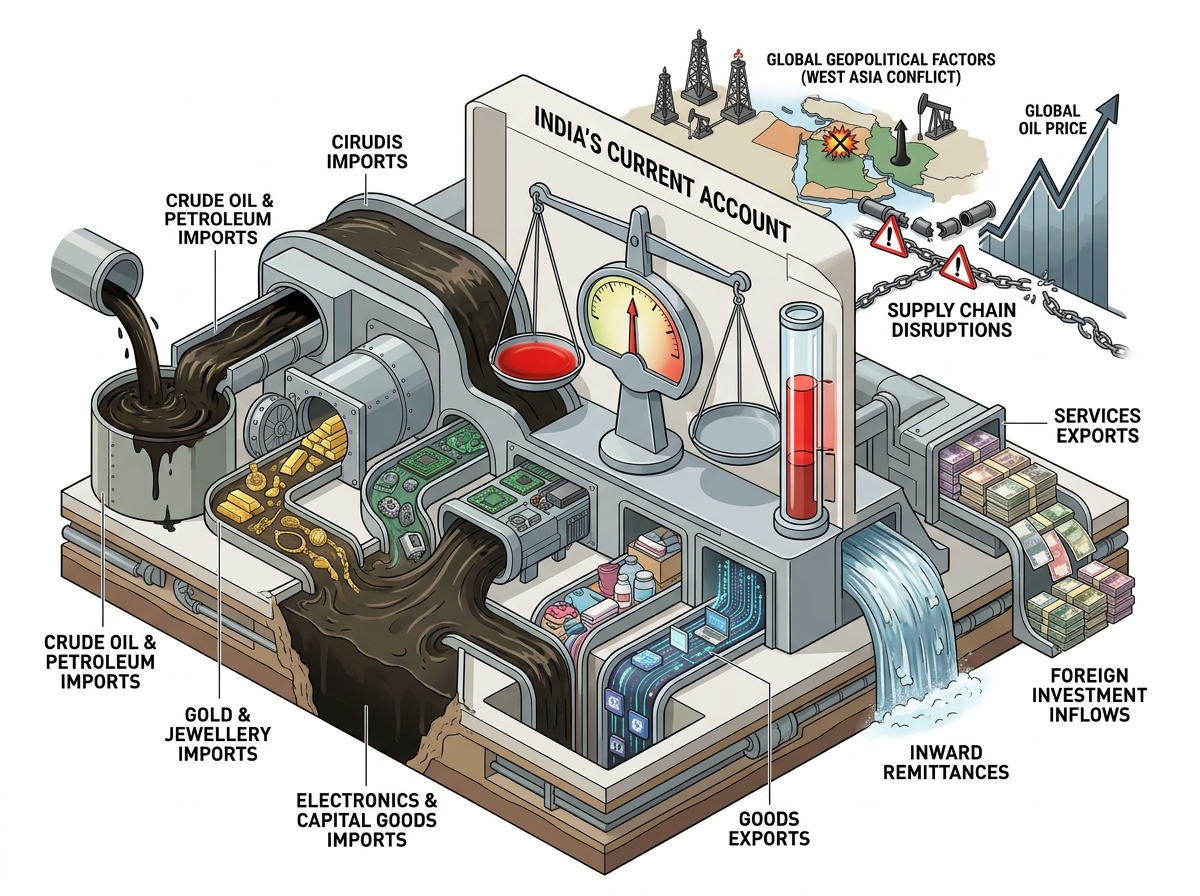
The Reserve Bank of India (RBI) has reported that India’s Current Account Deficit (CAD) widened to USD 4.2 billion (0.5% of GDP) in Q1 2026-27, up from USD 3.4 billion (0.4% of GDP) in the corresponding quarter of the previous fiscal year. This expansion occurred amid a sharp rise in the merchandise trade deficit, influenced by geopolitical tensions in West Asia, which heightened global oil prices and disrupted supply chains. The development underscores the sensitivity of India’s external sector to global commodity price fluctuations and geopolitical risks, necessitating a nuanced understanding of CAD dynamics for UPSC aspirants.
Background
- India’s external sector has historically been characterised by a structural merchandise trade deficit, primarily driven by high import dependence for crude oil, gold, and electronic goods.
- The Current Account Deficit (CAD) is a key indicator of a country’s external sector health, reflecting the gap between foreign exchange outflows (imports, investment income payments) and inflows (exports, remittances, services receipts).
- Geopolitical conflicts in West Asia have recurrently impacted India’s CAD by disrupting crude oil supplies, increasing freight costs, and destabilising regional trade routes.
- India’s services sector, particularly IT-enabled services and business process outsourcing, has emerged as a major source of foreign exchange earnings, partially offsetting the trade deficit.
- The Balance of Payments (BoP) framework, as defined by the IMF and adopted by the RBI, records all economic transactions between residents and non-residents over a specified period.
- India’s foreign exchange reserves serve as a critical buffer against external shocks, enabling the central bank to manage volatility in the external sector.
What is Current Account Deficit (CAD)?
- The Current Account Deficit (CAD) represents the excess of a country’s foreign exchange outflows over its inflows in the current account of the Balance of Payments (BoP).
- It is calculated as: CAD = (Merchandise Exports – Merchandise Imports) + (Net Services Exports) + (Net Primary Income) + (Net Secondary Income).
- A CAD arises when a country imports more goods, services, and investment income than it exports, or when it makes higher unilateral transfers abroad than it receives.
- The CAD is financed through capital inflows such as Foreign Direct Investment (FDI), Foreign Portfolio Investment (FPI), External Commercial Borrowings (ECBs), or by drawing down foreign exchange reserves.
- A sustainable CAD is one that can be financed without excessive reliance on volatile short-term capital flows or depletion of foreign exchange reserves.
- The CAD is expressed as a percentage of GDP to provide a relative measure of its impact on the economy.
- A CAD is not inherently negative; it can reflect a country’s investment-led growth strategy, where capital inflows exceed current account surpluses.
- However, a persistently high CAD may signal structural weaknesses, such as over-reliance on imports, low export competitiveness, or unsustainable consumption patterns.
Key Features
| Feature | Significance |
|---|---|
| Current Account Deficit (CAD) widened to $4.2 billion (0.5% of GDP) | Indicates higher import dependence and reduced export competitiveness, reflecting external sector vulnerabilities. |
| Merchandise trade deficit increased to $86.1 billion | Signals rising import costs, particularly for crude oil and commodities, amid geopolitical tensions in West Asia. |
| Net services receipts rose to $51.6 billion | Demonstrates resilience in service exports, particularly IT, business services, and transportation, offsetting some trade deficit impact. |
| Net outgo on primary income declined to $10.5 billion | Reflects reduced investment income outflows, potentially due to lower repatriation of profits by foreign firms. |
| Personal transfer receipts (remittances) increased to $42.9 billion | Highlights the critical role of diaspora remittances in supporting the current account balance. |
Why it Matters
Macroeconomic Stability
- A widening CAD, even within manageable limits (0.5% of GDP), underscores the need for vigilance in external sector management to prevent exchange rate volatility.
- The increase in CAD is primarily driven by higher import bills, particularly energy imports, which are sensitive to geopolitical disruptions in West Asia.
- Services exports growth provides a partial offset, but sustained CAD pressures may necessitate policy interventions to boost export competitiveness.
External Sector Dynamics
- The financial account data reveals contrasting trends: FDI inflows improved, but FPI outflows surged, indicating investor caution amid global uncertainties.
- Depletion of foreign exchange reserves by $8.1 billion in Q1 2026-27 suggests active intervention to stabilize the rupee, though reserves remain at comfortable levels.
- Lower NRI deposit inflows and ECB borrowings reflect tightening global liquidity conditions and cautious capital flow management.
Structural Challenges
- Dependence on imported crude oil and commodities exposes India to terms-of-trade shocks, particularly during geopolitical conflicts in West Asia.
- The trade deficit’s persistence highlights structural issues such as low manufacturing export competitiveness and high import intensity of growth.
Challenges
1. Geopolitical Risks and Energy Security
- Prolonged conflicts in West Asia disrupt global oil supply chains, leading to higher import costs and widening trade deficits.
- India’s reliance on crude oil imports (over 80% of domestic consumption) amplifies vulnerability to supply-side shocks.
- Policy measures such as strategic petroleum reserves and diversification of energy sources are critical to mitigate risks.
UPSC Link: GS3: Energy Security
2. Export Competitiveness
- Despite growth in services exports, merchandise exports remain constrained by high production costs, infrastructure bottlenecks, and global demand slowdown.
- The trade deficit’s persistence indicates a need for structural reforms in manufacturing, logistics, and trade facilitation.
- Initiatives like the Production-Linked Incentive (PLI) scheme aim to boost domestic manufacturing but require time to yield results.
UPSC Link: GS3: Export Promotion
3. Capital Flow Volatility
- Surge in FPI outflows (USD 9.6 billion) reflects global risk aversion, particularly during periods of monetary tightening by advanced economies.
- Dependence on volatile capital flows (FPI, NRI deposits) poses challenges for exchange rate stability and monetary policy management.
- The RBI’s foreign exchange interventions to stabilize the rupee deplete reserves, necessitating a balanced approach to capital account management.
UPSC Link: GS3: Capital Account Convertibility
4. Fiscal and Monetary Policy Coordination
- A widening CAD may prompt the RBI to maintain tighter monetary policy to curb import demand, potentially conflicting with growth objectives.
- The government’s fiscal stance (e.g., subsidies on petroleum products) indirectly impacts the CAD by influencing domestic demand for imports.
- Coordination between fiscal and monetary policies is essential to address external sector imbalances without compromising growth.
UPSC Link: GS3: Fiscal-Monetary Nexus
Challenges — UPSC Perspective
| Issue | Concern |
|---|---|
| Rising crude oil prices | Increases import bill, widens trade deficit, and pressures CAD. |
| Low manufacturing export growth | Reduces merchandise export earnings, exacerbating trade imbalance. |
| FPI outflows | Leads to rupee depreciation, higher import costs, and reserve depletion. |
| Dependence on remittances | While beneficial, over-reliance on remittances for CAD financing is unsustainable long-term. |
| Limited diversification of energy sources | Exposes economy to geopolitical shocks in West Asia. |
Way Forward
- Enhance export competitiveness through infrastructure upgrades, ease of doing business reforms, and targeted PLI schemes for labor-intensive sectors.
- Diversify energy sources by accelerating renewable energy adoption (solar, wind, green hydrogen) to reduce crude oil import dependence.
- Strengthen strategic petroleum reserves (SPR) to buffer against supply disruptions in West Asia.
- Implement policies to attract stable FDI in manufacturing and services, reducing reliance on volatile FPI flows.
- Promote rupee-denominated trade (INR-RUB, INR-AED) to mitigate exchange rate risks in bilateral trade with West Asian partners.
- Expand remittance channels (digital payments, fintech solutions) to reduce transaction costs and boost diaspora inflows.
- Monitor capital flows closely and use macroprudential tools to manage volatility without stifling growth.
UPSC Value Addition
Keywords for Mains Answer-Writing
Current Account Deficit (CAD) · Balance of Payments (BoP) · Merchandise Trade Deficit · Foreign Exchange Reserves · Foreign Portfolio Investment (FPI) · Foreign Direct Investment (FDI) · Non-Resident Deposits (NRI Deposits) · External Commercial Borrowings (ECBs) · Primary Income Account · Services Exports · Remittances · West Asia Conflict · Macroeconomic Stability · Capital Account · Financial Account
Concept Flow
Geopolitical conflict in West Asia → Disruption in global oil supply chains → Higher crude oil prices → Increased import bill → Widening merchandise trade deficit → CAD expansion. → CAD expansion → Higher foreign exchange outflows → Pressure on rupee → RBI interventions (reserve depletion) → Impact on monetary policy stance. → Widening CAD → Potential rupee depreciation → Higher import costs (inflation) → Reduced purchasing power → Impact on domestic growth. → FPI outflows → Rupee depreciation → Higher import costs → Widening CAD → Further FPI outflows (vicious cycle). → Remittances growth → Partial offset to CAD → But unsustainable if not complemented by structural export growth. → FDI inflows → Long-term capital → Supports CAD financing → But requires conducive business environment. → Policy response → Export promotion, energy diversification, capital flow management → Aims to restore CAD sustainability.
Prelims Practice Questions
Q1. Consider the following statements regarding India’s Current Account Deficit (CAD):
1. CAD is recorded when a country’s exports exceed its imports.
2. A widening CAD is always indicative of a decline in foreign exchange reserves.
3. Net services receipts contribute positively to the current account.
4. Personal transfer receipts under the secondary income account primarily represent remittances by Indians employed overseas.
How many of the above statements are correct?
- Only one
- Only two
- Only three
- All four
Answer: All four — Statement 1 is incorrect because CAD occurs when imports exceed exports. Statements 2, 3, and 4 are correct as per the RBI data and BoP framework.
Q2. Assertion (A): A rise in the merchandise trade deficit leads to a widening of the Current Account Deficit.
Reason (R): The Current Account Deficit is calculated as the sum of the trade balance, net services, and primary income account.
Options:
A. Both A and R are true, and R is the correct explanation of A.
B. Both A and R are true, but R is not the correct explanation of A.
C. A is true, but R is false.
D. A is false, but R is true.
- A
- B
- C
- D
Answer: A — Assertion (A) is true as a higher merchandise trade deficit directly contributes to a wider CAD. Reason (R) is also true and correctly explains the assertion.
Q3. Match the following components of India’s Balance of Payments with their respective net inflows/outflows in Q1 2026-27 (as per RBI data):
Column I (Component) | Column II (Net Flow in USD billion)
— | —
A. Foreign Direct Investment (FDI) | 1. -9.6
B. Foreign Portfolio Investment (FPI) | 2. 6.1
C. Non-Resident Deposits (NRI Deposits) | 3. 2.8
D. External Commercial Borrowings (ECBs) | 4. Lower than previous year
Options:
A-2, B-1, C-3, D-4
A-1, B-2, C-3, D-4
A-3, B-1, C-2, D-4
A-2, B-1, C-4, D-3
- A-2, B-1, C-3, D-4
- A-1, B-2, C-3, D-4
- A-3, B-1, C-2, D-4
- A-2, B-1, C-4, D-3
Answer: A-2, B-1, C-3, D-4 — FDI recorded a net inflow of USD 6.1 billion (A-2). FPI recorded a net outflow of USD 9.6 billion (B-1). NRI deposits recorded a net inflow of USD 2.8 billion (C-3). ECBs were lower than the previous year (D-4).
Mains Practice Question
✍ The widening of India’s Current Account Deficit (CAD) to USD 4.2 billion in Q1 2026-27, driven by a sharp rise in the merchandise trade deficit amid the West Asia conflict, underscores the vulnerabilities in India’s external sector. Critically examine the macroeconomic implications of a sustained CAD for India’s economy. Also, assess the role of the services sector and remittances in mitigating these challenges. (15 Marks)
Approach: MODEL-ANSWER SKELETON:
1. **Definition and Context**: Define CAD and its calculation (BoP framework: trade balance + net services + primary income + secondary income). Reference the RBI data for Q1 2026-27 (USD 4.2 billion, 0.5% of GDP) and the merchandise trade deficit (USD 86.1 billion).
2. **Macroeconomic Implications of Sustained CAD**:
– **Exchange Rate Pressure**: Discuss depreciation risks and import inflation (e.g., crude oil imports from West Asia).
– **Foreign Exchange Reserves**: Link to the depletion of USD 8.1 billion in Q1 2026-27 (BoP basis) and its impact on import cover.
– **Debt Sustainability**: Highlight the reliance on capital inflows (FDI, FPI, ECBs) and their volatility (e.g., net FPI outflow of USD 9.6 billion).
– **Inflation and Growth**: Explain the transmission mechanism via imported inflation and its impact on monetary policy (e.g., RBI’s stance on interest rates).
3. **Role of Services Sector and Remittances**:
– **Services Exports**: Cite the growth in net services receipts (USD 51.6 billion) and its composition (computer services, business services, transportation). Discuss the structural advantages (IT-BPM sector, skilled labour).
– **Remittances**: Reference the rise in personal transfer receipts (USD 42.9 billion) and its significance for the current account. Discuss the role of Indian diaspora in Gulf countries and its sensitivity to West Asia conflicts.
4. **Policy Responses and Challenges**:
– **Export Promotion**: Mention schemes like the Foreign Trade Policy (2023) and Production-Linked Incentive (PLI) schemes.
– **Diversification of Trade Partners**: Discuss the need to reduce dependence on West Asia for oil and non-oil imports.
– **Capital Account Management**: Highlight the role of FDI (USD 6.1 billion inflow) and the challenges in attracting stable FPI flows.
5. **Conclusion**: Balance the risks (CAD sustainability, exchange rate volatility) with opportunities (services sector resilience, remittances). Emphasise the need for a multi-pronged approach combining trade policy, export diversification, and capital account management.
Source: orissapost.com
Generated by AanyaAi for educational purpose.
Related guides on our sites
- Current affairs for upsc 2026
- Best economics optional coaching for upsc
- Best economics optional teacher for upsc
- How to prepare for GS paper 1 for UPSC CSE mains exam

- भारत को AI में ‘मालिक’ बनना है तो किराया वसूलना होगा - October 23, 2026
- Civil Defence Network: Vision of PM Modi for Enhanced Security - October 23, 2026
- भारत-रूस नौसैनिक अभ्यास INDRA 2026 संपन्न: रक्षा सहयोग में नया आयाम - October 23, 2026

No Comments