


02 Sep Telangana HC Stays Stay on Kalyana Lakshmi & Shaadi Mubarak Schemes
✎ Welfare schemes implemented through executive orders must align with constitutional provisions; judicial review ensures compliance but cannot arbitrarily stall welfare measures without due process.
Subject Relevance — Where This Topic Fits
- GS Paper II — Constitutional and Non-Constitutional Bodies (Judiciary) | GS Paper II — Government Policies and Interventions for Development in various sectors | GS Paper III — Issues relating to Poverty and Hunger | GS Paper III — Welfare Schemes for Vulnerable Sections of the population by the Centre and States
- Prelims: Kalyana Lakshmi Scheme, Shaadi Mubarak Scheme, Article 142 of the Constitution, Writ Jurisdiction under Article 226, Executive Orders vs Legislative Backing, Comptroller and Auditor General (CAG), Interlocutory Applications, Division Bench vs Single Judge Bench
- Essay: The Role of Judiciary in Balancing Social Welfare and Constitutional Governance, Federalism and State Autonomy in Implementing Welfare Schemes
Quick Revision: Welfare schemes implemented through executive orders must align with constitutional provisions; judicial review ensures compliance but cannot arbitrarily stall welfare measures without due process.
Why is this in the news?
The Telangana High Court’s division bench recently stayed a single judge’s order that had stalled the implementation of the Kalyana Lakshmi and Shaadi Mubarak schemes. The case raises critical questions about the constitutional validity of welfare schemes implemented through executive orders, the maintainability of public interest litigation, and the balance between judicial review and executive autonomy in welfare governance. The ruling assumes significance in the context of India’s federal structure, where states frequently deploy innovative welfare measures to address socio-economic disparities.
Background
- The Kalyana Lakshmi and Shaadi Mubarak schemes were launched by the Telangana government in 2014 to provide financial assistance to marginalised communities for marriage-related expenses.
- The schemes are implemented through Government Orders (GOs), which are executive instruments, rather than legislative enactments.
- A practicing advocate filed a writ petition challenging the schemes, arguing that they lacked constitutional validity and legal sanctity due to their executive origin.
- The single judge bench, in an interlocutory order, stayed the implementation of the schemes pending a final hearing on their constitutional validity.
- The state government, represented by the Advocate General, argued that the schemes had been in operation since 2014 and had received judicial appreciation in other contexts.
- The division bench’s stay order reflects the judiciary’s role in ensuring continuity of welfare schemes while examining their legal basis.
What are the Kalyana Lakshmi and Shaadi Mubarak Schemes?
- Launched in 2014 by the Government of Telangana, these schemes aim to provide financial assistance to economically weaker sections for marriage-related expenses.
- The schemes are implemented through Government Orders (GOs), which are executive instruments, and are not backed by specific legislative enactments.
- Eligibility criteria include income thresholds, age limits for the bride and groom, and domicile requirements in Telangana.
- The schemes are part of Telangana’s broader welfare architecture, which includes other initiatives like Rythu Bandhu (agricultural support) and Aasara pensions (social security).
- The financial outlay for these schemes is significant, with allocations made in the state budget annually.
- The schemes have been cited in judicial pronouncements as examples of state-led welfare measures addressing socio-economic vulnerabilities.
Key Features
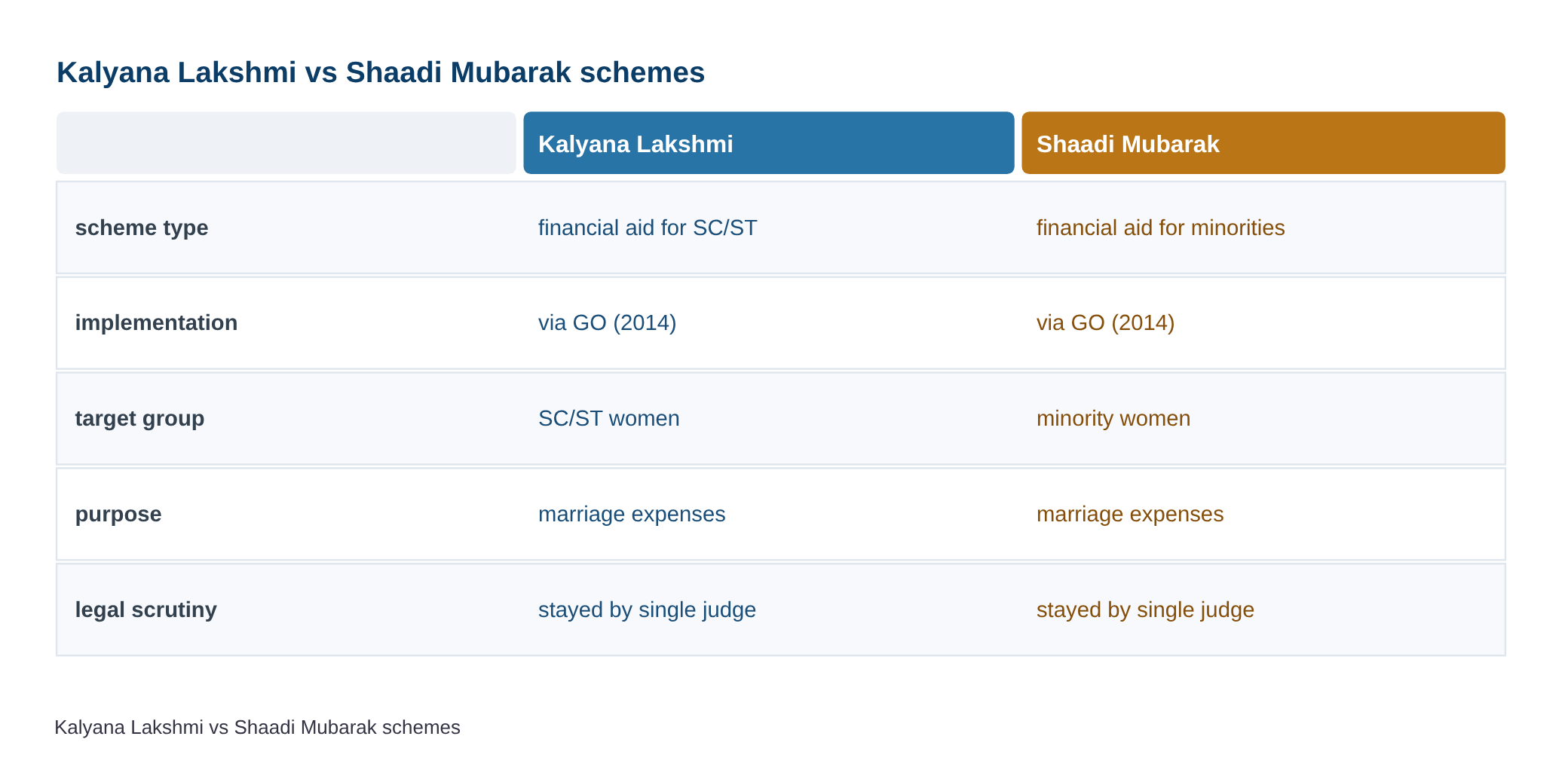
| Feature | Significance |
|---|---|
| Kalyana Lakshmi Scheme | Provides financial assistance to unmarried women from marginalised communities for marriage, aimed at reducing financial burden on economically weaker sections. |
| Shaadi Mubarak Scheme | Offers financial aid to Muslim women from backward classes for marriage, ensuring inclusive welfare coverage across religious communities. |
| Government Orders (GOs) | Executive instruments through which these schemes are operationalised, subject to legal scrutiny for constitutional validity. |
| Division Bench Stay Order | Judicial intervention suspending a single-judge order that stalled scheme implementation, pending final adjudication on legal sanctity. |
| Advocate General’s Argument | Contended that schemes have been operational since 2014 and lack of beneficiary status does not invalidate maintainability of the petition. |
Why it Matters
Social Welfare
- Addresses socio-economic barriers to marriage for marginalised women, particularly in Scheduled Castes, Scheduled Tribes, and Minority communities.
- Promotes gender equity by mitigating financial constraints that disproportionately affect women from economically weaker sections.
- Demonstrates state-led affirmative action to uplift vulnerable sections, aligning with Directive Principles of State Policy (Article 38, 46).
Fiscal Governance
- Highlights the fiscal implications of welfare schemes implemented via executive orders, necessitating legislative oversight for sustainability.
- Raises questions on the constitutional validity of expenditure incurred without explicit legislative backing, impacting budgetary allocations.
- Emphasises the role of judicial review in ensuring fiscal prudence and adherence to constitutional frameworks in welfare governance.
Judicial Process
- Illustrates the hierarchy of judicial intervention, where division benches can stay orders of single judges pending final adjudication.
- Demonstrates the principle of maintainability in public interest litigation, particularly regarding locus standi of petitioners.
- Showcases the judiciary’s role in balancing welfare implementation with constitutional scrutiny.
Challenges
1. Constitutional Validity of Executive Orders
- Schemes operationalised via GOs lack explicit legislative backing, raising concerns under Article 13 of the Constitution regarding ‘law’ as defined.
- Potential conflict with the principle of separation of powers, where executive schemes encroach upon legislative domain without statutory sanction.
- Judicial scrutiny required to determine if such schemes can be sustained under Article 21 (Right to Life) or Directive Principles (Article 38, 46).
UPSC Link: Article 13, 21, 38, 46
2. Maintainability of Public Interest Litigation
- Petitioner’s lack of direct stake in the schemes questions their locus standi under Article 32/226 of the Constitution.
- Judicial interpretation on whether PILs can be filed solely on grounds of legal validity without personal injury or adverse impact.
- Balancing access to justice for marginalised beneficiaries against frivolous or politically motivated litigation.
UPSC Link: Article 32, 226
3. Fiscal Sustainability and Audit Scrutiny
- Absence of CAG remarks does not preclude constitutional scrutiny; however, lack of audit trails may hinder fiscal accountability.
- Risk of schemes becoming fiscally unsustainable without legislative backing, leading to ad-hoc budgetary allocations.
- Need for transparent cost-benefit analysis to justify expenditure on welfare schemes of this nature.
UPSC Link: CAG, Fiscal Responsibility
4. Implementation Gaps and Exclusion Errors
- Potential for exclusion of deserving beneficiaries due to stringent eligibility criteria or administrative bottlenecks.
- Lack of standardised grievance redressal mechanisms for beneficiaries facing delays or denials.
- Need for periodic reviews to assess scheme efficacy and address implementation challenges.
UPSC Link: Administrative Law
Challenges — UPSC Perspective
| Issue | Concern |
|---|---|
| Lack of Legislative Backing | Schemes operationalised via GOs may violate constitutional principles of governance and fiscal prudence. |
| Judicial Overreach vs. Judicial Activism | Balancing the judiciary’s role in welfare governance without encroaching on legislative or executive domains. |
| Fiscal Irregularities | Risk of unchecked expenditure without legislative sanction, potentially violating constitutional fiscal discipline. |
| Exclusion and Inclusion Errors | Administrative lapses leading to either exclusion of eligible beneficiaries or inclusion of ineligible ones. |
| Maintainability of PILs | Determining the threshold for public interest litigation to prevent misuse while ensuring access to justice. |
Government Initiatives — Must-Memorise for Prelims
- Kalyana Lakshmi Scheme
- Shaadi Mubarak Scheme
Way Forward
- The division bench should expedite final adjudication to resolve the constitutional validity of schemes operationalised via executive orders.
- State governments must consider legislative backing for such schemes to ensure legal sanctity and fiscal sustainability.
- Conduct a CAG audit to assess fiscal prudence, transparency, and utilisation of funds under these schemes.
- Strengthen grievance redressal mechanisms to address implementation gaps and ensure inclusive coverage.
- Standardise eligibility criteria and verification processes to minimise exclusion and inclusion errors.
- Explore convergence with other welfare schemes (e.g., PMMVY) to enhance coverage and reduce administrative duplication.
- Publish periodic impact assessments to evaluate scheme efficacy and justify continued funding.
- Clarify judicial precedents on maintainability of PILs in cases of alleged constitutional violations.
UPSC Value Addition
Keywords for Mains Answer-Writing
Kalyana Lakshmi Scheme · Shaadi Mubarak Scheme · Telangana High Court · welfare schemes for marginalised sections · executive orders vs legislative backing · Constitutional validity of schemes · Comptroller and Auditor General (CAG) · writ jurisdiction under Article 226 · interim orders in writ petitions · State welfare policies · Backward Classes welfare · Scheduled Castes and Scheduled Tribes welfare · financial implications of welfare schemes · judicial review of executive actions
Constitutional & Policy Linkages
- {‘Article 13’: “Defines ‘law’ and judicial review of executive actions.”}
- {‘Article 21’: ‘Right to life and personal liberty, including dignity and welfare.’}
- {‘Article 32’: ‘Writs for enforcement of fundamental rights.’}
- {‘Article 226’: ‘High Court jurisdiction for enforcement of rights.’}
- {‘Article 38’: ‘Directive Principle promoting social welfare.’}
- {‘Article 46’: ‘Directive Principle for protection of weaker sections.’}
Concept Flow
State governments introduce welfare schemes (Kalyana Lakshmi, Shaadi Mubarak) via Government Orders (GOs) to provide financial assistance to marginalised women. → Executive orders face legal scrutiny for lack of legislative backing, raising questions under Article 13 and separation of powers. → Single-judge order halts implementation, citing lack of constitutional validity and maintainability issues in PIL. → Division bench stays single-judge order, allowing schemes to continue pending final adjudication on legal sanctity. → Judicial process examines fiscal governance, PIL maintainability, and constitutional validity, balancing welfare and rule of law. → Final judgment to determine if schemes can be sustained under constitutional provisions (Articles 21, 38, 46) or require legislative backing.
Prelims Practice Questions
Q1. Consider the following statements regarding the Kalyana Lakshmi and Shaadi Mubarak schemes of Telangana:
1. These schemes are implemented through Government Orders (GOs) issued by the executive branch.
2. The schemes provide financial assistance to unmarried women from marginalised sections for marriage.
3. The Comptroller and Auditor General (CAG) has explicitly declared these schemes as constitutionally invalid.
How many of the above statements are correct?
- Only one
- Only two
- All three
- None
Answer: Only two — Statement 1 is correct as the schemes are implemented through GOs. Statement 2 is correct as the schemes aim to provide financial assistance for marriage to marginalised women. Statement 3 is incorrect as the CAG has not declared the schemes constitutionally invalid.
Q2. Assertion (A): The Telangana High Court stayed a single judge order stalling the Kalyana Lakshmi and Shaadi Mubarak schemes.
Reason (R): The schemes lack legislative backing and constitutional validity, as argued by the petitioner.
Options:
A. Both A and R are true, and R is the correct explanation of A.
B. Both A and R are true, but R is not the correct explanation of A.
C. A is true, but R is false.
D. A is false, but R is true.
- A
- B
- C
- D
Answer: C — Assertion (A) is true as the High Court stayed the single judge order. Reason (R) is true but does not correctly explain the assertion, as the High Court’s decision was based on procedural grounds rather than the constitutional validity of the schemes.
Q3. Which of the following constitutional provisions empowers the High Courts to issue writs for the enforcement of fundamental rights and other legal rights?
- Article 32
- Article 226
- Article 136
- Article 142
Answer: Article 226 — Article 226 of the Indian Constitution empowers High Courts to issue writs for the enforcement of fundamental rights and other legal rights. Article 32 is related to the Supreme Court’s writ jurisdiction.
Mains Practice Question
✍ The implementation of welfare schemes such as Kalyana Lakshmi and Shaadi Mubarak in Telangana has been challenged on grounds of lack of legislative backing and constitutional validity. Critically examine the legal and constitutional dimensions of such welfare schemes, with particular reference to the role of executive orders, judicial review, and the principles of separation of powers. Also, analyse the implications of the Telangana High Court’s decision to stay the single judge order stalling these schemes. (15 Marks)
Approach: MODEL-ANSWER SKELETON:
1. **Introduction**: Define welfare schemes and their significance in Indian polity, citing constitutional provisions like Directive Principles of State Policy (Article 38, 39, 46) and Fundamental Rights (Article 21).
2. **Executive Orders vs Legislative Backing**: Explain the legal basis for implementing welfare schemes through executive orders (GOs) and the requirement of legislative backing under Article 299(1). Discuss the doctrine of ‘colourable legislation’ and the necessity of parliamentary or legislative sanction for schemes with significant financial implications.
3. **Judicial Review and Writ Jurisdiction**: Analyse the scope of judicial review under Article 226, including the maintainability of writ petitions challenging executive actions. Discuss the distinction between interim orders and final orders in writ petitions and the appellate jurisdiction of the High Court.
4. **Separation of Powers**: Examine the principle of separation of powers in the context of welfare schemes, highlighting the roles of the executive, legislature, and judiciary. Discuss the balance between judicial activism and judicial restraint.
5. **Telangana High Court’s Decision**: Critically assess the High Court’s decision to stay the single judge order, focusing on procedural grounds (e.g., maintainability of the petition) and the lack of evidence regarding constitutional invalidity.
6. **Role of CAG and Financial Implications**: Discuss the significance of the Comptroller and Auditor General’s role in auditing welfare schemes and the financial implications of such schemes on state exchequers.
7. **Conclusion**: Summarise the legal and constitutional dimensions, and provide a balanced view on the judiciary’s role in overseeing welfare schemes while respecting the executive’s policy-making authority.
Source: The Hindu
Generated by AanyaAi for educational purpose.
Related guides on our sites
- Best PSIR optional coaching for upsc
- Best PSIR optional teacher for upsc
- Best teacher of PSIR optional for upsc
- Best PSIR optional coaching in delhi for UPSC

- UPSC Focus: Labour Codes & Social Security in UP’s Two-Day Dialogue - October 24, 2026
- मध्य प्रदेश में नर्मदा माइक्रो सिंचाई परियोजना: 72 हजार किसानों को मिलेगा लाभ - October 24, 2026
- Chief Secretary directs districts to enrol hospitals under PM Rahat scheme - October 24, 2026

No Comments