


03 Sep Karnataka Withdraws Parks Amendment Bill After Massive Protests
✎ The Public Trust Doctrine mandates that urban parks, as public commons, must be preserved for public benefit and cannot be alienated arbitrarily without due process and public consultation.
Subject Relevance — Where This Topic Fits
- GS Paper II — Functions and Responsibilities of the Union and the States, Issues and Challenges Pertaining to the Federal Structure | GS Paper III — Conservation, Environmental Pollution and Degradation, Environmental Impact Assessment
- Prelims: Urban commons, public goods, Article 297 of the Constitution, Environmental Impact Assessment (EIA) 2006, Public Trust Doctrine, Lalbagh Botanical Garden, Cubbon Park
- Essay: The balance between developmental imperatives and preservation of public commons, Citizen participation in governance: efficacy and limits
Quick Revision: The Public Trust Doctrine mandates that urban parks, as public commons, must be preserved for public benefit and cannot be alienated arbitrarily without due process and public consultation.
Why is this in the news?
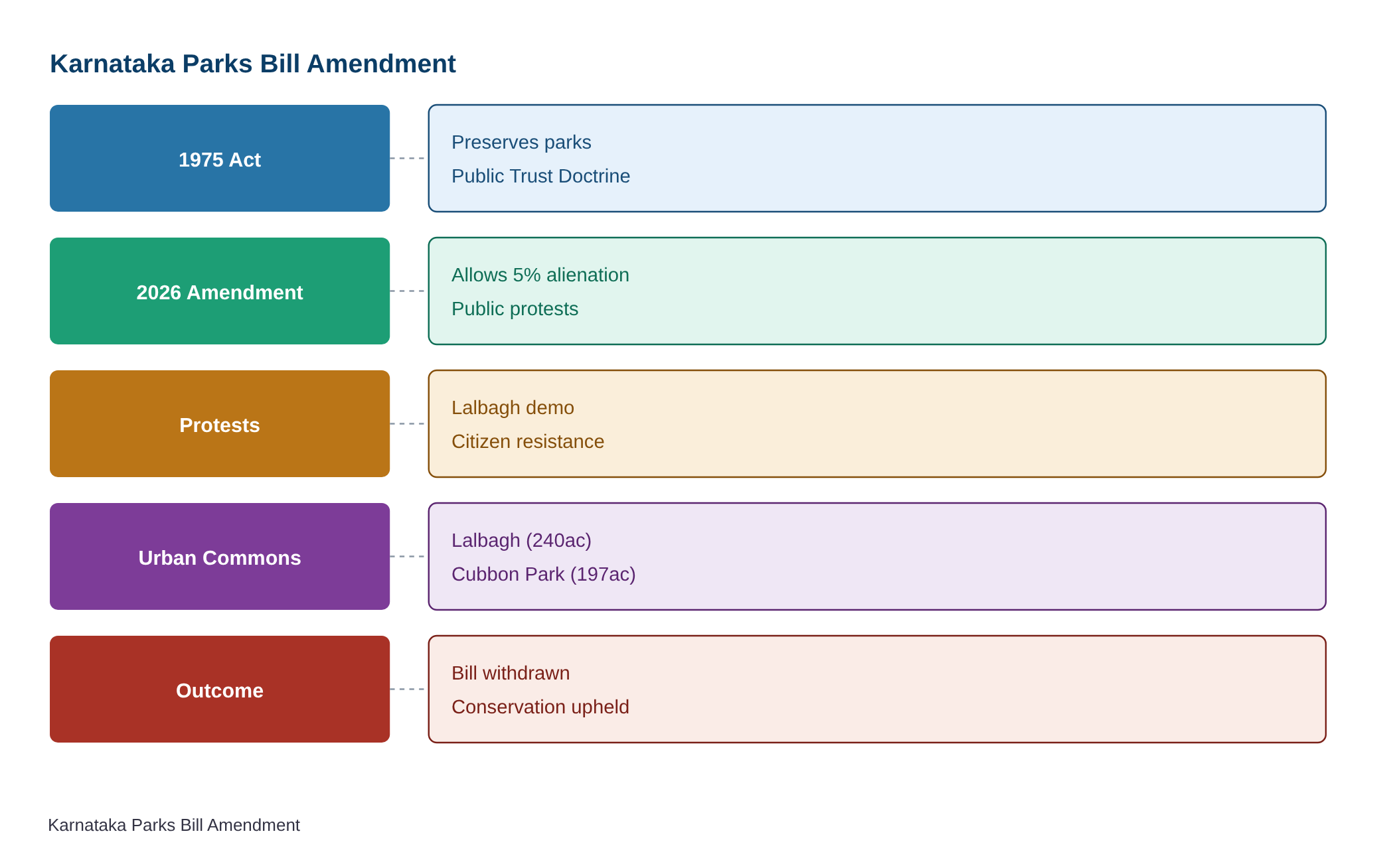
The Karnataka Government’s decision to withdraw the Karnataka Government Parks (Preservation) (Amendment) Bill, 2026, following widespread protests, highlights a critical governance dilemma: reconciling the need for public infrastructure with the preservation of urban commons. The Bill sought to amend the 1975 Act to allow up to 5% of park land to be alienated for public utility projects, sparking public outrage and political opposition. This episode underscores the constitutional and policy challenges in managing public spaces, the role of citizen participation in legislative processes, and the application of the Public Trust Doctrine in urban governance.
Background
- The Karnataka Government Parks (Preservation) Act, 1975, was enacted to protect government-owned parks from misuse, alienation, or commercial exploitation, ensuring their preservation as public goods for recreational, ecological, and aesthetic purposes.
- Bengaluru, with over 1,353 parks, hosts iconic green spaces such as the 240-acre Lalbagh Botanical Garden and the 197-acre Cubbon Park, which are vital for urban biodiversity, microclimate regulation, and public health.
- Urban commons like parks are subject to competing demands from infrastructure development, housing, and commercial projects, often leading to tensions between conservation and developmental priorities.
- The Public Trust Doctrine, derived from Roman law and embedded in Indian jurisprudence, mandates that certain resources (e.g., parks, rivers, forests) are held in trust by the state for the benefit of the public and cannot be alienated arbitrarily.
- The amendment proposed in 2026 sought to introduce flexibility in park land use, reflecting a broader trend of states revisiting conservation laws to address urbanisation pressures.
- Citizen protests, including a large demonstration at Lalbagh on August 30, 2026, signalled public resistance to the perceived dilution of protection for urban green spaces.
What is the Karnataka Government Parks (Preservation) (Amendment) Bill, 2026?
- The Bill aimed to amend Section 5 of the Karnataka Government Parks (Preservation) Act, 1975, to permit the alienation of up to 5% of park land for public infrastructure projects such as roads, utilities, or civic amenities.
- Alienation under the amendment included mechanisms like sale, lease, gift, exchange, or mortgage, raising concerns about potential commercialisation of public parks.
- The government justified the amendment by citing the need for public infrastructure, including roads, water supply lines, and other utilities, to support Bengaluru’s growing urban population.
- The Bill was passed during a legislative session without prior public consultation, which critics argued contributed to misconceptions and opposition.
- The amendment process triggered protests under the banner ‘Walk in Lalbagh. Walk for Lalbagh,’ reflecting citizen concerns over the potential loss of green spaces and ecological degradation.
- The withdrawal of the Bill by the Karnataka Cabinet on September 3, 2026, followed public backlash and political opposition, with the government pledging to seek wider public opinion before reintroducing it.
- The episode highlights the tension between developmental imperatives and the preservation of urban commons, a recurring theme in Indian urban governance.
Key Features
| Feature | Significance |
|---|---|
| Proposed Amendment to The Karnataka Government Parks (Preservation) Act, 1975 | Introduced a provision to permit diversion of up to 5% of park land for public infrastructure projects, expanding the scope of permissible land use beyond preservation. |
| Public Protests at Lalbagh and Cubbon Park | Demonstrated significant citizen engagement and opposition to the amendment, highlighting concerns over ecological and recreational loss in urban green spaces. |
| Cabinet Withdrawal and Reconsideration | Indicated responsiveness to public feedback and willingness to revisit the amendment, ensuring procedural transparency in legislative processes. |
| Public Consultation Mechanism | Emphasised the necessity of pre-legislative public discourse to address misconceptions and align policy with societal expectations. |
| Urban Green Space Management | Reflected the broader challenge of balancing developmental needs with environmental conservation in rapidly urbanising regions like Bengaluru. |
Why it Matters
Environmental Conservation
- Urban parks like Lalbagh and Cubbon Park serve as critical green lungs, mitigating air pollution and regulating microclimates in densely populated cities.
- Diversion of park land for non-green purposes risks fragmenting urban ecosystems and reducing biodiversity hotspots.
- The amendment’s withdrawal underscores the importance of preserving ecologically sensitive areas amid developmental pressures.
Urban Governance and Planning
- Highlighted the need for integrated urban planning that prioritises sustainable land use and public infrastructure without compromising green spaces.
- Demonstrated the role of citizen participation in shaping urban policies, reinforcing democratic governance in local development decisions.
- Exposed gaps in pre-legislative consultation processes, necessitating structured mechanisms for stakeholder engagement.
Legislative Process and Transparency
- Illustrated the importance of thorough legislative scrutiny and public debate before enacting amendments with potential environmental impacts.
- Showcased the executive’s flexibility in revisiting contentious proposals, aligning governance with evolving public sentiment.
- Emphasised the role of opposition parties in initiating public discourse, even when not in power.
Biodiversity and Ecosystem Services
- Urban parks contribute to pollination, groundwater recharge, and carbon sequestration, supporting both ecological and human health.
- Loss of green spaces disproportionately affects marginalised communities, exacerbating urban heat islands and respiratory ailments.
- The amendment’s reconsideration aligns with global commitments to the Sustainable Development Goals (SDG 11: Sustainable Cities and Communities).
Public Policy and Stakeholder Engagement
- Demonstrated the necessity of multi-stakeholder consultations in policy formulation to avoid misinterpretation and resistance.
- Highlighted the role of civil society in holding governments accountable for environmental stewardship.
- Provided a case study for balancing developmental imperatives with ecological sustainability in policy-making.
Challenges
1. Balancing Development and Conservation
- Urbanisation and infrastructure demands often conflict with the preservation of green spaces, necessitating trade-offs.
- Lack of clear criteria for land diversion may lead to arbitrary decisions, undermining long-term ecological goals.
- Inadequate public consultation mechanisms exacerbate distrust between citizens and policymakers.
UPSC Link: GS-III: Environmental Conservation
2. Public Participation in Governance
- Ensuring meaningful citizen engagement in policy-making remains a challenge, particularly in contentious issues like land use.
- Miscommunication or lack of transparency can fuel protests, delaying or derailing legislative processes.
- Structured feedback mechanisms are essential to bridge gaps between government intent and public perception.
UPSC Link: GS-II: Role of Civil Society
3. Urban Planning and Sustainability
- Rapid urban growth in Bengaluru has outpaced infrastructure planning, leading to ad-hoc solutions like park land diversion.
- Insufficient integration of green spaces into urban master plans risks long-term environmental degradation.
- Need for evidence-based policies that prioritise multi-functional urban landscapes.
UPSC Link: GS-III: Urbanisation
4. Legislative Transparency and Accountability
- Pre-legislative scrutiny is often inadequate, leading to rushed amendments with unintended consequences.
- Lack of post-legislative reviews hinders the assessment of policy impacts on ground realities.
- Strengthening parliamentary committees and public consultations can enhance legislative quality.
UPSC Link: GS-II: Parliament and State Legislatures
5. Climate Change and Urban Resilience
- Loss of green spaces exacerbates urban heat islands, increasing energy demands and heat-related health risks.
- Degraded ecosystems reduce cities’ adaptive capacity to climate change impacts like floods and heatwaves.
- Policymakers must adopt climate-resilient urban planning frameworks.
UPSC Link: GS-III: Climate Change
Challenges — UPSC Perspective
| Issue | Concern |
|---|---|
| Land Diversion for Infrastructure | Risk of irreversible ecological damage to urban green spaces |
| Public Consultation Gaps | Erosion of trust between citizens and government due to lack of transparency |
| Urban Heat Island Effect | Increased vulnerability to heatwaves due to reduced green cover |
| Biodiversity Loss | Fragmentation of habitats leading to decline in urban wildlife populations |
| Policy Implementation Challenges | Difficulty in enforcing balanced land-use policies amid competing demands |
Way Forward
- Institutionalise pre-legislative consultations for all amendments affecting public spaces, with mandatory public hearings.
- Develop a city-wide green space inventory and zoning plan to prioritise conservation in urban planning.
- Strengthen the role of environmental impact assessments (EIAs) for all infrastructure projects near parks.
- Establish a multi-stakeholder committee comprising ecologists, urban planners, and citizen representatives to oversee green space policies.
- Promote vertical greening and rooftop gardens as alternatives to land diversion for urban development.
- Enhance public awareness campaigns on the ecological and health benefits of urban green spaces.
- Integrate climate resilience into Bengaluru’s master plan, with specific provisions for green infrastructure.
- Mandate periodic reviews of land-use policies to align with evolving environmental and developmental needs.
UPSC Value Addition
Keywords for Mains Answer-Writing
Urban commons · Public park governance · Right to Public Space · Urban environmental justice · Land use regulation · Public trust doctrine · Urban biodiversity conservation · Legislative procedure for land diversion · Public participation in policymaking · Constitutional safeguards for public spaces · Urban planning and sustainability · Public infrastructure development
Constitutional & Policy Linkages
- [‘Article 21 (Right to Life)’, ‘Includes right to clean environment and ecological balance’]
- [‘Article 48A (DPSP)’, ‘Directive to protect and improve environment and safeguard forests’]
- [‘Seventh Schedule (State List)’, ‘Entry 17: Land, including forests and wildlife’]
Concept Flow
Urbanisation and infrastructure demand → Proposal to amend parks preservation act → Public opposition and protests → Legislative withdrawal → Reconsideration of policy → Emphasis on public consultation → Balanced urban planning
Prelims Practice Questions
Q1. Consider the following statements regarding the Karnataka Government Parks (Preservation) Act, 1975, and its 2026 Amendment:
1. The original Act prohibits any diversion of park land for non-park purposes.
2. The 2026 Amendment allowed diversion of up to 5% of park land for public infrastructure.
3. The Amendment required prior public consultation before introducing the bill in the Assembly.
How many of the above statements are correct?
- Only one
- Only two
- All three
- None
Answer: Only two — Statement 1 is incorrect: the original Act permitted limited diversion under specific conditions. Statement 2 is correct: the 2026 Amendment allowed diversion of up to 5% of park land. Statement 3 is incorrect: the Amendment was introduced without prior public consultation, as noted in the withdrawal statement.
Q2. Assertion (A): The withdrawal of the Karnataka parks amendment bill demonstrates the importance of public participation in legislative processes.
Reason (R): The Indian Constitution, under Article 292, mandates public consultation for all land-use changes in urban areas.
- Both A and R are true, and R is the correct explanation of A
- Both A and R are true, but R is not the correct explanation of A
- A is true, but R is false
- A is false, but R is true
Answer: A is true, but R is false — Assertion (A) is true: the withdrawal followed public protests. Reason (R) is false: Article 292 pertains to borrowing by states, not public consultation in land-use decisions.
Mains Practice Question
✍ The Karnataka Government Parks (Preservation) (Amendment) Bill, 2026, sought to permit diversion of up to 5% of park land for public infrastructure. Critically examine the constitutional and policy dimensions of such land-use changes in urban commons. Also, discuss the role of public participation in balancing developmental imperatives with environmental justice. (15 Marks)
Approach: MODEL-ANSWER SKELETON:
1. **Constitutional Framework**
– Reference to the Public Trust Doctrine (M.C. Mehta v. Union of India, 1988) and its application to urban commons.
– Article 21 (Right to Life) and Article 48A (Directive Principle on environmental protection) as foundational anchors.
– State’s duty under Article 47 to improve public health through environmental conservation.
2. **Legislative and Policy Context**
– Examine the original Karnataka Government Parks (Preservation) Act, 1975, and its objectives.
– Analyse the 2026 Amendment’s provisions: scope of diversion (5%), types of infrastructure permitted, and safeguards proposed.
– Contrast with the National Green Tribunal’s stance on diversion of protected areas (e.g., NGT’s emphasis on ‘no net loss’ of green cover).
3. **Public Participation and Procedural Justice**
– Role of public consultation in legislative processes: Article 253 (Parliament’s power to legislate on matters in the national interest) and the need for pre-legislative consultation (as per the Pre-Legislative Consultation Policy, 2014).
– Case study: Lalbagh and Cubbon Park protests as manifestations of urban environmental justice movements.
– Contrast with the procedural lapses noted in the withdrawal statement (lack of prior discussion, misconceptions about usage).
4. **Balancing Development and Conservation**
– Arguments for diversion: meeting urban infrastructure needs (e.g., roads, utilities) in rapidly growing cities like Bengaluru.
– Arguments against: irreversible loss of biodiversity, thermal regulation benefits of green spaces, and equity concerns (disproportionate impact on marginalised communities).
– Reference to Bengaluru’s urban heat island effect and the role of parks in mitigating it.
5. **Way Forward**
– Propose a framework for diversion: strict environmental impact assessments, compensatory afforestation with a 1:1 ratio, and mandatory public hearings under the Environment Impact Assessment Notification, 2006.
– Suggest institutional mechanisms: creation of an Urban Commons Authority to oversee land-use changes in parks.
– Highlight the need for transparency in defining ‘public infrastructure’ and limiting its scope to essential services.
6. **Conclusion**
– Reiterate the primacy of the Public Trust Doctrine in protecting urban commons.
– Emphasise that developmental imperatives must not override constitutional and ecological safeguards, and that procedural justice is non-negotiable in democratic policymaking.
Source: The Indian Express
Karnataka PCS (KPSC) — State PCS Practice
Prelims: Which of the following was the primary reason for the Karnataka government’s decision to roll back the Parks (Amendment) Bill, 2023?
- A. Widespread protests by citizens and opposition parties, including the BJP
- B. Legal challenges from the High Court of Karnataka
- C. Financial constraints due to budgetary deficits
- D. Recommendations from the Union Government
Answer: A. Widespread protests by citizens and opposition parties, including the BJP — The rollback was driven by extensive protests from citizens and opposition parties, including the BJP, citing concerns over land use and environmental impact.
Mains: Critically analyze the socio-political implications of the Karnataka government’s decision to roll back the Parks (Amendment) Bill, 2023, in the context of balancing developmental goals with environmental conservation and public participation in policymaking.
Generated by AanyaAi for educational purpose.
Related guides on our sites
- Current affairs for upsc 2026
- Anthropology VS PSIR
- Best PSIR optional coaching
- Best PSIR optional coaching online

- मद्रास उच्च न्यायालय में ‘वेट्ट्री पयणम’ योजना को असंवैधानिक घोषित करने की मांग - October 4, 2026
- Gurugram’s groundwater extraction exceeds limit by 212%; HC seeks ban - October 4, 2026
- स्वतंत्रता सेनानी श्यामजी कृष्ण वर्मा की जन्म जयंती पर पीएम का श्रद्धांजलि - October 4, 2026

No Comments