


04 Sep Odisha CM releases ₹833 crore under CM-KISAN scheme for farmers
✎ The CM-KISAN scheme in Odisha exemplifies the use of Direct Benefit Transfers to enhance agricultural income support, complementing PM-KISAN and targeting marginalised farmer groups through seasonal disbursements.
Subject Relevance — Where This Topic Fits
- GS Paper III — Agriculture, Food Security and Subsidies | GS Paper III — Government Budgeting and Financial Inclusion | GS Paper II — Federalism and Centre-State Relations
- Prelims: Direct Benefit Transfer (DBT), Pradhan Mantri Kisan Samman Nidhi (PM-KISAN), Minimum Support Price (MSP), Particularly Vulnerable Tribal Groups (PVTGs), Rabi season
- Essay: Role of Direct Benefit Transfers in transforming rural economies, Federalism in India: Centre-State cooperation in welfare delivery
Quick Revision: The CM-KISAN scheme in Odisha exemplifies the use of Direct Benefit Transfers to enhance agricultural income support, complementing PM-KISAN and targeting marginalised farmer groups through seasonal disbursements.
Why is this in the news?
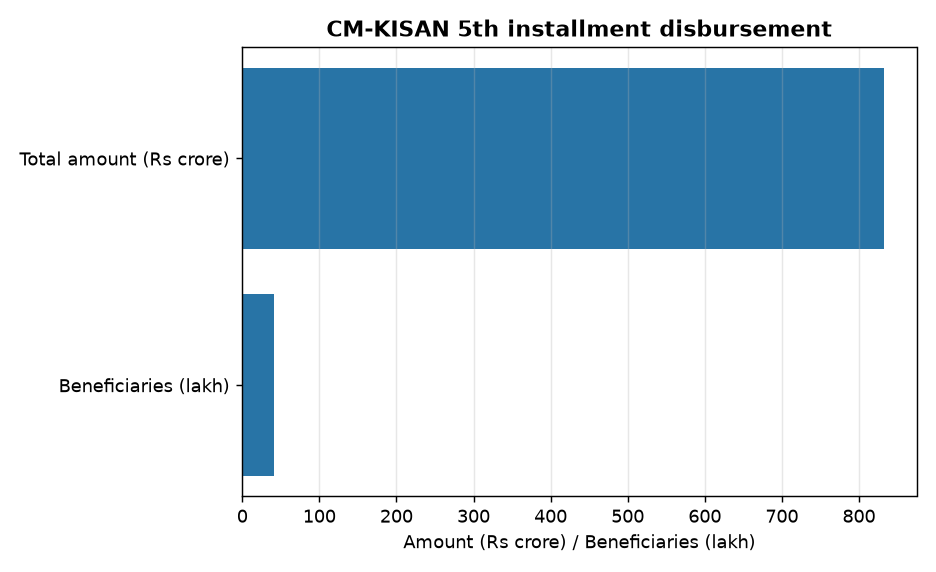
The disbursement of ₹833 crore under the CM-KISAN scheme in Odisha, benefiting over 41 lakh farmers, underscores the growing emphasis on direct financial assistance to agricultural households in India. This development highlights the operationalisation of state-level agricultural support schemes in tandem with centrally sponsored initiatives such as PM-KISAN, and raises questions about the efficacy of such transfers in addressing farm distress and ensuring food security.
Background
- The Pradhan Mantri Kisan Samman Nidhi (PM-KISAN) was launched in 2019 by the Government of India to provide income support of ₹6,000 per year to all landholding farmer families, irrespective of farm size, in three equal instalments.
- State governments have increasingly adopted complementary schemes to augment central support, recognising the heterogeneity of agricultural conditions across regions.
- Odisha, with a significant tribal and small/marginal farmer population, has historically faced challenges in agricultural productivity and farmer welfare, necessitating targeted interventions.
- The use of Direct Benefit Transfer (DBT) mechanisms has been institutionalised in India since the 2013 Direct Benefit Transfer Mission, aimed at reducing leakages and ensuring timely delivery of welfare benefits.
What is the CM-KISAN Scheme of Odisha?
- The CM-KISAN scheme is a state-level income support initiative launched by the Government of Odisha to provide financial assistance to farmers, including small, marginal, and landless cultivators, as well as members of Particularly Vulnerable Tribal Groups (PVTGs).
- Under the scheme, eligible beneficiaries receive ₹2,000 per instalment, with multiple instalments provided annually to align with agricultural seasons such as Rabi and Kharif.
- The financial assistance is disbursed directly into the bank accounts of beneficiaries through the Direct Benefit Transfer (DBT) mechanism, ensuring transparency and minimising leakages.
- The scheme is designed to supplement the central PM-KISAN scheme, which provides ₹6,000 annually to eligible farmer families, thereby enhancing the overall income support framework for Odisha’s agricultural households.
- The CM-KISAN scheme targets inclusion of landless farmers and tenant cultivators, who are often excluded from landholding-based welfare schemes, thereby expanding the coverage of agricultural support.
- The scheme is implemented through a robust digital infrastructure, including the Odisha Rural Development and Panchayati Raj Department’s database, which integrates with the Public Financial Management System (PFMS) for seamless fund flow.
- The scheme is part of Odisha’s broader strategy to address farmer distress, reduce indebtedness, and promote agricultural sustainability through direct financial interventions.
Key Features
| Feature | Significance |
|---|---|
| Direct Benefit Transfer (DBT) | Ensures timely and transparent disbursement of financial assistance directly to beneficiaries’ bank accounts, reducing leakages and intermediaries. |
| Financial Assistance of ₹2,000 per farmer | Provides immediate liquidity support for Rabi season agricultural activities, particularly for small, marginal, and landless farmers. |
| Coverage of 41 lakh farmers | Reaches a significant proportion of Odisha’s agricultural workforce, including Particularly Vulnerable Tribal Groups (PVTGs), ensuring inclusive welfare. |
| Integration with PM-KISAN | Complements the central scheme by adding state-level support, enhancing overall income security for farmers. |
| Minimum Support Price (MSP) for paddy | Provides price stability and income assurance, reducing distress sales and market volatility risks for farmers. |
Why it Matters
Economic Impact
- Augments rural liquidity, stimulating local economies through increased spending on agricultural inputs and household needs.
- Reduces farmer distress by providing a safety net against income shocks, particularly in rain-fed and smallholder farming systems.
- Supports food security by ensuring continued agricultural production through timely financial assistance.
Social Impact
- Targeted support to marginalised groups, including small farmers and PVTGs, addresses historical inequities in agricultural welfare.
- Contributes to poverty alleviation by enhancing the economic resilience of farming households.
- Potential reduction in farmer suicides, as highlighted by the state government, though causal attribution requires further empirical validation.
Governance Impact
- Demonstrates the efficacy of DBT mechanisms in delivering welfare schemes with minimal administrative overhead.
- Showcases intergovernmental coordination between state and central schemes (PM-KISAN and CM-KISAN) for holistic farmer support.
- Sets a precedent for scalable welfare delivery models in India’s federal structure.
Challenges
1. Leakage and Exclusion Errors
- Risk of ineligible beneficiaries receiving benefits due to outdated or inaccurate land records.
- Possible exclusion of genuine farmers due to Aadhaar seeding gaps or bank account issues.
- Need for robust grievance redressal mechanisms to address beneficiary grievances promptly.
UPSC Link: Governance: DBT challenges
2. Sustainability of Funding
- Dependence on state budget allocations may lead to fiscal strain during economic downturns.
- Need for diversified funding sources to ensure continuity of the scheme beyond electoral cycles.
UPSC Link: Public Finance: Fiscal federalism
3. Effectiveness of MSP Implementation
- MSP for paddy may not cover all crops, leaving farmers of other commodities vulnerable to price fluctuations.
- Market distortions may arise if MSP is not aligned with market realities, leading to surplus or shortage issues.
UPSC Link: Agriculture: Price policy
4. Climate and Agricultural Risks
- Increasing frequency of extreme weather events may undermine the efficacy of financial assistance in ensuring farm viability.
- Need for climate-resilient agricultural practices to complement income support measures.
UPSC Link: Environment: Climate change adaptation
Challenges — UPSC Perspective
| Issue | Concern |
|---|---|
| Land record discrepancies | May lead to exclusion or inclusion of ineligible beneficiaries, undermining scheme objectives. |
| Digital divide in rural areas | Limited access to banking and Aadhaar services in remote regions could delay or deny benefits. |
| Fiscal sustainability | Long-term viability of the scheme depends on stable state revenues and efficient resource allocation. |
| Monitoring and evaluation | Lack of real-time data on utilisation of funds may hinder impact assessment and course correction. |
| Crop diversification challenges | Over-reliance on paddy MSP may discourage diversification, affecting nutritional security and soil health. |
| Coordination between schemes | Ensuring seamless integration between PM-KISAN and CM-KISAN requires inter-departmental synergy. |
Government Initiatives — Must-Memorise for Prelims
- PM-KISAN (Pradhan Mantri Kisan Samman Nidhi)
Way Forward
- Strengthen land record digitisation and updation to minimise exclusion and inclusion errors in beneficiary identification.
- Expand financial literacy programmes to ensure farmers utilise benefits optimally for agricultural and allied activities.
- Enhance climate-resilient agriculture initiatives to complement income support and reduce long-term risks.
- Establish a real-time monitoring dashboard for scheme disbursements and beneficiary feedback to enable evidence-based policymaking.
- Promote crop diversification through MSP adjustments and market linkages to reduce over-dependence on paddy.
- Improve last-mile delivery infrastructure, including banking correspondents and digital payment gateways in remote areas.
- Conduct periodic impact assessments to evaluate the scheme’s contribution to farmer income stability and poverty reduction.
- Foster inter-state learning exchanges to adopt best practices in agricultural welfare delivery from other states.
UPSC Value Addition
Keywords for Mains Answer-Writing
Direct Benefit Transfer · Agricultural income support · PM-KISAN scheme · State-level welfare schemes · Small and marginal farmers · Financial inclusion of farmers · Minimum Support Price · Particularly Vulnerable Tribal Groups · Rabi season · Farm distress alleviation · Direct cash transfers · Welfare governance · Agrarian crisis · Convergence of central and state schemes · Landless farmers
Concept Flow
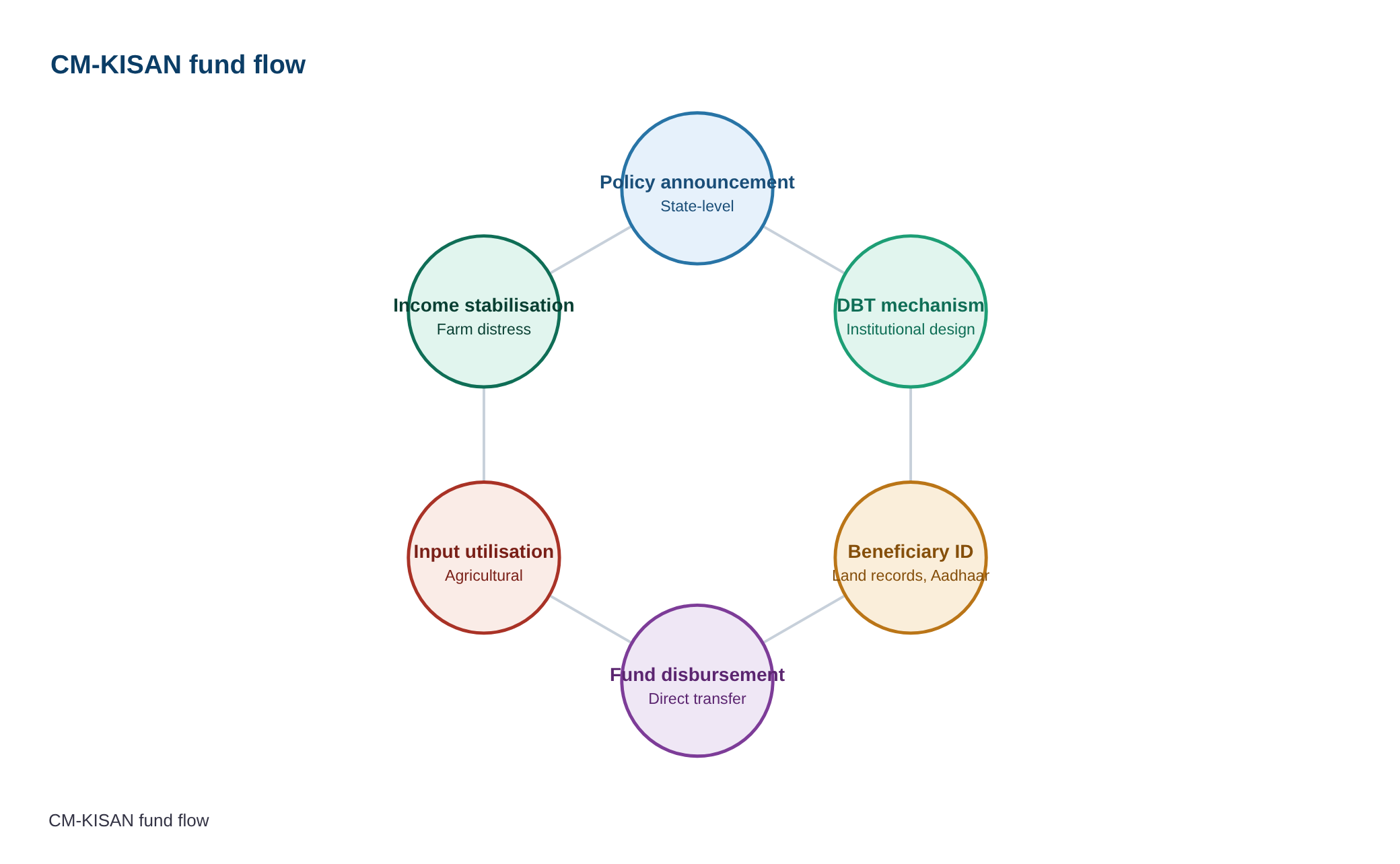
State-level policy announcement → Institutional design (DBT mechanism) → Beneficiary identification (land records, Aadhaar) → Fund disbursement (direct transfer) → Agricultural input utilisation → Income stabilisation → Rural demand stimulation → Economic growth feedback loop
Prelims Practice Questions
Q1. Consider the following statements about the PM-KISAN scheme in India:
1. It is a centrally sponsored scheme providing income support to all land-holding farmers.
2. The financial assistance is provided in three equal installments of Rs 2,000 each per year.
3. The scheme is implemented through the Direct Benefit Transfer (DBT) mechanism.
4. The scheme excludes landless farmers and sharecroppers from its ambit.
How many of the above statements are correct?
- Only one
- Only two
- Only three
- All four
Answer: Only three — Statements 1 and 3 are correct: PM-KISAN is a centrally sponsored scheme providing income support to land-holding farmers via DBT. Statement 2 is incorrect as the assistance is provided in three installments of Rs 2,000 each, totaling Rs 6,000 per year, not Rs 2,000 per installment. Statement 4 is incorrect as the scheme includes landless farmers and sharecroppers under certain conditions.
Q2. Assertion (A): The CM-KISAN scheme in Odisha is a state-level agricultural income support scheme.
Reason (R): It is designed to complement the central PM-KISAN scheme by providing additional financial assistance to farmers during the Rabi season.
In the context of the above two statements, which one of the following is correct?
- Both A and R are true and R is the correct explanation of A
- Both A and R are true but R is NOT the correct explanation of A
- A is true but R is false
- A is false but R is true
Answer: Both A and R are true but R is NOT the correct explanation of A — Both the assertion and reason are true. The CM-KISAN scheme is indeed a state-level agricultural income support scheme in Odisha, and it complements the central PM-KISAN scheme by providing additional financial assistance (Rs 2,000 per farmer) during the Rabi season, thereby addressing farm distress more comprehensively.
Q3. Match the following pairs related to agricultural income support schemes in India:
Column I (Scheme) Column II (Key Feature)
A. PM-KISAN 1. State-level scheme providing Rs 2,000 per farmer during Rabi season
B. CM-KISAN 2. Central scheme providing Rs 6,000 per year to land-holding farmers
C. Minimum Support Price (MSP) 3. Government-guaranteed price for agricultural produce
D. Direct Benefit Transfer (DBT) 4. Mechanism for direct transfer of subsidies to beneficiaries’ bank accounts
Select the correct match:
- A-2, B-1, C-3, D-4
- A-1, B-2, C-4, D-3
- A-3, B-4, C-1, D-2
- A-4, B-3, C-2, D-1
Answer: A-2, B-1, C-3, D-4 — The correct matches are: A-2 (PM-KISAN provides Rs 6,000 per year to land-holding farmers), B-1 (CM-KISAN provides Rs 2,000 per farmer during Rabi season), C-3 (MSP is a government-guaranteed price for agricultural produce), and D-4 (DBT is the mechanism for direct transfer of subsidies to beneficiaries’ bank accounts).
Mains Practice Question
✍ The convergence of centrally sponsored and state-level agricultural income support schemes represents a significant evolution in India’s welfare governance for farmers. Critically examine this statement with reference to the PM-KISAN and CM-KISAN schemes. Also, analyse the potential implications of such convergence for agricultural productivity and farmer distress alleviation. (15 Marks)
Approach: MODEL-ANSWER SKELETON:
1. **Introduction (2 marks)**: Define agricultural income support schemes and their relevance in addressing farm distress. Briefly introduce PM-KISAN (central scheme) and CM-KISAN (state scheme in Odisha) as case studies.
2. **Convergence of Schemes (3 marks)**:
– Explain the concept of convergence in welfare governance: integration of central and state schemes to create a unified support system.
– Highlight the complementary roles: PM-KISAN provides Rs 6,000/year to land-holding farmers, while CM-KISAN adds Rs 2,000/farmer during Rabi season, including landless farmers and PVTGs.
– Emphasise the use of Direct Benefit Transfer (DBT) as a common mechanism, ensuring transparency and reducing leakages.
3. **Critical Examination (5 marks)**:
– **Strengths**:
– Enhanced financial security for farmers by combining central and state support.
– Inclusion of marginalized groups (landless farmers, PVTGs) in Odisha’s CM-KISAN.
– Reduction in farmer suicides (as claimed by the Odisha CM), indicating potential alleviation of distress.
– **Limitations**:
– Limited coverage: PM-KISAN excludes landless farmers; CM-KISAN partially addresses this but may not cover all.
– State-level disparities: Variations in state schemes may lead to unequal support across regions.
– Sustainability concerns: Long-term financial burden on state exchequers.
– **Institutional Challenges**: Coordination between central and state agencies, data integration, and targeting accuracy.
4. **Implications for Agricultural Productivity and Farmer Distress (3 marks)**:
– **Productivity**: Short-term income support may not directly translate to productivity gains; need for complementary measures (e.g., irrigation, technology adoption).
– **Distress Alleviation**: Evidence suggests reduced farmer suicides in Odisha, but broader data is needed to assess long-term impact.
– **Policy Recommendations**:
– Expand coverage to include all farmers (landless, sharecroppers).
– Link income support to productivity-enhancing inputs (seeds, fertilizers).
– Strengthen MSP mechanisms to ensure remunerative prices.
5. **Conclusion (2 marks)**: Summarise the significance of convergence in welfare governance while acknowledging its limitations. Stress the need for a holistic approach combining income support with structural reforms in agriculture.
Source: orissapost.com
Odisha PCS (OPSC (OAS)) — State PCS Practice
Prelims: Under the CM-KISAN scheme in Odisha, the recent disbursement of Rs 833 crore aims to benefit which of the following groups?
- A. Marginal and small farmers
- B. Landless agricultural laborers
- C. Women self-help group members
- D. Urban youth entrepreneurs
Answer: A. Marginal and small farmers — The CM-KISAN scheme primarily targets marginal and small farmers for direct income support.
Mains: Discuss the significance of the CM-KISAN scheme in Odisha’s agricultural economy, highlighting its impact on farmer income, food security, and rural development. Also, suggest measures to enhance the scheme’s effectiveness in achieving its objectives.
Generated by AanyaAi for educational purpose.
Related guides on our sites
- Best agriculture optional coaching
- Anthropology VS PSIR
- Best PSIR optional coaching
- Best PSIR optional coaching online

- डीएफपीडी विशेष अभियान 6: 2 से 31 अक्टूबर 2026 तक स्वच्छता एवं दक्षता अभियान - September 16, 2026
- DFPD’s Special Campaign 6: Key Focus Areas for UPSC & State PCS - September 16, 2026
- विश्व ओजोन दिवस 2026: भारत ने लॉन्च किए नेट जीरो पोर्टल और एनएपीसीसी डैशबोर्ड - September 16, 2026

No Comments