


05 Sep PM-SETU Scheme: Why Public-Private Partnership is Critical for ITI Upgrades
✎ PM-SETU scheme aims to modernise 1,000 ITIs via a hub-and-spoke model, with industry-led curriculum design and multi-stakeholder funding to bridge India’s skill gap and enhance employability.
Subject Relevance — Where This Topic Fits
- GS Paper II — Governance, Administration and Challenges (Public-Private Partnerships) | GS Paper III — Human Resource Development and Skill Development
- Prelims: PM-SETU, Industrial Training Institutes (ITIs), hub-and-spoke model, Skill India Mission, National Skill Development Corporation (NSDC), Special Purpose Vehicle (SPV), Corporate Social Responsibility (CSR)
- Essay: The role of public-private partnerships in India’s socio-economic transformation, Skill development as a catalyst for India’s demographic dividend
Quick Revision: PM-SETU scheme aims to modernise 1,000 ITIs via a hub-and-spoke model, with industry-led curriculum design and multi-stakeholder funding to bridge India’s skill gap and enhance employability.
Why is this in the news?
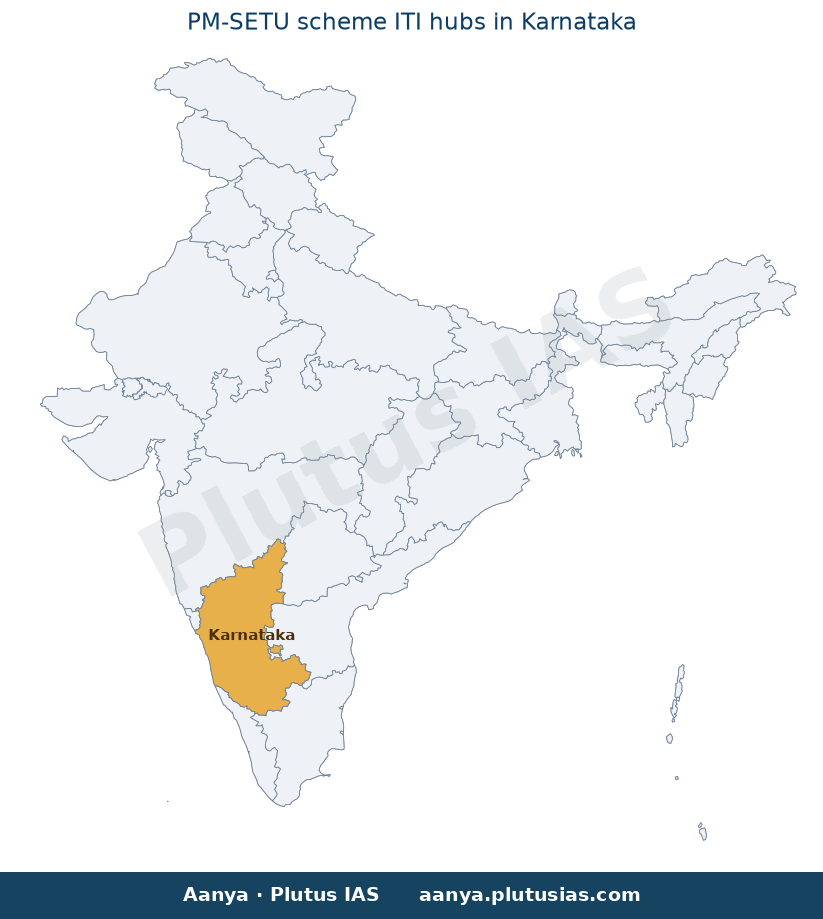
The Union and Karnataka governments have initiated the PM-SETU scheme to modernise 1,000 Industrial Training Institutes (ITIs) across India, including 48 in Karnataka, through active collaboration between public and private sectors. A recent meeting chaired by Karnataka’s Large and Medium Industries Minister M.B. Patil highlighted the necessity of industry-led adoption, curriculum design, and funding mechanisms to ensure the scheme’s success. The initiative underscores the broader national priority of aligning vocational education with industry demands to enhance employability.
Background
- The Government of India launched the Skill India Mission in 2015 to address the skill gap in the workforce and enhance employability through vocational training.
- Industrial Training Institutes (ITIs) are post-secondary schools established under the Directorate General of Training (DGT), Ministry of Skill Development and Entrepreneurship, to provide technical and vocational training.
- Despite the existence of 15,000+ ITIs, challenges such as outdated infrastructure, lack of industry alignment, and insufficient funding have limited their effectiveness in meeting labour market demands.
- Karnataka, with 270 government ITIs, is a key state for implementation, with 48 ITIs selected for upgradation under the hub-and-spoke model.
- The scheme aligns with the National Education Policy (NEP) 2020, which emphasises skill integration and vocational education from secondary school levels.
What is the PM-SETU Scheme?
- PM-SETU (Pradhan Mantri Skilling and Employability Transformation through Upgraded ITIs) is an initiative of the Union government launched to modernise 1,000 ITIs across India into industry-aligned skill centres.
- The scheme adopts a hub-and-spoke model, where one hub ITI is connected to four spoke ITIs, facilitating resource sharing, faculty training, and curriculum standardisation.
- Industry participation is central to the scheme, with eligible companies (annual turnover ≥ ₹500 crore and ≥1,000 employees) contributing to curriculum design, training programmes, and infrastructure development.
- A Special Purpose Vehicle (SPV) will be constituted for implementation, with six industry representatives as members, ensuring industry ownership and accountability.
- Funding is shared between the Union government (₹112 crore for Karnataka), state government (₹98 crore), and industry (₹31 crore), demonstrating a multi-stakeholder approach.
- Industries can adopt ITIs to enhance their training infrastructure, aligning vocational education with sector-specific demands, such as manufacturing, construction, and services.
- The scheme integrates Corporate Social Responsibility (CSR) initiatives, allowing companies to contribute through skill development programmes, thereby fulfilling their social obligations.
- The goal is to create a skilled workforce that meets industry standards, reduces unemployment, and supports India’s economic growth through a robust vocational education ecosystem.
Key Features
| Feature | Significance |
|---|---|
| PM-SETU Scheme (Pradhan Mantri Skilling and Employability Transformation through Upgraded ITIs) | A ₹60,000 crore centrally sponsored initiative to modernise 1,000 ITIs nationwide into industry-aligned skill hubs, enhancing employability and reducing skill gaps. |
| Hub-and-Spoke Model | A decentralised governance structure where 4 ITIs (spokes) are linked to a central hub ITI, facilitating resource sharing, standardised training, and regional skill development. |
| Industry Adoption of ITIs | Provision for industries to adopt government ITIs, enabling direct curriculum design, infrastructure upgrades, and workforce training aligned with sectoral demands. |
| Special Purpose Vehicle (SPV) | A dedicated implementation body with six industry representatives to ensure public-private coordination, transparency, and efficient fund utilisation. |
| Multi-Stakeholder Funding | Shared financial responsibility among Union government (₹112 crore), State government (₹98 crore), and industries (₹31 crore), ensuring sustainable resource allocation. |
Why it Matters
Economic
- Addresses India’s persistent skill deficit by upgrading ITIs to meet industry 4.0 demands, particularly in high-growth sectors like manufacturing, construction, and services.
- Enhances employability of 200+ million youth entering the workforce annually, reducing structural unemployment and underemployment.
- Stimulates private investment in vocational education, fostering a self-sustaining ecosystem beyond government funding.
Governance & Institutional
- Demonstrates a model of cooperative federalism, integrating Union and State governments with industry stakeholders for targeted skill development.
- Introduces outcome-based funding mechanisms, linking financial allocations to performance metrics such as placement rates and industry feedback.
- Promotes decentralised decision-making through hub-and-spoke ITIs, aligning local labour market needs with training programmes.
Social
- Reduces socio-economic disparities by providing equitable access to quality vocational training across urban and rural Karnataka.
- Empowers marginalised groups (e.g., women, SC/ST) through targeted adoption of ITIs and inclusion in skill programmes.
- Aligns with the National Education Policy (NEP) 2020’s emphasis on vocational education integration in mainstream curricula.
Challenges
1. Industry Participation Gaps
- Reluctance of industries to invest in long-term skill development due to perceived low ROI or lack of immediate returns.
- Regional imbalances in private sector engagement, with urban hubs (e.g., Bengaluru) attracting more participation than rural areas.
- Ensuring sustained industry involvement post-adoption, avoiding ad-hoc or superficial collaborations.
UPSC Link: GS-II: Skill Development & Employment
2. Quality Assurance & Standardisation
- Risk of inconsistent training quality across hub-and-spoke ITIs due to varying industry capabilities and regional disparities.
- Need for robust accreditation frameworks to validate industry-designed curricula and ensure national recognition of certifications.
- Balancing industry-specific training with broader employability skills (e.g., soft skills, digital literacy).
UPSC Link: GS-II: Vocational Education
3. Funding & Resource Mobilisation
- Dependence on private sector contributions (₹31 crore) may be insufficient for large-scale upgrades, necessitating innovative financing (e.g., CSR, PPP models).
- State government’s share (₹98 crore) may face fiscal constraints, requiring efficient fund utilisation and monitoring.
- Ensuring transparency in fund disbursement to prevent leakages or misallocation in the SPV.
UPSC Link: GS-III: Resource Mobilisation
4. Monitoring & Evaluation
- Lack of real-time data on placement rates, skill retention, and industry demand-supply gaps post-upgrade.
- Need for a centralised dashboard to track progress across 1,000 ITIs and 48 hubs in Karnataka.
- Establishing feedback loops between industries, ITIs, and trainees to iteratively improve programmes.
UPSC Link: GS-II: Skill Development
Challenges — UPSC Perspective
| Issue | Concern |
|---|---|
| Industry Skepticism | Perceived lack of tangible benefits for industries investing in ITI upgrades, leading to low participation rates. |
| Regional Disparities | Concentration of industry adoption in urban hubs (e.g., Bengaluru), neglecting rural and semi-urban ITIs. |
| Curriculum Relevance | Risk of training programmes becoming outdated if industry needs evolve faster than curriculum updates. |
| Monitoring Mechanisms | Absence of a unified framework to assess the effectiveness of industry-ITI collaborations across states. |
| Funding Sustainability | Over-reliance on private sector contributions may not scale for all 1,000 ITIs, requiring alternative revenue streams. |
Government Initiatives — Must-Memorise for Prelims
- Skill India Mission
Way Forward
- Constitute the SPV with industry representatives within 3 months, defining clear roles, responsibilities, and timelines for ITI upgrades.
- Develop a standardised industry engagement framework, including MOUs, performance benchmarks, and exit clauses for non-performing adopters.
- Launch a state-wide awareness campaign targeting industries, highlighting tax incentives, CSR compliance, and long-term workforce benefits.
- Establish a centralised digital platform for real-time monitoring of ITI performance, industry feedback, and placement data.
- Pilot outcome-based funding models in Karnataka, linking disbursements to metrics like placement rates and industry satisfaction scores.
- Expand the hub-and-spoke model to include ITIs in aspirational districts, ensuring equitable skill development across regions.
- Integrate PM-SETU with existing schemes (e.g., PMKVY, NSQF) to avoid duplication and leverage synergies in certification and recognition.
- Conduct quarterly reviews with industry stakeholders to address bottlenecks, refine curricula, and align training with emerging technologies.
UPSC Value Addition
Keywords for Mains Answer-Writing
PM-SETU scheme · Pradhan Mantri Skilling and Employability Transformation through Upgraded ITIs · Industrial Training Institutes modernisation · Public-Private Partnership in skill development · Hub-and-spoke model in education · Special Purpose Vehicle (SPV) for skill schemes · Corporate Social Responsibility (CSR) in skill development · Skill ecosystem governance · Union-State collaboration in skill programmes · Industry-led curriculum design in vocational training
Concept Flow
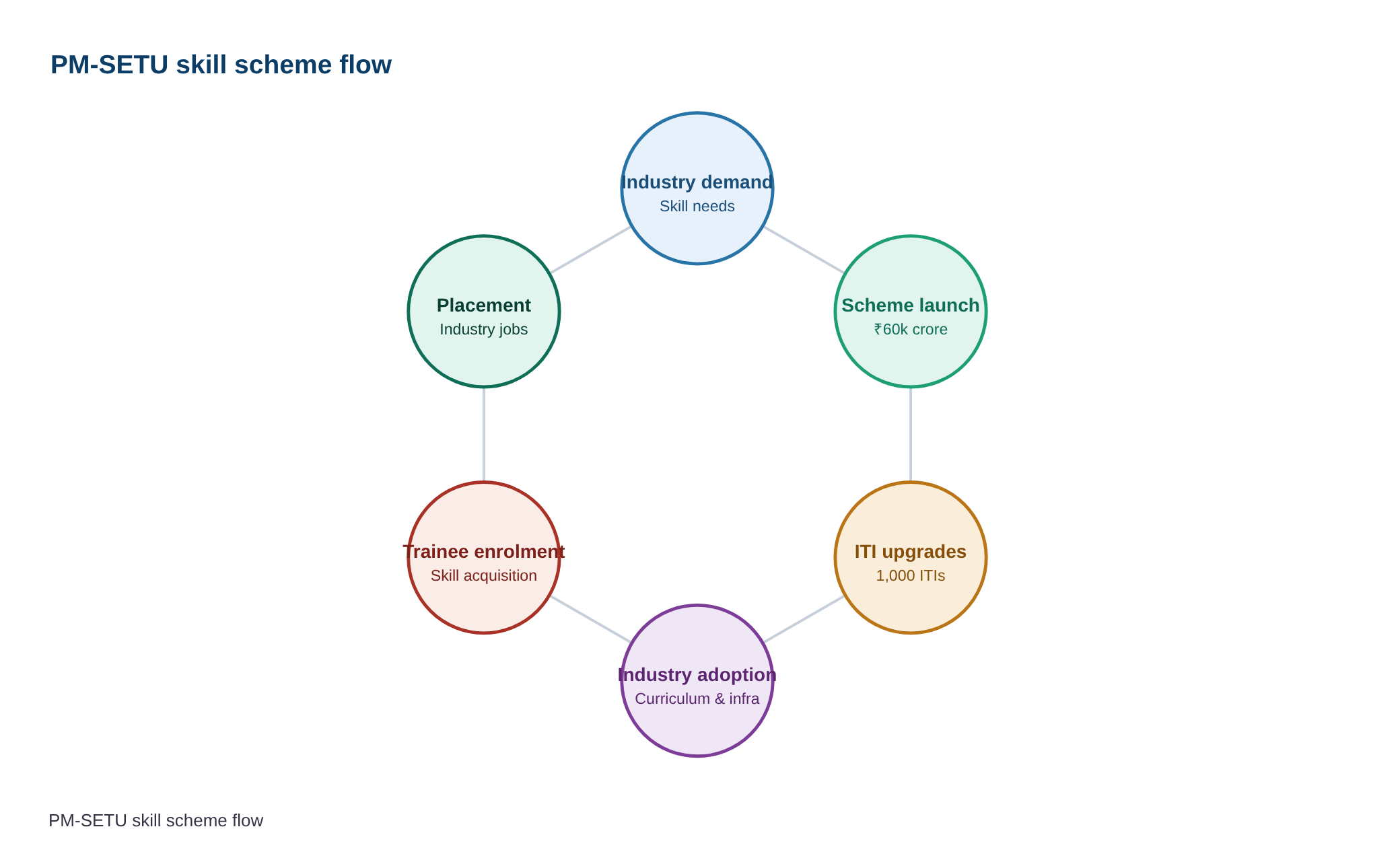
Industry-led skill demand → PM-SETU scheme launched (₹60,000 crore) → Upgrade 1,000 ITIs via hub-and-spoke model → Industry adoption of ITIs → Curriculum design & infrastructure upgrades → Trainee enrolment & skill acquisition → Placement in industry → Feedback loop for continuous improvement.
Prelims Practice Questions
Q1. Consider the following statements regarding the PM-SETU scheme:
1. The scheme aims to modernise 1,000 Industrial Training Institutes (ITIs) across India.
2. The Union government has allocated ₹112 crore for the scheme in Karnataka.
3. Companies with an annual turnover of at least ₹500 crore and more than 1,000 employees are eligible to participate.
4. The scheme follows a cluster-based model where one hub ITI is attached to four spoke ITIs.
How many of the above statements are correct?
- Only one
- Only two
- Only three
- All four
Answer: All four — Statements 1, 2, and 3 are correct. Statement 4 is incorrect as the scheme follows a hub-and-spoke model where one hub ITI is attached to four spoke ITIs, not a cluster-based model.
Q2. Assertion (A): The PM-SETU scheme mandates the constitution of a Special Purpose Vehicle (SPV) for its implementation.
Reason (R): The SPV includes six industry representatives as members to facilitate industry-led governance in skill development.
Options:
A. Both A and R are true, and R is the correct explanation of A.
B. Both A and R are true, but R is not the correct explanation of A.
C. A is true, but R is false.
D. A is false, but R is true.
- A
- B
- C
- D
Answer: A — Both the Assertion (A) and Reason (R) are true, and R correctly explains A as the SPV is constituted with industry representatives to ensure industry-led governance in the scheme.
Q3. Match the following ITIs in Karnataka with their respective roles under the PM-SETU scheme:
Column I (ITI Name) Column II (Role)
1. Peenya ITI A. Hub ITI in Bengaluru Urban
2. Tumakuru Road ITI B. Spoke ITI in Bengaluru Urban
3. Kalaburagi Government ITI for Boys C. Hub ITI in Kalaburagi
4. Sedam ITI D. Spoke ITI in Kalaburagi
Options:
A. 1-A, 2-B, 3-C, 4-D
B. 1-B, 2-A, 3-D, 4-C
C. 1-A, 2-D, 3-C, 4-B
D. 1-C, 2-B, 3-A, 4-D
- A
- B
- C
- D
Answer: A — Peenya ITI is the hub in Bengaluru Urban (1-A). Tumakuru Road ITI is a spoke in Bengaluru Urban (2-B). Kalaburagi Government ITI for Boys is the hub in Kalaburagi (3-C). Sedam ITI is a spoke in Kalaburagi (4-D).
Mains Practice Question
✍ The PM-SETU scheme represents a paradigm shift in India’s skill development ecosystem by institutionalising public-private collaboration. Critically examine the design and governance architecture of the scheme, with particular reference to its hub-and-spoke model, SPV mechanism, and industry participation criteria. Also, analyse the potential challenges in ensuring equitable access and quality across ITIs in diverse regional contexts. (15 Marks)
Approach: MODEL-ANSWER SKELETON:
1. Introduction (2 lines): Contextualise PM-SETU as a ₹60,000 crore national initiative under the Ministry of Skill Development and Entrepreneurship to modernise 1,000 ITIs.
2. Design Architecture (5 lines):
– Hub-and-spoke model: Define the structure (one hub ITI linked to four spoke ITIs) and cite Karnataka’s 12 hubs and 48 ITIs as an example.
– Special Purpose Vehicle (SPV): Explain its role in governance, composition (six industry representatives), and legal status for efficient implementation.
– Industry participation criteria: Highlight eligibility (₹500 crore turnover, >1,000 employees) and avenues (curriculum design, CSR funding, ITI adoption).
3. Governance Innovations (4 lines):
– Federalism dimension: Union-State funding split (₹112 crore Union, ₹98 crore State, ₹31 crore industry in Karnataka) and collaborative federalism.
– Market-led skill alignment: Industry-led curriculum design to bridge skill gaps and enhance employability.
4. Potential Challenges (3 lines):
– Regional disparities: Uneven ITI quality, urban-rural divide, and resource constraints in aspirational districts.
– Equity concerns: Risk of elite ITIs attracting more industry partners, leaving others under-resourced.
– Sustainability: Long-term viability post-SPV phase-out and ensuring industry commitment beyond CSR obligations.
5. Conclusion (1 line): Balanced view—scheme’s potential to revolutionise skill development while requiring safeguards for inclusivity and quality.
Source: The Hindu
Generated by AanyaAi for educational purpose.
Related guides on our sites
- Anthropology VS PSIR
- Best PSIR optional coaching
- Best PSIR optional coaching online
- Best PSIR optional teacher


No Comments