


05 Sep UN Report: Israel’s Forcible Displacement of 33,000 Palestinians in West Bank
✎ Forcible displacement in occupied territories constitutes a grave violation of international humanitarian law, particularly under the Fourth Geneva Convention, and may amount to crimes against humanity if proven systematic or…
Subject Relevance — Where This Topic Fits
- GS Paper II — International Relations: International Law and Human Rights; Conflict Resolution; Role of UN and International Organisations
- Prelims: West Bank, Palestine refugee camps (Jenin, Nur Shams, Tulkarem), forcible displacement, Operation Iron Wall, OHCHR, UNRWA, International Court of Justice (ICJ), crime against humanity, forcible transfer, collective punishment, ethnic cleansing, Geneva Conventions, Fourth Geneva Convention
- Essay: Humanitarian crises in conflict zones: Causes, consequences, and the role of international law, The principle of non-refoulement and the protection of civilian populations in occupied territories
Quick Revision: Forcible displacement in occupied territories constitutes a grave violation of international humanitarian law, particularly under the Fourth Geneva Convention, and may amount to crimes against humanity if proven systematic or widespread.
Why is this in the news?
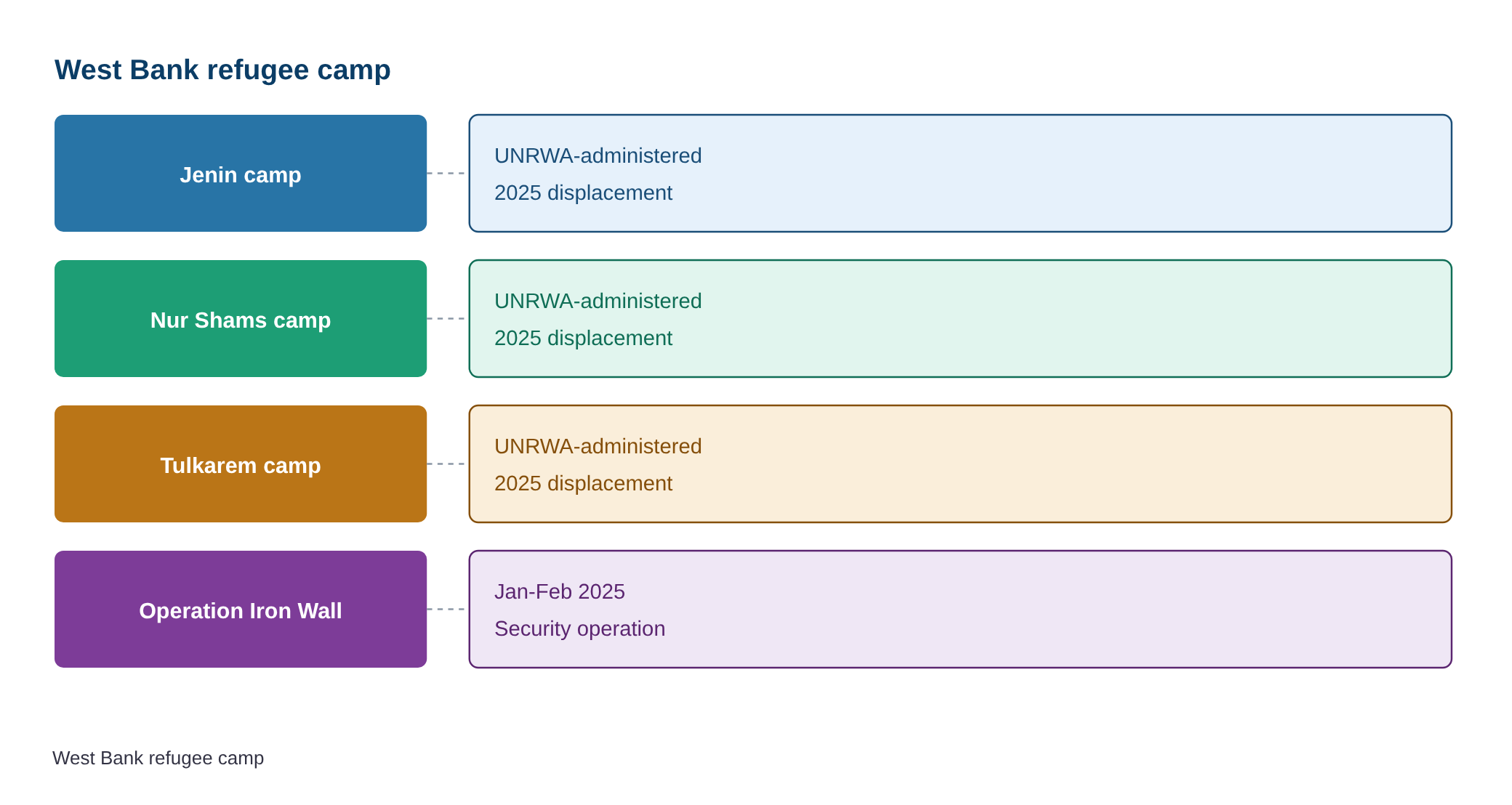
The UN Office of the High Commissioner for Human Rights (OHCHR) released a report in September 2026 documenting the forcible displacement of the entire population of three Palestine refugee camps in the West Bank—Jenin, Nur Shams, and Tulkarem—during Israel’s Operation Iron Wall in January–February 2025. The report alleges systematic violations of international humanitarian and human rights law, including the potential commission of crimes against humanity, collective punishment, and ethnic cleansing, raising urgent questions about accountability and the protection of civilians in occupied territories.
Background
- The West Bank, including East Jerusalem, has been under Israeli occupation since the 1967 Six-Day War, a status recognised as unlawful by the International Court of Justice (ICJ) in its 2024 advisory opinion.
- Palestine refugee camps in the West Bank, administered by the United Nations Relief and Works Agency for Palestine Refugees in the Near East (UNRWA), house approximately 2 million registered refugees, many of whom have lived in the camps for generations.
- Operation Iron Wall, launched in early 2025, was framed by Israeli authorities as a security operation targeting militant groups but resulted in extensive civilian infrastructure destruction and displacement.
- The Fourth Geneva Convention (1949) explicitly prohibits the forcible transfer of civilians from occupied territories, as well as collective punishment and the destruction of civilian property unless absolutely necessitated by military operations.
- The ICJ, in its 2024 advisory opinion, ruled that Israel’s continued occupation of Palestinian territory is unlawful and must be brought to an end ‘as rapidly as possible,’ though compliance remains contested.
- UNRWA reports that as of July 2026, around 33,362 people remain displaced as of July this year, exacerbating an already severe humanitarian crisis in the region.
Forcible Displacement and International Humanitarian Law: Key Legal and Operational Dimensions
- Forcible displacement refers to the involuntary or coerced movement of civilians from their homes, prohibited under international humanitarian law (IHL) unless justified by imperative military necessity, which is narrowly defined and rarely applicable in densely populated civilian areas.
- The crime against humanity of ‘forcible transfer’ (Rome Statute, Article 7(1)(d)) requires proof of systematic or widespread acts committed as part of a state or organisational policy, with the intent to remove a population from a region, as alleged in the OHCHR report.
- Collective punishment, prohibited under Article 33 of the Fourth Geneva Convention, involves penalising an entire group for the actions of a few, often through measures such as home demolitions, curfews, or denial of essential services, as documented in the report.
- Ethnic cleansing, though not a distinct crime under international criminal law, is often used to describe acts intended to remove a population from a territory based on ethnicity or national origin, frequently involving violence, intimidation, or destruction of property.
- The principle of non-refoulement, derived from refugee law, prohibits the return of displaced persons to a territory where they face persecution or serious harm, reinforcing the obligation to allow voluntary, safe, and dignified return.
- The destruction of civilian infrastructure, including homes, water, and electricity networks, violates the principle of distinction (Geneva Conventions) and may constitute disproportionate or indiscriminate attacks, depending on the circumstances.
- UNRWA’s mandate includes providing humanitarian assistance to Palestine refugees, but its operations are severely constrained in conflict zones due to access restrictions, funding shortages, and security risks.
- The ICJ’s advisory opinion on the illegality of Israel’s occupation underscores the legal framework governing the protection of civilians in occupied territories, though enforcement mechanisms remain limited without international consensus.
Key Features
| Feature | Significance |
|---|---|
| Forcible displacement of 33,000+ Palestinians | Violation of international humanitarian law, including the prohibition on forcible transfer under the Fourth Geneva Convention |
| Destruction of 36-52% of camp infrastructure | Systematic rendering of areas uninhabitable, raising concerns of collective punishment and ethnic cleansing |
| Use of airstrikes, armoured bulldozers, and controlled detonations | Methods inconsistent with military necessity, escalating civilian harm and long-term displacement |
| Blockade of humanitarian access | Violation of the right to essential services (water, electricity) and denial of medical and food aid to displaced populations |
| UN OHCHR report findings on crimes against humanity | Legal categorisation of forcible transfer as a potential crime against humanity under the Rome Statute |
Why it Matters
Humanitarian
- Mass displacement disrupts livelihoods, education, and healthcare access for over 33,000 individuals, exacerbating humanitarian crises in the West Bank.
- Destruction of homes and infrastructure compounds socio-economic vulnerabilities, particularly for women, children, and elderly populations.
- Denial of return violates the principle of voluntary repatriation enshrined in international refugee law.
Legal/International Law
- Forcible displacement and destruction of civilian property may constitute violations of the Fourth Geneva Convention (1949) and the Rome Statute (1998).
- The International Court of Justice’s advisory opinion on Israel’s occupation (2024) underscores the obligation to cease unlawful presence in occupied territories.
- The UN report aligns with prior findings by UN bodies and human rights organisations on systematic violations in the Occupied Palestinian Territory.
Geopolitical/Regional Stability
- Large-scale displacement risks regional instability, fueling tensions and potential escalation in the Israel-Palestine conflict.
- Humanitarian crises in refugee camps may exacerbate cross-border migration pressures, affecting neighbouring states.
- International condemnation or sanctions could strain diplomatic relations, impacting regional security architectures.
Settlement Expansion Dynamics
- Reports suggest displacement may facilitate expansion of Israeli settlements, a long-standing issue under international law.
- Settlement expansion in the West Bank is a core obstacle to the two-state solution, as recognised by the UN and international community.
Challenges
1. Enforcement of International Humanitarian Law
- Lack of effective mechanisms to hold perpetrators accountable for violations in occupied territories.
- Asymmetry in power dynamics between occupying forces and displaced populations complicates legal recourse.
- Political and diplomatic constraints limit the efficacy of international oversight bodies.
UPSC Link: GS-II: International Law & Human Rights
2. Humanitarian Access and Protection
- Blockades and restrictions on aid delivery undermine the right to essential services for displaced populations.
- Destruction of infrastructure (water, electricity) exacerbates health risks, particularly for vulnerable groups.
- Absence of safe return mechanisms prolongs displacement, violating the principle of voluntary repatriation.
UPSC Link: GS-II: Humanitarian Law & Refugee Issues
3. Settlement Expansion and Territorial Disputes
- Continued settlement expansion in the West Bank contravenes international law and undermines peace negotiations.
- Forcible displacement may be linked to strategic territorial control, complicating conflict resolution.
- Lack of consensus on final status negotiations perpetuates cycles of violence and displacement.
UPSC Link: GS-II: Conflict Resolution & Middle East Politics
4. Accountability and Impunity
- Absence of binding legal frameworks to prosecute violations in non-party states (e.g., Israel) limits accountability.
- Politicisation of international bodies (e.g., UN Security Council) hampers decisive action.
- Victim communities face systemic barriers to seeking justice and reparations.
UPSC Link: GS-II: International Organisations & Global Governance
5. Regional Security Implications
- Humanitarian crises may fuel radicalisation and recruitment by non-state actors, destabilising the region.
- Cross-border migration pressures strain resources in neighbouring states (e.g., Jordan, Lebanon).
- Escalation of violence risks broader conflict, impacting global energy and trade routes.
UPSC Link: GS-II: Regional Security & Diplomacy
Challenges — UPSC Perspective
| Issue | Concern |
|---|---|
| Forcible displacement | Violation of Fourth Geneva Convention and potential crime against humanity |
| Destruction of civilian infrastructure | Systematic rendering of areas uninhabitable, violating proportionality principle |
| Blockade of humanitarian access | Denial of essential services (water, electricity) and medical aid |
| Lack of accountability mechanisms | Impunity for violations due to political and legal constraints |
| Settlement expansion | Contradiction with international law and peace process objectives |
| Regional instability | Risk of escalation and cross-border migration pressures |
Way Forward
- Strengthen international monitoring mechanisms to document violations and ensure transparency in occupied territories.
- Advocate for the implementation of the ICJ’s advisory opinion on Israel’s occupation to expedite compliance with international law.
- Facilitate humanitarian corridors to ensure uninterrupted access to essential services for displaced populations.
- Promote diplomatic initiatives to revive negotiations on a two-state solution, addressing core issues like settlements and borders.
- Support UNRWA and other agencies in delivering aid and rebuilding infrastructure in affected refugee camps.
- Encourage third-party mediation to de-escalate tensions and prevent further displacement.
- Advocate for the ratification and enforcement of the Rome Statute by non-party states to enable ICC jurisdiction over alleged crimes.
- Promote grassroots reconciliation efforts to address historical grievances and foster long-term peace.
UPSC Value Addition
Keywords for Mains Answer-Writing
Forcible displacement · International Humanitarian Law · Geneva Conventions · Crimes against humanity · Occupied Palestinian Territory · UN Human Rights Council · ICJ advisory opinion · Collective punishment · Ethnic cleansing · Refugee protection · Humanitarian access · International Court of Justice · UNRWA mandate · Fourth Geneva Convention · UN human rights mechanisms
Constitutional & Policy Linkages
- Article 49 of the Fourth Geneva Convention: Prohibition on forcible transfer of protected persons
- Article 53 of the Fourth Geneva Convention: Prohibition on destruction of property
- UN Charter Chapter VII: Authority for international action in cases of threats to peace
Concept Flow
Israeli military operation (Operation Iron Wall) → Use of force in refugee camps → Destruction of infrastructure and civilian property → Forcible displacement of 33,000+ Palestinians → Violation of Fourth Geneva Convention → Potential crime against humanity → Blockade of humanitarian access → Denial of essential services → Escalation of humanitarian crisis → Destruction of homes and infrastructure → Rendering areas uninhabitable → Long-term displacement → UN OHCHR report findings → Legal categorisation of violations → Calls for accountability and compliance with ICJ opinion → International condemnation → Political and diplomatic responses → Potential regional instability → Lack of enforcement mechanisms → Impunity for violations → Perpetuation of cycle of violence
Prelims Practice Questions
Q1. Consider the following statements regarding the Fourth Geneva Convention (1949) and its applicability to the West Bank:
1. The Fourth Geneva Convention explicitly prohibits the forcible transfer of civilians from occupied territory.
2. The Convention applies to situations of occupation even if the occupying power does not recognise the occupation.
3. The Convention permits the destruction of civilian property if it is militarily necessary.
4. The Convention requires occupying powers to facilitate humanitarian access to occupied territories.
How many of the above statements are correct?
- Only one
- Only two
- Only three
- All
Answer: All — Statements 1, 2, and 4 are correct. Statement 3 is incorrect as the Convention prohibits destruction of civilian property unless absolutely required by military necessity, which must be strictly construed.
Q2. Assertion (A): The International Court of Justice (ICJ) in its advisory opinion on the Legal Consequences of the Construction of a Wall in the Occupied Palestinian Territory (2004) held that Israel must comply with its obligations under international humanitarian law in the Occupied Palestinian Territory.
Reason (R): The ICJ advisory opinion is binding on all UN member states as it interprets the Charter of the United Nations.
Which of the following is correct?
- Both A and R are true, and R is the correct explanation of A
- Both A and R are true, but R is not the correct explanation of A
- A is true, but R is false
- A is false, but R is true
Answer: A is true, but R is false — A is true as the ICJ did hold Israel must comply with international humanitarian law. R is false because ICJ advisory opinions are not binding on UN member states, though they carry significant legal weight.
Q3. Match the following UN bodies with their primary functions related to human rights and humanitarian law:
Column I (UN Body) Column II (Primary Function)
1. UN Human Rights Council (HRC) A. Provides humanitarian aid and protection to refugees
2. UN Office for the Coordination of Humanitarian Affairs (OCHA) B. Monitors human rights violations globally and makes recommendations
3. UN Relief and Works Agency for Palestine Refugees (UNRWA) C. Coordinates international humanitarian response during emergencies
4. International Court of Justice (ICJ) D. Settles legal disputes between states and provides advisory opinions on international law
Select the correct match:
- 1-B, 2-C, 3-A, 4-D
- 1-A, 2-B, 3-C, 4-D
- 1-C, 2-B, 3-A, 4-D
- 1-D, 2-A, 3-B, 4-C
Answer: 1-B, 2-C, 3-A, 4-D — Correct matches are: 1-B (HRC monitors human rights), 2-C (OCHA coordinates humanitarian response), 3-A (UNRWA provides aid to Palestine refugees), 4-D (ICJ settles disputes and gives advisory opinions).
Mains Practice Question
✍ The forcible displacement of civilians from occupied territories constitutes a grave breach of international humanitarian law and may amount to crimes against humanity under the Rome Statute. Critically examine this proposition with reference to the recent OHCHR report on the West Bank. (15 Marks)
Approach: MODEL-ANSWER SKELETON:
1. **Legal Framework**:
– Cite Article 49 of the Fourth Geneva Convention (1949) prohibiting forcible transfer of civilians from occupied territory.
– Reference Article 8(2)(a)(vii) of the Rome Statute defining ‘unlawful deportation or transfer’ as a war crime.
– Mention Article 7(1)(d) of the Rome Statute defining ‘deportation or forcible transfer of population’ as a crime against humanity when committed as part of a widespread or systematic attack.
2. **OHCHR Report Findings**:
– Highlight the systematic nature of displacement in Jenin, Nur Shams, and Tulkarem refugee camps.
– Note destruction of civilian infrastructure (52% in Jenin, 48% in Nur Shams, 36% in Tulkarem) and denial of humanitarian access.
– Reference killings of civilians (102 Palestinians, including 21 children) as potential violations of Article 8(2)(b)(i) (wilful killing).
3. **Legal Analysis**:
– Discuss whether the acts meet the threshold for ‘widespread or systematic’ under Article 7(1) of the Rome Statute.
– Examine the defence of ‘military necessity’ under Article 53 of the Fourth Geneva Convention—strictly construed and not absolute.
– Evaluate whether the actions constitute ‘collective punishment’ (Article 33, Fourth Geneva Convention) or ‘ethnic cleansing’ (not a defined crime in the Rome Statute but may overlap with crimes against humanity).
4. **Institutional Responses**:
– Reference the ICJ’s 2004 advisory opinion on the Wall in the Occupied Palestinian Territory affirming Israel’s obligations under international humanitarian law.
– Note the UN Human Rights Council’s role in monitoring violations and the OHCHR’s mandate to document and report.
5. **Balanced View**:
– Acknowledge Israel’s security concerns but underscore that security measures must comply with proportionality and distinction principles under international law.
– Highlight the humanitarian consequences: 33,362 displaced persons as of July 2025 (UNRWA data).
6. **Conclusion**:
– Conclude that the reported actions likely violate international humanitarian law and may constitute war crimes or crimes against humanity, warranting further investigation by the ICC or other competent bodies.
Source: news.un.org
Generated by AanyaAi for educational purpose.
Related guides on our sites
- Best economics services coaching
- Anthropology VS PSIR
- Best PSIR optional coaching
- Best PSIR optional coaching online

- पेरियार टाइगर रिजर्व में 6 नई प्रजातियाँ खोजी गईं, जानिए क्या हैं विशेषताएँ - September 22, 2026
- Six New Species Discovered in Periyar Tiger Reserve: UPSC & PCS Key Biodiversity Insights - September 22, 2026
- तमिलनाडु में बस किराए में संशोधन: सरकार को चार सप्ताह और समय मिला, उच्च न्यायालय का फैसला - September 22, 2026

No Comments