


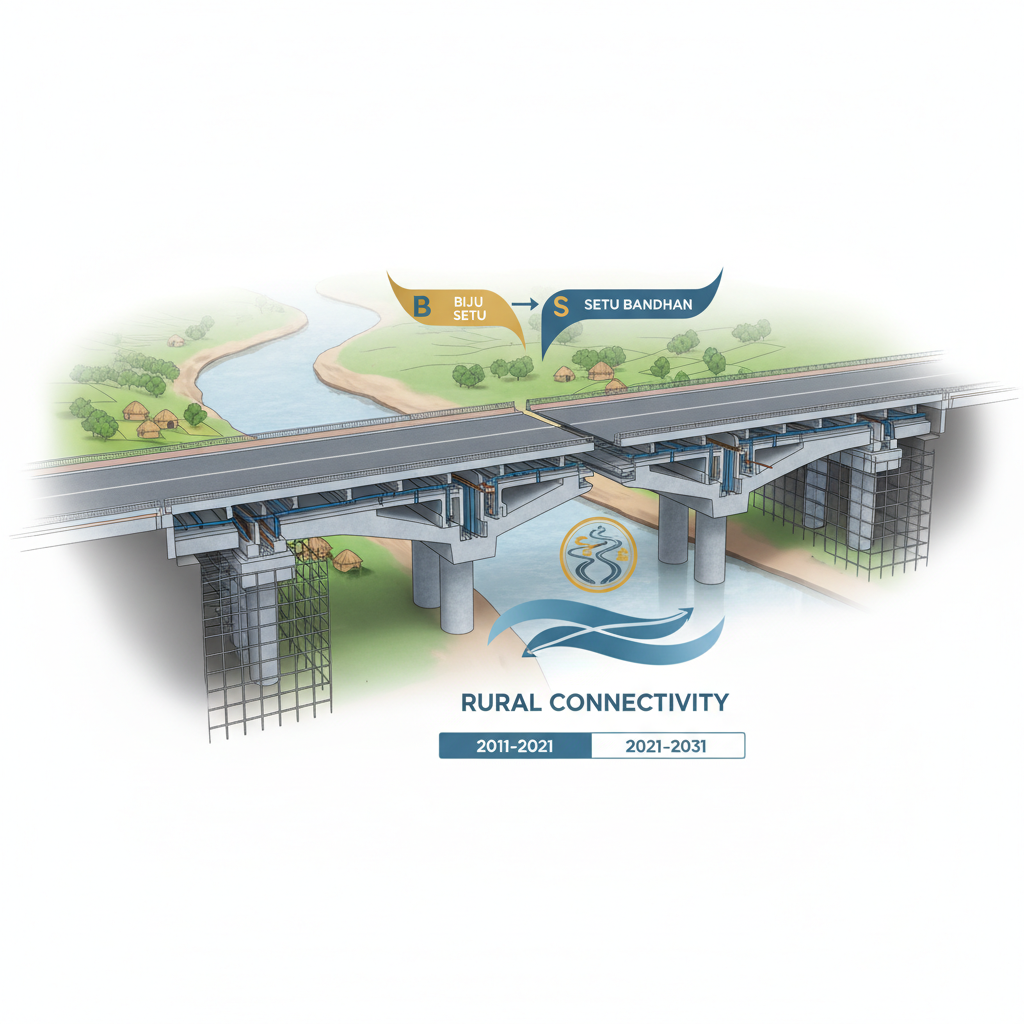
05 Sep Odisha Renames Biju Setu Yojana to Setu Bandhan Yojana till 2031
✎ The Setu Bandhan Yojana is Odisha’s flagship rural bridge-construction scheme, designed to enhance all-weather connectivity in underserved regions, with implementation extended to 2031 to align with national rural infrastructure…
Subject Relevance — Where This Topic Fits
- GS Paper II — Governance, Administration and Challenges | GS Paper III — Infrastructure: Roads and Bridges
- Prelims: Rural infrastructure gap, Bharatmala Pariyojana, Pradhan Mantri Gram Sadak Yojana (PMGSY), rural connectivity, bridge construction, rural development schemes
- Essay: Rural development and urban-rural divide, Infrastructure as a catalyst for inclusive growth
Quick Revision: The Setu Bandhan Yojana is Odisha’s flagship rural bridge-construction scheme, designed to enhance all-weather connectivity in underserved regions, with implementation extended to 2031 to align with national rural infrastructure priorities.
Why is this in the news?
The Odisha government’s decision to rename the ‘Biju Setu Yojana’ as the ‘Setu Bandhan Yojana’ and extend its implementation till 2031 underscores the state’s sustained commitment to bridging rural connectivity deficits. This policy adjustment, announced through a formal notification by the Rural Development Department, reflects a strategic recalibration of a long-standing rural infrastructure programme to align with evolving governance priorities and developmental needs.
Background
- The scheme was originally launched in 2011-12 under the nomenclature ‘Biju Setu Yojana’, named after a former Chief Minister of Odisha, to address the critical gap in rural connectivity by constructing bridges across rivers, nullahs, and other water bodies.
- Rural connectivity is a key determinant of socio-economic development, enabling access to markets, healthcare, education, and administrative services for rural populations.
- Odisha, with its diverse topography including riverine and hilly terrains, faces unique challenges in ensuring all-weather connectivity, necessitating targeted infrastructure interventions.
- The extension of the scheme till 2031 aligns with national frameworks such as the Pradhan Mantri Gram Sadak Yojana (PMGSY) and the Bharatmala Pariyojana, which prioritise rural road and bridge connectivity as a public good.
- The renaming of the scheme to ‘Setu Bandhan Yojana’ (literally ‘Bridge Linkage Scheme’) signifies a rebranding to emphasize its objective of fostering socio-economic linkages through physical infrastructure.
- This initiative is part of a broader trend in Indian governance where state-specific schemes are periodically reviewed and rebranded to enhance their visibility and impact.
What is the Setu Bandhan Yojana?
- The Setu Bandhan Yojana is a state-sponsored rural infrastructure programme implemented by the Rural Development Department of Odisha, aimed at constructing bridges to improve rural connectivity.
- The scheme targets the construction of bridges across rivers, nullahs, and other water bodies that disrupt rural mobility, particularly during monsoon seasons, thereby ensuring year-round access.
- Financial outlay for the scheme is borne by the state exchequer, with technical and administrative oversight provided by the Rural Development Department and local bodies.
- The scheme operates in tandem with national programmes such as PMGSY, which mandates the construction of all-weather roads and bridges in rural areas, ensuring synergy between state and central initiatives.
- Eligible beneficiaries include rural communities in Odisha, with priority accorded to areas with historically poor connectivity or high socio-economic vulnerability.
- The scheme employs a multi-stakeholder approach, involving gram panchayats, district administrations, and technical agencies for site selection, design, and implementation.
- Monitoring and evaluation are conducted through periodic reviews, geo-tagging of assets, and community feedback mechanisms to ensure transparency and accountability.
- The extension till 2031 reflects a long-term vision to address persistent infrastructure gaps while adapting to emerging challenges such as climate change and urban-rural migration.
Key Features
| Feature | Significance |
|---|---|
| Renaming to ‘Setu Bandhan Yojana’ | Signals continuity of policy with a rebranded identity, potentially enhancing public recognition and administrative ownership. |
| Extension till 2031 | Provides long-term fiscal and operational certainty for rural infrastructure planning and execution. |
| Rural bridge construction focus | Directly addresses connectivity gaps in rural Odisha, improving access to markets, healthcare, and education. |
| Implementation by Rural Development Department | Centralises governance under a dedicated department, ensuring technical oversight and accountability. |
| Original launch in 2011-12 | Demonstrates a decade-long commitment to rural connectivity, allowing for cumulative impact assessment. |
Why it Matters
Economic
- Enhances rural economic integration by reducing travel time and costs, thereby facilitating agricultural and non-farm livelihoods.
- Stimulates local employment in construction, maintenance, and ancillary sectors, contributing to inclusive growth.
- Supports supply chain efficiency by improving last-mile connectivity for goods and services in rural hinterlands.
Social
- Improves access to essential services such as healthcare and education, particularly in remote and tribal areas.
- Reduces vulnerability of rural communities during monsoons by ensuring all-weather connectivity.
- Promotes gender inclusion by easing mobility constraints for women and girls in accessing public spaces and institutions.
Administrative
- Demonstrates state-level commitment to decentralised governance through targeted rural infrastructure development.
- Provides a model for other states to emulate in bridging rural-urban divides via focused bridge construction programmes.
- Enhances data-driven policymaking through longitudinal assessment of connectivity improvements and their socio-economic impacts.
Environmental
- Mitigates the need for detours around natural barriers, reducing fuel consumption and carbon emissions from prolonged travel.
- Encourages sustainable land-use planning by integrating infrastructure with ecological considerations in rural landscapes.
Challenges
1. Geographical and Topographical Constraints
- Odisha’s diverse terrain, including hilly regions and flood-prone areas, poses engineering challenges for bridge construction.
- Seasonal flooding disrupts construction timelines and necessitates flood-resistant design standards.
- Remote locations increase logistical costs and delay material procurement and workforce deployment.
UPSC Link: Geography of India: Physical features and their implications
2. Funding and Fiscal Sustainability
- Long-term extension requires sustained budgetary allocations amid competing priorities in public expenditure.
- Potential dependency on central devolution or external funding sources introduces fiscal uncertainty.
- Need for robust cost-benefit analysis to justify continued investment in marginalised areas.
UPSC Link: Public Finance: Budgetary processes and fiscal federalism
3. Maintenance and Durability
- Ensuring post-construction maintenance to prevent premature deterioration, especially in high-rainfall regions.
- Balancing initial construction quality with lifecycle costs to avoid recurring expenditure.
- Adopting innovative materials and technologies for climate-resilient infrastructure.
UPSC Link: Disaster Management: Infrastructure resilience
4. Community Engagement and Land Acquisition
- Securing land rights and resolving encroachment issues in rural areas can delay project timelines.
- Ensuring local stakeholder buy-in to prevent vandalism or misuse of newly constructed bridges.
- Addressing displacement concerns while balancing developmental imperatives.
UPSC Link: Land Reforms: Challenges and reforms
5. Monitoring and Evaluation
- Developing real-time monitoring systems to track progress, quality, and utilisation of constructed bridges.
- Instituting third-party audits to assess socio-economic impact and ensure transparency.
- Creating feedback mechanisms for beneficiary communities to report deficiencies.
UPSC Link: Good Governance: E-governance and transparency
Challenges — UPSC Perspective
| Issue | Concern |
|---|---|
| Topographical diversity | Engineering and cost challenges in hilly and flood-prone terrains |
| Climate vulnerability | Risk of damage due to cyclones and heavy rainfall |
| Fiscal federalism | Dependency on central funds and state budgetary allocations |
| Land acquisition | Delays in securing rights and resolving encroachments |
| Maintenance gaps | Risk of infrastructure decay without sustained upkeep |
Government Initiatives — Must-Memorise for Prelims
- Setu Bandhan Yojana (formerly Biju Setu Yojana)
Way Forward
- Conduct a comprehensive topographical survey to identify high-priority locations for bridge construction.
- Integrate climate-resilient design standards to mitigate risks from extreme weather events.
- Establish a dedicated maintenance fund with annual allocations for upkeep and repairs.
- Strengthen inter-departmental coordination between Rural Development, Panchayati Raj, and Disaster Management authorities.
- Introduce a digital platform for real-time monitoring of construction progress and post-completion utilisation.
- Facilitate community participation through awareness campaigns and grievance redressal mechanisms.
- Explore public-private partnerships for innovative financing models, if feasible.
- Undertake periodic impact assessments to evaluate socio-economic benefits and guide future expansions.
UPSC Value Addition
Keywords for Mains Answer-Writing
Rural Connectivity · Biju Setu Yojana · Setu Bandhan Yojana · Rural Infrastructure Development · Public Goods Provision · State-Sponsored Welfare Schemes · Bridging Rural Divides · Multi-Level Governance · Sustainable Development Goals (SDG 9) · Fiscal Federalism · Decentralised Planning · Rural-Urban Divide · Infrastructure Financing · State-Level Policy Initiatives
Concept Flow
Rural connectivity gaps → Identification of strategic locations → Policy intervention (Biju Setu Yojana → Setu Bandhan Yojana) → Long-term extension (till 2031) → Infrastructure development (bridges) → Enhanced mobility and economic integration → Socio-economic upliftment → Sustained maintenance and monitoring.
Prelims Practice Questions
Q1. Consider the following statements regarding the ‘Setu Bandhan Yojana’ in Odisha:
1. The scheme was originally launched in 2011-12 as the ‘Biju Setu Yojana’.
2. It aims to improve rural connectivity by constructing bridges across Odisha.
3. The scheme has been renamed and extended till 2031 under the Rural Development Department.
4. The scheme is a centrally sponsored initiative with 100% funding from the Union Government.
How many of the above statements are correct?
- Only one
- Only two
- Only three
- All
Answer: Only three — Statements 1, 2, and 3 are correct. Statement 4 is incorrect as the scheme is a state-sponsored initiative with funding primarily from the Odisha state budget.
Q2. Assertion (A): The renaming of ‘Biju Setu Yojana’ to ‘Setu Bandhan Yojana’ reflects a rebranding effort to align with national nomenclature conventions.
Reason (R): The extension of the scheme till 2031 indicates a long-term commitment to rural infrastructure development in Odisha.
In the context of the above statements, which of the following is correct?
- Both A and R are true, and R is the correct explanation of A.
- Both A and R are true, but R is not the correct explanation of A.
- A is true, but R is false.
- A is false, but R is true.
Answer: A is true, but R is false. — The renaming is a rebranding effort, but it is not directly linked to national nomenclature conventions. The extension till 2031 demonstrates the state’s long-term commitment to rural infrastructure development.
Q3. Match the following schemes with their respective objectives:
Column I (Scheme) | Column II (Objective)
—————–|——————-
A. Setu Bandhan Yojana | 1. Provision of rural housing
B. Pradhan Mantri Gram Sadak Yojana (PMGSY) | 2. Construction of rural bridges
C. Mahatma Gandhi National Rural Employment Guarantee Scheme (MGNREGS) | 3. Rural road connectivity
D. Indira Awaas Yojana | 4. Employment generation in rural areas
Select the correct match:
- A-2, B-3, C-4, D-1
- A-1, B-2, C-3, D-4
- A-3, B-4, C-1, D-2
- A-4, B-1, C-2, D-3
Answer: A-2, B-3, C-4, D-1 — Setu Bandhan Yojana focuses on rural bridge construction (A-2). PMGSY aims at rural road connectivity (B-3). MGNREGS is for employment generation (C-4). Indira Awaas Yojana provides rural housing (D-1).
Mains Practice Question
✍ The renaming of the ‘Biju Setu Yojana’ to ‘Setu Bandhan Yojana’ and its extension till 2031 underscores the state’s commitment to rural infrastructure development. Critically examine the significance of such schemes in bridging rural divides and fostering inclusive growth in India. (15 Marks)
Approach: MODEL-ANSWER SKELETON:
1. **Introduction (2 marks)**: Define rural connectivity and its role in inclusive growth. Mention the objectives of Setu Bandhan Yojana and its alignment with SDG 9 (Industry, Innovation, and Infrastructure).
2. **Rural Divides and Connectivity (3 marks)**: Explain the rural-urban divide in India, citing data on rural road density, access to markets, and economic disparities. Highlight the role of infrastructure in reducing these divides.
3. **Significance of Rural Infrastructure Schemes (4 marks)**: Discuss how schemes like Setu Bandhan Yojana contribute to:
– Economic integration (access to markets, employment)
– Social inclusion (healthcare, education access)
– Administrative efficiency (delivery of welfare schemes)
– Environmental sustainability (reducing carbon footprint via efficient transport)
Cite examples from Odisha or other states.
4. **Challenges and Limitations (3 marks)**: Critically assess:
– Funding constraints (state vs. central funding, fiscal federalism)
– Implementation bottlenecks (land acquisition, environmental clearances)
– Maintenance and sustainability issues
– Equity concerns (benefit distribution across regions and social groups)
5. **Comparative Perspective (2 marks)**: Compare with similar centrally sponsored schemes like PMGSY. Discuss the advantages of state-led initiatives in tailoring solutions to local needs.
6. **Conclusion (1 mark)**: Summarise the role of rural connectivity in achieving the broader goals of ‘Sabka Saath, Sabka Vikas’. Emphasise the need for multi-level governance and long-term planning.
Source: orissapost.com
Odisha PCS (OPSC (OAS)) — State PCS Practice
Prelims: Under the recently renamed ‘Setu Bandhan Yojana’ in Odisha, which of the following is the primary objective of the scheme?
- A. Construction of rural bridges to improve connectivity
- B. Provision of free healthcare to tribal communities
- C. Distribution of subsidized agricultural inputs to farmers
- D. Promotion of digital literacy among school children
Answer: A. Construction of rural bridges to improve connectivity — The scheme aims to enhance rural connectivity by constructing bridges over rivers and canals.
Mains: Discuss the significance of the ‘Setu Bandhan Yojana’ (formerly ‘Biju Setu Yojana’) in the socio-economic development of Odisha, with special reference to its extended timeline till 2031. Highlight its impact on rural infrastructure and connectivity.
Generated by AanyaAi for educational purpose.
Related guides on our sites
- Anthropology VS PSIR
- Best PSIR optional coaching
- Best PSIR optional coaching online
- Best PSIR optional teacher

- UPSC Alert: 40-Day ‘Khet Bachao Abhiyan’ Launch by Union Minister - October 22, 2026
- भारत ने बताया UN रिपोर्ट में दाऊद इब्राहिम को ‘भारत-आधारित’ बताना ‘गलत’ - October 22, 2026
- GRAP Stage I activated in Delhi-NCR amid rising AQI: Key actions for aspirants - October 22, 2026

No Comments