


07 Sep NITI Aayog Launches PACT for Zero-Emission Freight in India
✎ PACCT and the ZET Marketplace are NITI Aayog’s demand aggregation and ecosystem coordination tools under e-FAST India to scale zero-emission freight transport by uniting shippers, financiers, and charging infrastructure providers.
Subject Relevance — Where This Topic Fits
- GS Paper III — Environment, Pollution and Climate Change | GS Paper III — Infrastructure: Energy, Roads and Logistics | GS Paper III — Mobilisation of Resources and Investment Models
- Prelims: Zero-Emission Trucks (ZETs), Battery Swapping Policy, National Electric Freight Platform (e-FAST India), PACCT, ZET Marketplace, Logistics Data Bank, PM Gati Shakti
- Essay: India’s transition to sustainable logistics: Challenges and opportunities, Role of public-private partnerships in achieving net-zero emissions
Quick Revision: PACCT and the ZET Marketplace are NITI Aayog’s demand aggregation and ecosystem coordination tools under e-FAST India to scale zero-emission freight transport by uniting shippers, financiers, and charging infrastructure providers.
Why is this in the news?
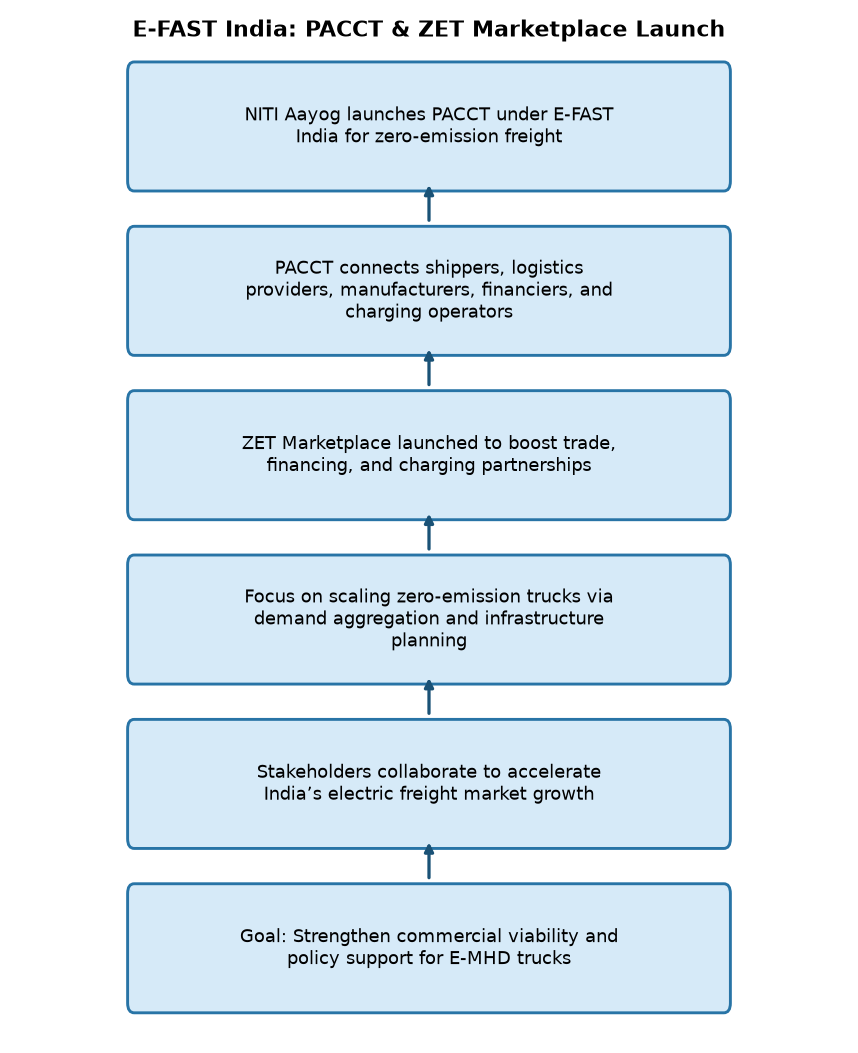
NITI Aayog, under its e-FAST India initiative, launched the Platform for Accelerating Commercialisation of Electric Trucks (PACCT) and the Zero-Emission Truck (ZET) Marketplace on 7 September 2026. These initiatives aim to scale up zero-emission freight transport in India by fostering demand aggregation, financing partnerships, and charging infrastructure planning, aligning with the country’s decarbonisation goals in the logistics sector.
Background
- India’s logistics sector contributes approximately 14% to the national GDP and is a major consumer of diesel, accounting for about 11% of the country’s total diesel consumption.
- The Government of India has set a target to reduce logistics costs from 13-14% of GDP to 8% by 2030, necessitating efficiency improvements and decarbonisation.
- As of FY 2026, India has over 3,000 operational electric medium and heavy-duty trucks, with a fourfold increase in e-freight vehicles from FY 2025 to FY 2026.
What are PACCT and the ZET Marketplace?
- PACCT (Platform for Accelerating Commercialisation of Electric Trucks) is a demand aggregation and ecosystem coordination platform launched under NITI Aayog’s e-FAST India initiative to accelerate the adoption of zero-emission trucks in India’s freight sector.
- PACCT aims to bring together shippers, logistics service providers (LSPs), vehicle manufacturers, financiers, charging point operators (CPOs), and other stakeholders to create a unified market for electric freight transport.
- The platform will identify freight demand corridors, facilitate long-term offtake agreements, and support the development of corridor-specific charging infrastructure to enhance the commercial viability of zero-emission trucks.
- The ZET Marketplace is a digital platform launched alongside PACCT to connect electric truck manufacturers, LSPs, CPOs, financiers, and technology providers, enabling collaboration on projects, financing, and infrastructure deployment.
- The ZET Marketplace will facilitate end-to-end project execution, from planning to implementation, by matching demand with supply, showcasing products, and fostering partnerships for zero-emission freight projects.
- Both PACCT and the ZET Marketplace are designed to address key barriers to electric truck adoption, including high upfront costs, limited charging infrastructure, and fragmented demand.
Key Features
| Feature | Significance |
|---|---|
| Platform for Accelerating Commercial Transition (PACT) | A collaborative platform designed to aggregate freight demand, identify zero-emission freight corridors, and strengthen the commercial viability of electric medium and heavy-duty trucks (e-MHD) through stakeholder engagement. |
| ZET Marketplace (Zero-Emission Truck Marketplace) | A digital marketplace connecting e-truck manufacturers, logistics service providers (LSPs), charging point operators (CPOs), financiers, and technology firms to facilitate partnerships, product showcases, and project implementation. |
| Demand Aggregation Mechanism | Consolidates freight demand from shippers and LSPs to provide clarity on market potential, enabling targeted investments in charging infrastructure and fleet electrification. |
| Corridor-Based Charging Infrastructure Planning | Identifies high-demand freight corridors to prioritize the deployment of charging stations, reducing range anxiety and operational bottlenecks for e-trucks. |
| Innovative Financing Models | Facilitates access to financing for fleet operators, vehicle manufacturers, and infrastructure providers by showcasing bankable projects and reducing perceived investment risks. |
Why it Matters
Economic Growth and Competitiveness
- Enhances the logistics sector’s competitiveness by reducing dependence on fossil fuels, thereby lowering operational costs and improving supply chain efficiency.
- Stimulates domestic manufacturing of electric trucks and related components, aligning with the ‘Make in India’ initiative and reducing import dependency.
- Attracts investment in green logistics, fostering job creation in manufacturing, charging infrastructure, and allied services.
Environmental Sustainability
- Supports India’s commitment to reducing carbon emissions in the transport sector, a key component of the Nationally Determined Contributions (NDCs) under the Paris Agreement.
- Promotes the adoption of zero-emission vehicles, contributing to improved air quality and public health outcomes, particularly in urban and industrial corridors.
- Aligns with the ‘Panchamrit’ targets announced at COP26, including the goal of achieving 30% electric vehicle penetration by 2030.
Energy Security and Infrastructure Development
- Reduces reliance on imported fossil fuels by transitioning freight transport to domestically generated renewable energy, enhancing energy security.
- Accelerates the development of charging infrastructure, which can be leveraged for broader electric mobility adoption, including passenger vehicles.
- Encourages the integration of renewable energy sources (e.g., solar, wind) into charging networks, fostering a sustainable energy ecosystem.
Policy and Governance Framework
- Demonstrates the role of NITI Aayog as a facilitator of multi-stakeholder collaborations to address systemic challenges in transitioning to sustainable transport.
- Provides a model for public-private partnerships (PPPs) in infrastructure development, where government agencies, industry, and financiers co-create solutions.
- Serves as a case study for policy interventions that combine demand aggregation, financing support, and infrastructure planning to drive sectoral transformation.
Technological Innovation and Industry Collaboration
- Fosters innovation in battery technology, charging solutions, and fleet management systems tailored for medium and heavy-duty electric vehicles.
- Encourages collaboration between startups, established manufacturers, and research institutions to develop cost-effective and scalable solutions.
- Creates a feedback loop where real-world operational data from e-trucks informs policy adjustments and technological improvements.
Challenges
1. High Capital Costs and Financing Barriers
- Electric trucks and charging infrastructure require significant upfront investments, which may deter small and medium-sized fleet operators from adoption.
- Lenders perceive higher risks in financing e-trucks due to unproven resale value and operational uncertainties, limiting access to credit.
- Need for innovative financing models such as green bonds, viability gap funding, and blended finance to de-risk investments.
UPSC Link: Economic Survey: Financing Green Infrastructure
2. Charging Infrastructure Gaps
- Insufficient and unevenly distributed charging stations, particularly along high-density freight corridors, create range anxiety and operational inefficiencies.
- Grid capacity constraints and the need for high-power charging solutions to support heavy-duty vehicles during long-haul operations.
- Regulatory and land acquisition challenges in setting up charging stations, especially in densely populated or industrial areas.
UPSC Link: NITI Aayog: EV Charging Infrastructure Guidelines
3. Battery Technology and Operational Limitations
- Current battery technologies face limitations in energy density, charging time, and durability, which are critical for long-haul freight operations.
- Dependence on imported battery materials (e.g., lithium, cobalt) poses supply chain risks and cost vulnerabilities.
- Lack of standardized battery swapping or fast-charging protocols for e-trucks, leading to interoperability issues across manufacturers.
UPSC Link: Science & Tech: Battery Storage Innovations
4. Market and Behavioral Barriers
- Limited awareness and trust among fleet operators regarding the reliability and cost-effectiveness of e-trucks compared to diesel trucks.
- Fragmented freight demand and lack of coordinated procurement strategies among shippers and LSPs, slowing down economies of scale.
- Resistance to change within traditional logistics ecosystems, where diesel trucks are entrenched due to established supply chains and maintenance networks.
UPSC Link: Logistics Performance Index (World Bank)
5. Policy and Regulatory Hurdles
- Inconsistent state-level policies on EV incentives, registration fees, and road taxes create a fragmented regulatory environment.
- Lack of clear standards for safety, performance, and emissions of electric trucks, leading to compliance uncertainties.
- Need for harmonized GST rates on EV components and charging services to reduce cost burdens on operators.
UPSC Link: GST Council: EV Taxation Framework
6. Supply Chain and Workforce Transition
- Disruption in traditional diesel truck manufacturing and maintenance sectors, requiring reskilling and redeployment of the workforce.
- Dependence on global supply chains for critical components (e.g., batteries, power electronics) exposes the sector to geopolitical and trade risks.
- Need for upskilling programs to train drivers, technicians, and logistics managers in operating and maintaining e-trucks and charging infrastructure.
UPSC Link: Skill India Mission: Green Jobs
Challenges — UPSC Perspective
| Issue | Concern |
|---|---|
| Upfront Capital Costs | High initial investment for e-trucks and charging stations deters small operators and limits market expansion. |
| Charging Infrastructure Deficit | Uneven distribution of charging stations along freight corridors creates operational inefficiencies and range anxiety. |
| Battery Technology Limitations | Energy density, charging time, and durability constraints hinder long-haul freight operations. |
| Financing Risks | Lack of proven resale value and operational data increases perceived investment risks for financiers. |
| Regulatory Fragmentation | Inconsistent state-level policies on EV incentives and taxes create a complex compliance environment. |
| Workforce Transition | Disruption in traditional diesel truck sectors requires significant reskilling and redeployment efforts. |
Way Forward
- Strengthen PACT by expanding stakeholder engagement to include state governments, municipal bodies, and international development partners for coordinated action.
- Develop corridor-specific master plans for charging infrastructure, prioritizing high-density freight routes and urban logistics hubs.
- Introduce blended finance mechanisms, such as green bonds and viability gap funding, to de-risk investments in e-truck fleets and charging stations.
- Accelerate battery technology R&D through public-private partnerships, focusing on energy density, fast-charging capabilities, and cost reduction.
- Standardize safety, performance, and emissions norms for electric trucks to ensure interoperability and build market confidence.
- Launch nationwide awareness campaigns to educate fleet operators, drivers, and logistics managers on the economic and environmental benefits of e-trucks.
- Establish a national data repository on e-truck operations to generate real-time insights on performance, maintenance, and infrastructure gaps.
- Integrate PACT and ZET Marketplace with existing logistics and transport digital platforms (e.g., e-NAM, Gati Shakti) for seamless coordination.
UPSC Value Addition
Keywords for Mains Answer-Writing
Zero-emission freight logistics · e-FAST India initiative · PACCT platform · ZET Marketplace · Electric Medium and Heavy-Duty (e-MHD) trucks · charging infrastructure for e-trucks · logistics decarbonisation · NITI Aayog · Road Transport and Highways Ministry · freight corridor electrification · battery swapping and monitoring systems · financing mechanisms for e-freight · logistics competitiveness · energy security in transport · sustainable supply chains
Concept Flow
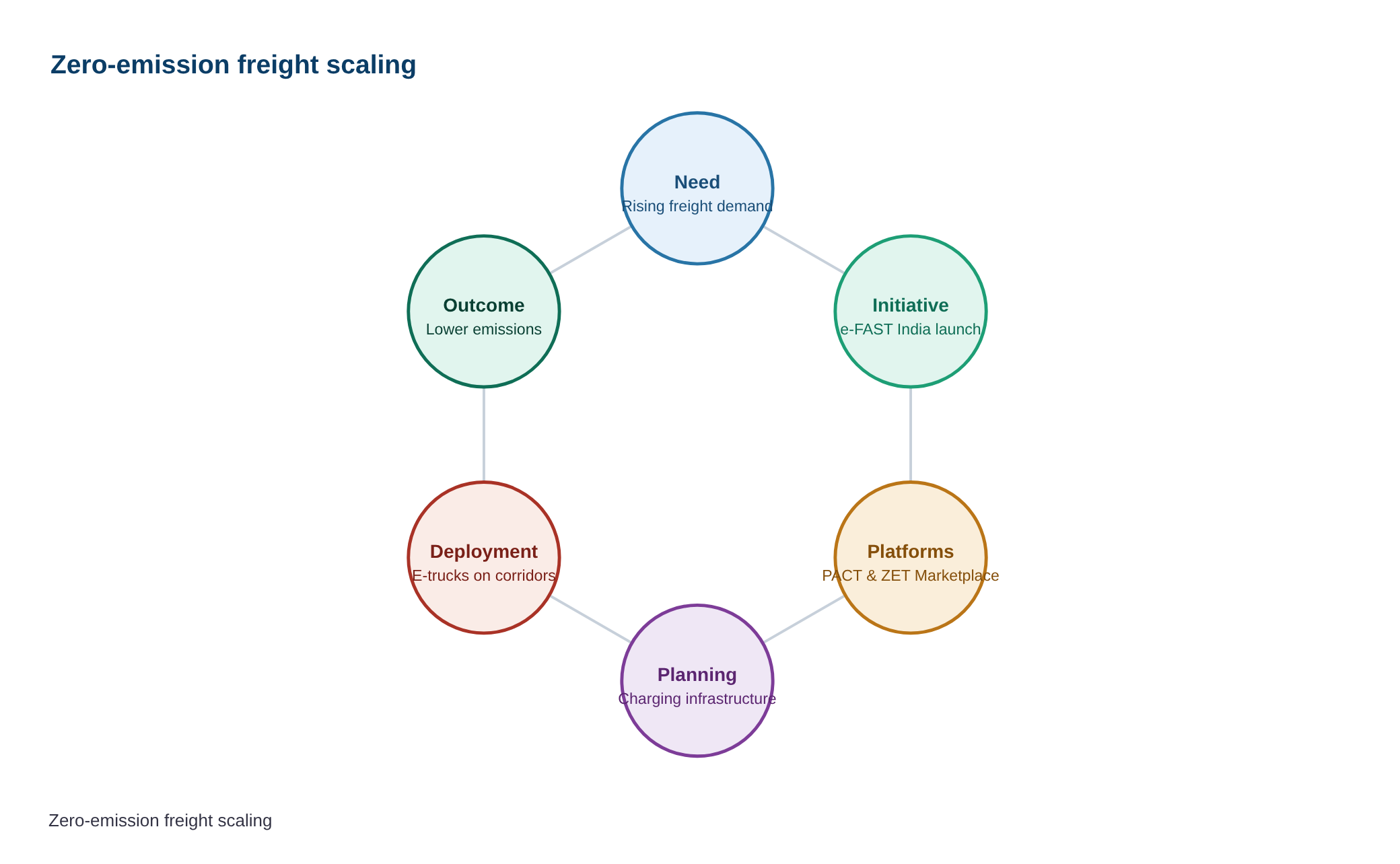
Rising freight demand and environmental concerns → Recognition of need for zero-emission freight transport → NITI Aayog’s e-FAST India initiative → Launch of PACT and ZET Marketplace → Aggregation of freight demand and identification of high-potential corridors → Targeted planning for charging infrastructure → Attraction of investments in e-trucks and charging stations → Collaboration among shippers, LSPs, manufacturers, financiers, and CPOs → Development of innovative financing models and operational frameworks → Strengthening of commercial viability of e-trucks → Deployment of e-trucks along prioritized corridors → Reduction in carbon emissions and fossil fuel dependence → Enhancement of logistics competitiveness and energy security → Data-driven feedback loop from operational e-trucks → Continuous improvement in battery technology, charging solutions, and policy frameworks → Scalable model for broader electric mobility adoption
Prelims Practice Questions
Q1. Consider the following statements about the PACCT platform launched under the e-FAST India initiative:
1. PACCT is designed to strengthen the commercial base for zero-emission trucks in India.
2. It was launched by the Ministry of Road Transport and Highways.
3. PACCT aims to facilitate demand aggregation and charging infrastructure planning for electric freight vehicles.
How many of the above statements are correct?
- Only one
- Only two
- All three
- None
Answer: All three — Statement 1 and 3 are correct as PACCT is aimed at strengthening the commercial base for zero-emission trucks and facilitating demand aggregation and charging infrastructure planning. Statement 2 is incorrect as PACCT was launched by NITI Aayog, not the Ministry of Road Transport and Highways.
Q2. Assertion (A): The ZET Marketplace launched under e-FAST India is a digital platform connecting electric truck manufacturers, logistics service providers, and charging point operators.
Reason (R): The ZET Marketplace aims to facilitate business opportunities and partnerships for zero-emission freight projects in India.
Options:
A. Both A and R are true, and R is the correct explanation of A.
B. Both A and R are true, but R is not the correct explanation of A.
C. A is true, but R is false.
D. A is false, but R is true.
Answer: ? — Both Assertion (A) and Reason (R) are true, and Reason (R) correctly explains Assertion (A). The ZET Marketplace is indeed a digital platform connecting stakeholders and aims to facilitate business opportunities and partnerships for zero-emission freight projects.
Q3. Match the following initiatives with their respective objectives:
Column I (Initiative)
1. PACCT
2. ZET Marketplace
3. e-FAST India
Column II (Objective)
A. Strengthening commercial base for zero-emission trucks
B. Facilitating business opportunities and partnerships for zero-emission freight projects
C. National platform for accelerating electric freight in India
- 1-A, 2-B, 3-C; 1-B, 2-A, 3-C; 1-C, 2-B, 3-A; 1-A, 2-C, 3-B
Answer: 1-A, 2-B, 3-C; 1-B, 2-A, 3-C; 1-C, 2-B, 3-A; 1-A, 2-C, 3-B — PACCT (1) is designed to strengthen the commercial base for zero-emission trucks (A). ZET Marketplace (2) facilitates business opportunities and partnerships for zero-emission freight projects (B). e-FAST India (3) is the national platform for accelerating electric freight in India (C).
Mains Practice Question
✍ The transition to zero-emission freight logistics in India is being accelerated through initiatives like PACCT and the ZET Marketplace under the e-FAST India platform. Critically examine the significance of these initiatives for India’s logistics competitiveness and energy security. Also, outline the key challenges in scaling up electric medium and heavy-duty trucks for freight operations in India. (15 Marks)
Approach: MODEL-ANSWER SKELETON:
1. **Introduction (2 marks)**: Define zero-emission freight logistics and its relevance for India’s decarbonisation goals (e.g., NDC targets, Paris Agreement commitments). Mention the role of e-FAST India as a national platform for accelerating electric freight.
2. **Significance of PACCT and ZET Marketplace (5 marks)**:
– **PACCT (Platform for Aggregation of Clean Commercial Transport)**: Explain its role in demand aggregation, corridor-based charging infrastructure planning, and strengthening the commercial base for zero-emission trucks. Cite data on the growth of e-MHD trucks (e.g., 201 in FY25 to 826 in FY26).
– **ZET Marketplace**: Highlight its function as a digital platform connecting manufacturers, logistics service providers (LSPs), charging point operators (CPOs), financiers, and technology firms to facilitate partnerships and business opportunities for zero-emission freight projects.
– **Collaborative governance**: Emphasise the role of NITI Aayog, Ministry of Road Transport and Highways, and industry stakeholders in fostering a coordinated ecosystem.
3. **Impact on Logistics Competitiveness and Energy Security (4 marks)**:
– **Logistics Competitiveness**: Discuss how electrification of freight can reduce operational costs (lower fuel expenses, maintenance), improve fleet efficiency, and enhance supply chain resilience. Reference the potential for corridor-based charging infrastructure to reduce downtime and improve turnaround times.
– **Energy Security**: Explain how reduced dependence on imported fossil fuels for freight operations can enhance India’s energy security. Highlight the role of domestic manufacturing of electric trucks and batteries in reducing import dependency.
4. **Key Challenges in Scaling Up e-MHD Trucks (4 marks)**:
– **Infrastructure Gaps**: Lack of widespread charging infrastructure, especially for medium and heavy-duty trucks. Mention the need for high-power charging stations and battery swapping solutions.
– **Financing and Risk**: High upfront costs of e-MHD trucks and financing challenges. Discuss the role of innovative financing models (e.g., leasing, green bonds) and risk mitigation mechanisms (e.g., battery monitoring systems).
– **Policy and Regulatory Hurdles**: Fragmented regulatory frameworks, lack of uniform standards for charging infrastructure, and incentives for adoption. Reference the need for harmonised policies across states.
– **Technological and Operational Barriers**: Battery range limitations, payload capacity concerns, and the need for driver training and upskilling.
5. **Conclusion (2 marks)**: Summarise the transformative potential of PACCT and ZET Marketplace while acknowledging the challenges. Emphasise the need for a multi-stakeholder approach, including government, industry, and financial institutions, to achieve India’s zero-emission freight goals.
Source: PIB (Press Information Bureau)
Generated by AanyaAi for educational purpose.
Related guides on our sites
- Anthropology VS PSIR
- Best PSIR optional coaching
- Best PSIR optional coaching online
- Best PSIR optional teacher

- NITI Aayog Launches PACT for Zero-Emission Freight in India - September 7, 2026
- UPSC Civil Services (Main) Examination 2026 — History Optional Paper II: Questions with Model Answers | Plutus IAS - September 7, 2026
- लोकायन 2026: आईएनएस सुदर्शिनी की बार्सिलोना यात्रा, भारत-स्पेन संबंधों को मजबूत बनाएगी - September 7, 2026

No Comments