


08 Sep Tamil Nadu Assembly’s 28-Day Budget Session: Key Highlights for UPSC & State PCS
✎ The Tamil Nadu Legislative Assembly’s Budget Session 2026 recorded the highest public participation in three years, and passed 13 Bills while adopting 8 resolutions under strict procedural compliance.
Subject Relevance — Where This Topic Fits
- GS Paper II — Parliament and State Legislatures — Structure, Functioning, Conduct of Business, Powers & Privileges | GS Paper III — Role of Media and Technology in Governance
- Prelims: Legislative Assembly, Budget Session, Rule 110 of the Rules of Procedure and Conduct of Business in the Tamil Nadu Legislative Assembly, Adjournment sine die, Live telecast of proceedings, Sign-language interpretation
- Essay: The evolving role of legislative assemblies in fostering democratic transparency and inclusivity
Quick Revision: The Tamil Nadu Legislative Assembly’s Budget Session 2026 recorded the highest public participation in three years, and passed 13 Bills while adopting 8 resolutions under strict procedural compliance.
Why is this in the news?
The Tamil Nadu Legislative Assembly concluded its Budget Session for 2026 after 28 days of proceedings, marking a significant procedural milestone with record public participation. The session underscored the Assembly’s emphasis on accessibility, transparency, and civic engagement through technological integration and systematic legislative output.
Background
- The Tamil Nadu Legislative Assembly, like other state legislatures in India, conducts a Budget Session annually to review, debate, and approve the state’s financial proposals, as mandated under Article 202 of the Constitution of India.
- The duration and productivity of legislative sessions are governed by the Rules of Procedure and Conduct of Business, which outline the mechanisms for conducting business, including the adoption of resolutions, passage of Bills, and suo motu announcements.
- Public participation in legislative proceedings is facilitated through visitor galleries, with the number of visitors serving as an indicator of civic engagement and democratic awareness.
- Technological integration in legislative processes, such as live telecasts and sign-language interpretation, aligns with global best practices aimed at enhancing accessibility and inclusivity in governance.
- Rule 110 of the Tamil Nadu Legislative Assembly Rules empowers the Chief Minister to make suo motu announcements on matters of public importance, subject to procedural compliance.
- The adjournment sine die signifies the formal conclusion of the session without a predetermined date for reassembly, allowing for the scheduling of the next session at the discretion of the Speaker.
Key Features of the Tamil Nadu Legislative Assembly’s Budget Session 2026
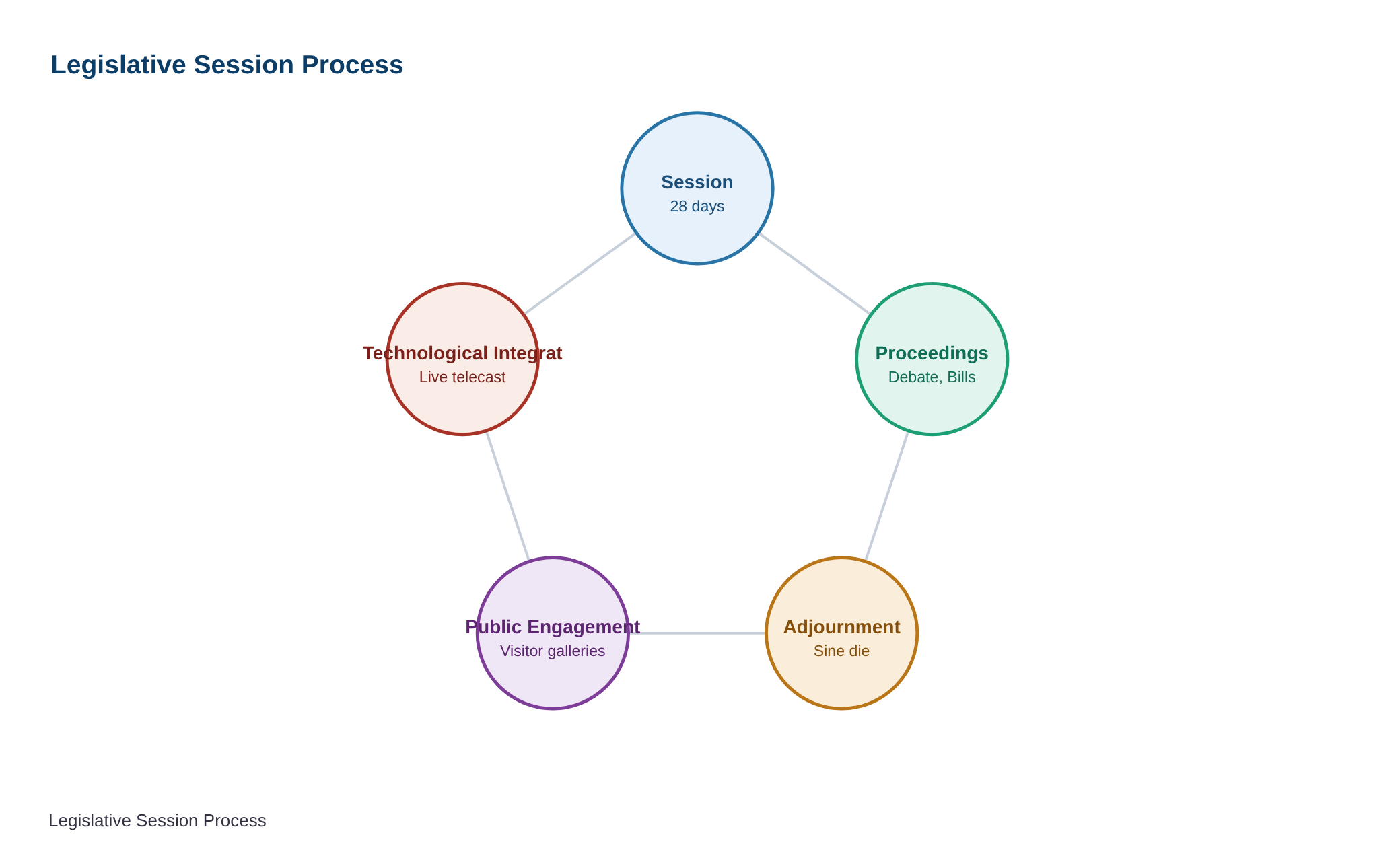
- Duration and Productivity: The session spanned 28 days with 170 hours and 6 minutes of active business, during which 13 Bills were passed and 8 resolutions were adopted, reflecting the Assembly’s legislative productivity.
- Public Engagement: A record 32,055 visitors, including students from 76 educational institutions, witnessed the proceedings, indicating heightened civic interest and transparency in legislative functioning.
- Accessibility Initiatives: From the next Assembly session, live sign-language interpretation will be telecast alongside the proceedings, ensuring inclusivity for the hearing-impaired community in alignment with the Rights of Persons with Disabilities Act, 2016.
- Suo Motu Announcements: Eighteen announcements were made under Rule 110, with 17 attributed to the Chief Minister, demonstrating the executive’s role in addressing urgent public issues through legislative channels.
- Procedural Compliance: The session adhered to the Rules of Procedure and Conduct of Business, ensuring adherence to constitutional and statutory norms in legislative conduct.
- Technological Integration: The live telecast of proceedings, now extended to sign-language interpretation, enhances transparency and enables citizens to observe legislative processes in real time.
- Adjournment Sine Die: The formal conclusion of the session without a fixed reassembly date allows for flexible scheduling of future sittings based on legislative priorities and administrative requirements.
Key Features
| Feature | Significance |
|---|---|
| Duration of 28 days with 170 hours and 6 minutes of business | Demonstrates sustained legislative engagement and procedural efficiency, enhancing the Assembly’s functional output. |
| Record visitor turnout of 32,055 individuals, including 76 school/college students | Indicates heightened public interest in democratic processes and potential for civic education through exposure to legislative functioning. |
| Live sign-language interpretation to be telecast from next session | Advances inclusivity by ensuring accessibility for persons with hearing disabilities, aligning with constitutional and statutory mandates for reasonable accommodation. |
| Eight resolutions adopted and thirteen Bills passed | Reflects legislative productivity and the Assembly’s role in enacting laws and policy directions for the state’s governance. |
| Eighteen suo motu announcements under Rule 110 | Highlights the proactive role of the executive in addressing urgent or significant matters without external prompting, within the Assembly’s procedural framework. |
Why it Matters
Legislative and Procedural
- The extended session underscores the Assembly’s commitment to thorough deliberation, scrutiny, and passage of legislation, which is critical for effective governance and policy implementation.
- The adoption of resolutions and passage of Bills indicate active legislative output, contributing to the state’s legal and policy framework.
- Suo motu announcements under Rule 110 demonstrate executive responsiveness within the Assembly’s procedural rules, balancing urgency with constitutional governance norms.
Democratic Participation and Inclusivity
- The record visitor turnout, particularly among students, signifies growing public engagement with democratic institutions, fostering civic awareness and participation.
- The introduction of live sign-language interpretation marks a progressive step toward inclusivity, ensuring that legislative proceedings are accessible to all citizens, including those with disabilities.
Institutional Transparency and Accountability
- The telecast of live proceedings, including sign-language interpretation, enhances transparency by making the legislative process accessible to a broader audience, thereby strengthening public trust in democratic institutions.
- The Speaker’s emphasis on visitor turnout and procedural details reflects a focus on institutional accountability and openness.
Challenges
1. Ensuring Sustainable Public Engagement
- Sustaining high levels of public interest in legislative proceedings over longer sessions may require innovative outreach and educational initiatives.
- Balancing the demands of extended sessions with the need for quality deliberation and scrutiny remains a challenge for legislative bodies.
UPSC Link: Parliamentary functioning and public participation
2. Accessibility for Persons with Disabilities
- While live sign-language interpretation is a commendable step, ensuring its seamless implementation and accessibility across all platforms requires robust infrastructure and periodic review.
- Expanding accessibility measures to include other disabilities (e.g., visual or mobility impairments) in legislative processes is an ongoing challenge.
UPSC Link: Rights of Persons with Disabilities Act, 2016
3. Legislative Productivity vs. Procedural Rigor
- Achieving a balance between the volume of legislative output (Bills passed, resolutions adopted) and the depth of scrutiny is essential to maintain the quality of laws and policies.
- Ensuring that suo motu announcements do not overshadow structured legislative processes is critical for maintaining procedural integrity.
UPSC Link: Parliamentary procedures and legislative scrutiny
Challenges — UPSC Perspective
| Issue | Concern |
|---|---|
| Sustaining public engagement in legislative proceedings | Risk of declining interest if sessions are not made engaging or outcomes are not communicated effectively. |
| Implementation of accessibility measures for persons with disabilities | Potential gaps in infrastructure, training, or technological readiness may hinder full inclusivity. |
| Balancing legislative output with procedural rigor | Overemphasis on quantity may compromise the quality of laws and the depth of debate. |
| Ensuring transparency in executive announcements within the Assembly | Suo motu announcements must align with constitutional principles and avoid bypassing structured legislative processes. |
Way Forward
- Strengthen civic education initiatives to sustain public interest in legislative processes, particularly among students and youth.
- Develop a phased rollout plan for accessibility measures, including sign-language interpretation, with periodic audits to ensure compliance and effectiveness.
- Institute a dedicated committee to review the quality of legislative output, ensuring that Bills and resolutions undergo rigorous scrutiny before adoption.
- Enhance the Assembly’s digital infrastructure to support live telecasts and accessibility features, including multilingual options where feasible.
- Promote structured interactions between the executive and legislature to align suo motu announcements with broader policy frameworks and legislative agendas.
- Conduct post-session feedback surveys among visitors to assess the impact of public engagement and identify areas for improvement.
- Collaborate with educational institutions to integrate legislative awareness into curricula, fostering a culture of informed civic participation.
UPSC Value Addition
Keywords for Mains Answer-Writing
State Legislature · Budget Session · Legislative Assembly · Rule 110 · Suo Motu Announcements · Live Sign-Language Interpretation · Legislative Process · State Budget · Parliamentary Procedures · Accessibility in Governance · Legislative Accountability · Tamil Nadu Legislative Assembly
Constitutional & Policy Linkages
- Article 19(1)(a) — Freedom of speech and expression, including the right to access information about legislative proceedings.
- Article 21 — Right to life and personal liberty, encompassing the right to dignity and reasonable accommodation for persons with disabilities.
- Article 14 — Equality before law, mandating inclusive access to public institutions and services.
Concept Flow
Extended legislative sessions → Increased public engagement and scrutiny → Enhanced transparency and accountability. → Public participation in Assembly proceedings → Heightened civic awareness and democratic involvement → Strengthened institutional trust. → Introduction of live sign-language interpretation → Compliance with accessibility mandates → Inclusive governance practices. → Suo motu announcements under Rule 110 → Executive responsiveness within legislative framework → Balanced governance and procedural integrity.
Prelims Practice Questions
Q1. Consider the following statements regarding the Budget Session of the Tamil Nadu Legislative Assembly (2026):
1. The session concluded after 28 days of functioning.
2. A total of 13 Bills were passed during the session.
3. Live sign-language interpretation was telecast during the session.
4. The session recorded the highest number of visitors in the past three years.
How many of the above statements are correct?
- Only one
- Only two
- Only three
- All four
Answer: All four — Statements 1, 2, and 4 are correct. Statement 3 is incorrect as live sign-language interpretation will be telecast from the next session, not the current one.
Q2. Assertion (A): The suo motu announcements under Rule 110 of the Tamil Nadu Legislative Assembly are made by the Speaker.
Reason (R): Rule 110 empowers the Speaker to make suo motu announcements on matters of public importance without prior notice.
Options:
A. Both A and R are true, and R is the correct explanation of A.
B. Both A and R are true, but R is not the correct explanation of A.
C. A is true, but R is false.
D. A is false, but R is true.
Answer: ? — Assertion (A) is false as suo motu announcements under Rule 110 are made by the Chief Minister, not the Speaker. Reason (R) is true as Rule 110 empowers the Speaker to allow such announcements, but it does not make the Speaker the announcer.
Q3. Match the following columns related to the Tamil Nadu Legislative Assembly’s Budget Session (2026):
Column I
1. Total hours of functioning
2. Number of Bills passed
3. Number of suo motu announcements
4. Visitors witnessed proceedings
Column II
A. 170 hours and 6 minutes
B. 13
C. 18
D. 32,055
Options:
1-A, 2-B, 3-C, 4-D
1-B, 2-A, 3-D, 4-C
1-C, 2-D, 3-A, 4-B
1-D, 2-C, 3-B, 4-A
Answer: ? — 1-A (Total hours of functioning: 170 hours and 6 minutes), 2-B (Number of Bills passed: 13), 3-C (Number of suo motu announcements: 18), 4-D (Visitors witnessed proceedings: 32,055).
Mains Practice Question
✍ The Tamil Nadu Legislative Assembly’s Budget Session (2026) concluded after 28 days, with significant legislative output and procedural innovations. In this context, critically examine the role of State Legislatures in India’s federal framework, with particular reference to their legislative, deliberative, and oversight functions. Also, analyse the significance of procedural innovations such as live sign-language interpretation and suo motu announcements in enhancing legislative accessibility and accountability. (15 Marks)
Approach: MODEL-ANSWER SKELETON:
1. **Introduction (2 Marks)**
– Define the federal structure of India and the constitutional position of State Legislatures (Articles 168–212).
– State the three core functions: legislative, deliberative, and oversight.
2. **Legislative Function (3 Marks)**
– Enactment of laws on State List subjects (e.g., agriculture, public order, local government).
– Role in financial legislation (Annual Financial Statement, Appropriation Bills, Money Bills).
– Recent examples from Tamil Nadu (e.g., Bills passed in the 2026 session).
3. **Deliberative Function (3 Marks)**
– Debates on public issues, resolutions, and policy discussions.
– Role of Rule 110 suo motu announcements in addressing urgent matters.
– Importance of Question Hour and discussions in holding the executive accountable.
4. **Oversight Function (3 Marks)**
– Scrutiny of the executive through committees (e.g., Public Accounts Committee, Estimates Committee).
– Role of the Speaker in ensuring orderly conduct (e.g., adjournment sine die).
– Limitations: Party whip, anti-defection law, and executive dominance.
5. **Procedural Innovations and Accessibility (2 Marks)**
– Significance of live sign-language interpretation in promoting inclusivity (Article 14, Right to Equality).
– Role of suo motu announcements in ensuring transparency and responsiveness.
– Broader implications for participatory democracy and citizen engagement.
6. **Conclusion (2 Marks)**
– Summarise the evolving role of State Legislatures in India’s federal democracy.
– Highlight the need for continuous reforms to strengthen legislative functions and accessibility.
Source: The Hindu
Tamil Nadu PCS (TNPSC) — State PCS Practice
Prelims: The Tamil Nadu Assembly Budget session concluded after how many days in the year 2023?
- 28 days
- 30 days
- 25 days
- 21 days
Answer: 28 days — The Tamil Nadu Assembly Budget session concluded after 28 days in the year 2023.
Mains: Discuss the significance of the Tamil Nadu Assembly Budget session in the context of the state’s fiscal planning and governance. Highlight the key outcomes and challenges addressed during the session.
Generated by AanyaAi for educational purpose.
Related guides on our sites
- Current affairs for upsc 2026
- Best economics optional coaching for upsc
- Best economics optional teacher for upsc
- How to prepare for GS paper 1 for UPSC CSE mains exam

- आरबीआई द्वारा 91, 182 और 364 दिनीय ट्रेजरी बिलों की नीलामी: प्रमुख तथ्य - October 24, 2026
- Inflation’s Second-Round Effects: RBI Policy & Economic Impact Analysis - October 24, 2026
- ISRO का NVS-03 उपग्रह: NavIC को पुनः सक्रिय करेगा, जानिए कैसे? - October 24, 2026

No Comments