


09 Sep Kerala’s New Mechanism to Fast-Track Budget Projects: UPSC-State PCS Analysis
✎ The Keralam government’s new mechanism institutionalises multi-stakeholder collaboration, clear timelines, and Detailed Project Reports (DPRs) to transform Budget announcements into timely, credible, and accountable project…
Subject Relevance — Where This Topic Fits
- GS Paper II — Governance, Transparency and Accountability | GS Paper III — Public Finance Management and Budgetary Processes
- Prelims: Budgetary process, Public expenditure management, Inter-departmental coordination, State Finance Commissions, Project monitoring mechanisms, Economic models for infrastructure, DPR (Detailed Project Report), Stakeholder consultation
- Essay: Efficiency in public expenditure: Balancing speed and accountability, Institutional reforms for good governance: Lessons from sub-national governments
Quick Revision: The Keralam government’s new mechanism institutionalises multi-stakeholder collaboration, clear timelines, and Detailed Project Reports (DPRs) to transform Budget announcements into timely, credible, and accountable project implementations.
Why is this in the news?
The Keralam government has introduced a structured mechanism to expedite the implementation of Budget-announced projects, addressing chronic delays attributed to inter-departmental coordination gaps and inadequate pre-implementation planning. This initiative, involving multi-stakeholder round-table conferences and the preparation of Detailed Project Reports (DPRs), marks a shift from ad-hoc execution to a systematic, time-bound approach, with implications for public finance governance and fiscal credibility in sub-national budgeting.
Background
- Budget announcements in Indian states often face implementation delays due to fragmented departmental responsibilities, unclear timelines, and inadequate pre-project planning, leading to underutilisation of allocated funds and erosion of public trust in fiscal commitments.
- Keralam, like other states, has historically grappled with project delays despite robust Budget allocations, particularly for inter-departmental initiatives requiring cross-sectoral coordination (e.g., infrastructure, social welfare, and economic development).
- The Comptroller and Auditor General (CAG) of India, in its audit reports, has repeatedly highlighted deficiencies in project implementation timelines, cost overruns, and weak monitoring mechanisms in state governments, underscoring the need for institutional reforms.
- Public Finance Management (PFM) reforms in India, including the adoption of the Public Financial Management System (PFMS) and the Twelfth Finance Commission’s recommendations, have aimed to enhance transparency and accountability in state-level expenditure, though implementation gaps persist at the operational level.
What is the Keralam Government’s New Mechanism for Budget Project Implementation?
- A structured, time-bound framework to ensure the expeditious and accountable execution of projects announced in the state Budget, addressing past delays and credibility concerns.
- The mechanism involves organising multi-stakeholder round-table conferences (September 16–18, 2026) to finalise Detailed Project Reports (DPRs) for 34 prioritised projects across six thematic clusters, ensuring alignment with strategic objectives and economic viability.
- Inter-departmental coordination gaps are explicitly targeted by assigning clear ownership of projects to specific departments, defining implementation timelines, and mandating cross-sectoral collaboration through structured deliberations.
- The initiative includes the categorisation of 73 projects (63 inter-departmental and the remaining projects fall under individual departments) under a unified governance structure, with terms of reference (ToR) pre-defined to guide discussions and decision-making.
- A knowledge partner has been engaged to provide technical and analytical support, ensuring evidence-based planning and adherence to best practices in project management and fiscal prudence.
- Stakeholder engagement extends beyond government departments to include think tanks, academics, multilateral and bilateral development partners, financial institutions, industry associations, and startups, reflecting a participatory approach to project design and implementation.
- The framework mandates the preparation of DPRs for each project, which will serve as the blueprint for execution, including cost estimates, timelines, risk assessments, and monitoring mechanisms, thereby enhancing transparency and accountability.
- The mechanism aligns with broader Public Finance Management (PFM) reforms, such as the adoption of performance budgeting and outcome-based monitoring, which are critical for improving the efficiency of public expenditure in India’s federal structure.
Key Features
| Feature | Significance |
|---|---|
| Round-table conferences (16–18 Sept 2026) | Multi-stakeholder forums to co-design implementation plans for 73 inter-departmental projects, ensuring cross-sectoral alignment and shared ownership of outcomes. |
| Cluster-based project grouping (6 clusters) | Facilitates thematic coordination, reduces duplication, and enables targeted resource allocation across functionally related projects. |
| Knowledge partner engagement | Leverages external expertise (think tanks, academics, multilateral agencies) to validate technical, economic, and strategic assumptions in project design. |
| Department-wise categorisation and allocation | Assigns clear administrative responsibility at the Budget stage itself, reducing ambiguity in post-announcement implementation responsibilities. |
| Detailed Project Reports (DPRs) preparation | Ensures project feasibility, cost estimation, and risk assessment are rigorously documented before execution, enhancing credibility and fund utilisation. |
Why it Matters
Governance & Public Administration
- Demonstrates a shift from ad-hoc project execution to structured, time-bound implementation frameworks, aligning with the constitutional principle of efficient public service delivery (Article 38, Directive Principles of State Policy).
- Introduces a participatory model of governance where stakeholders co-create implementation pathways, enhancing transparency and reducing bureaucratic inertia.
- Institutionalises inter-departmental coordination mechanisms, addressing a systemic challenge in large-scale public project delivery.
Economic Management
- Aims to restore credibility in Budget announcements by ensuring timely completion, thereby improving investor confidence and fiscal discipline in public expenditure.
- Reduces the economic drag of stalled projects by accelerating completion timelines, which can unlock multiplier effects in employment and regional development.
- Enhances the allocative efficiency of public funds by linking expenditure to pre-approved, vetted project designs (DPRs).
Institutional Capacity Building
- Strengthens the role of knowledge partners (academics, multilateral agencies) in shaping policy implementation, fostering evidence-based decision-making.
- Creates a precedent for structured stakeholder engagement in project planning, which can be replicated for other developmental initiatives.
- Raises the bar for administrative accountability by fixing timelines and defining departmental responsibilities upfront.
Challenges
1. Inter-departmental Coordination Gaps
- Historical delays in Kerala’s Budget projects have often stemmed from siloed functioning, where departments operate without shared timelines or incentives.
- Even with structured forums, entrenched bureaucratic cultures may resist collaborative decision-making, requiring cultural change alongside procedural reforms.
- Divergent priorities among departments (e.g., revenue vs. welfare objectives) can create friction in aligning project objectives.
UPSC Link: Laxman Prasad v. Union of India (2020) on inter-sectoral coordination
2. Resource Mobilisation & Fiscal Constraints
- Kerala’s fiscal space remains constrained by high debt-to-GSDP ratio (approx. 35% in 2025-26), limiting headroom for additional public investment.
- Delays in land acquisition, environmental clearances, or statutory approvals could derail even well-designed projects, irrespective of internal mechanisms.
- Dependence on external funding (e.g., multilateral agencies) introduces conditionalities that may not align with state priorities.
UPSC Link: Fiscal Responsibility and Budget Management (FRBM) Act, 2003
3. Stakeholder Engagement & Inclusivity
- Ensuring representation of marginalised groups (e.g., tribal communities, informal workers) in round-table discussions may face logistical or political challenges.
- Balancing technical expertise with grassroots participation requires careful facilitation to avoid tokenism.
- Industry associations and investors may prioritise profit-driven outcomes over public welfare objectives, necessitating robust governance safeguards.
UPSC Link: Article 29 (Protection of Interests of Minorities) and Article 38 (Promotion of Welfare)
4. Monitoring & Accountability Mechanisms
- Without real-time tracking systems, post-implementation reviews may become perfunctory, undermining the credibility of the new mechanism.
- Assigning clear accountability is necessary but insufficient; incentives (e.g., performance-linked promotions) must align with timely delivery.
- Over-reliance on external knowledge partners risks diluting local ownership if their recommendations are not contextualised.
UPSC Link: CAG’s role in auditing public expenditure (Article 149)
Challenges — UPSC Perspective
| Issue | Concern |
|---|---|
| Bureaucratic inertia | Resistance to procedural changes due to established norms and risk-averse culture. |
| Fiscal federalism constraints | Limited state autonomy in resource allocation due to centrally sponsored schemes and debt obligations. |
| Multi-level governance delays | Overlapping jurisdictions between state, local bodies, and central agencies (e.g., forest clearances). |
| Data gaps in DPRs | Incomplete or outdated baseline data may lead to flawed cost-benefit analyses. |
| Political economy of projects | Lobbying by vested interests may skew project selection or implementation timelines. |
Way Forward
- Establish a real-time project monitoring dashboard with public access to track progress against timelines, enhancing transparency and citizen oversight.
- Institutionalise post-project audits by the Comptroller and Auditor General (CAG) to evaluate efficiency gains and identify systemic bottlenecks.
- Develop a cadre of project management professionals within the state bureaucracy, trained in inter-departmental coordination and DPR preparation.
- Create a dedicated fund for pre-feasibility studies to ensure DPRs are robust before Budget announcements, reducing mid-course corrections.
- Strengthen grievance redressal mechanisms for stakeholders (e.g., industry, civil society) to address implementation bottlenecks proactively.
- Align the new mechanism with Kerala’s State Action Plan on Climate Change to ensure sustainability is integrated into project design.
- Conduct capacity-building workshops for district-level officials to cascade the cluster-based approach to grassroots projects.
UPSC Value Addition
Keywords for Mains Answer-Writing
Budget implementation · inter-departmental coordination · public expenditure management · fiscal credibility · project monitoring mechanisms · Government of Kerala’s governance reforms · round-table conferences for stakeholder consultation · Departmental responsibility allocation · Detailed Project Reports (DPRs) · multi-stakeholder governance · fiscal federalism · public financial management · timely project delivery · economic models for public projects · institutional mechanisms for governance
Constitutional & Policy Linkages
- Article 38 (Directive Principles) – State obligation to secure social and economic welfare.
- Article 265 – No tax shall be levied or collected except by authority of law, implying fiscal discipline in Budget execution.
- Article 14 – Equality before law, relevant to ensuring non-discriminatory project implementation.
Concept Flow
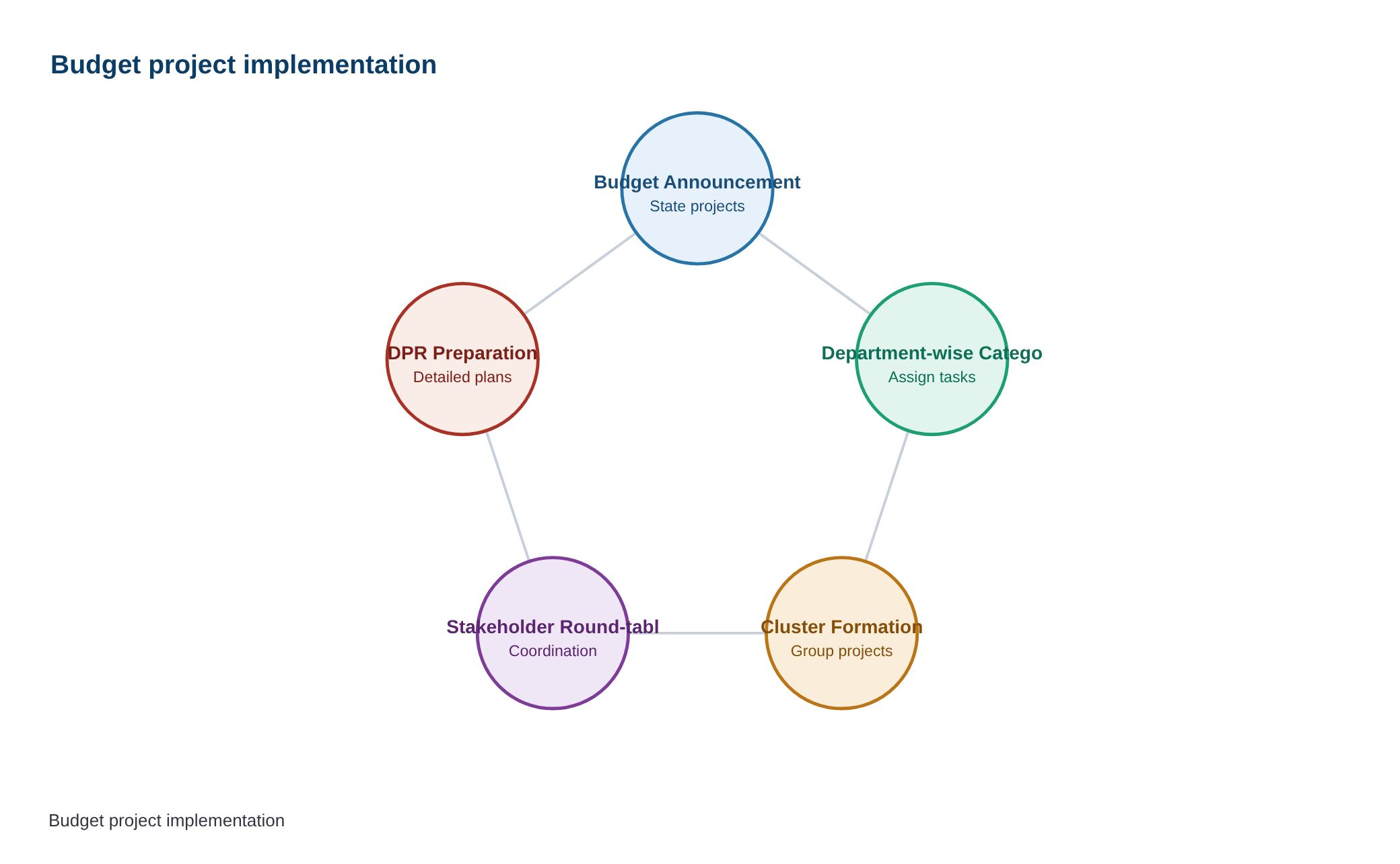
Budget Announcement → Department-wise Categorisation → Cluster Formation → Stakeholder Round-table Conferences → DPR Preparation → Implementation & Monitoring → Inter-departmental Coordination Gaps → Delayed Projects → Erosion of Credibility → New Mechanism → Structured Forums & Timelines → Fiscal Constraints → Need for Efficient Allocation → Knowledge Partner Engagement → Evidence-based DPRs → Optimised Resource Use → Bureaucratic Silos → Lack of Shared Ownership → Stakeholder Round-tables → Cross-sectoral Alignment → Collective Accountability → Public Expectations → Perceived Inefficiency → Loss of Investor Confidence → Transparency Mechanisms → Restored Credibility
Prelims Practice Questions
Q1. Consider the following statements regarding the new mechanism introduced by the Government of Kerala to ensure timely implementation of Budget projects:
1. The mechanism involves organising round-table conferences with officials from different departments and stakeholders.
2. The projects are grouped into six clusters, with 34 projects selected for detailed discussions.
3. The mechanism does not involve the preparation of Detailed Project Reports (DPRs) for individual projects.
How many of the above statements are correct?
- Only one
- Only two
- All three
- None
Answer: Only two — Statement 1 is correct as the mechanism includes round-table conferences with officials and stakeholders. Statement 2 is correct as 34 projects are selected for detailed discussions under six clusters. Statement 3 is incorrect as DPRs are to be prepared for each project.
Q2. Assertion (A): The new mechanism introduced by the Government of Kerala aims to address delays in Budget project implementation by clearly defining departmental responsibilities and fixing implementation timelines.
Reason (R): Inter-departmental coordination has often been a major reason for delays in implementing projects in the past.
- Both A and R are true, and R is the correct explanation of A
- Both A and R are true, but R is not the correct explanation of A
- A is true, but R is false
- A is false, but R is true
Answer: Both A and R are true, and R is the correct explanation of A — Assertion (A) is true as the mechanism seeks to define responsibilities and timelines. Reason (R) is also true and directly explains why such a mechanism is necessary, as inter-departmental coordination issues have historically caused delays.
Mains Practice Question
✍ Critically examine the significance of the new mechanism introduced by the Government of Kerala to ensure timely implementation of Budget projects. How does this mechanism address the challenges of inter-departmental coordination and fiscal credibility in public expenditure management? (15 Marks)
Approach: MODEL-ANSWER SKELETON:
1. **Introduction (2 marks)**
– Define public expenditure management and its importance in governance.
– Contextualise the Kerala government’s initiative as a response to delays in Budget project implementation.
2. **Mechanism Overview (3 marks)**
– Explain the key components: round-table conferences, clustering of projects, stakeholder inclusion, and DPR preparation.
– Highlight the role of a knowledge partner and the categorisation of projects by department.
3. **Addressing Inter-Departmental Coordination (4 marks)**
– Discuss the challenges of coordination in multi-departmental projects (e.g., overlapping jurisdictions, lack of accountability).
– Explain how the mechanism mitigates these challenges: clear responsibility allocation, fixed timelines, and structured stakeholder engagement.
– Reference the Supreme Court’s emphasis on accountability in governance (e.g., *Vineet Narain v. Union of India*).
4. **Enhancing Fiscal Credibility (3 marks)**
– Define fiscal credibility and its impact on public trust and investor confidence.
– Explain how timely project delivery and transparent processes (e.g., DPRs, economic models) strengthen credibility.
– Reference the Kerala government’s stated aim of ensuring greater credibility to Budget announcements.
5. **Critique and Limitations (2 marks)**
– Acknowledge potential challenges: bureaucratic resistance, resource constraints, and the need for sustained political will.
– Discuss the role of monitoring and evaluation mechanisms post-implementation.
6. **Conclusion (1 mark)**
– Summarise the significance of the mechanism as a model for other states in improving public financial management.
Source: The Hindu
Generated by AanyaAi for educational purpose.
Related guides on our sites
- Current affairs for upsc 2026
- Best economics optional coaching for upsc
- Best economics optional teacher for upsc
- How to prepare for GS paper 1 for UPSC CSE mains exam

- Kerala’s New Mechanism to Fast-Track Budget Projects: UPSC-State PCS Analysis - September 9, 2026
- यूपीएससी/पीसीएस परीक्षा: लंपी स्किन रोग से निपटने के लिए डीएएचडी के कदम, जानें पूरी रणनीति - September 9, 2026
- लंपी स्किन रोग (एलएसडी) रोकथाम: डीएएचडी के नवीनतम उपाय और टीकाकरण रणनीति - September 9, 2026

No Comments