


09 Sep Bengaluru Crackdown: 29 Children Rescued from Child Labour, 4 FIRs Lodged
✎ The Child Labour (Prohibition and Regulation) Act, 1986 (amended 2016) prohibits all forms of child labour below 14 years and regulates employment of adolescents aged 14–18 years, while the Juvenile Justice Act, 2015 mandates…
Subject Relevance — Where This Topic Fits
- GS Paper I — Social Empowerment | GS Paper II — Governance, Welfare Schemes for Vulnerable Sections | GS Paper III — Labour, Employment, Children’s Rights
- Prelims: Child Labour (Prohibition and Regulation) Act, 1986, Juvenile Justice (Care and Protection of Children) Act, 2015, National Child Labour Project (NCLP), Bonded Labour System (Abolition) Act, 1976, Right to Education (RTE) Act, 2009, UN Convention on the Rights of the Child, Census 2011 data on child labour
- Essay: Child Labour in India: A Persistent Challenge to Social Justice and Constitutional Commitments, Balancing Economic Growth and Child Welfare: Policy Dilemmas in India
Quick Revision: The Child Labour (Prohibition and Regulation) Act, 1986 (amended 2016) prohibits all forms of child labour below 14 years and regulates employment of adolescents aged 14–18 years, while the Juvenile Justice Act, 2015 mandates rehabilitation of rescued child labourers through Child Welfare Committees.
Why is this in the news?
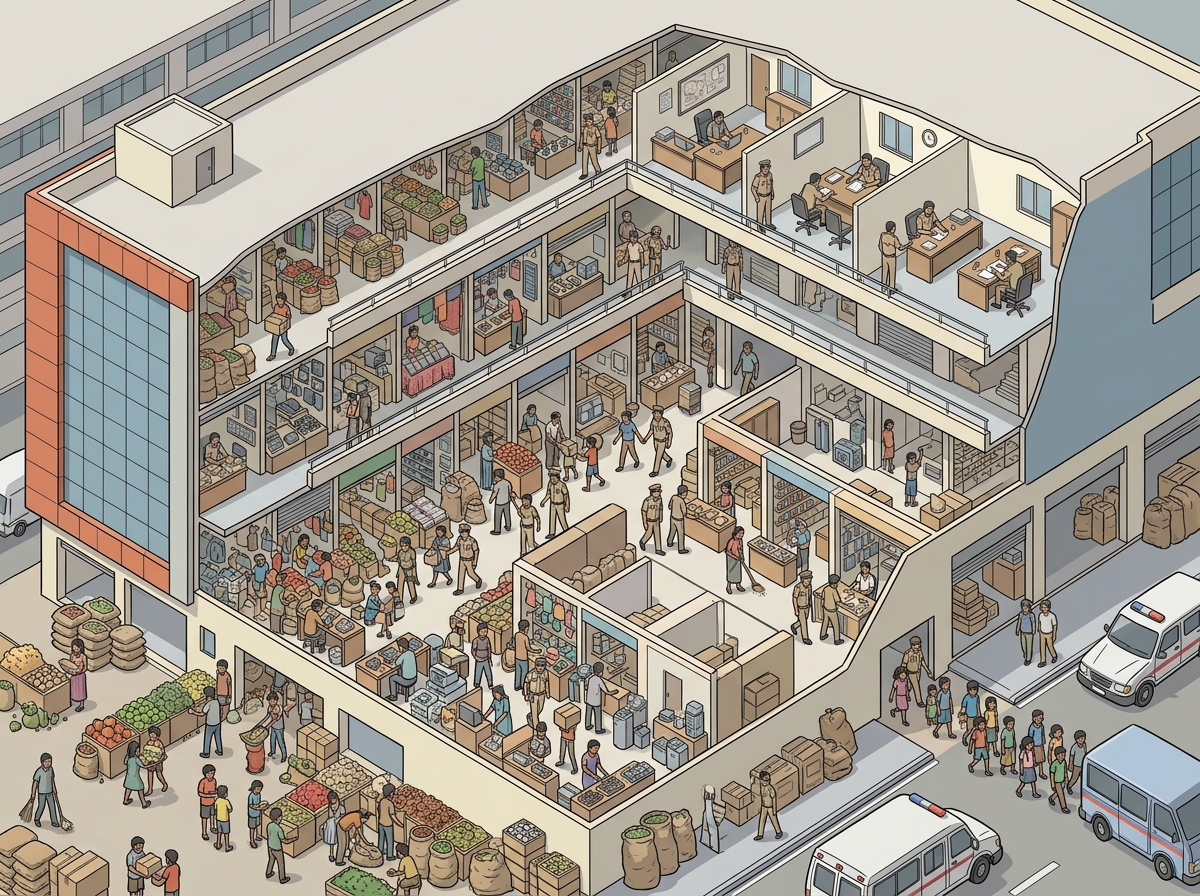
The rescue of 29 children, including 19 allegedly employed in shops at Bengaluru’s Yeshwanthpur APMC market, following directives from the Chief Minister, underscores systemic enforcement gaps in child labour prohibition laws. The operation, conducted by police and labour department officials, led to four FIRs under the Child Labour (Prohibition and Regulation) Act and the Juvenile Justice Act, highlighting the intersection of labour exploitation, interstate migration, and market vulnerabilities. This incident exemplifies the operational challenges in urban centres where child labour persists despite constitutional and statutory safeguards.
Background
- The Constitution of India, through Articles 21 (Right to Life and Personal Liberty), 23 (Prohibition of Human Trafficking), and 24 (Prohibition of Child Labour), guarantees fundamental rights against child labour and exploitation.
- The Juvenile Justice (Care and Protection of Children) Act, 2015, classifies children in need of care and protection and mandates their rehabilitation, including those rescued from labour.
- Urban markets, particularly wholesale and retail hubs like APMC yards, are identified as high-risk zones for child labour due to unregulated employment practices and migrant workforce vulnerabilities.
Child Labour in India: Legal Framework, Enforcement Mechanisms, and Socio-economic Context
- Child Labour (Prohibition and Regulation) Act, 1986: Prohibits employment of children below 14 years in hazardous occupations and regulates working conditions for those aged 14–18 years. The Act was amended in 2016 to prohibit all forms of child labour below 14 years and to include stricter penalties.
- Juvenile Justice (Care and Protection of Children) Act, 2015: Provides a legal framework for the protection, care, and rehabilitation of children in conflict with law or in need of care and protection, including those rescued from labour. Section 2(14) defines ‘child in need of care and protection’ to include those found working in hazardous conditions.
- National Child Labour Project (NCLP): A centrally sponsored scheme that provides non-formal education, vocational training, and stipends to child labourers aged 9–14 years, with a focus on rehabilitation and mainstreaming.
- Role of State Governments: State labour departments, district administrations, and police are responsible for enforcement under the Child Labour Act. District Magistrates and Child Welfare Committees (CWCs) play a pivotal role in rehabilitation and repatriation of rescued children.
- Urban Informal Sector Vulnerabilities: Wholesale markets, street vending, dhabas, and small manufacturing units are identified as high-risk sectors due to unregulated employment, migrant workforce, and lack of monitoring mechanisms.
- Interstate Migration and Child Trafficking: Children from economically weaker states (e.g., Bihar, West Bengal, Uttar Pradesh) are often trafficked to urban centres for labour, exploiting gaps in interstate coordination and victim identification.
- Rehabilitation Mechanisms: Rescued children are produced before CWCs, which assess their needs and direct them to appropriate care homes, schools, or vocational training centres. The Integrated Child Protection Scheme (ICPS) provides financial and logistical support for rehabilitation.
- Challenges in Enforcement: Limited manpower in labour departments, lack of awareness among stakeholders, corruption, and collusion between employers and officials hinder effective enforcement. Urban centres face additional challenges due to high population density and informal labour markets.
Key Features
| Feature | Significance |
|---|---|
| Rescue Operation | Demonstrates the operationalisation of child labour prohibition laws through inter-departmental coordination between police and labour departments. |
| Inter-State Child Trafficking | Highlights cross-state movement of children for exploitative labour, indicating systemic gaps in border and destination-state monitoring. |
| FIRs under Child Labour Act | Legal recourse initiated against employers, underscoring the penal provisions for violation of child labour laws. |
| Child Welfare Committee Referral | Ensures institutional care and rehabilitation for rescued children, aligning with juvenile justice principles. |
| Market Inspection Mechanism | Shows the role of administrative heads (e.g., Chief Minister) in directing on-ground enforcement of labour laws. |
Why it Matters
Legal and Institutional
- The operation exemplifies the enforcement of the Child Labour (Prohibition and Regulation) Act, 1986, and the Juvenile Justice (Care and Protection of Children) Act, 2015, through coordinated action by police and labour departments.
- The involvement of the Child Welfare Committee ensures compliance with the constitutional mandate under Article 39(f) to protect children from exploitation.
- The case underscores the importance of inter-departmental synergy in addressing child labour, particularly in unorganised sectors like petty trade.
Socio-Economic
- The presence of children from multiple states (Bihar, West Bengal, Uttar Pradesh, Rajasthan, Karnataka) highlights the pan-Indian nature of child trafficking and labour exploitation.
- The operation in a wholesale market (APMC) reveals vulnerabilities in supply chains where child labour may be embedded in informal economic activities.
- The rescue of children working in vegetable and onion shops points to the persistence of child labour in low-wage, high-turnover sectors.
Policy and Governance
- The Chief Minister’s directive to conduct the operation reflects the role of political leadership in driving administrative action against child labour.
- The registration of FIRs and cases under the Child and Adolescent Labour Act signals a shift from mere rescue to penal accountability.
- The case aligns with the National Child Labour Project (NCLP) Scheme’s objective of rehabilitation, though the immediate focus is on enforcement.
Challenges
1. Cross-State Child Trafficking
- Lack of integrated inter-state databases to track movement of children vulnerable to trafficking.
- Inadequate coordination between source and destination states in monitoring and repatriating trafficked children.
- Weak enforcement of the Inter-State Migrant Workmen (Regulation of Employment and Conditions of Service) Act, 1979, in informal sectors.
UPSC Link: GS-II: Governance, GS-I: Social Issues
2. Enforcement Gaps in Informal Economy
- High prevalence of child labour in unorganised sectors (e.g., petty shops, street vending) due to low visibility and regulatory oversight.
- Limited resources and personnel for sustained inspections in markets and commercial areas.
- Cultural and economic factors normalising child labour in certain trades, complicating enforcement.
UPSC Link: GS-II: Governance, GS-III: Economic Development
3. Rehabilitation and Reintegration
- Inadequate infrastructure for long-term rehabilitation, including education, skill training, and psychological support.
- Delays in repatriation of children to their native states due to bureaucratic hurdles and lack of dedicated mechanisms.
- Low awareness among rescued children and families about rehabilitation schemes like the NCLP.
UPSC Link: GS-II: Social Justice, GS-I: Social Issues
4. Data and Monitoring Deficiencies
- Absence of real-time data on child labour hotspots, making targeted interventions difficult.
- Inconsistent reporting of child labour cases due to fear of retribution or lack of awareness among stakeholders.
- Limited use of technology (e.g., GIS mapping, AI-based monitoring) in identifying and tracking child labour.
UPSC Link: GS-II: Governance, GS-III: Economic Development
Challenges — UPSC Perspective
| Issue | Concern |
|---|---|
| Inter-State Child Trafficking | Systemic gaps in tracking and preventing movement of children for exploitative labour. |
| Enforcement in Informal Sectors | Regulatory oversight is weak in unorganised trades like petty shops and street vending. |
| Rehabilitation Infrastructure | Inadequate facilities for education, skill development, and psychological support post-rescue. |
| Data Gaps | Lack of real-time, granular data on child labour hotspots and trends. |
| Legal Delays | Protracted legal processes under child labour laws reduce deterrence and delay justice. |
| Awareness Deficits | Low awareness among families, employers, and communities about child labour laws and rehabilitation schemes. |
Government Initiatives — Must-Memorise for Prelims
- National Child Labour Project (NCLP) Scheme
- Juvenile Justice (Care and Protection of Children) Act, 2015
Way Forward
- Strengthen inter-state coordination mechanisms to track and prevent child trafficking, including integrated databases and repatriation protocols.
- Expand the scope of labour inspections in informal sectors through periodic drives and the use of technology (e.g., drones, AI-based monitoring).
- Enhance rehabilitation infrastructure by scaling up NCLP centres, ensuring access to education, skill training, and mental health support for rescued children.
- Conduct awareness campaigns among employers, workers, and communities in high-risk areas to sensitise them about child labour laws and penalties.
- Establish fast-track courts or special benches to expedite trials under child labour laws, ensuring timely justice and deterrence.
- Integrate child labour monitoring with existing welfare schemes (e.g., PM Kaushal Vikas Yojana) to provide alternative livelihood options for families.
- Promote formalisation of informal sectors (e.g., petty shops, street vending) to improve regulatory oversight and reduce child labour vulnerabilities.
- Develop a national portal for real-time reporting and tracking of child labour cases, enabling data-driven policy interventions.
UPSC Value Addition
Keywords for Mains Answer-Writing
Child Labour (Prohibition and Regulation) Act, 1986 · Juvenile Justice Act, 2015 · Constitutional provisions on child rights (Article 21A, Article 24, Article 39(e), Article 39(f)) · National Policy on Child Labour (1987, 2016) · Role of State Governments in enforcing child labour laws · International Labour Organization (ILO) Convention 138 and 182 · Child Welfare Committees (CWCs) · District Child Protection Units (DCPUs) · Sustainable Development Goal 8.7 (elimination of child labour) · Trafficking of Children (Prevention) Act, 2018 · Right to Education (RTE) Act, 2009 · Social security measures for rescued children
Constitutional & Policy Linkages
- Article 24: Prohibition of employment of children in factories, etc.
- Article 39(f): Directive Principle to protect children from exploitation and moral degradation.
Concept Flow
Administrative Directive (CM’s visit to APMC market) → Identification of child labour violations → Formation of multi-departmental teams → Inspection and rescue operations → Registration of FIRs under Child Labour Act → Referral to Child Welfare Committee → Investigation into trafficking routes and employment history → Repatriation and rehabilitation.
Prelims Practice Questions
Q1. Consider the following statements regarding the Child Labour (Prohibition and Regulation) Act, 1986:
1. The Act prohibits the employment of children below the age of 14 years in any occupation or process.
2. The Act allows the employment of adolescents (14-18 years) in hazardous occupations under certain conditions.
3. The Act mandates that every establishment employing children must register with the District Child Labour Rehabilitation-cum-Welfare Society.
4. The Act was amended in 2016 to prohibit the employment of children below 14 years in all occupations and processes except in family enterprises.
How many of the above statements are correct?
- Only one
- Only two
- Only three
- All four
Answer: Only three — Statements 1 and 4 are correct. Statement 2 is incorrect because the Act prohibits the employment of adolescents in hazardous occupations. Statement 3 is incorrect as registration is not mandatory under the Act.
Q2. Assertion (A): The Juvenile Justice Act, 2015, provides for the rehabilitation and social reintegration of children in conflict with law as well as children in need of care and protection.
Reason (R): The Act mandates the establishment of Child Welfare Committees (CWCs) in every district to oversee the welfare and rehabilitation of children.
Options:
A. Both A and R are true, and R is the correct explanation of A.
B. Both A and R are true, but R is NOT the correct explanation of A.
C. A is true, but R is false.
D. A is false, but R is true.
Answer: ? — Both Assertion (A) and Reason (R) are true. The Juvenile Justice Act, 2015, indeed focuses on rehabilitation and social reintegration of children, and CWCs are established under the Act to oversee such matters. However, R is not the correct explanation of A as it does not directly explain the assertion.
Q3. Match the following legal provisions with their respective Acts:
Column I (Provision) | Column II (Act)
1. Prohibition of employment of children in hazardous occupations | A. Right to Education (RTE) Act, 2009
2. Free and compulsory education for children aged 6-14 years | B. Child Labour (Prohibition and Regulation) Act, 1986
3. Establishment of Child Welfare Committees (CWCs) | C. Juvenile Justice Act, 2015
4. Protection of children from trafficking and bonded labour | D. Trafficking of Children (Prevention) Act, 2018
Options:
A. 1-B, 2-A, 3-C, 4-D
B. 1-A, 2-B, 3-C, 4-D
C. 1-C, 2-A, 3-B, 4-D
D. 1-D, 2-A, 3-C, 4-B
Answer: ? — The correct matches are: 1-B (Prohibition of hazardous employment under Child Labour Act), 2-A (Free and compulsory education under RTE Act), 3-C (CWCs under Juvenile Justice Act), 4-D (Protection from trafficking under Trafficking of Children Act).
Mains Practice Question
✍ The enforcement of child labour laws in India continues to face systemic challenges despite robust legal frameworks. Critically examine the efficacy of existing constitutional, statutory, and institutional mechanisms in addressing child labour, with particular reference to recent judicial interventions and administrative measures. Also, outline the role of State Governments in ensuring compliance with these mechanisms. (15 Marks)
Approach: MODEL-ANSWER SKELETON:
1. **Constitutional Provisions and Directives** (3 points):
– Article 24: Prohibition of employment of children below 14 in hazardous occupations.
– Article 39(e): Directive Principle to protect children from exploitation.
– Article 21A (RTE Act): Right to free and compulsory education for children aged 6-14.
– Article 39(f): State’s responsibility to ensure children’s development and protection.
2. **Statutory Framework** (4 points):
– Child Labour (Prohibition and Regulation) Act, 1986 (amended 2016): Prohibits employment of children below 14 in all occupations except family enterprises; defines hazardous occupations.
– Juvenile Justice Act, 2015: Provides for rehabilitation and social reintegration of children in need of care and protection.
– Right to Education (RTE) Act, 2009: Mandates free and compulsory education for children aged 6-14.
– Trafficking of Children (Prevention) Act, 2018: Addresses trafficking and bonded labour.
3. **Institutional Mechanisms** (3 points):
– District Child Protection Units (DCPUs): Monitor and report child labour cases.
– Child Welfare Committees (CWCs): Oversee rehabilitation and welfare of rescued children.
– National Child Labour Project (NCLP): Focuses on rehabilitation of child labourers in identified districts.
– Role of Labour Departments and Police: Enforcement through inspections and FIRs (as seen in Bengaluru drive).
4. **Judicial Interventions** (2 points):
– Supreme Court’s directives in *M.C. Mehta v. State of Tamil Nadu* (1996) and *Bandhua Mukti Morcha v. Union of India* (1984) for rehabilitation of child labourers.
– Recent High Court orders for strict enforcement of child labour laws (e.g., *High Court of Delhi, 2023*).
5. **Systemic Challenges** (2 points):
– Socio-economic factors: Poverty, lack of awareness, and migration.
– Weak enforcement: Inadequate inspections, corruption, and delayed justice.
– Gaps in rehabilitation: Overburdened CWCs and lack of long-term support.
6. **Role of State Governments** (1 point):
– Implementing National Policy on Child Labour (1987, 2016).
– Establishing State Child Labour Rehabilitation-cum-Welfare Societies.
– Conducting awareness campaigns and ensuring compliance with RTE Act.
– Coordinating with DCPUs and CWCs for rescue and rehabilitation.
Source: The Indian Express
Karnataka PCS (KPSC) — State PCS Practice
Prelims: As part of the recent crackdown on child labour in Bengaluru, which of the following agencies was primarily responsible for rescuing 29 children and lodging 4 FIRs?
- A. Karnataka State Commission for Protection of Child Rights (KSCPCR)
- B. Bengaluru City Police (Trafficking and Child Welfare Unit)
- C. Department of Labour, Government of Karnataka
- D. National Commission for Protection of Child Rights (NCPCR)
Answer: B. Bengaluru City Police (Trafficking and Child Welfare Unit) — The Bengaluru City Police, specifically the Trafficking and Child Welfare Unit, led the operation to rescue 29 children and lodge 4 FIRs against child labour violators.
Mains: Analyze the socio-economic factors contributing to child labour in Bengaluru, citing the recent crackdown as a case study. Suggest policy measures to address the root causes while ensuring Karnataka’s compliance with national and international child protection frameworks.
Generated by AanyaAi for educational purpose.
Related guides on our sites
- Current affairs for upsc 2026
- Best sociology optional coaching for upsc
- Which is best sociology optional coaching for upsc
- Best teacher of sociology optional for upsc

- झारखंड का 1.36 लाख करोड़ का बकाया खत्म! केंद्र बनाम राज्य अब सुप्रीम कोर्ट में - September 14, 2026
- Jharkhand’s ₹1.36 Lakh Crore Dues: Supreme Court Battle Over MMDRA Amendment - September 14, 2026
- गुजरात में स्थापित होंगे भारत के 12 सेमीकंडक्टर संयंत्रों में से 6, जानिए कैसे? - September 14, 2026

No Comments