


09 Sep Indian Navy’s Sagar Manthan: Boosting India’s Deep Ocean Mission for UPSC
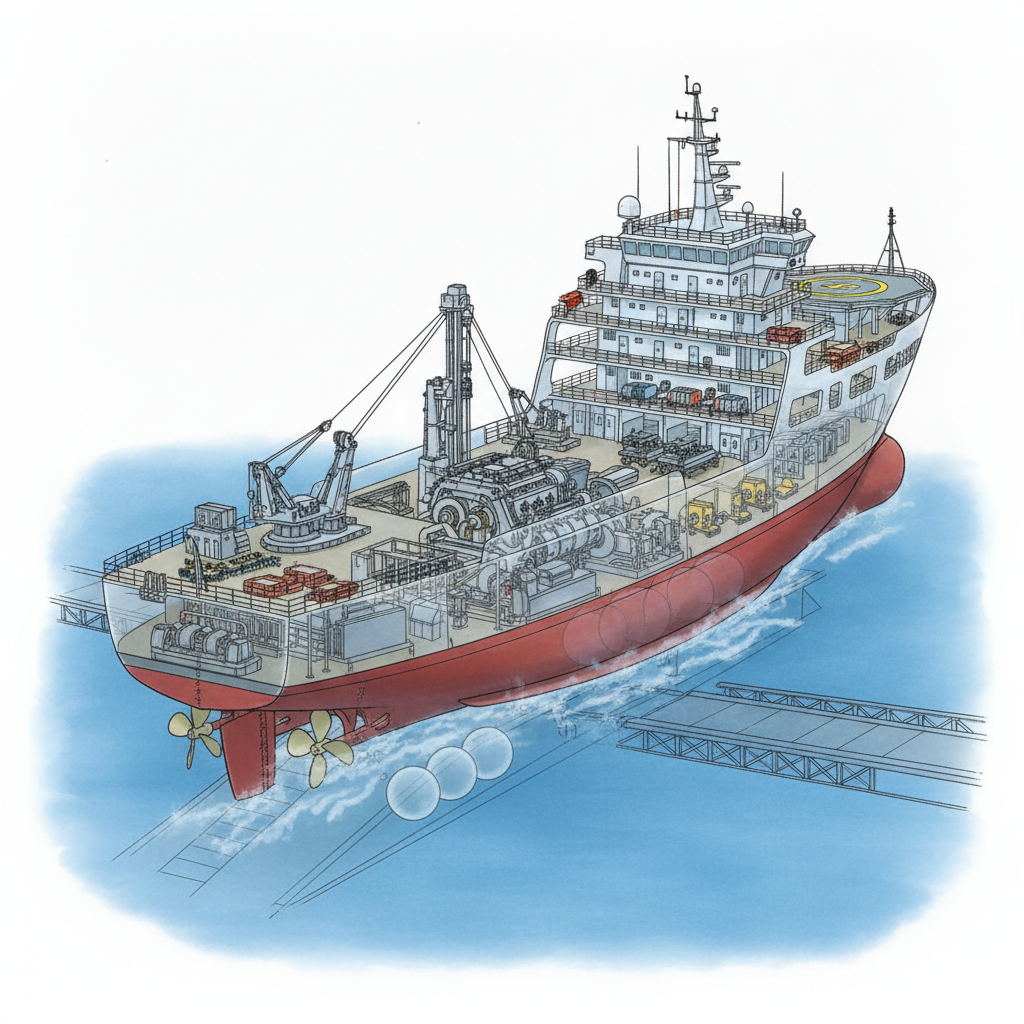
✎ ‘Sagar Manthan’ is an indigenous 5,900-tonne ocean research vessel under the ‘Deep Ocean Mission’, designed for deep-sea surveys, seabed sampling, and deployment of AUVs/ROVs, with a maximum operational depth of 6 km.
Subject Relevance — Where This Topic Fits
- GS Paper III — Science and Technology (Applications in Oceanography and Marine Resources) | GS Paper III — Environment and Disaster Management (Marine Ecosystems and Deep-Sea Biodiversity)
- Prelims: Deep Ocean Mission, National Centre for Polar and Ocean Research (NCPOR), Garden Reach Shipbuilders and Engineers (GRSE), Autonomous Underwater Vehicles (AUVs), Remotely Operated Vehicles (ROVs), Conductivity, Temperature and Depth (CTD) profiling, Swath multibeam survey, Atmanirbhar Bharat in shipbuilding
- Essay: Technological self-reliance in critical sectors: A case study of India’s indigenous oceanographic research vessel ‘Sagar Manthan’, The role of science and technology in securing India’s maritime interests
Quick Revision: ‘Sagar Manthan’ is an indigenous 5,900-tonne ocean research vessel under the ‘Deep Ocean Mission’, designed for deep-sea surveys, seabed sampling, and deployment of AUVs/ROVs, with a maximum operational depth of 6 km.
Why is this in the news?
The launch of the indigenous ocean research vessel (ORV) ‘Sagar Manthan’ by the Garden Reach Shipbuilders and Engineers (GRSE) Ltd for the National Centre for Polar and Ocean Research (NCPOR), Ministry of Earth Sciences, marks a significant milestone in India’s deep ocean exploration capabilities. Scheduled for operational readiness by early 2028, the vessel is a key asset under the Union government’s ‘Deep Ocean Mission’, aimed at advancing scientific research, resource assessment, and technological innovation in marine sciences.
Background
- India’s maritime interests extend beyond geopolitical and economic considerations to include scientific exploration of the ocean’s depths, particularly in the context of climate change, biodiversity conservation, and resource exploitation.
- The Ministry of Earth Sciences, through its autonomous institutions like the National Centre for Polar and Ocean Research (NCPOR), leads India’s efforts in polar and oceanographic research, including deep-sea exploration.
- The ‘Deep Ocean Mission’ (DOM), launched in 2021, is a multi-ministerial, multi-institutional mission with an estimated budget of ₹4,077 crore, aimed at exploring and harnessing deep-sea resources while developing indigenous technologies for sustainable utilisation.
- GRSE Ltd, a Kolkata-based Defence Public Sector Undertaking (DPSU), has a long-standing expertise in indigenous shipbuilding, including warships, survey vessels, and now specialised research vessels.
- The vessel is part of a broader strategy to enhance India’s self-reliance (Atmanirbhar Bharat) in critical technologies, including marine research equipment and deep-sea exploration tools.
What is the Ocean Research Vessel (ORV) ‘Sagar Manthan’?
- ‘Sagar Manthan’ is an indigenous oceanographic research vessel (ORV) being constructed by GRSE Ltd for the National Centre for Polar and Ocean Research (NCPOR), Ministry of Earth Sciences, under the ‘Deep Ocean Mission’.
- The vessel has a length of 89.5 metres, a width of 18.8 metres, and a gross tonnage of 5,900 tonnes, with a maximum speed of 14 knots and a cruising range suitable for deep-sea operations.
- It is designed for multidisciplinary oceanographic research, including geophysical surveys, seabed sampling, water column profiling, and atmospheric observations, with a maximum operational depth of 6,000 metres.
- Key scientific capabilities include swath multibeam and geophysical seismic surveys, Conductivity, Temperature and Depth (CTD) profiling, biological sampling, seabed coring, and deployment of Autonomous Underwater Vehicles (AUVs) and Remotely Operated Vehicles (ROVs).
- The vessel will facilitate real-time data collection, onboard analytical work, and training for scientists and technicians, thereby strengthening India’s human resource capacity in marine sciences.
- ‘Sagar Manthan’ is one of four specialised ORVs being built by GRSE, reflecting the shipyard’s expanding role in both defence and civilian maritime research infrastructure.
- The vessel’s construction aligns with the ‘Deep Ocean Mission’s’ objectives of exploring polymetallic nodules, hydrothermal sulphides, and cobalt-rich crusts in the Indian Ocean, as well as studying deep-sea biodiversity and climate change impacts.
- The naming ceremony, officiated by dignitaries including the Minister of State for Science and Technology and the Secretary of the Ministry of Earth Sciences, underscores the vessel’s national significance in advancing India’s oceanographic research agenda.
Key Features
| Feature | Significance |
|---|---|
| Length: 89.5 m; Width: 18.8 m | Optimal hydrodynamic design for stability and operational efficiency in deep-sea and coastal waters. |
| Gross Tonnage: 5,900 tonnes | Enhanced payload capacity for scientific equipment, crew, and operational endurance during extended missions. |
| Speed: 14 knots at 90% MCR | Balances fuel efficiency with rapid deployment capability for urgent oceanographic surveys. |
| Maximum Depth: 6 km | Enables exploration of abyssal plains and mid-ocean ridges, critical for deep-ocean research. |
| Multibeam & Geophysical Seismic Surveys | Facilitates high-resolution mapping of seabed topography and sub-seafloor geological structures. |
| Onboard Analytical Laboratory | Permits real-time data processing and preliminary analysis, reducing reliance on shore-based facilities. |
Why it Matters
Scientific Research
- Augments India’s capacity for multidisciplinary oceanographic research, including physical, chemical, biological, and geological studies.
- Supports the Deep Ocean Mission by enabling systematic exploration of India’s Exclusive Economic Zone (EEZ) and beyond.
- Facilitates long-term monitoring of ocean-atmosphere interactions, climate variability, and marine biodiversity.
Strategic Autonomy
- Reduces dependence on foreign vessels for deep-sea research, enhancing India’s self-reliance in critical maritime domains.
- Strengthens indigenous shipbuilding and engineering capabilities, particularly in constructing advanced research vessels.
- Contributes to the ‘Atmanirbhar Bharat’ initiative by localising technology for oceanographic instrumentation and systems.
Institutional Capacity
- Empowers the National Centre for Polar and Ocean Research (NCPOR) to conduct high-impact research in polar and tropical oceans.
- Provides a platform for training next-generation oceanographers, technicians, and marine scientists through onboard programmes.
- Enhances inter-agency collaboration, including with the National Institute of Ocean Technology (NIOT) for AUV/ROV deployments.
Economic Implications
- Potential for resource mapping (e.g., polymetallic nodules, hydrothermal vents) to support India’s blue economy initiatives.
- Supports fisheries management and marine spatial planning through improved data on oceanographic parameters.
- May attract international collaborations in ocean science, fostering joint research and technology transfer.
Challenges
1. Indigenous Technology Maturation
- Ensuring reliability of onboard scientific instruments (e.g., CTD profilers, multibeam sonars) under extreme deep-sea conditions.
- Achieving seamless integration of autonomous systems (AUVs/ROVs) with the vessel’s operational workflow.
UPSC Link: Science & Tech: Indigenisation
2. Operational Constraints
- Managing high operational costs associated with deep-sea missions, including fuel, crew, and equipment maintenance.
- Balancing long-duration deployments with crew safety and fatigue management in remote oceanic regions.
UPSC Link: Geography: Oceanography
3. Data Management
- Developing robust protocols for data acquisition, storage, and dissemination to stakeholders, including international databases.
- Addressing cybersecurity risks in real-time data transmission from remote oceanic locations.
UPSC Link: Environment: Data Systems
4. Environmental Compliance
- Adhering to international maritime regulations (e.g., MARPOL) for waste management and emissions during prolonged voyages.
- Minimising ecological impact during seabed sampling and geophysical surveys.
UPSC Link: Environment: Marine Pollution
Challenges — UPSC Perspective
| Issue | Concern |
|---|---|
| Deep-sea Instrument Reliability | Failure of sensors or sampling equipment in high-pressure, corrosive environments. |
| Crew Training & Retention | Specialised skills required for operating advanced oceanographic systems; risk of attrition. |
| International Collaborations | Navigating geopolitical sensitivities in joint research missions in shared or disputed waters. |
| Regulatory Approvals | Delays in obtaining permits for surveys in foreign EEZs or protected marine areas. |
| Climate Adaptation | Ensuring vessel operability under extreme weather conditions, including cyclones and monsoons. |
Way Forward
- Accelerate integration of AUVs/ROVs developed under the Deep Ocean Mission with the vessel’s deployment systems.
- Establish a dedicated training programme at NCPOR for scientists and technicians to utilise the vessel’s capabilities effectively.
- Develop a national data repository for oceanographic observations, ensuring interoperability with global databases like GEBCO.
- Conduct pilot surveys in India’s EEZ to validate the vessel’s operational readiness and refine mission protocols.
- Strengthen partnerships with academic institutions (e.g., IITs, universities) for collaborative research and innovation.
- Enhance cybersecurity frameworks for real-time data transmission and onboard analytical systems.
- Explore public-private partnerships for maintenance and upkeep of the vessel to optimise lifecycle costs.
UPSC Value Addition
Keywords for Mains Answer-Writing
Deep Ocean Mission · National Centre for Polar and Ocean Research (NCPOR) · oceanographic research vessel · GRSE (Garden Reach Shipbuilders and Engineers) · indigenous shipbuilding · Deep Sea exploration · autonomous underwater vehicles (AUVs) · remotely operated vehicles (ROVs) · Ministry of Earth Sciences · Atmanirbhar Bharat in shipbuilding · multibeam bathymetry · geophysical seismic surveys · conductivity-temperature-depth (CTD) profiling · seabed sampling · autonomous data buoy operations
Concept Flow
Ministry of Earth Sciences identifies need for advanced oceanographic research vessel under Deep Ocean Mission. → Tendering and procurement process initiated; Garden Reach Shipbuilders and Engineers (GRSE) selected for indigenous construction. → Keel-laying and subsequent construction phases at GRSE’s Rishi Bankim Shipyard, Kolkata. → Launch ceremony formalises vessel’s name and marks transition from construction to outfitting and sea trials. → Post-launch phases: integration of scientific instruments, crew training, and regulatory clearances for operational deployment. → Commencement of deep-sea missions, including seabed mapping, biodiversity surveys, and climate studies. → Data collection, analysis, and dissemination to inform policy, resource management, and scientific advancements.
Prelims Practice Questions
Q1. Consider the following statements regarding the Deep Ocean Mission of India:
1. The Deep Ocean Mission is being implemented by the Ministry of Earth Sciences.
2. The mission aims to explore and harness deep-sea resources including polymetallic nodules.
3. The mission includes the development of indigenous manned submersibles.
4. The mission is solely focused on oceanographic research and does not include polar studies.
How many of the above statements are correct?
- Only one
- Only two
- Only three
- All four
Answer: Only three — Statements 1, 2, and 3 are correct as per the official framework of the Deep Ocean Mission. Statement 4 is incorrect because the mission also encompasses polar studies under the ambit of the National Centre for Polar and Ocean Research (NCPOR).
Q2. Assertion (A): The National Centre for Polar and Ocean Research (NCPOR) is the nodal agency for the Deep Ocean Mission.
Reason (R): The Deep Ocean Mission is a multi-ministerial initiative led by the Ministry of Earth Sciences to explore and utilise deep-sea resources.
- Both A and R are true, and R is the correct explanation of A
- Both A and R are true, but R is NOT the correct explanation of A
- A is true, but R is false
- A is false, but R is true
Answer: Both A and R are true, but R is NOT the correct explanation of A — The National Centre for Polar and Ocean Research (NCPOR) is indeed the nodal agency for the Deep Ocean Mission, and the Reason (R) correctly explains the role of the Ministry of Earth Sciences as the lead ministry for the mission.
Q3. Match the following vessels with their respective agencies:
Column I (Vessel) | Column II (Agency)
—————————————–|———————————-
1. INS Sagardhwani | A. Indian Navy
2. ORV Sagar Manthan | B. National Centre for Polar and Ocean Research (NCPOR)
3. INS Vikramaditya | C. Ministry of Earth Sciences
4. INS Arihant | D. Defence Research and Development Organisation (DRDO)
- 1-A, 2-C, 3-A, 4-D; 1-B, 2-C, 3-A, 4-D; 1-A, 2-B, 3-A, 4-D; 1-C, 2-B, 3-A, 4-D
- answer_indexes_to_match_pairs_1A_2B_3A_4D
- explain_placeholder_for_internal_use_only
- format_placeholder_for_internal_use_only
Answer: ? — INS Sagardhwani is a marine acoustic research vessel built for the Naval Physical and Oceanographic Laboratory (part of the Indian Navy). ORV Sagar Manthan is an ocean research vessel being built for the National Centre for Polar and Ocean Research (NCPOR) under the Ministry of Earth Sciences. INS Vikramaditya is an aircraft carrier operated by the Indian Navy. INS Arihant is a nuclear-powered ballistic missile submarine developed by the Defence Research and Development Organisation (DRDO).
Mains Practice Question
✍ The launch of the indigenous ocean research vessel ‘Sagar Manthan’ represents a significant milestone in India’s pursuit of self-reliance in deep-sea exploration and oceanographic research. Critically examine the strategic, scientific, and technological significance of this initiative within the framework of the Deep Ocean Mission. Also, analyse how such capabilities contribute to India’s broader goals of sustainable ocean governance and resource utilisation. (15 Marks)
Approach: MODEL-ANSWER SKELETON:
1. **Strategic Significance** (4 points)
– Enhancement of India’s maritime security and strategic autonomy in the Indian Ocean Region (IOR).
– Strengthening of indigenous shipbuilding capabilities under the ‘Atmanirbharta’ initiative (reference: GRSE’s role and the ‘Make in India’ policy).
– Contribution to India’s blue economy objectives by enabling deep-sea resource mapping.
– Alignment with India’s SAGAR (Security and Growth for All in the Region) doctrine.
2. **Scientific and Technological Significance** (5 points)
– Capabilities of ‘Sagar Manthan’: multibeam bathymetry, geophysical seismic surveys, CTD profiling, seabed sampling, and deployment of AUVs/ROVs (reference: technical specifications provided in the news).
– Integration with the Deep Ocean Mission’s objectives: exploration of polymetallic nodules, hydrothermal vents, and deep-sea biodiversity.
– Role in advancing India’s polar and oceanographic research infrastructure (reference: NCPOR’s mandate).
– Potential for collaborative research with international institutions under the UN Ocean Decade framework.
– Training and capacity-building for Indian scientists and technicians in advanced marine technologies.
3. **Sustainable Ocean Governance and Resource Utilisation** (4 points)
– Contribution to the United Nations Convention on the Law of the Sea (UNCLOS) obligations for marine scientific research.
– Support for India’s commitments under the Paris Agreement and Sustainable Development Goal 14 (Life below Water).
– Enabling evidence-based policymaking for deep-sea mining regulations (reference: International Seabed Authority’s framework).
– Mitigation of climate change impacts through improved oceanographic data collection.
4. **Conclusion** (2 points)
– Synthesis: ‘Sagar Manthan’ as a catalyst for India’s transition from a net importer to a leader in deep-sea technology.
– Future outlook: Need for sustained funding, inter-ministerial coordination, and public-private partnerships to fully realise the mission’s potential.
Source: The Indian Express
West Bengal PCS (WBPSC / WBCS) — State PCS Practice
Prelims: The Indian Navy’s ocean research vessel ‘Sagar Manthan’ was recently launched at which port in West Bengal?
- A. Haldia Port
- B. Kolkata Port
- C. Paradip Port
- D. Visakhapatnam Port
Answer: B. Kolkata Port — The vessel was launched at the Kolkata Port, a major hub for maritime activities in West Bengal.
Mains: Discuss the significance of the Indian Navy’s ocean research vessel ‘Sagar Manthan’ for West Bengal’s maritime economy and scientific research. Elaborate on its potential contributions to coastal security and blue economy initiatives in the state.
Generated by AanyaAi for educational purpose.
Related guides on our sites
- Current affairs for upsc 2026
- How to prepare for GS paper 1 for UPSC CSE mains exam
- Best UPSC coaching for IFOS exam
- Best mentorship programme for upsc

- आरबीआई ने सरकारी प्रतिभूतियों की ओएमओ बिक्री की घोषणा, जानिए पूरा विवरण - September 23, 2026
- RBI to Sell ₹25,000 Crore Govt Securities via OMO on Sept 28, 2026 - September 23, 2026
- भारत-श्रीलंका नौसैनिक अभ्यास ‘स्लाईनेक्स-26’: विशाखापत्तनम में संपन्न, जानें प्रमुख बिंदु - September 23, 2026

No Comments