


10 Sep UPSC Alert: National Conference on Construction Workers in Mumbai on Sept 11-12
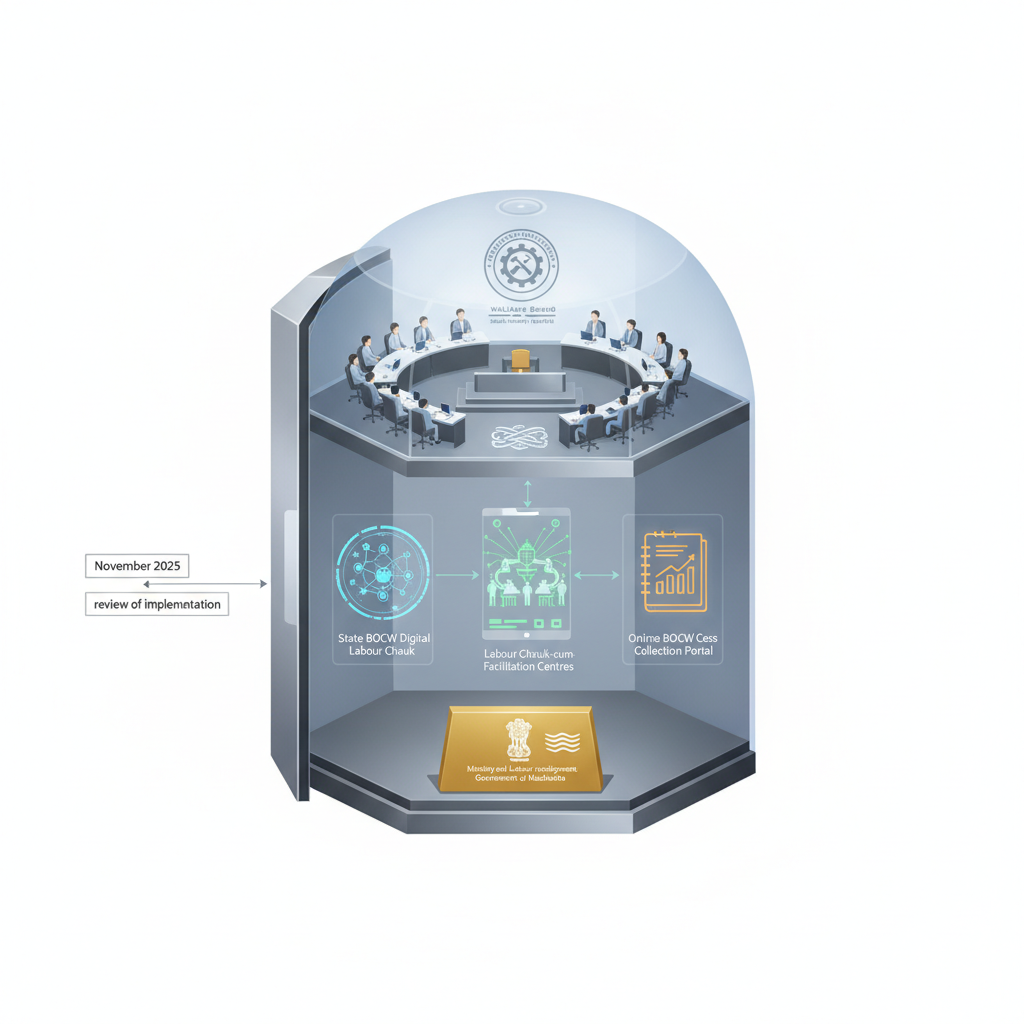
✎ The National Conference on BOCW (2026) is a governance milestone that reviews the implementation of digital welfare delivery mechanisms—State BOCW Digital Labour Chauk, Labour Chauk-cum-Facilitation Centres, and Online Cess…
Subject Relevance — Where This Topic Fits
- GS Paper II — Governance, Transparency and Accountability | GS Paper III — Labour, Employment and Social Security | GS Paper IV — Ethical Governance and Public Service Delivery
- Prelims: Building and Other Construction Workers (BOCW) Act, 1996, Construction Labour Welfare Cess, e-Shram Portal, Social Security Code, 2020, National Labour Conference 2025
- Essay: Role of technology in achieving inclusive growth: A case study of BOCW sector reforms, Social security as a catalyst for formalisation of the unorganised workforce
Quick Revision: The National Conference on BOCW (2026) is a governance milestone that reviews the implementation of digital welfare delivery mechanisms—State BOCW Digital Labour Chauk, Labour Chauk-cum-Facilitation Centres, and Online Cess Collection Portal—to enhance transparency, efficiency, and social security for India’s 50+ million construction workers under the BOCW Act, 1996.
Why is this in the news?
The Ministry of Labour and Employment, Government of India, in collaboration with the Government of Maharashtra, is convening a two-day National Conference on Building & Other Construction Workers (BOCW) in Mumbai on 11–12 September 2026. The event assumes significance as it reviews the implementation of three key digital initiatives launched at the National Labour Conference (November 2025)—State BOCW Digital Labour Chauk, Labour Chauk-cum-Facilitation Centres, and the Online BOCW Cess Collection Portal—aimed at enhancing transparency, efficiency, and access to social security for construction workers across India.
Background
- The Building and Other Construction Workers (BOCW) Act, 1996, mandates the establishment of Welfare Boards in each state/UT to provide social security benefits to construction workers, including health, education, housing, and pension.
- The construction sector employs over 50 million workers in India, predominantly in the unorganised segment, making formalisation and social security delivery a governance challenge.
- The Construction Labour Welfare Cess, levied at 1% of the cost of construction, funds welfare schemes under the BOCW Act but has historically faced issues of under-collection and inefficient utilisation.
- The National Labour Conference 2025, held in New Delhi, announced three transformative digital initiatives to modernise welfare delivery: State BOCW Digital Labour Chauk, Labour Chauk-cum-Facilitation Centres, and an Online BOCW Cess Collection Portal.
- The COVID-19 pandemic exposed vulnerabilities in the construction workforce, accelerating policy focus on digital inclusion and last-mile delivery of welfare benefits.
- The Government of India’s ‘Digital India’ and ‘e-Governance’ initiatives have provided the technological framework for these reforms, emphasising Aadhaar-enabled Direct Benefit Transfers (DBT) and unified service delivery portals.
What is the National Conference on Building & Other Construction Workers (BOCW)?
- The National Conference on BOCW is a biennial platform convened by the Ministry of Labour and Employment to review the implementation of the Building and Other Construction Workers (BOCW) Act, 1996, and associated welfare schemes across states and Union Territories.
- The 2026 Mumbai edition focuses on the progress of three digital initiatives—State BOCW Digital Labour Chauk, Labour Chauk-cum-Facilitation Centres, and the Online BOCW Cess Collection Portal—launched at the National Labour Conference 2025.
- The conference aims to strengthen coordination between the Centre, states/UTs, and BOCW Welfare Boards to identify implementation gaps and prioritise action for improved social security delivery to construction workers.
- It serves as a forum for mutual learning, sharing best practices, and replicating successful state-level models to enhance the efficiency and transparency of welfare schemes.
- The event brings together Union Ministers, state Labour Ministers, senior officials, BOCW Welfare Board chairpersons and secretaries to deliberate on policy and administrative challenges.
- The conference will also launch new state-specific initiatives, including the inauguration of Labour Chauk-cum-Facilitation Centres in Bihar and West Bengal and the rollout of the Online BOCW Cess Collection Portal in Madhya Pradesh and West Bengal.
Key Features
| Feature | Significance |
|---|---|
| State BOCW Digital Labour Chauk | Digitises access to employment and welfare services for construction workers, reducing physical dependency on intermediaries and improving transparency in service delivery. |
| Labour Chauk-cum-Facilitation Centres | Physical service hubs combining employment registration, welfare scheme linkage, and grievance redressal under one roof for construction workers. |
| Online BOCW Cess Collection Portal | Automates cess collection, tracking, and audit trails under the Building and Other Construction Workers (BOCW) Act, 1996, ensuring fiscal discipline and reducing leakages. |
| National Conference on BOCW | Serves as a platform for multi-stakeholder coordination among Centre, States, UTs, and BOCW Welfare Boards to review implementation gaps and prioritise interventions. |
Why it Matters
Social Security Governance
- Institutionalises a rights-based approach for construction workers, aligning with the constitutional directive under Article 41 (Right to Public Assistance in cases of unemployment, old age, sickness and disablement) and Article 42 (Provision for just and humane conditions of work).
- Strengthens the welfare architecture for India’s largest unorganised workforce, estimated at 50 million workers, by ensuring access to social security benefits under the BOCW Act, 1996.
Digital Public Infrastructure (DPI)
- Demonstrates the integration of DPI in labour welfare, enhancing last-mile delivery of services through state-specific digital labour chauks and cess portals.
- Sets a precedent for interoperable, citizen-centric digital systems in India’s informal sector, reducing transaction costs and improving accountability.
Fiscal Federalism & Transparency
- Promotes cooperative federalism by enabling states to adopt central frameworks while tailoring implementation to local needs, particularly in cess collection and utilisation.
- Enhances fiscal transparency by digitising cess collection and monitoring, thereby reducing discretionary practices and improving trust in public financial management.
Labour Market Efficiency
- Improves labour market efficiency by reducing information asymmetry between workers and employers, facilitating better job matching and skill utilisation.
- Encourages formalisation of the construction workforce by linking employment records with welfare entitlements, thereby reducing precarity.
Challenges
1. Low Registration Coverage
- Despite the BOCW Act, 1996, registration of construction workers remains sub-optimal due to lack of awareness, complex procedures, and employer resistance.
- Digital systems risk excluding workers without access to smartphones or internet, necessitating hybrid models combining digital and physical service delivery.
UPSC Link: GS II: Labour Reforms, GS III: Inclusive Growth
2. State-Level Implementation Gaps
- Variations in state capacity and political will lead to uneven adoption of digital initiatives, with some states lagging in portal development and facility establishment.
- Coordination challenges between state welfare boards, labour departments, and municipal authorities hinder seamless service delivery.
UPSC Link: GS II: Centre-State Relations, GS II: Governance
3. Cess Utilisation and Audit Trails
- Historical issues of cess funds being diverted for unrelated purposes persist, requiring robust audit mechanisms and third-party verification.
- Digital portals must be integrated with existing treasury systems to ensure real-time tracking of cess utilisation against welfare expenditures.
UPSC Link: GS III: Fiscal Policy, GS III: Transparency
4. Worker Awareness and Digital Literacy
- Low digital literacy among construction workers, particularly migrant labourers, poses a barrier to effective utilisation of digital services.
- Need for sustained awareness campaigns in regional languages and through on-ground mobilisers to ensure equitable access.
UPSC Link: GS II: Human Resource Development
5. Data Privacy and Security
- Digitisation of worker data raises concerns about privacy, data localisation, and potential misuse by intermediaries or employers.
- Implementation must comply with the Digital Personal Data Protection Act, 2023, to safeguard worker information.
UPSC Link: GS III: Cyber Security, GS III: Legal Framework
Challenges — UPSC Perspective
| Issue | Concern |
|---|---|
| Worker Registration | Low awareness and procedural complexity limit coverage under BOCW schemes. |
| State Adoption | Variations in digital infrastructure and political prioritisation lead to uneven implementation. |
| Cess Diversion | Historical misuse of cess funds undermines trust in the welfare system. |
| Digital Divide | Limited access to smartphones/internet excludes marginalised workers from digital services. |
| Data Governance | Risk of data breaches and privacy violations in the absence of robust safeguards. |
Government Initiatives — Must-Memorise for Prelims
- Building and Other Construction Workers (BOCW) Act, 1996
- Atal Pension Yojana (APY) – linked to BOCW welfare boards
- Pradhan Mantri Suraksha Bima Yojana (PMSBY) – part of BOCW welfare package
- National Career Service (NCS) – integrated with Labour Chauk services
Way Forward
- Accelerate state-level adoption of digital labour chauks and cess portals through capacity-building and technical support from the Ministry of Labour and Employment.
- Launch multi-lingual awareness campaigns targeting construction workers, especially migrant labourers, using on-ground mobilisers and digital kiosks.
- Strengthen audit mechanisms for cess utilisation by integrating digital portals with the Comptroller and Auditor General (CAG) and state audit departments.
- Develop standard operating procedures (SOPs) for Labour Chauk-cum-Facilitation Centres to ensure uniformity in service delivery across states.
- Establish a grievance redressal mechanism with real-time tracking of worker complaints through the digital portal.
- Promote inter-state data sharing to track migrant workers and ensure continuity of welfare benefits across jurisdictions.
- Conduct periodic reviews of digital infrastructure gaps in states and allocate targeted funds under the National Social Security Fund for BOCW.
- Ensure compliance with the Digital Personal Data Protection Act, 2023, by implementing data encryption and access controls in all digital systems.
UPSC Value Addition
Keywords for Mains Answer-Writing
Building and Other Construction Workers (BOCW) Act, 1996 · Social security for unorganised workers · Digital Labour Chawk initiative · BOCW Welfare Boards · Construction sector labour welfare · Online cess collection portal · Labour Chauka-Saha-Suvidha Kendra · National Labour Conference 2025 · Maharashtra Labour Welfare Board · Unorganised sector governance
Constitutional & Policy Linkages
- Article 41 – Right to Public Assistance (Directive Principle of State Policy)
- Article 42 – Just and Humane Conditions of Work (Directive Principle of State Policy)
- Article 21 – Right to Life and Personal Liberty (interpreted to include right to livelihood and dignity)
- Article 38 – Promotion of Welfare State (Directive Principle of State Policy)
Concept Flow
Construction workforce faces precarity due to informal employment and lack of social security → BOCW Act, 1996 mandates welfare boards and cess collection → Low registration and utilisation due to procedural barriers → Digital Labour Chauk and cess portals introduced to streamline access → States adopt portals, but face implementation gaps → National Conference reviews progress and addresses challenges → Way forward includes capacity-building, audit reforms, and worker awareness → Outcome: Improved social security, formalisation, and dignity for construction workers.
Prelims Practice Questions
Q1. Consider the following statements regarding the Building and Other Construction Workers (BOCW) Act, 1996:
1. The Act mandates the establishment of State BOCW Welfare Boards in every state.
2. The Act provides for the levy and collection of a cess on the cost of construction for welfare of building workers.
3. The Act is applicable only to registered construction workers and excludes unregistered workers.
How many of the above statements are correct?
- Only one
- Only two
- All three
- None
Answer: Only two — Statement 1 is correct as the Act requires every state to constitute a BOCW Welfare Board. Statement 2 is correct as the Act empowers the levy of a cess on construction costs for welfare schemes. Statement 3 is incorrect as the Act covers all building workers, including unregistered ones, though benefits are disbursed to registered workers.
Q2. Assertion (A): The Digital Labour Chawk initiative under the BOCW framework aims to enhance transparency in employment registration and welfare service delivery for construction workers.
Reason (R): The initiative leverages digital platforms to streamline the registration process and reduce delays in accessing welfare benefits.
In the context of the above two statements, which of the following is correct?
- Both A and R are true, and R is the correct explanation of A.
- Both A and R are true, but R is not the correct explanation of A.
- A is true, but R is false.
- A is false, but R is true.
Answer: Both A and R are true, and R is the correct explanation of A. — Both the assertion and reason are correct, and the reason directly explains the assertion as the Digital Labour Chawk initiative is designed to improve transparency and efficiency in service delivery through digital means.
Mains Practice Question
✍ The Government of India has recently intensified efforts to digitise welfare delivery mechanisms for building and other construction workers through initiatives such as the State BOCW Digital Labour Chawk, online cess collection portals, and Labour Chauka-Saha-Suvidha Kendras. In this context, critically examine the efficacy of these digital interventions in addressing the challenges faced by construction workers in accessing social security and welfare benefits. (15 Marks)
Approach: MODEL-ANSWER SKELETON:
1. **Context**: Briefly outline the BOCW Act, 1996, and its objectives regarding social security for construction workers.
2. **Digital Interventions**: Describe the three initiatives:
– State BOCW Digital Labour Chawk (purpose: seamless registration, skill mapping, and job linkage).
– Online cess collection portal (purpose: transparency in cess collection and utilisation).
– Labour Chauka-Saha-Suvidha Kendras (purpose: single-window service delivery for welfare schemes).
3. **Challenges Addressed**: Explain how these initiatives address key challenges:
– Informal nature of construction work and lack of formal documentation.
– Delayed and opaque cess collection and utilisation.
– Fragmented access to welfare schemes due to geographical and administrative barriers.
4. **Efficacy Analysis**: Evaluate the effectiveness of these interventions:
– **Strengths**: Improved transparency, reduced leakages, and enhanced accessibility.
– **Limitations**: Digital divide, low awareness among workers, and issues of last-mile delivery.
5. **Comparative Perspective**: Reference global best practices (e.g., Brazil’s social security for informal workers) to contextualise India’s efforts.
6. **Way Forward**: Suggest measures such as:
– Strengthening last-mile connectivity through mobile vans or community centres.
– Conducting regular awareness campaigns in regional languages.
– Integrating these platforms with other welfare schemes (e.g., PM-KISAN, Ayushman Bharat).
**Balanced View Required**: Highlight both the transformative potential and the ground-level implementation gaps.
Source: PIB (Press Information Bureau)
Maharashtra PCS (MPSC) — State PCS Practice
Prelims: Which of the following is a key objective of the ‘Building and Other Construction Workers’ (BOCW) National Conference’ being held in Mumbai?
- A. To discuss the implementation of the National Urban Livelihood Mission (NULM) for construction workers
- B. To address welfare schemes, safety measures, and skill development for construction workers in Maharashtra and across India
- C. To launch a new housing scheme exclusively for construction workers in Mumbai Metropolitan Region
- D. To finalize the budget allocation for the Pradhan Mantri Awas Yojana (PMAY) for the next fiscal year
Answer: B. To address welfare schemes, safety measures, and skill development for construction workers in Maharashtra and across India — The BOCW conference focuses on welfare, safety, and skill development for construction workers, aligning with national and state policies.
Mains: Discuss the significance of the ‘Building and Other Construction Workers’ (BOCW) National Conference’ for Maharashtra’s construction sector. Analyze how the outcomes of this conference could impact the welfare and productivity of construction workers in the state.
Generated by AanyaAi for educational purpose.
Related guides on our sites
- Current affairs for upsc 2026
- How to prepare for GS paper 1 for UPSC CSE mains exam
- Best UPSC coaching for IFOS exam
- Best ias coaching in mumbai

- कर्नाटक सरकार ने पूर्ण रूप से लागू करेगी अनुच्छेद 371(जे), जानिए क्या है इसका महत्व - September 16, 2026
- Karnataka to Fully Implement Article 371(J) for Kalyana Karnataka Development - September 16, 2026
- एल नीनो से प्रभावित केरल की चाय उत्पादन में 2% की गिरावट, जानें कारण और प्रभाव - September 16, 2026

No Comments