


13 Sep GDP Deflator Distortion: Why Real Growth May Be Overstated in UPSC Exams
✎ The GDP deflator, a Paasche index, measures price changes across the entire economy and is derived from the ratio of nominal GDP to real GDP; its divergence from CPI and WPI inflation necessitates rigorous methodological…
Subject Relevance — Where This Topic Fits
- GS Paper III — Indian Economy: Issues relating to planning, resource mobilisation, growth, development and employment | GS Paper III — Economic Survey and Union Budget: Concepts, analysis and implications
- Prelims: GDP deflator, Nominal GDP, Real GDP, Base year revision, Fiscal deficit to GDP ratio, Debt to GDP ratio, CPI inflation, WPI inflation, National Statistical Office (NSO), National Accounts Statistics
- Essay: The Reliability of Economic Data: Challenges in Measurement and Policy Formulation, Balancing Growth Metrics: The Role of Deflators in Economic Analysis
Quick Revision: The GDP deflator, a Paasche index, measures price changes across the entire economy and is derived from the ratio of nominal GDP to real GDP; its divergence from CPI and WPI inflation necessitates rigorous methodological scrutiny, particularly in light of recent base-year revisions and fiscal ratio implications.
Why is this in the news?
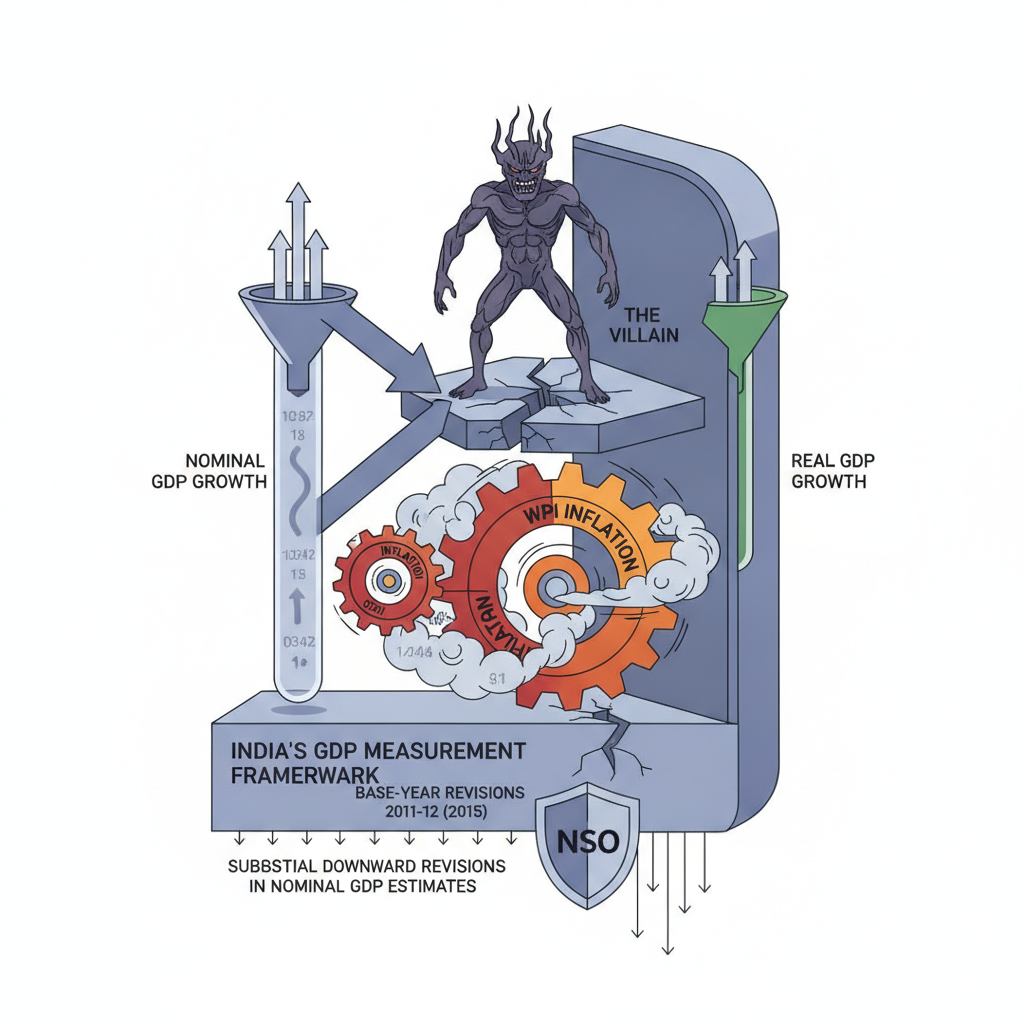
The reported 7.8% real GDP growth for Q1 2026-27, juxtaposed with a nominal GDP growth of 10.3%, has precipitated a debate on the reliability of the GDP deflator as a measure of price changes in India. The divergence between the GDP deflator (2.5%), CPI inflation (3.9%), and WPI inflation (>9%) has raised questions about the accuracy, transparency, and methodological robustness of India’s GDP measurement framework, particularly in light of recent base-year revisions and substantial downward revisions in nominal GDP estimates.
Background
- The GDP deflator is a price index that measures the change in prices of all goods and services produced in an economy, serving as a key tool for distinguishing between nominal and real GDP growth.
- India revised its GDP series with 2011-12 as the base year in 2015, replacing the 2004-05 series.
- The National Statistical Office (NSO), under the Ministry of Statistics and Programme Implementation, is responsible for compiling and revising national accounts data, including the GDP deflator.
- Fiscal ratios such as the fiscal deficit-to-GDP and debt-to-GDP are directly impacted by revisions in nominal GDP estimates, influencing macroeconomic policy and fiscal sustainability assessments.
- Concerns about the transparency and verifiability of GDP deflator calculations have been raised by former Chief Economic Adviser Arvind Subramanian and former Finance Secretary Subhash Chandra Garg, underscoring the need for methodological rigour.
What is the GDP Deflator?
- The GDP deflator is a comprehensive price index that measures the average change in prices of all goods and services included in GDP, encompassing consumption, investment, government spending, and net exports.
- It is calculated as the ratio of nominal GDP to real GDP, expressed as a percentage, and serves as a broad measure of inflation in the economy, distinct from consumer or wholesale price indices.
- The GDP deflator is a Paasche index, which uses current-period quantities as weights, making it more reflective of changes in production composition and relative prices over time.
- Unlike CPI (which measures price changes for a fixed basket of goods consumed by households) or WPI (which measures price changes for a basket of wholesale goods), the GDP deflator captures price movements across the entire economy, including intermediate and capital goods.
- The GDP deflator is sensitive to structural shifts in the economy, such as changes in the composition of output, technological advancements, or shifts in production techniques, which can distort its movement relative to other inflation measures.
- A low GDP deflator, as observed in Q1 2026-27 (2.5%), may indicate subdued price pressures or methodological factors such as changes in the relative prices of goods and services, rather than an absence of inflationary pressures.
- The GDP deflator is revised periodically with changes in the base year of the GDP series, reflecting updates in price indices, sectoral weights, and methodological improvements in national accounts compilation.
- The reliability of the GDP deflator depends on the accuracy and timeliness of underlying price and quantity data, as well as the transparency of its calculation methodology, which are critical for policy formulation and independent assessment.
Key Features
| Feature | Significance |
|---|---|
| GDP Deflator | A price index used to convert nominal GDP into real GDP by accounting for inflation, reflecting changes in the price level of domestically produced goods and services. |
| Nominal GDP | The total market value of all final goods and services produced within a country in a given period, measured at current prices without adjustment for inflation. |
| Real GDP | The inflation-adjusted measure of GDP, reflecting the actual volume of goods and services produced, enabling comparison across time periods. |
| Base Year Revision | Updating the reference year for GDP calculations to reflect structural changes in the economy, ensuring accuracy in measuring real growth. |
| Fiscal Ratios | Key indicators such as fiscal deficit-to-GDP and debt-to-GDP, which are directly impacted by revisions in nominal GDP estimates. |
Why it Matters
Measurement of Economic Growth
- The GDP deflator serves as a critical tool for distinguishing between nominal and real economic growth, ensuring that inflation effects are excluded from growth calculations.
- A divergence between the GDP deflator, CPI, and WPI necessitates scrutiny to validate the accuracy of growth estimates and price movements.
- Revisions in nominal GDP estimates, particularly downward adjustments, raise questions about the reliability of growth metrics and their implications for economic policy.
Fiscal Policy Implications
- Lower nominal GDP estimates directly influence fiscal ratios, such as the fiscal deficit-to-GDP and debt-to-GDP, which are benchmarks for fiscal discipline and macroeconomic stability.
- Overestimation or underestimation of nominal GDP can lead to misallocation of resources, inefficient policy design, and potential fiscal imbalances.
- Accurate GDP measurement is essential for determining the government’s borrowing capacity and sustainability of public debt.
Data Transparency and Methodology
- The construction of the GDP deflator, including its weights and price indices, must be transparent to allow independent verification and ensure credibility in economic reporting.
- The transition to a new base year (e.g., 2022–23) introduces methodological changes that may affect comparability with previous estimates, necessitating clear documentation of revisions.
- Concerns about data integrity and methodological rigor undermine public trust in official economic statistics, which are foundational for evidence-based policymaking.
Challenges
1. Divergence in Price Indices
- The discrepancy between the GDP deflator (2.5%) and WPI (9%) raises questions about the representativeness of price movements in GDP calculations.
- CPI inflation (3.9%) and WPI inflation (9%) diverge significantly, complicating the interpretation of the GDP deflator’s accuracy in reflecting price dynamics.
- Such divergences may indicate structural issues in price measurement, including the exclusion of certain sectors or the overrepresentation of others in the deflator.
UPSC Link: GS-III: Inflation & Price Index
2. Downward Revisions in Nominal GDP
- The revision of nominal GDP for 2025–26 from Rs 357.1 lakh crore to Rs 345.47 lakh crore (a 3.3% reduction) suggests potential overestimation in earlier estimates.
- The sharp downward revision in April–June 2025 GDP (from Rs 86.05 lakh crore to Rs 80.00 lakh crore) warrants investigation into sectoral contributions and methodological adjustments.
- Large revisions in nominal GDP undermine the credibility of economic data and may distort policy responses, particularly in fiscal planning.
UPSC Link: GS-III: National Income Accounting
3. Methodological Concerns in GDP Calculation
- The shift from the 2011–12 base year to 2022–23 introduces changes in the composition of price indices and weights, which may affect the comparability of real GDP estimates.
- The substantial increase in real GDP (e.g., Rs 47.89 lakh crore to Rs 75.46 lakh crore for April–June 2025) under the new series raises questions about the magnitude of revisions.
- Lack of clarity in the derivation of individual price deflators (over 300) and their aggregation into the GDP deflator complicates independent verification.
UPSC Link: GS-III: Measurement of GDP
4. Impact on Fiscal Ratios
- Downward revisions in nominal GDP directly increase fiscal deficit-to-GDP and debt-to-GDP ratios, potentially signaling tighter fiscal space or higher debt burdens.
- Misalignment between nominal GDP and real GDP growth may lead to misinterpretation of economic performance, affecting investor confidence and policy credibility.
- Fiscal ratios are critical for assessing macroeconomic stability, and inaccuracies in their calculation can distort policy responses.
UPSC Link: GS-III: Fiscal Policy & FRBM Act
Challenges — UPSC Perspective
| Issue | Concern |
|---|---|
| Divergence in Price Indices | The GDP deflator’s deviation from CPI and WPI raises questions about the accuracy of price measurement in GDP calculations. |
| Downward Revisions in Nominal GDP | Sharp reductions in nominal GDP estimates undermine the reliability of economic data and fiscal planning. |
| Methodological Changes in Base Year | Transition to a new base year (2022–23) introduces comparability issues and methodological complexities in GDP measurement. |
| Transparency in Deflator Construction | Lack of clarity in the derivation of over 300 price deflators and their aggregation raises concerns about data integrity. |
| Impact on Fiscal Ratios | Revisions in nominal GDP directly affect fiscal deficit-to-GDP and debt-to-GDP ratios, complicating macroeconomic assessments. |
Way Forward
- Conduct an independent audit of the GDP deflator’s construction, including the weights and price indices used, to ensure methodological rigor and transparency.
- Enhance the documentation of base-year revisions, providing clear explanations for sectoral adjustments and their impact on nominal and real GDP estimates.
- Strengthen inter-agency coordination between the Ministry of Statistics and Programme Implementation (MoSPI), the Reserve Bank of India (RBI), and other stakeholders to align price indices.
- Publish detailed breakdowns of GDP revisions, including sectoral contributions and methodological changes, to facilitate independent verification.
- Review the fiscal impact of nominal GDP revisions on key ratios, ensuring that policy responses are based on accurate and credible economic data.
- Promote public awareness and academic scrutiny of GDP measurement methodologies to foster a culture of evidence-based policymaking.
- Explore the integration of advanced data analytics and machine learning to improve the accuracy and timeliness of GDP estimates.
UPSC Value Addition
Keywords for Mains Answer-Writing
GDP deflator · real GDP growth · nominal GDP · price deflation · base year revision · National Statistical Office · GDP measurement methodology · inflation measurement · fiscal deficit-to-GDP ratio · debt-to-GDP ratio · price indices · economic data transparency · economic statistics · measurement bias in GDP
Concept Flow
Nominal GDP (current prices) → Adjustment via GDP Deflator → Real GDP (constant prices) → Divergence between GDP Deflator and CPI/WPI → Questions on Price Measurement Accuracy → Downward Revision in Nominal GDP → Impact on Fiscal Ratios (Fiscal Deficit-to-GDP, Debt-to-GDP) → Base Year Revision (2011–12 to 2022–23) → Changes in Price Indices and Weights → Sectoral Adjustments in GDP Calculation → Methodological Concerns and Data Transparency Issues → Policy Implications → Fiscal Discipline, Resource Allocation, and Investor Confidence
Prelims Practice Questions
Q1. Consider the following statements regarding the GDP deflator:
1. The GDP deflator is a measure of price changes in an economy.
2. It is used to convert nominal GDP into real GDP.
3. The GDP deflator is always equal to the Consumer Price Index (CPI) in any given year.
4. It is calculated using a fixed basket of goods and services similar to CPI.
How many of the above statements are correct?
- Only one
- Only two
- Only three
- All four
Answer: Only two — Statement 1 and 2 are correct. The GDP deflator measures the change in prices of all goods and services produced domestically, and it is used to convert nominal GDP (current prices) into real GDP (constant prices). Statement 3 is incorrect because the GDP deflator and CPI measure different sets of prices; the GDP deflator includes all domestically produced goods and services, while CPI includes only a fixed basket of goods and services consumed by households. Statement 4 is incorrect because the GDP deflator uses a changing basket of goods and services, reflecting the current composition of production, unlike CPI which uses a fixed basket.
Q2. Assertion (A): A low GDP deflator implies that the economy is experiencing deflation.
Reason (R): The GDP deflator measures the average level of prices of all new, domestically produced, final goods and services in an economy.
- Both A and R are true, and R is the correct explanation of A
- Both A and R are true, but R is NOT the correct explanation of A
- A is true, but R is false
- A is false, but R is true
Answer: ? — Assertion (A) is false because a low GDP deflator does not necessarily imply deflation; it may reflect changes in the composition of production or relative price movements rather than a general decline in prices. Reason (R) is true as it correctly defines the GDP deflator as a measure of the average level of prices of all new, domestically produced, final goods and services in an economy.
Q3. Match the following terms related to GDP measurement with their correct descriptions:
Column I
A. Nominal GDP
B. Real GDP
C. GDP deflator
D. Base year
Column II
1. GDP measured at current market prices
2. GDP measured at constant prices of a reference year
3. A price index used to convert nominal GDP to real GDP
4. The year against which prices are held constant for real GDP calculation
- {‘A’: ‘1’, ‘B’: ‘2’, ‘C’: ‘3’, ‘D’: ‘4’}
- {‘A’: ‘4’, ‘B’: ‘3’, ‘C’: ‘2’, ‘D’: ‘1’}
- {‘A’: ‘2’, ‘B’: ‘1’, ‘C’: ‘4’, ‘D’: ‘3’}
- {‘A’: ‘1’, ‘B’: ‘2’, ‘C’: ‘3’, ‘D’: ‘4’}
Answer: {‘A’: ‘1’, ‘B’: ‘2’, ‘C’: ‘3’, ‘D’: ‘4’} — A matches with 1 (Nominal GDP is measured at current market prices), B matches with 2 (Real GDP is measured at constant prices of a reference year), C matches with 3 (GDP deflator is a price index used to convert nominal GDP to real GDP), and D matches with 4 (Base year is the year against which prices are held constant for real GDP calculation).
Mains Practice Question
✍ The divergence between nominal GDP growth, real GDP growth, and the GDP deflator raises critical questions about the reliability and methodology of India’s GDP measurement system. Critically examine the factors contributing to such divergences and their implications for economic policy and fiscal management. (15 Marks)
Approach: MODEL-ANSWER SKELETON:
1. **Introduction**: Define GDP, nominal GDP, real GDP, and the GDP deflator. Briefly state the observed divergence in the given data (nominal GDP growth 10.3%, real GDP growth 7.8%, GDP deflator ~2.5%, CPI inflation ~3.9%, WPI inflation ~9%).
2. **Factors contributing to divergence**:
– **Conceptual differences**: Explain that GDP deflator, CPI, and WPI measure different baskets of goods and services (GDP deflator covers all domestically produced goods and services; CPI covers household consumption; WPI covers wholesale transactions).
– **Base year revision**: Discuss the methodological shift from the 2011–12 base year to the 2022–23 base year, including changes in weights, price indices, and sectoral coverage. Reference the downward revision in nominal GDP (e.g., Rs 345.47 lakh crore vs. Rs 357.1 lakh crore in the old series).
– **Compositional changes**: Highlight how changes in the relative prices of goods and services or shifts in production composition can distort the deflator. For example, a decline in the price of capital goods (included in GDP deflator) relative to consumer goods (included in CPI) can lower the deflator.
– **Data transparency and methodology**: Discuss concerns raised by economists (e.g., Arvind Subramanian) about the transparency of the deflator’s construction, including the use of over 300 individual price deflators and the lack of independent verification mechanisms.
3. **Implications for economic policy and fiscal management**:
– **Fiscal ratios**: Explain how a lower nominal GDP (due to revisions) can distort fiscal deficit-to-GDP and debt-to-GDP ratios, potentially misleading fiscal consolidation assessments.
– **Monetary policy**: Discuss how an inaccurate deflator can mislead monetary policy decisions, as real GDP growth is a key input for policy rate decisions.
– **Investor confidence**: Highlight the risk of policy uncertainty and reduced investor confidence if GDP measurement is perceived as unreliable.
– **Comparability over time**: Emphasise the challenge of comparing GDP growth across years due to base year revisions and methodological changes.
4. **Counterarguments and safeguards**:
– Acknowledge that a low deflator may reflect genuine economic phenomena (e.g., productivity gains, technological advancements reducing costs).
– Mention institutional safeguards: Role of the National Statistical Office (NSO), National Statistical Commission (NSC), and international standards (e.g., System of National Accounts 2008).
5. **Conclusion**: Summarise the need for greater transparency, independent audits, and periodic reviews of the GDP measurement methodology to ensure its credibility and utility for policy-making.
Source: orissapost.com
Generated by AanyaAi for educational purpose.
Related guides on our sites
- Current affairs for upsc 2026
- UPSC EPFO syllabus
- Best economics optional coaching for upsc
- Best economics optional teacher for upsc

- KWML’s Feasibility Reports for Water Metro in 18 Cities: UPSC & PCS Insights - October 3, 2026
- ओडिशा में वन्यजीव अनुसंधान अनुदान कार्यक्रम शुरू, सिमिलिपाल में 300 कैमरे और बढ़ेंगे - October 3, 2026
- India Summons Pakistan High Commission Official Over Violation - October 3, 2026

No Comments