


13 Sep Durga the Elephant: Assam to Madurai Meenakshi Temple Transfer Raises Concerns
✎ The transfer of captive elephants between states in India is governed by the Wild Life (Protection) Act, 1972, and requires a No Objection Certificate (NOC) from the Chief Wildlife Warden, verifying compliance with welfare…
Subject Relevance — Where This Topic Fits
- GS Paper II — Governance, Transparency and Accountability | GS Paper III — Environment and Biodiversity | GS Paper IV — Ethics and Human Interface
- Prelims: Captive Wildlife (Management) Rules, 2018, Wild Life (Protection) Act, 1972, Madras High Court, Chief Wildlife Warden, No Objection Certificate (NOC), District Captive Elephant Management Committee, Tamil Nadu Captive Elephants (Management and Maintenance) Rules, 2011, Elephant Welfare Board, Project Elephant
- Essay: Ethical considerations in the management of captive wildlife: Balancing tradition and animal welfare, Judicial intervention in environmental governance: The role of the judiciary in protecting wildlife
Quick Revision: The transfer of captive elephants between states in India is governed by the Wild Life (Protection) Act, 1972, and requires a No Objection Certificate (NOC) from the Chief Wildlife Warden, verifying compliance with welfare standards at the destination facility.
Why is this in the news?
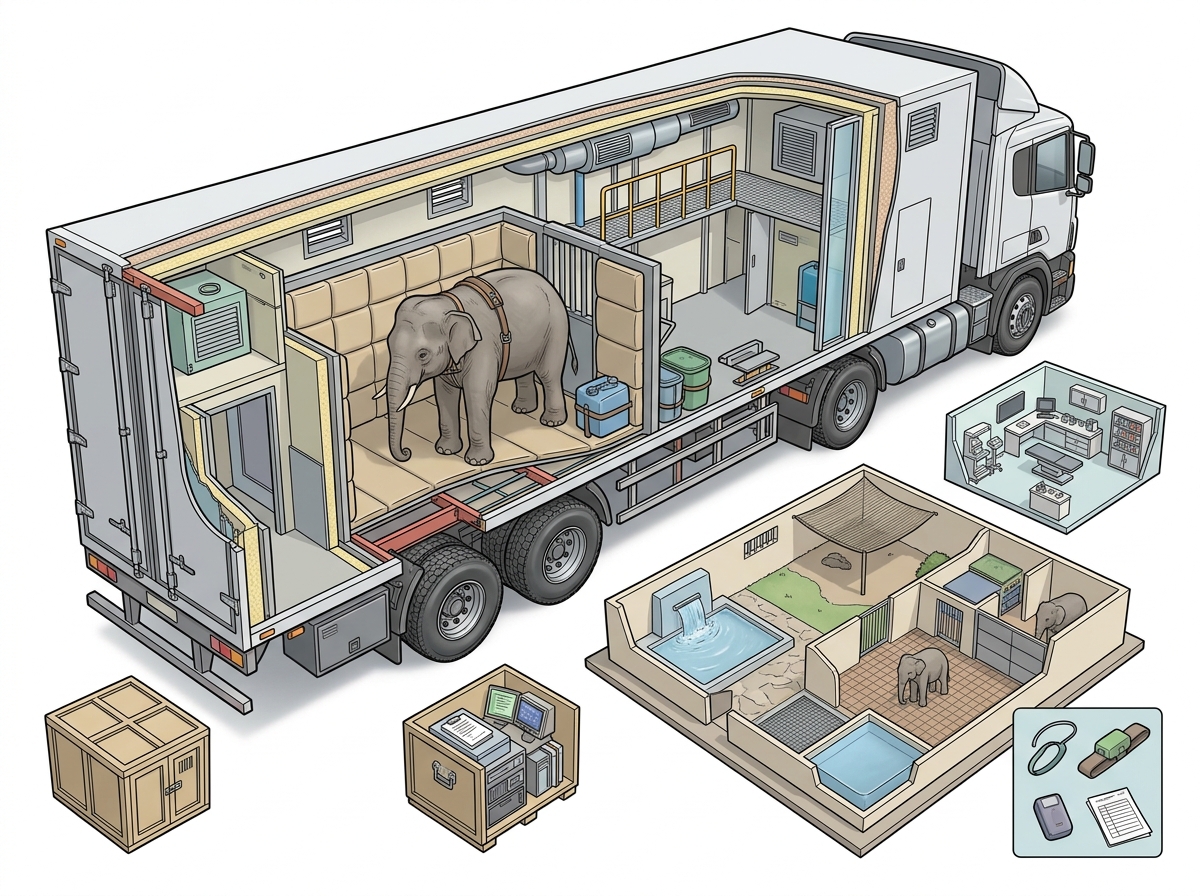
The proposed transfer of a five-year-old female elephant named ‘Durga’ from Assam to the Meenakshi Amman Temple in Madurai, Tamil Nadu, has brought into focus the regulatory mechanisms governing the movement of captive elephants and the welfare standards required for their transportation and maintenance. The transfer, facilitated by a No Objection Certificate (NOC) issued by the Tamil Nadu Forest Department, has sparked concerns among activists regarding the adequacy of infrastructure and welfare provisions at the destination temple, as well as the broader implications for the management of captive elephants in India.
Background
- The Wild Life (Protection) Act, 1972, regulates the keeping and movement of captive elephants in India, requiring prior permission from the Chief Wildlife Warden for any transfer between states.
- The Tamil Nadu Captive Elephants (Management and Maintenance) Rules, 2011, provide detailed guidelines for the care, housing, and welfare of elephants held in captivity, including requirements for space, bathing facilities, and veterinary care.
- The Madras High Court has recently adjudicated on the movement of captive elephants to temples, affirming the legality of transfers under the existing regulatory framework while emphasising the need for strict adherence to welfare standards.
- The transfer of elephants from Assam to Tamil Nadu temples is part of a broader practice where state forest departments facilitate the donation of elephants to religious institutions, subject to compliance with legal and welfare norms.
- Activist groups have raised concerns about the welfare conditions of captive elephants in temples, citing issues such as inadequate space, lack of veterinary care, and the psychological stress of confinement.
- The Chief Wildlife Warden of Tamil Nadu, in issuing the NOC, stated that the District Captive Elephant Management Committee had inspected the Meenakshi Amman Temple to verify the availability of facilities such as mud baths, water baths, and walking space.
What are the regulatory and welfare frameworks governing the transfer of captive elephants in India?
- **Wild Life (Protection) Act, 1972**: The primary legislation governing the protection of wildlife in India, including captive elephants. Section 40 and 42 of the Act mandate that no person shall acquire or keep in captivity any wild animal unless such acquisition or keeping is authorised by a permit or license issued by the Chief Wildlife Warden.
- The **Tamil Nadu Captive Elephants (Management and Maintenance) Rules, 2011**, are a state-specific implementation of the national rules. These rules mandate that temples or institutions receiving elephants must provide adequate facilities, including a minimum space requirement, bathing areas, and veterinary care. They also require regular inspections by the District Captive Elephant Management Committee.
- The **District Captive Elephant Management Committee** is a local body constituted under the state rules to oversee the welfare of captive elephants. Its responsibilities include inspecting facilities, verifying compliance with welfare standards, and recommending or denying transfers based on the conditions observed.
- **No Objection Certificate (NOC)**: Issued by the Chief Wildlife Warden of the state receiving the elephant, the NOC certifies that the destination facility meets the prescribed welfare standards and that the transfer is not detrimental to the animal’s well-being. The NOC is a prerequisite for the transfer of elephants between states under the Wild Life (Protection) Act, 1972.
- The **Madras High Court’s recent judgment** set aside State-wide directions that sought to prevent temples from acquiring captive elephants, while retaining specific orders for the welfare of individual elephants.
- The **Project Elephant**, a centrally sponsored scheme launched in 1992, aims to provide financial and technical support to states for the conservation and welfare of elephants. While primarily focused on wild elephants, the scheme also addresses the welfare of captive elephants through capacity-building and awareness programmes.
Key Features
| Feature | Significance |
|---|---|
| No Objection Certificate (NOC) issuance | Validates compliance with wildlife protection norms prior to inter-State transfer of captive elephants. |
| District Captive Elephant Management Committee inspection | Ensures pre-transfer assessment of infrastructure adequacy (mud bath, water bath, walking space) at the recipient temple. |
| Madras High Court proceedings | Examines legality of temple-acquired captive elephants under Tamil Nadu Captive Elephants (Management and Maintenance) Rules, 2011. |
| Tamil Nadu Captive Elephants (Management and Maintenance) Rules, 2011 | Regulates acquisition, welfare, and maintenance of captive elephants in religious institutions. |
| Elephant ‘Durga’ transfer | Represents a specific case of inter-State movement of a captive elephant for religious purposes, subject to judicial and administrative scrutiny. |
Why it Matters
Administrative and Legal
- Demonstrates the intersection of wildlife governance and religious practices under statutory frameworks.
- Highlights the role of judicial oversight in balancing cultural traditions with animal welfare regulations.
- Illustrates the procedural rigour required for inter-State transfer of protected species under the Wildlife (Protection) Act, 1972.
Ecological and Animal Welfare
- Raises questions about the welfare standards for captive elephants in temple settings, including space, bathing facilities, and veterinary care.
- Underscores the ethical considerations in transporting juvenile elephants over long distances for religious purposes.
- Emphasises the need for adherence to the Prevention of Cruelty to Animals Act, 1960, in captive elephant management.
Cultural and Religious
- Reflects the cultural significance of elephants in Hindu temple traditions, particularly in South Indian religious practices.
- Exposes the legal ambiguities in reconciling religious freedoms with animal rights in temple management.
- Highlights the role of the Hindu Religious and Charitable Endowments Department in regulating temple resources.
Challenges
1. Welfare Standards for Captive Elephants
- Inadequate infrastructure at recipient temples may compromise elephant health and well-being.
- Long-distance transportation poses risks of stress, dehydration, and injury to juvenile elephants.
- Lack of uniform welfare protocols across temples exacerbates inconsistencies in care.
- Judicial interventions highlight gaps between statutory rules and ground-level implementation.
UPSC Link: GS III: Environment & Ecology
2. Legal and Procedural Compliance
- Ensuring strict adherence to the Wildlife (Protection) Act, 1972, and state-specific rules during transfers.
- Balancing religious freedoms with statutory obligations under the Prevention of Cruelty to Animals Act, 1960.
- Addressing judicial concerns over arbitrary or unregulated temple acquisitions of captive elephants.
- Streamlining inter-State transfer processes to avoid delays and legal challenges.
UPSC Link: GS II: Judiciary & Constitutional Framework
3. Ethical and Societal Concerns
- Public perception of animal rights versus religious traditions in temple management.
- Need for public awareness campaigns on ethical treatment of captive elephants.
- Role of civil society organisations in monitoring welfare standards in religious institutions.
- Potential for policy reforms to harmonise cultural practices with animal welfare.
UPSC Link: GS IV: Ethics & Governance
Challenges — UPSC Perspective
| Issue | Concern |
|---|---|
| Infrastructure gaps at temples | Risk of inadequate bathing, walking, and veterinary facilities for elephants. |
| Long-distance transport stress | Potential health risks to juvenile elephants during inter-State transfer. |
| Judicial scrutiny of transfers | Legal challenges may delay or invalidate temple-acquired elephants. |
| Regulatory inconsistencies | Variations in enforcement of welfare rules across temples and states. |
| Ethical dilemmas | Balancing religious traditions with animal rights concerns. |
| Policy ambiguity | Lack of clear guidelines on temple acquisitions of captive elephants. |
Way Forward
- Conduct mandatory pre-transfer inspections by wildlife authorities to certify temple infrastructure.
- Develop standardised welfare protocols for captive elephants in temple settings, aligned with statutory rules.
- Establish a centralised monitoring mechanism for inter-State transfers of captive elephants.
- Organise capacity-building workshops for temple authorities on animal welfare and legal compliance.
- Enhance judicial sensitivity to animal welfare in cases involving religious practices.
- Promote public-private partnerships for funding and maintaining elephant welfare infrastructure in temples.
- Strengthen civil society oversight to report violations of animal welfare norms in religious institutions.
UPSC Value Addition
Keywords for Mains Answer-Writing
Captive Elephant Management and Maintenance Rules, 2011 · Wild Life (Protection) Act, 1972 · No Objection Certificate (NOC) · District Captive Elephant Management Committee · Madras High Court · Tamil Nadu Forest Department · Elephant welfare and conservation · Animal rights and ethical governance · Constitutional provisions for animal welfare (Article 51A(g)) · Judicial review of administrative decisions
Constitutional & Policy Linkages
- [‘Article 25(1): Freedom of Religion’, ‘Balances religious practices with statutory regulations.’]
- [‘Article 48: Animal Welfare Directive’, ‘Encourages state action for humane treatment of animals.’]
- [‘Article 51A(g): Fundamental Duty’, ‘Duty to protect and improve the natural environment, including wildlife.’]
Concept Flow
Public interest litigation challenges temple acquisitions of captive elephants. → Madras High Court examines legality under Tamil Nadu Captive Elephants Rules, 2011. → State wildlife authorities issue NOC after District Committee inspections. → Inter-State transfer of juvenile elephant ‘Durga’ from Assam to Madurai Meenakshi Temple. → Activists raise concerns over welfare standards and transport stress. → Judicial scrutiny continues on pending temple applications for elephant transfers. → Policy reforms may emerge to harmonise religious traditions with animal welfare.
Prelims Practice Questions
Q1. Consider the following statements regarding the transfer of captive elephants in India:
1. The transfer of captive elephants from one state to another requires a No Objection Certificate (NOC) from the Chief Wildlife Warden of the receiving state.
2. The Tamil Nadu Captive Elephants (Management and Maintenance) Rules, 2011 govern the welfare and transfer of captive elephants in Tamil Nadu.
3. The Wild Life (Protection) Act, 1972 prohibits the transfer of all captive elephants across state borders.
How many of the above statements are correct?
- Only one
- Only two
- All three
- None
Answer: Only two — Statement 1 is correct as the NOC is a mandatory requirement under the Wild Life (Protection) Act, 1972. Statement 2 is correct as the rules specify the framework for elephant management. Statement 3 is incorrect as the Act does not prohibit all transfers but regulates them.
Q2. Assertion (A): The Madras High Court has the power to set aside administrative decisions related to the transfer of captive elephants.
Reason (R): The judiciary in India can review executive actions to ensure compliance with statutory and constitutional provisions.
Options:
A. Both A and R are true, and R is the correct explanation of A.
B. Both A and R are true, but R is not the correct explanation of A.
C. A is true, but R is false.
D. A is false, but R is true.
Answer: ? — Assertion A is true as the Madras High Court has set aside administrative decisions in the context of elephant transfers. Reason R is also true and correctly explains A, as judicial review is a constitutional power to ensure executive actions are lawful.
Q3. Match the following provisions with their respective legal frameworks:
Column I
1. No Objection Certificate (NOC) for elephant transfer
2. Welfare standards for captive elephants
3. Prohibition of cruelty to animals
Column II
A. Wild Life (Protection) Act, 1972
B. Tamil Nadu Captive Elephants (Management and Maintenance) Rules, 2011
C. Prevention of Cruelty to Animals Act, 1960
- 1-A, 2-B, 3-C; 1-B, 2-A, 3-C; 1-C, 2-B, 3-A; 1-A, 2-C, 3-B
Answer: 1-A, 2-B, 3-C; 1-B, 2-A, 3-C; 1-C, 2-B, 3-A; 1-A, 2-C, 3-B — 1-A: NOC for elephant transfer is governed by the Wild Life (Protection) Act, 1972. 2-B: Welfare standards are specified in the Tamil Nadu Captive Elephants (Management and Maintenance) Rules, 2011. 3-C: Prohibition of cruelty to animals is covered under the Prevention of Cruelty to Animals Act, 1960.
Mains Practice Question
✍ The transfer of captive elephants from Assam to temples in Tamil Nadu has been facilitated under the Wild Life (Protection) Act, 1972 and the Tamil Nadu Captive Elephants (Management and Maintenance) Rules, 2011. Critically examine the legal and ethical dimensions of such transfers, with particular reference to the role of judicial oversight and the welfare of the animals. (15 Marks)
Approach: MODEL-ANSWER SKELETON:
1. **Legal Framework**:
– Wild Life (Protection) Act, 1972: Sections 40, 42, and 43 govern the transfer, acquisition, and welfare of captive elephants. Highlight the requirement of NOC from the Chief Wildlife Warden and the role of the District Captive Elephant Management Committee.
– Tamil Nadu Captive Elephants (Management and Maintenance) Rules, 2011: Specify standards for housing, feeding, and veterinary care. Reference Rule 4 (facilities like mud bath, water bath, and walking space) and Rule 7 (inspection mechanisms).
– Constitutional Provisions: Article 51A(g) imposes a fundamental duty on citizens to have compassion for living creatures.
2. **Judicial Oversight**:
– Madras High Court’s role: Cite the recent judgment setting aside statewide directions preventing temples from acquiring captive elephants, while retaining directives for the welfare of individual elephants (e.g., Lalitha case). Emphasise the balance between religious practices and animal welfare.
– Judicial review: Explain how the court ensures compliance with the Wild Life (Protection) Act and Rules, 2011, and prevents arbitrary transfers.
3. **Ethical and Welfare Concerns**:
– Animal rights: Discuss the ethical implications of transferring young elephants (e.g., Durga) from their natural habitat to temples, including stress, social disruption, and potential cruelty.
– Stakeholder perspectives: Contrast the views of temple authorities (religious and cultural significance) with animal rights activists (welfare and conservation concerns).
– Alternatives: Suggest rehabilitation in wildlife sanctuaries or ethical tourism models.
4. **Conclusion**:
– Weigh the legal permissibility against ethical imperatives. Argue for stricter enforcement of welfare standards and the need for a national policy on the transfer and management of captive elephants.
Source: The Hindu
Assam PCS (APSC) — State PCS Practice
Prelims: Which of the following concerns have been raised by activists regarding the transfer of the young elephant ‘Durga’ from Assam to the Madurai Meenakshi Temple?
- A. Violation of wildlife protection laws due to lack of proper permits
- B. Potential stress on the elephant due to long-distance travel and unfamiliar environment
- C. Ethical concerns over using wild elephants for religious purposes
- D. All of the above
Answer: D. All of the above — Activists have raised multiple concerns including legal violations, animal welfare issues, and ethical debates surrounding the transfer of wild elephants for religious purposes.
Mains: Discuss the ethical, legal, and ecological implications of transferring wild elephants like ‘Durga’ from Assam to temples in other states. Suggest measures to balance religious practices with wildlife conservation in such cases.
Generated by AanyaAi for educational purpose.

- KWML’s Feasibility Reports for Water Metro in 18 Cities: UPSC & PCS Insights - October 3, 2026
- ओडिशा में वन्यजीव अनुसंधान अनुदान कार्यक्रम शुरू, सिमिलिपाल में 300 कैमरे और बढ़ेंगे - October 3, 2026
- India Summons Pakistan High Commission Official Over Violation - October 3, 2026

No Comments