


15 Sep 12th District Collector Water Dialogue: Key Innovations & Progress Under Jal Jeevan Mission Phase II
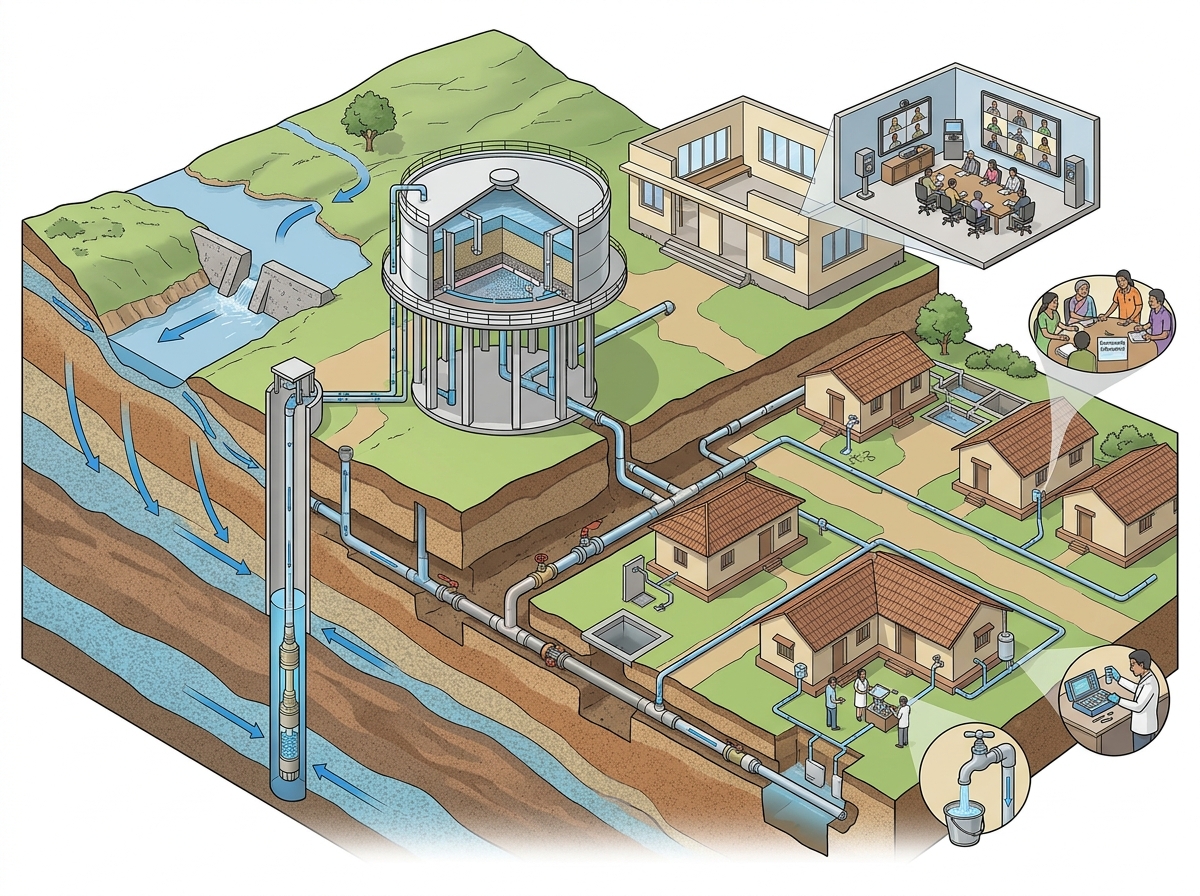
✎ The Department of Drinking Water and Sanitation, Ministry of Jal Shakti, convened the 12th District Collector Jal Jeevan Mission Dialogue on 15 September 2026 via video conferencing.
Subject Relevance — Where This Topic Fits
- GS Paper II — Governance, Transparency and Accountability | GS Paper III — Water Resources and Infrastructure Development | GS Paper III — Rural Development and Panchayati Raj
- Prelims: Jal Jeevan Mission (JJM), Source Sustainability, Community Ownership, Gram Panchayat, Water Quality Monitoring, Service Delivery Gaps, Rainwater Harvesting, Groundwater Recharge, District Development Coordination and Monitoring Committee (DDCMC), Water & Sanitation Mission (WSSM)
- Essay: Role of local governance in sustainable development, Community participation in public service delivery: lessons from rural water supply
Why is this in the news?
The Department of Drinking Water and Sanitation, Ministry of Jal Shakti, convened the 12th District Collector Jal Jeevan Mission Dialogue on 15 September 2026 via video conferencing. The event focused on accelerating the implementation of Jal Jeevan Mission Phase-II, sharing best practices, and reviewing progress in service delivery, water quality, and source sustainability across six districts. The dialogue underscored the importance of institutional mechanisms, community ownership, and convergence for ensuring reliable and sustainable piped water supply in rural India.
Background
- Jal Jeevan Mission (JJM), launched in August 2019, aims to provide Functional Household Tap Connection (FHTC) to every rural household by 2024, with a focus on source sustainability, service delivery, and community management.
- The mission is implemented through a decentralized governance model involving Gram Panchayats, District Water and Sanitation Missions (DWSM), State Water and Sanitation Missions (SWSM), and the Department of Drinking Water and Sanitation (DDWS) under the Ministry of Jal Shakti.
- Institutional arrangements include District Development Coordination and Monitoring Committees (DDCMC), State Water and Sanitation Missions (SWSM), and District Water and Sanitation Missions (DWSM) for planning, monitoring, and convergence.
- The mission mandates regular testing of water quality, documentation of completed schemes, and handover of assets to Gram Panchayats via ‘Jal Arpan’ ceremonies to promote community ownership and sustainable O&M.
- The 12th District Collector Dialogue follows a series of such interactions to facilitate peer learning, review progress, and address implementation challenges in JJM Phase-II.
What is Jal Jeevan Mission Phase-II and its governance framework?
- The mission operates through a multi-tiered governance structure: Gram Panchayats at the village level, District Water and Sanitation Missions (DWSM) at the district level, State Water and Sanitation Missions (SWSM) at the state level, and the Department of Drinking Water and Sanitation (DDWS) at the central level.
- District Water and Sanitation Missions (DWSM) are responsible for planning, implementation, monitoring, and convergence of JJM activities at the district level, including regular review meetings and progress tracking.
- The mission mandates the establishment of a robust grievance redressal mechanism, community engagement through Information, Education, and Communication (IEC) activities, and behavior change campaigns to promote water conservation and hygiene practices.
- Source sustainability is a critical component of JJM Phase-II, with a focus on rainwater harvesting, groundwater recharge, and the use of Decision Support Systems (DSS) for planning and monitoring water resource management.
- The ‘Jal Arpan’ program is a key initiative under JJM, where completed water supply schemes are formally handed over to Gram Panchayats to foster community ownership, ensure sustainable O&M, and enhance transparency in service delivery.
- Regular water quality testing, documentation of completed schemes, and timely reporting of physical and financial progress are mandatory under the mission to ensure accountability and service reliability.
- Convergence with other schemes such as Mahatma Gandhi National Rural Employment Guarantee Scheme (MGNREGS), Swachh Bharat Mission (SBM), and National Rural Livelihood Mission (NRLM) is encouraged to maximize resource utilization and ensure holistic rural development.
Key Features
| Feature | Significance |
|---|---|
| 12th District Collector Water Dialogue | Provides a platform for senior officials and district administrators to review progress, share best practices, and accelerate implementation of Jal Jeevan Mission Phase-II under the Department of Drinking Water and Sanitation. |
| Jal Jeevan Mission Phase-II | Aims to ensure 100% coverage of functional household tap connections in rural India, with a focus on service delivery, water quality, and source sustainability. |
| Water Aapda Programme (Jal Aapda) | Formal handover of completed water supply schemes to Gram Panchayats to foster community ownership, sustainable operation, and maintenance. |
| Monthly District Water & Sanitation Mission Meetings | Ensures regular monitoring of progress, service delivery gaps, and documentation of completed schemes for transparency and accountability. |
| Decision Support System (DSS) for Water Source Sustainability | Facilitates data-driven planning for rainwater harvesting and groundwater recharge to enhance long-term water security. |
| Digital Platform for Overhead Tank Maintenance | Improves transparency, efficiency, and accountability in the upkeep of water infrastructure through digital tracking and reporting. |
Why it Matters
Governance & Institutional Strengthening
- Institutionalises a structured review mechanism for rural water supply schemes, ensuring timely completion and sustainable operation.
- Enhances inter-departmental coordination between district administrations, state missions, and central ministries for effective implementation.
- Promotes participatory governance by involving elected representatives (MPs, MLAs) in monitoring and community engagement.
Socio-Economic Impact
- Ensures equitable access to safe drinking water, reducing health risks and improving quality of life in rural areas.
- Supports livelihoods by reducing time spent on water collection, particularly for women and girls, enabling greater workforce participation.
- Boosts local economies through improved sanitation and hygiene, reducing waterborne diseases and healthcare costs.
Technological & Digital Integration
- Leverages digital tools (DSS, online payment systems) for real-time monitoring, transparency, and efficient service delivery.
- Encourages adoption of best practices in digital revenue collection and infrastructure maintenance to enhance accountability.
Environmental Sustainability
- Prioritises water source sustainability through rainwater harvesting and groundwater recharge, aligning with climate resilience goals.
- Promotes long-term water security by integrating sustainability measures into rural water supply infrastructure.
Challenges
1. Geographical & Hydro-Geological Constraints
- Diverse topography and reliance on groundwater in regions like Jammu & Kashmir (Samba) pose challenges to uniform water supply coverage.
- Hilly and remote terrains in districts such as North & Middle Andaman require innovative solutions for water distribution and maintenance.
UPSC Link: GS-III: Water Resources
2. Service Delivery Gaps
- Delays in completion of civil and electrical works in some districts (e.g., Shahdol) risk missing deadlines for full coverage.
- Inadequate documentation and delayed handover of completed schemes hinder community ownership and sustainable operation.
UPSC Link: GS-II: Governance
3. Financial & Administrative Bottlenecks
- Timely utilisation of funds under Jal Jeevan Mission Phase-II requires robust financial planning and reporting mechanisms.
- Need for accurate and transparent reporting of physical and financial progress to avoid misallocation of resources.
UPSC Link: GS-III: Public Finance
4. Community Engagement & Behaviour Change
- Ensuring sustained community participation in operation and maintenance of water infrastructure remains a persistent challenge.
- Addressing behavioural resistance to adopting new water conservation practices (e.g., rainwater harvesting) requires targeted IEC activities.
UPSC Link: GS-IV: Social Justice
5. Water Quality Monitoring
- Regular testing and documentation of water quality across all rural households are essential to prevent contamination-related health risks.
- Scaling up testing infrastructure and capacity-building for local authorities is critical for effective monitoring.
UPSC Link: GS-III: Environment
Challenges — UPSC Perspective
| Issue | Concern |
|---|---|
| Topographical Diversity | Hilly, remote, and geographically diverse districts face logistical and technical challenges in water supply implementation. |
| Groundwater Dependency | Regions relying heavily on groundwater (e.g., Samba) are vulnerable to depletion and quality degradation. |
| Delayed Scheme Completion | Civil and electrical works in some districts lag behind, risking missing deadlines for full coverage. |
| Community Ownership Gaps | Inadequate handover processes and lack of awareness hinder long-term sustainability of water infrastructure. |
| Financial Utilisation | Timely and transparent utilisation of allocated funds remains a challenge for efficient scheme execution. |
| Water Quality Testing | Inconsistent testing and documentation of water quality across rural areas pose health risks. |
Government Initiatives — Must-Memorise for Prelims
- National Rural Drinking Water Programme (NRDWP)
Way Forward
- Accelerate completion of pending civil and electrical works in lagging districts through weekly reviews and strict timelines.
- Strengthen the ‘Jal Aapda’ programme to ensure timely handover of completed schemes to Gram Panchayats with robust documentation.
- Enhance utilisation of the Decision Support System (DSS) for data-driven planning of rainwater harvesting and groundwater recharge.
- Expand digital platforms for real-time monitoring of water infrastructure maintenance, including overhead tank upkeep.
- Conduct targeted IEC campaigns to promote community participation in water conservation and hygiene practices.
- Institute mandatory water quality testing protocols with transparent reporting to ensure safe drinking water for all.
- Involve elected representatives (MPs, MLAs) in monthly reviews and community engagement to foster transparency and accountability.
UPSC Value Addition
Keywords for Mains Answer-Writing
Jal Jeevan Mission Phase-II · District Collector Jal Jeevan Dialogue · Source Sustainability Measures · Water Quality Monitoring · Community Ownership of Water Infrastructure · Gram Panchayat-led O&M · Digital Platforms for Water Governance · Rainwater Harvesting and Groundwater Recharge · Decentralised Water Supply Systems · Sustainable Rural Water Supply · Water Supply Service Delivery · Water and Sanitation Mission · Water Quality Testing and Documentation · Community Participation in Water Management · District Water and Sanitation Mission · Water Aapda Programme · Water Governance and Transparency · Decentralised Planning for Water Security
Concept Flow
Rural water supply infrastructure development under Jal Jeevan Mission Phase-II → District-level planning and implementation by District Water & Sanitation Missions → Regular monitoring through monthly meetings and digital tools (DSS, online platforms) → Completion of schemes and handover to Gram Panchayats via Jal Aapda Programme → Sustainable operation and maintenance through community ownership and revenue collection mechanisms → Long-term water security via rainwater harvesting and groundwater recharge → Achievement of 100% functional household tap connections and improved quality of life
Prelims Practice Questions
Q1. Consider the following statements regarding the Jal Jeevan Mission Phase-II:
1. The mission aims to provide tap water connections to every rural household by 2024.
2. The mission includes provisions for source sustainability measures such as rainwater harvesting and groundwater recharge.
3. The mission mandates the use of a Decision Support System (DSS) for planning water supply infrastructure.
4. The mission requires all completed schemes to be handed over to Gram Panchayats through a formal ‘Water Aapda’ programme.
How many of the above statements are correct?
- Only one
- Only two
- Only three
- All
Answer: All — Statements 1, 2, and 4 are correct. Statement 3 is incorrect as the DSS is encouraged for planning source sustainability measures but not mandated for all infrastructure planning under the mission.
Q2. Assertion (A): The Jal Jeevan Mission Phase-II emphasises the role of District Collectors in accelerating the implementation of rural water supply schemes.
Reason (R): District Collectors are responsible for conducting monthly reviews of the District Water and Sanitation Mission to ensure timely completion and quality of water supply infrastructure.
In the context of the above two statements, which one of the following is correct?
- Both A and R are true, and R is the correct explanation of A
- Both A and R are true, but R is not the correct explanation of A
- A is true, but R is false
- A is false, but R is true
Answer: Both A and R are true, but R is not the correct explanation of A — Both the Assertion and Reason are true. The mission indeed places significant responsibility on District Collectors for implementation and monitoring, and the monthly reviews by the District Water and Sanitation Mission are a key mechanism to achieve this.
Q3. Match the following districts with the states they belong to in the context of the 12th District Collector Jal Jeevan Dialogue:
List I (District) List II (State)
1. Shahdol A. Punjab
2. Samba B. West Bengal
3. Hooghly C. Jammu & Kashmir
4. Fatehgarh Sahib D. Madhya Pradesh
Select the correct match:
- 1-D, 2-C, 3-B, 4-A; 1-A, 2-B, 3-C, 4-D; 1-B, 2-A, 3-D, 4-C; 1-C, 2-D, 3-A, 4-B
- answer_index_listed_above
- explain_listed_above
- format
Answer: 1-D, 2-C, 3-B, 4-A; 1-A, 2-B, 3-C, 4-D; 1-B, 2-A, 3-D, 4-C; 1-C, 2-D, 3-A, 4-B —
Mains Practice Question
✍ The Jal Jeevan Mission Phase-II represents a paradigm shift in India’s approach to rural water supply by integrating source sustainability, community ownership, and decentralised governance. Critically examine the institutional mechanisms, technological interventions, and community participation strategies employed under the mission to ensure sustainable and equitable water supply. (15 Marks)
Approach: MODEL-ANSWER SKELETON:
1. **Institutional Mechanisms** (5 marks):
– Role of District Collectors and District Water & Sanitation Missions in accelerating implementation (monthly reviews, convergence with MPs/MLAs).
– Institutionalisation of Gram Panchayat-led Operation & Maintenance (O&M) through formal handover via ‘Water Aapda’ programme.
– Convergence with other schemes (e.g., MGNREGS for water infrastructure) and multi-stakeholder coordination.
2. **Technological Interventions** (5 marks):
– Use of Decision Support Systems (DSS) for planning source sustainability (rainwater harvesting, groundwater recharge).
– Digital platforms for O&M (e.g., overhead tank cleaning, online fee collection via UPI/net banking).
– Water quality monitoring and documentation protocols to ensure service delivery standards.
3. **Community Participation & Governance** (5 marks):
– Behaviour change communication (IEC activities) to foster ownership and reduce service gaps.
– Transparency through public participation in monitoring committees and grievance redressal mechanisms.
– Challenges: Ensuring equitable access, addressing service interruptions, and sustaining community engagement post-handover.
Balance of views: Highlight successes (e.g., Shahdol’s digital O&M platform) and constraints (e.g., geographical disparities in Samba district). Conclude with the mission’s potential to redefine rural water governance if institutional and technological integration is sustained.
Source: PIB (Press Information Bureau)
Generated by AanyaAi for educational purpose.
Related guides on our sites
- Best sociology optional coaching
- Best coaching for sociology optional
- Best sociology optional coaching online
- is sociology good optional

- 12th District Collector Water Dialogue: Key Innovations & Progress Under Jal Jeevan Mission Phase II - September 15, 2026
- छत्तीसगढ़ पुलिस कांस्टेबल भर्ती: सुप्रीम कोर्ट ने राज्य सरकार की याचिका खारिज, क्या मिलेगी नौकरी? - September 15, 2026
- Supreme Court Clears Constable Recruitment in Chhattisgarh: Key UPSC Polity Insight - September 15, 2026

No Comments