


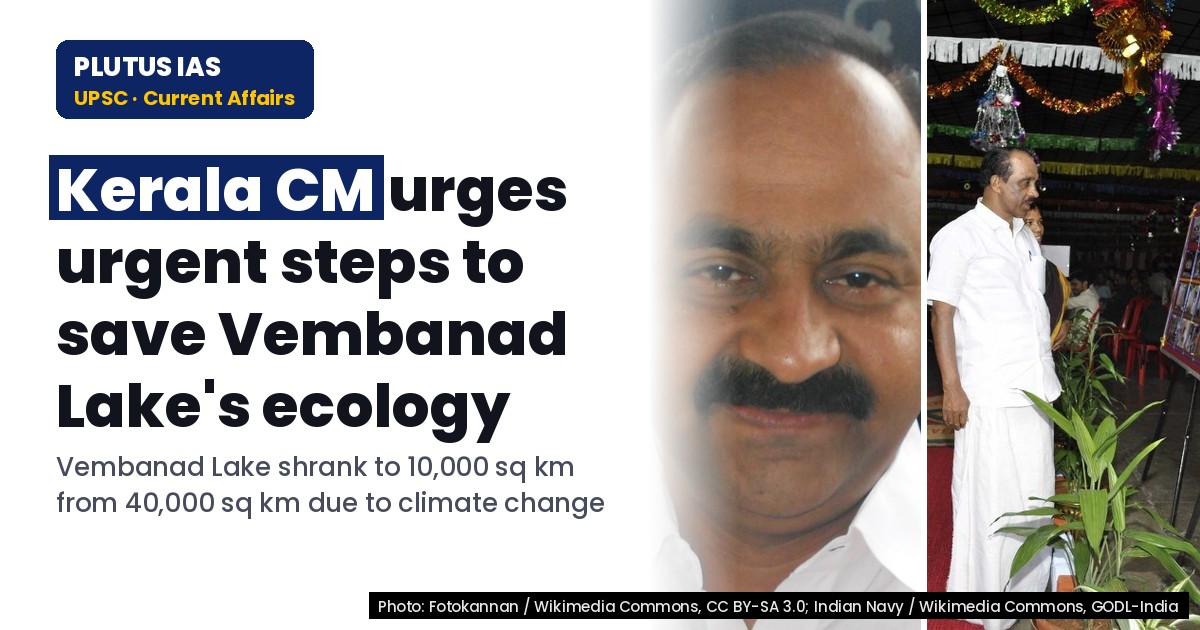
31 Oct Kerala CM Urges Protection of Vembanad Lake’s Ecology for UPSC
✎ The Vembanad-Kole wetlands, a Ramsar site in Kerala, face severe anthropogenic and climatic pressures, necessitating integrated governance, scientific research, and community-led conservation to sustain their ecological and…
Subject Relevance — Where This Topic Fits
- GS Paper III — Environment and Biodiversity | GS Paper III — Disaster Management | GS Paper II — Federalism and State Governments
- Prelims: Vembanad-Kole Wetlands, Ramsar Convention, Wetland (Conservation and Management) Rules, 2017, National Wetland Conservation Programme (NWCP), Kerala State Wetland Authority, Kole lands, Blue Carbon ecosystems, Anthropogenic stress on wetlands, Climate change adaptation, Ecosystem services
- Essay: The interplay of ecological conservation and developmental imperatives: Lessons from India’s wetlands, Federalism in environmental governance: Balancing state autonomy and ecological priorities
Quick Revision: The Vembanad-Kole wetlands, a Ramsar site in Kerala, face severe anthropogenic and climatic pressures, necessitating integrated governance, scientific research, and community-led conservation to sustain their ecological and livelihood functions.
Why is this in the news?
The Chief Minister of Kerala has underscored the urgent need for ecological protection of the Vembanad lake system, a Ramsar-listed wetland under severe anthropogenic and climatic stress. The call comes during a commemorative event honouring late fisheries expert B. Madhusoodana Kurup, who pioneered research on the ecological degradation of the Vembanad-Kole wetlands and proposed revival strategies. This highlights the intersection of scientific research, governance, and conservation policy in addressing India’s wetland crisis.
Background
- The Vembanad-Kole wetland system, spanning Kerala’s Alappuzha, Kottayam, and Ernakulam districts, is one of India’s largest Ramsar sites (designated in 2002) and a critical component of the Southwest Coast’s biodiversity.
- Historically, the system covered approximately 40,000 sq. km but has since shrunk to around 10,000 sq. km due to land reclamation, urbanisation, and agricultural expansion, particularly for rice cultivation in Kole lands.
- The wetlands provide essential ecosystem services, including flood mitigation, groundwater recharge, carbon sequestration, and livelihood support for over 1.6 million people dependent on fisheries, agriculture, and tourism.
- Anthropogenic pressures such as pollution from domestic and industrial effluents, encroachment for infrastructure projects, and unsustainable fishing practices have degraded water quality and biodiversity.
- Climate change exacerbates these challenges through sea-level rise, altered monsoon patterns, and increased frequency of extreme weather events, threatening the hydrological balance of the system.
- The Wetlands (Conservation and Management) Rules, 2017, and the Kerala State Wetland Authority were established to regulate activities and promote conservation, but implementation gaps persist.
What is the Vembanad-Kole Wetland System?
- The Vembanad-Kole wetland system is a complex of lagoons, lakes, marshes, and rice fields (Kole lands) interconnected by a network of canals and rivers, primarily the Vembanad Lake and the Kole fields.
- It is a Ramsar site under the Ramsar Convention (2002), recognised for its international significance in biodiversity conservation, particularly as a habitat for migratory birds, fish species, and mangroves.
- The Kole lands, a traditional agro-ecosystem, are seasonally flooded rice fields that double as wetland habitats during the monsoon, supporting high agricultural productivity and biodiversity.
- The system plays a pivotal role in Kerala’s socio-economic fabric, contributing to fisheries (e.g., pearl spot, prawns), agriculture (rice, coconut), and tourism (houseboat cruises, backwaters).
- Ecologically, it acts as a natural sponge, absorbing excess water during floods and recharging groundwater, while its mangroves and aquatic vegetation sequester carbon, mitigating climate change impacts.
- The wetlands are also culturally significant, featuring in Kerala’s folklore, art, and traditional knowledge systems related to water management and agriculture.
- The system is governed by multiple legal frameworks, including the Wetland (Conservation and Management) Rules, 2017, the Environment Protection Act, 1986, and the Kerala State Wetland Authority’s guidelines.
- Research by institutions like the Kerala University of Fisheries and Ocean Studies (KUFOS) and the Cochin University of Science and Technology (CUSAT) has documented the system’s ecological decline and proposed revival strategies.
Key Features
| Feature | Significance |
|---|---|
| Vembanad-Kole Wetlands | One of India’s largest Ramsar-listed wetland complexes, supporting biodiversity, fisheries, and flood mitigation. |
| Anthropogenic Stressors | Urbanisation, agricultural runoff, sand mining, and industrial discharge degrade water quality and reduce habitat. |
| Climate Change Impacts | Rising sea levels, altered precipitation patterns, and extreme weather events exacerbate ecological degradation. |
| Historical Shrinkage | Reduction from 40,000 sq. km to 10,000 sq. km due to land reclamation and developmental pressures. |
| Research and Policy Focus | Academic contributions by B. Madhusoodana Kurup highlight the need for integrated conservation strategies. |
Why it Matters
Ecological Importance
- Supports over 150 species of birds, including migratory species, and acts as a critical breeding ground for fish.
- Serves as a natural flood buffer for Kerala’s coastal districts, reducing urban flooding risks.
- Maintains hydrological balance in the Vembanad-Kole region, preventing saline intrusion into agricultural lands.
Economic Value
- Generates livelihoods for over 1.5 million people through fisheries, agriculture, and tourism.
- Supports Kerala’s aquaculture sector, contributing significantly to the state’s GDP.
- Provides ecosystem services valued at approximately ₹1,500 crore annually (conservative estimate).
Cultural and Social Dimensions
- Hosts traditional fishing communities (e.g., Karimeen fishermen) whose livelihoods are intricately linked to the wetland.
- Forms part of Kerala’s cultural heritage, with historical references in folklore and literature.
- Supports religious and recreational activities, including the annual Nehru Trophy Boat Race.
Policy and Governance Relevance
- Aligned with India’s commitments under the Ramsar Convention (1971) for wetland conservation.
- Integral to Kerala’s State Wetland Policy (2023) and National Wetland Conservation Programme.
- Highlights the role of state-level initiatives in complementing central schemes like the National Mission for Clean Ganga.
Challenges
1. Anthropogenic Pollution
- Discharge of untreated sewage and agricultural runoff leading to eutrophication and algal blooms.
- Industrial effluents from Kochi’s petrochemical and manufacturing hubs contaminating water bodies.
- Sand mining and land reclamation activities disrupting sediment balance and aquatic habitats.
UPSC Link: Environmental Pollution and Degradation (GS-III)
2. Climate Change Vulnerabilities
- Increased salinity intrusion due to sea-level rise, threatening freshwater ecosystems.
- Erratic monsoons and extreme weather events (e.g., floods, cyclones) altering wetland hydrology.
- Temperature rise affecting fish breeding cycles and biodiversity composition.
UPSC Link: Climate Change and Environmental Governance (GS-III)
3. Governance and Institutional Gaps
- Fragmented regulatory oversight among multiple agencies (e.g., Kerala State Wetlands Authority, Pollution Control Board).
- Lack of integrated water and land-use planning leading to conflicting developmental pressures.
- Inadequate enforcement of existing wetland protection laws (e.g., Wetlands (Conservation and Management) Rules, 2017).
UPSC Link: Institutional Mechanisms for Environmental Management (GS-II)
4. Biodiversity Loss and Habitat Degradation
- Decline in flagship species such as the endangered Vembanad sawfish and Otter species.
- Conversion of wetlands for agriculture and urban expansion reducing critical habitats.
- Invasive species (e.g., water hyacinth) outcompeting native flora and fauna.
UPSC Link: Biodiversity and Conservation (GS-III)
5. Socio-Economic Disparities
- Marginalised fishing communities face displacement due to wetland degradation and developmental projects.
- Lack of alternative livelihood opportunities for communities dependent on wetland resources.
- Inadequate compensation and rehabilitation mechanisms for affected populations.
UPSC Link: Social Issues and Sustainable Development (GS-II)
Challenges — UPSC Perspective
| Issue | Concern |
|---|---|
| Eutrophication | Algal blooms reduce dissolved oxygen, leading to fish kills and loss of biodiversity. |
| Saline Intrusion | Rising sea levels and reduced freshwater flow increase salinity, harming agriculture and fisheries. |
| Land Use Conflicts | Urbanisation and agriculture encroach upon wetland boundaries, reducing ecological functions. |
| Policy Implementation Gaps | Inadequate enforcement of wetland protection laws and lack of inter-agency coordination. |
| Climate-Induced Stress | Extreme weather events exacerbate erosion, sedimentation, and habitat fragmentation. |
| Economic Externalities | Degradation imposes costs on fisheries, tourism, and public health (e.g., waterborne diseases). |
Government Initiatives — Must-Memorise for Prelims
- National Wetland Conservation Programme (NWCP)
- Kerala State Wetland Policy (2023)
- National Mission for Clean Ganga (NMCG) – for river-wetland linkages
Way Forward
- Strengthen enforcement of the Wetlands (Conservation and Management) Rules, 2017, with regular monitoring and penalties for violations.
- Establish an inter-departmental task force under the Kerala State Wetlands Authority to coordinate conservation efforts.
- Promote community-based wetland management through participatory governance and traditional knowledge integration.
- Invest in nature-based solutions (e.g., constructed wetlands, mangrove restoration) to enhance ecological resilience.
- Develop climate-resilient infrastructure for flood management and saline intrusion control in the Vembanad-Kole region.
- Expand research initiatives at institutions like KUFOS and CUSAT to monitor biodiversity and ecosystem services.
- Launch public awareness campaigns to reduce pollution from domestic and agricultural sources.
- Integrate wetland conservation into urban planning and coastal zone management policies.
UPSC Value Addition
Keywords for Mains Answer-Writing
Vembanad-Kole Wetlands · Ramsar Convention · Wetland conservation in India · National Wetland Conservation Programme · Kerala Wetland Authority · Biodiversity hotspot · Anthropogenic stress on wetlands · Climate change impacts on coastal ecosystems · Wetland ecosystem services · Institutional mechanisms for wetland protection
Concept Flow
Anthropogenic pressures (urbanisation, agriculture, industry) → Pollution and habitat loss in Vembanad-Kole Wetlands → Climate change exacerbates stressors (sea-level rise, extreme weather) → Accelerated ecological degradation → Decline in biodiversity and ecosystem services → Threats to livelihoods and public health → Fragmented governance and weak enforcement → Inadequate policy implementation → Loss of ecological and economic value → Urgent need for integrated conservation strategies → Academic and policy interventions (e.g., Kurup’s research) → Framework for revival and protection → State-led initiatives (e.g., Kerala State Wetland Policy) → Pathway for sustainable management
Prelims Practice Questions
Q1. Consider the following statements regarding the Vembanad-Kole Wetlands:
1. It is the largest brackish water lake in India.
2. The wetland system is spread across three districts of Kerala.
3. It is designated as a Ramsar site.
4. The wetland system has shrunk to 10,000 sq. km from its original extent of 40,000 sq. km.
How many of the above statements are correct?
- Only one
- Only two
- Only three
- All four
Answer: All four — Statements 1, 2, and 3 are correct. Statement 4 is incorrect as the wetland system has shrunk to approximately 1,500 sq. km (not 10,000 sq. km) from its original extent.
Q2. Assertion (A): The National Wetland Conservation Programme (NWCP) is a centrally sponsored scheme aimed at the conservation and management of wetlands in India.
Reason (R): Wetlands provide critical ecosystem services such as flood mitigation, groundwater recharge, and carbon sequestration.
- Both A and R are true, and R is the correct explanation of A
- Both A and R are true, but R is not the correct explanation of A
- A is true, but R is false
- A is false, but R is true
Answer: A is true, but R is false — Assertion (A) is true as the NWCP is indeed a centrally sponsored scheme for wetland conservation. Reason (R) is also true but does not directly explain the assertion, as the NWCP’s objectives are broader than just ecosystem services.
Q3. Match the following wetlands with their respective states:
Column I (Wetland) Column II (State)
A. Vembanad-Kole Wetlands 1. West Bengal
B. Chilika Lake 2. Kerala
C. Loktak Lake 3. Odisha
D. Sundarbans 4. Manipur
Select the correct match:
- A-2, B-3, C-4, D-1
- A-1, B-2, C-3, D-4
- A-3, B-2, C-4, D-1
- A-4, B-1, C-2, D-3
Answer: A-2, B-3, C-4, D-1 — The correct matches are: Vembanad-Kole Wetlands (Kerala), Chilika Lake (Odisha), Loktak Lake (Manipur), and Sundarbans (West Bengal).
Mains Practice Question
✍ The Vembanad-Kole Wetlands, a Ramsar site and biodiversity hotspot, face severe anthropogenic and climatic stresses. Critically examine the institutional and legal frameworks for wetland conservation in India. Also, assess the role of state-level authorities in ensuring the ecological integrity of such wetlands. (15 Marks)
Approach: MODEL-ANSWER SKELETON:
1. **Introduction (2 Marks)**: Define wetlands and their ecological significance. Highlight the Vembanad-Kole Wetlands as a Ramsar site and biodiversity hotspot, emphasizing their ecosystem services (flood mitigation, groundwater recharge, carbon sequestration, and livelihood support).
2. **Legal and Institutional Frameworks (6 Marks)**:
– **National Level**: National Wetland Conservation Programme (NWCP), Wetlands (Conservation and Management) Rules, 2017, and the Ramsar Convention (India is a signatory).
– **State Level**: Kerala Wetland Authority, Kerala State Biodiversity Board, and local governance bodies (e.g., Panchayats, Municipal Corporations).
– **Judicial Interventions**: Landmark judgments such as *T.N. Godavarman Thirumulpad v. Union of India* (1996) and *Subhash Kumar v. State of Bihar* (1991) on environmental protection.
3. **Challenges and Critique (4 Marks)**:
– Fragmented implementation due to overlapping jurisdictions.
– Inadequate funding and enforcement of conservation rules.
– Climate change impacts (e.g., sea-level rise, salinity intrusion) exacerbating anthropogenic pressures.
– Lack of community participation and traditional knowledge integration.
4. **Role of State Authorities (3 Marks)**:
– Kerala Wetland Authority’s initiatives (e.g., mapping, restoration projects, and livelihood programs).
– Integration of wetland conservation in state-level policies (e.g., Kerala State Action Plan on Climate Change).
– Challenges in balancing development (e.g., infrastructure projects) with conservation goals.
5. **Conclusion (2 Marks)**: Recommendations such as strengthening inter-state coordination, enhancing community-based conservation, and leveraging climate finance for wetland restoration.
Source: The Hindu
Generated by AanyaAi for educational purpose.
Related guides on our sites
- Current affairs for upsc 2026
- UPSC EPFO syllabus
- Gs Paper 1 Syllabus
- How to prepare for GS paper 1 for UPSC CSE mains exam

- Kerala CM Urges Protection of Vembanad Lake’s Ecology for UPSC - October 31, 2026
- कर्नाटक में दूध की कीमतों में 8 रुपये की बढ़ोतरी: बजट और पोषण पर असर - October 31, 2026
- AI Revolution in U.S. Military Industrial Complex: UPSC & PCS Insights - October 31, 2026

No Comments