


16 Sep Tamil Nadu defers expansion of Kamarajar Breakfast Scheme to Sept 22
✎ The Perunthalaivar Kamarajar Breakfast Scheme is a state-level nutritional intervention in Tamil Nadu, originally targeting Classes I–V, now being expanded to Classes VI–VIII, with implementation subject to administrative and…
Subject Relevance — Where This Topic Fits
- GS Paper II — Governance, Welfare Schemes for Vulnerable Sections | GS Paper III — Social Sector Initiatives, Nutrition and Child Development
- Prelims: Mid-Day Meal Scheme, Model Code of Conduct, Social Welfare Schemes, State-level Policy Implementation, Perunthalaivar Kamarajar Breakfast Scheme
- Essay: Public Policy and Governance: Balancing Efficiency and Inclusivity, The Role of State Governments in Social Sector Development
Quick Revision: The Perunthalaivar Kamarajar Breakfast Scheme is a state-level nutritional intervention in Tamil Nadu, originally targeting Classes I–V, now being expanded to Classes VI–VIII, with implementation subject to administrative and electoral considerations.
Why is this in the news?
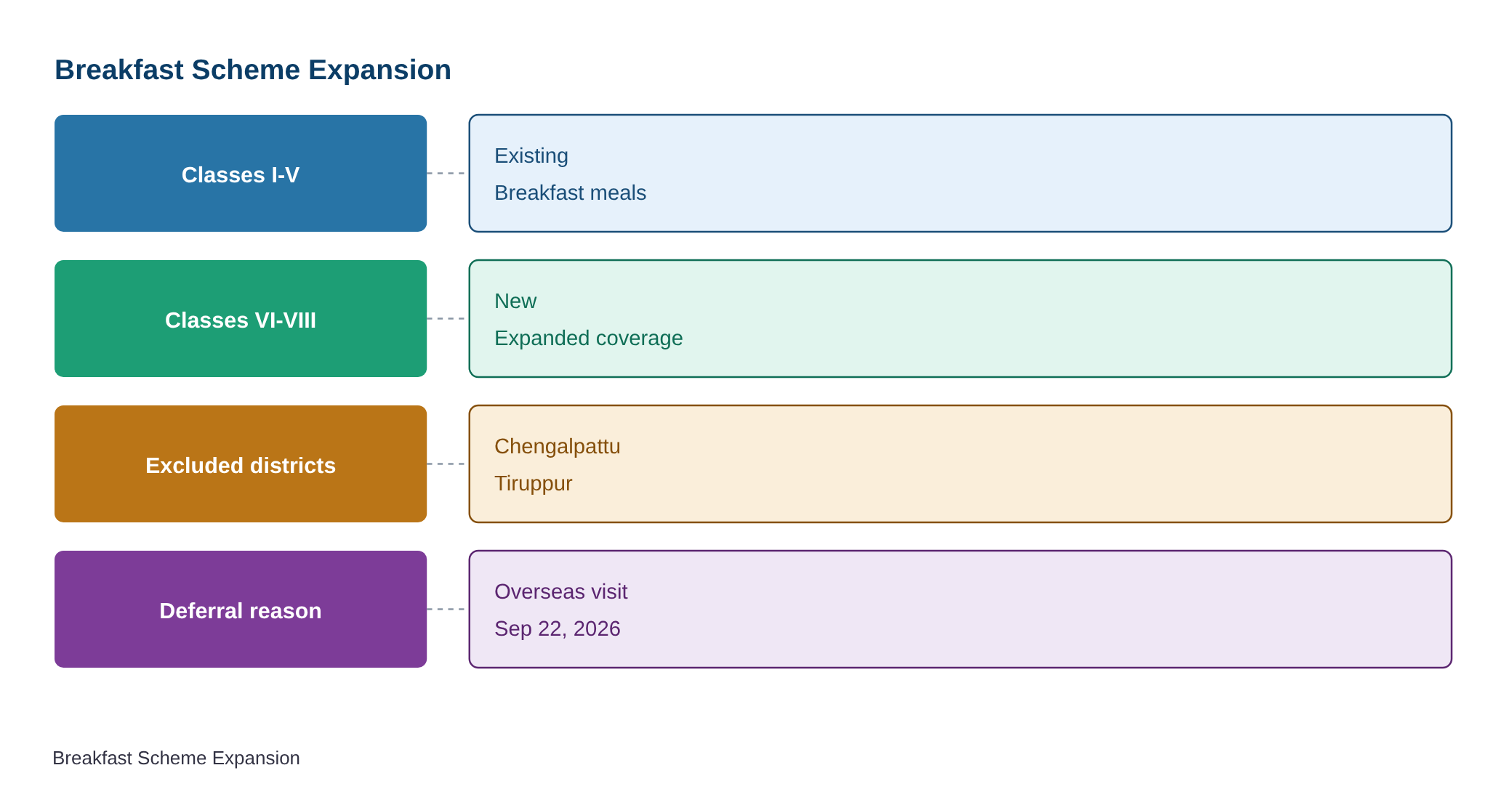
The Tamil Nadu government has deferred the launch of the expansion of the Perunthalaivar Kamarajar Breakfast Scheme from September 17 to September 22, 2026, due to the Chief Minister’s official overseas visit. The scheme’s expansion to include students of Classes VI to VIII across all districts except Chengalpattu and Tiruppur—where the Model Code of Conduct is in force—highlights the interplay between governance priorities, administrative logistics, and electoral constraints.
Background
- The Perunthalaivar Kamarajar Breakfast Scheme is a flagship social welfare initiative of the Tamil Nadu government.
- The scheme was initially launched for primary school students (Classes I to V) and provided nutritious breakfast meals to address malnutrition and improve school attendance.
- The expansion to Classes VI to VIII reflects a progressive enhancement of the scheme’s coverage, aligning with the state’s commitment to child welfare and educational equity.
- Tamil Nadu’s social welfare policies are often benchmarked against national schemes such as the Mid-Day Meal Programme under the National Food Security Act, 2013.
- The deferment of the scheme’s launch underscores the administrative challenges in policy implementation, particularly during periods of electoral activity.
- The Model Code of Conduct (MCC) in Chengalpattu and Tiruppur districts, triggered by upcoming bypolls, restricts the government from announcing new schemes or expanding existing ones.
What is the Perunthalaivar Kamarajar Breakfast Scheme?
- A state-funded nutritional intervention scheme implemented by the Tamil Nadu government to provide free breakfast to school-going children in government and government-aided schools.
- Originally launched for students of Classes I to V, the scheme aims to combat malnutrition, improve cognitive development, and enhance school attendance rates among children from economically disadvantaged backgrounds.
- The breakfast menu typically includes locally sourced, nutritious items such as millets, eggs, and vegetables, ensuring dietary diversity and adherence to nutritional standards.
- The scheme operates under the Department of Social Welfare and Women Empowerment, Tamil Nadu, in collaboration with the Department of School Education.
- Expansion to Classes VI to VIII is part of a phased rollout strategy to extend the benefits of nutritional support to older children, addressing the nutritional gaps that persist in higher primary grades.
- The scheme is monitored through a robust grievance redressal mechanism and periodic evaluations to ensure transparency and accountability in implementation.
- The deferment of the scheme’s expansion highlights the administrative flexibility required to align policy rollouts with governance priorities and electoral constraints.
Key Features
| Feature | Significance |
|---|---|
| Expansion to Classes VI–VIII | Extends nutritional coverage to an additional cohort of school-going children, aligning with the Right to Education Act’s mandate for universal elementary education and mid-day meal provisions. |
| District-wise rollout exclusion | Demonstrates adherence to the Model Code of Conduct during bypolls, ensuring neutrality and fairness in electoral processes as per the Election Commission’s guidelines. |
| Deferral due to official visit | Illustrates the operational flexibility of government programmes in balancing domestic priorities with international engagements, without compromising policy commitments. |
| Birth anniversary linkage | Associates the scheme’s launch with the legacy of Periyar E. V. Ramasamy, embedding socio-cultural symbolism in public welfare initiatives. |
Why it Matters
Social Sector
- Advances the state’s commitment to child nutrition by expanding the breakfast scheme, a critical intervention for cognitive development and educational equity in line with Sustainable Development Goal 2 (Zero Hunger).
- Targets marginalised sections by integrating with existing school infrastructure, reducing classroom hunger and improving attendance rates among socio-economically disadvantaged groups.
Administrative Governance
- Showcases inter-departmental coordination between the Social Welfare and Women Empowerment Department and district administrations for seamless programme implementation.
- Highlights the role of the Chief Secretary and district Collectors in policy execution, reflecting the hierarchical structure of state governance.
Electoral Integrity
- Upholds the Model Code of Conduct’s provisions to prevent the misuse of government schemes for electoral advantage, ensuring a level playing field during bypolls.
- Demonstrates institutional discipline in deferring launches to comply with constitutional and statutory norms governing electoral processes.
Challenges
1. Logistical Coordination
- Ensuring uniform distribution of breakfast across all districts, including remote and tribal areas, requires robust supply chain management.
- Training of mid-day meal staff and teachers to maintain quality standards and hygiene protocols under expanded coverage.
UPSC Link: GS-II: Social Sector Schemes
2. Nutritional Adequacy
- Designing a menu that meets dietary diversity requirements while remaining cost-effective and culturally acceptable to diverse communities.
- Monitoring and addressing malnutrition indicators such as stunting and wasting through integrated health and nutrition programmes.
UPSC Link: GS-II: Health & Nutrition
3. Electoral Neutrality
- Balancing the urgency of programme expansion with the need to avoid any perception of political bias during bypoll periods.
- Ensuring that deferred districts (Chengalpattu and Tiruppur) do not face long-term exclusion from the scheme’s benefits.
UPSC Link: GS-II: Election Commission & Model Code
Challenges — UPSC Perspective
| Issue | Concern |
|---|---|
| Supply Chain Disruptions | Risk of delays in procuring raw materials or prepared meals due to logistical bottlenecks or market fluctuations. |
| Quality Control | Maintaining consistent nutritional standards across 32 districts with varying local food availability and culinary practices. |
| Awareness Gaps | Ensuring beneficiary families understand the scheme’s objectives and actively participate in the programme. |
| Funding Sustainability | Securing long-term budgetary allocations to prevent programme discontinuation or reduction in coverage. |
| Monitoring Mechanisms | Establishing real-time data systems to track attendance, consumption patterns, and health outcomes among beneficiaries. |
Government Initiatives — Must-Memorise for Prelims
- Perunthalaivar Kamarajar Breakfast Scheme
- Thaimaman Thanga Mothiram Thittam
Way Forward
- Conduct a pre-launch pilot in 2–3 districts to identify and rectify operational bottlenecks before statewide expansion.
- Collaborate with the National Institute of Nutrition (NIN) to design a scientifically validated menu that meets RDA (Recommended Dietary Allowance) standards.
- Establish a multi-stakeholder oversight committee comprising nutritionists, educators, and civil society representatives to monitor implementation.
- Integrate the scheme with Poshan Tracker and other digital platforms to enable real-time monitoring of beneficiary outcomes.
- Launch targeted awareness campaigns in local languages to educate parents and students about the scheme’s benefits and eligibility criteria.
- Ensure seamless transition for deferred districts post-bypolls by expediting administrative clearances and resource allocation.
- Conduct periodic third-party audits to assess nutritional impact, cost-efficiency, and compliance with hygiene standards.
UPSC Value Addition
Keywords for Mains Answer-Writing
Perunthalaivar Kamarajar Breakfast Scheme · Tamil Nadu school meal programmes · Mid-Day Meal Scheme · Model Code of Conduct · by-elections in Tamil Nadu · Chief Minister’s overseas visits · public welfare schemes · child nutrition policies · constitutional provisions for governance · deferral of government schemes · district administration · social welfare initiatives
Constitutional & Policy Linkages
- Article 21A: Right to Education (RTE) Act, 2009 (ensuring free and compulsory education for children aged 6–14 years).
- Article 47: Directive Principles of State Policy (raising the level of nutrition and standard of living).
Concept Flow
State government announces expansion of Perunthalaivar Kamarajar Breakfast Scheme to Classes VI–VIII. → Chief Minister’s overseas visit necessitates deferral of launch to maintain administrative focus. → Model Code of Conduct invoked in Chengalpattu and Tiruppur districts due to bypolls, leading to exclusion from immediate rollout. → District Collectors and Social Welfare Department coordinate for phased implementation post-deferral. → Scheme integrates with existing mid-day meal infrastructure to enhance nutritional outcomes and educational equity. → Long-term monitoring and evaluation frameworks are established to assess impact on child health and school attendance.
Prelims Practice Questions
Q1. Consider the following statements regarding the Perunthalaivar Kamarajar Breakfast Scheme in Tamil Nadu:
1. The scheme provides breakfast to students of Classes I to V.
2. The expansion of the scheme includes coverage of Classes VI to VIII.
3. The scheme was originally scheduled to be launched on September 17, 2026.
4. The scheme is being deferred in Chengalpattu and Tiruppur districts due to the Model Code of Conduct.
How many of the above statements are correct?
- Only one
- Only two
- Only three
- All
Answer: All — Statements 1, 2, and 4 are correct. Statement 1 is incorrect as the scheme originally covered Classes I to V, while the expansion includes Classes VI to VIII. The deferral in Chengalpattu and Tiruppur districts is due to the Model Code of Conduct in view of by-elections.
Q2. Assertion (A): The Model Code of Conduct (MCC) is a constitutional provision that restricts the functioning of the executive during elections.
Reason (R): The MCC is enforced by the Election Commission of India under Article 324 of the Constitution.
Options:
A. Both A and R are true, and R is the correct explanation of A.
B. Both A and R are true, but R is not the correct explanation of A.
C. A is true, but R is false.
D. A is false, but R is true.
Answer: ? — Assertion (A) is true as the MCC restricts certain activities of the executive during elections. Reason (R) is also true as the MCC is enforced by the Election Commission under Article 324. However, R is not the correct explanation of A, as the MCC’s enforcement is distinct from its restrictive impact on the executive.
Q3. Match the following pairs related to Tamil Nadu’s welfare schemes:
Column I (Scheme) | Column II (Launch Date/Deferral Reason)
——————————————-|——————————————-
A. Perunthalaivar Kamarajar Breakfast Scheme | 1. September 15, 2026 (Deferred)
B. Thaimaman Thanga Mothiram Thittam | 2. September 17, 2026 (Original Launch)
C. Mid-Day Meal Scheme | 3. September 22, 2026 (Rescheduled)
D. PM Poshan Shakti Nirman | 4. Ongoing since 1995
Options:
A. A-3, B-1, C-4, D-2
B. A-2, B-1, C-4, D-3
C. A-3, B-1, C-2, D-4
D. A-1, B-3, C-4, D-2
Answer: ? — A-3: The expansion of the Perunthalaivar Kamarajar Breakfast Scheme is rescheduled to September 22, 2026. B-1: The Thaimaman Thanga Mothiram Thittam was deferred from September 15, 2026. C-4: The Mid-Day Meal Scheme has been ongoing since 1995. D-2: The PM Poshan Shakti Nirman is a centrally sponsored scheme with no specific launch date mentioned in the context.
Mains Practice Question
✍ The Perunthalaivar Kamarajar Breakfast Scheme exemplifies the State’s commitment to child nutrition and educational equity. Critically examine the significance of such welfare schemes in achieving Sustainable Development Goal 2 (Zero Hunger) and SDG 4 (Quality Education). Also, analyse the challenges posed by the deferral of such schemes due to administrative exigencies like the Model Code of Conduct. (15 Marks)
Approach: MODEL-ANSWER SKELETON:
1. **Introduction (2 marks)**: Define SDG 2 and SDG 4, and highlight their interlinkages with child nutrition and education. Mention the role of state-led welfare schemes in achieving these goals.
2. **Significance of the Scheme (5 marks)**:
– **Nutritional Impact**: Cite data on child malnutrition in India/Tamil Nadu (e.g., NFSA 2013, POSHAN Abhiyaan, or state-specific reports). Explain how breakfast schemes address micronutrient deficiencies and cognitive development.
– **Educational Equity**: Discuss the scheme’s role in reducing hunger-induced absenteeism and improving learning outcomes (reference to studies like the Mid-Day Meal Scheme’s impact on enrollment and retention).
– **Social Justice**: Link the scheme to Article 47 (DPSP) and the Right to Food jurisprudence (e.g., PUCL v. Union of India, 2001).
3. **Challenges of Deferral (5 marks)**:
– **Administrative Constraints**: Explain the Model Code of Conduct (MCC) under the Election Commission’s Model Code of Conduct (Part VII) and its impact on governance. Discuss the trade-off between electoral purity and public welfare.
– **Policy Coherence**: Critique the lack of a permanent mechanism to address such deferrals (e.g., no constitutional provision for automatic suspension of MCC during emergencies). Reference the Sarkaria Commission (1988) on Centre-State relations and the need for flexible governance.
– **Public Trust**: Discuss the erosion of trust in government schemes due to postponements (cite examples like the deferral of the Thaimaman Thanga Mothiram Thittam).
4. **Way Forward (3 marks)**:
– **Institutional Reforms**: Propose measures like pre-election planning for welfare schemes or a constitutional amendment to exempt critical schemes from MCC during by-elections.
– **Data-Driven Targeting**: Suggest integrating Aadhaar-linked PDS data to prioritize districts for scheme rollout.
– **Judicial Safeguards**: Reference the Supreme Court’s directives in *PUCL v. Union of India* (2001) and *People’s Union for Civil Liberties v. Union of India* (2003) on the right to food, urging courts to intervene in such deferrals.
Source: The Hindu
Generated by AanyaAi for educational purpose.
Related guides on our sites
- Anthropology VS PSIR
- Best PSIR optional coaching
- Best PSIR optional coaching online
- Best PSIR optional teacher

- Tamil Nadu defers expansion of Kamarajar Breakfast Scheme to Sept 22 - September 16, 2026
- उड़ीसा डीजीपी चयन पर सुप्रीम कोर्ट में आज सुनवाई, जानें पूरा मामला - September 16, 2026
- Supreme Court Hearing Today on Odisha DGP Selection Controversy - September 16, 2026

No Comments