


16 Sep Army Chief’s 3-Day Russia Visit: Key Agreements & Military Ties Explained
✎ Military diplomacy between India and Russia is institutionalised through high-level exchanges, joint exercises, and defence industrial cooperation, serving as a key pillar of their strategic partnership amid evolving geopolitical…
Subject Relevance — Where This Topic Fits
- GS Paper II — International Relations: India and its Neighbourhood, Bilateral Groupings, Regional Groupings, Agreements involving India and affecting India’s interests | GS Paper III — Security: Challenges to Internal Security through External State and Non-State Actors, Role of External State and Non-State Actors in creating challenges to Internal Security
- Prelims: Military diplomacy, Defence Procurement Procedure (DPP), Joint Military Exercises, Strategic Partnerships, Defence Industrial Cooperation
- Essay: India’s strategic autonomy in foreign policy: Balancing multilateralism and bilateralism, The evolving architecture of India’s defence partnerships in a multipolar world
Quick Revision: Military diplomacy between India and Russia is institutionalised through high-level exchanges, joint exercises, and defence industrial cooperation, serving as a key pillar of their strategic partnership amid evolving geopolitical dynamics.
Why is this in the news?
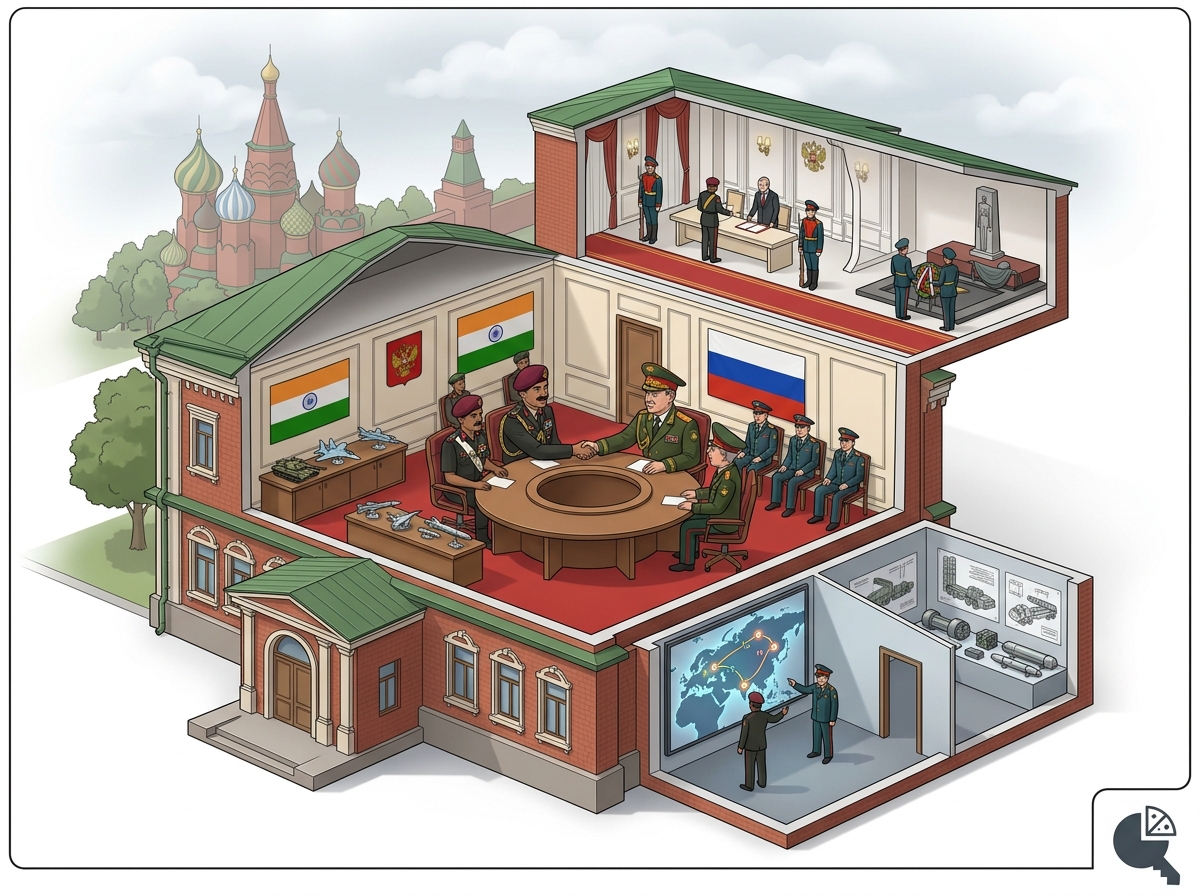
The three-day official visit of the Chief of the Army Staff (COAS) of India to Russia from September 16–18, 2026, underscores the sustained emphasis placed by both nations on institutionalised military diplomacy. The engagement includes high-level discussions with senior Russian defence officials, visits to key military institutions, and participation in commemorative ceremonies, reflecting the depth of the bilateral defence relationship and its strategic significance for India’s broader foreign policy calculus.
Background
- India and Russia share a long-standing defence partnership rooted in the Cold War era, formalised through the Indo-Soviet Treaty of Peace, Friendship and Cooperation (1971) and sustained post-Soviet dissolution through the Strategic Partnership Agreement (2000).
- Defence cooperation forms a cornerstone of India-Russia relations, with Russia historically accounting for approximately 40–50% of India’s defence imports, though recent diversification efforts have reduced this share.
- The bilateral relationship is governed by institutional mechanisms such as the India-Russia Inter-Governmental Commission on Military-Technical Cooperation (IRIGC-MTC) and the Joint Working Group on Military-Technical Cooperation.
- India’s defence procurement from Russia includes platforms such as the T-90 tanks, INS Vikramaditya aircraft carrier, and the S-400 Triumf air defence system, with ongoing discussions for advanced systems like the FGFA (Fifth Generation Fighter Aircraft) and AK-203 rifles.
- The visit occurs against the backdrop of evolving global geopolitical dynamics, including India’s strategic partnerships with the United States, Japan, and Australia under the Quad framework, and Russia’s alignment with China in the Eurasian context.
- Military diplomacy serves as a critical tool for confidence-building measures (CBMs) and crisis prevention in bilateral and regional security architectures.
What constitutes military diplomacy in the context of India-Russia defence relations?
- Military diplomacy refers to the use of military channels and institutions to advance foreign policy objectives, enhance strategic trust, and facilitate defence cooperation between nations.
- In the India-Russia context, military diplomacy encompasses high-level exchanges between defence chiefs, joint military exercises (e.g., INDRA series), training programmes for officers, and institutional collaborations in defence research and development.
- The visit includes engagements with the Russian Land Forces Commander-in-Chief and the Deputy Minister of Defence responsible for procurement, highlighting the dual focus on operational cooperation and defence industrial collaboration.
- Institutional visits such as the National Defence Control Centre in Moscow and the Mikhailovskaya Military Artillery Academy in St. Petersburg underscore the emphasis on professional military education, technological exchange, and interoperability.
- Commemorative acts, such as paying tribute at the ‘Tomb of the Unknown Soldier’, reinforce the shared historical memory of sacrifices in global conflicts, thereby strengthening people-to-people and institutional bonds.
- Military diplomacy also serves as a platform for discussing contemporary security challenges, including counter-terrorism, cyber warfare, and hybrid threats, which are increasingly transnational in nature.
- The visit aligns with India’s broader ‘Act East’ and ‘Neighbourhood First’ policies, integrating defence diplomacy into its overarching foreign policy framework to ensure strategic autonomy and regional stability.
Key Features
| Feature | Significance |
|---|---|
| High-level military diplomacy visit | Demonstrates sustained engagement in defence cooperation between India and Russia, reinforcing strategic partnerships amid evolving geopolitical dynamics. |
| Tribute to fallen soldiers at ‘Tomb of the Unknown Soldier’ | Symbolises shared military heritage and respect for sacrifices, strengthening mutual trust and historical bonds. |
| Interactions with Russian Land Forces leadership | Facilitates direct exchanges on professional military cooperation, training methodologies, and contemporary defence challenges. |
| Visit to National Defence Control Centre, Moscow | Provides insights into Russia’s defence infrastructure and strategic decision-making processes, enabling comparative analysis. |
| Engagement with Russian Ministry of Defence officials | Explores avenues for defence industry collaboration, procurement, and technological exchanges, aligning with India’s indigenisation goals. |
| Visit to Mikhailovskaya Military Artillery Academy, St. Petersburg | Highlights academic and training cooperation, fostering long-term military-to-military learning and institutional linkages. |
Why it Matters
Strategic Partnerships
- Reinforces the longstanding defence relationship between India and Russia, a cornerstone of India’s strategic autonomy and multi-alignment policy.
- Demonstrates India’s commitment to diversifying partnerships while maintaining historical alliances, particularly in defence procurement and technology transfer.
- Provides a platform for India to assess Russia’s evolving military capabilities and strategic priorities in the context of global security architectures.
Defence Diplomacy
- Serves as a mechanism for crisis communication and confidence-building measures between the armed forces of both nations.
- Enhances interoperability through joint exercises, training programs, and exchange of best practices in military operations.
- Facilitates high-level dialogue on regional security challenges, including border management and counter-terrorism cooperation.
Indigenisation and Modernisation
- Opportunities for India to explore collaborative defence manufacturing, research, and development projects under the ‘Make in India’ initiative.
- Potential for technology transfer in critical areas such as artillery systems, armoured vehicles, and advanced weaponry, aligning with India’s defence modernisation goals.
- Exposure to Russia’s defence industrial ecosystem, including its state-of-the-art research institutions and production facilities.
Geopolitical Implications
- Underscores India’s balanced foreign policy approach, engaging with major powers while avoiding alignment with any single bloc.
- Reflects India’s pragmatic engagement with Russia despite Western sanctions, ensuring continuity in defence supplies and strategic partnerships.
- Highlights the role of military diplomacy in maintaining regional stability, particularly in the Indo-Pacific and Eurasian contexts.
Challenges
1. Sanctions and Geopolitical Constraints
- Russia’s isolation due to Western sanctions may limit the scope of defence cooperation, particularly in technology transfer and joint ventures.
- India faces a delicate balancing act between maintaining strategic autonomy and complying with international norms, including export controls.
- Potential delays in defence procurement and project execution due to logistical and financial constraints in Russia’s defence sector.
UPSC Link: GS-II: Effect of Policies & Politics of Countries on India
2. Diversification of Defence Partnerships
- Over-reliance on Russia for defence supplies poses risks to India’s strategic autonomy, necessitating diversification of sources.
- Delays in finalising alternative defence partners (e.g., USA, France, Israel) may impact India’s defence modernisation timelines.
- Balancing defence procurement from multiple sources while ensuring interoperability and standardisation across armed forces.
UPSC Link: GS-III: Security Challenges and Their Management
3. Technological Gaps and Indigenisation
- Limited indigenous capabilities in certain defence technologies (e.g., engines, avionics) may constrain India’s ability to absorb transferred technologies.
- Dependence on foreign original equipment manufacturers (OEMs) for critical components may lead to supply chain vulnerabilities.
- Need for sustained investment in defence R&D and skill development to reduce reliance on imported defence systems.
UPSC Link: GS-III: Science & Technology in Defence
4. Regional Security Dynamics
- Escalation of conflicts (e.g., Ukraine, West Asia) may disrupt defence supply chains and strain diplomatic relations with key partners.
- China’s assertive military posture in the Indo-Pacific and its strategic partnership with Russia necessitates careful navigation of India’s foreign policy.
- Ensuring that military engagements do not inadvertently escalate tensions or provoke reactions from other regional stakeholders.
UPSC Link: GS-II: India and its Neighbourhood
5. Bureaucratic and Procedural Delays
- Lengthy procurement processes and bureaucratic hurdles may delay the implementation of defence cooperation agreements.
- Coordination challenges between the Ministry of Defence, armed forces, and defence PSUs in executing joint projects.
- Need for streamlined approval mechanisms to fast-track defence procurement and technology transfer agreements.
UPSC Link: GS-II: Government Policies & Interventions
Challenges — UPSC Perspective
| Issue | Concern |
|---|---|
| Sanctions on Russia | Limited scope for defence technology transfer and joint ventures due to Western restrictions. |
| Over-reliance on Russian defence supplies | Strategic vulnerability in case of supply chain disruptions or geopolitical shifts. |
| Indigenisation gaps in critical technologies | Constraints in absorbing transferred technologies and developing indigenous alternatives. |
| Regional security instability | Potential disruptions in defence cooperation due to conflicts in Ukraine or West Asia. |
| Bureaucratic delays in procurement | Slow execution of defence agreements and project timelines. |
| Balancing multi-alignment in foreign policy | Navigating partnerships with Russia, USA, and other stakeholders without alignment bias. |
Way Forward
- Institutionalise regular high-level military dialogues to ensure continuity in defence cooperation beyond ad-hoc visits.
- Accelerate the implementation of joint defence projects under the ‘Make in India’ initiative to reduce import dependence.
- Enhance collaboration in defence R&D, particularly in areas like artificial intelligence, cyber warfare, and hypersonic technology.
- Develop contingency plans for alternative defence procurement sources to mitigate risks from geopolitical disruptions.
- Strengthen inter-ministerial coordination between the Ministry of Defence, Ministry of External Affairs, and defence PSUs to streamline project execution.
- Invest in upskilling and training of Indian defence personnel in advanced Russian military technologies and doctrines.
- Promote defence industrial partnerships with other friendly nations (e.g., USA, France, Israel) to diversify supply chains.
- Establish a dedicated mechanism for monitoring and addressing challenges in defence cooperation, including sanctions-related issues.
UPSC Value Addition
Keywords for Mains Answer-Writing
Indian Army Chief’s visit to Russia · military diplomacy · defence partnership · military-to-military cooperation · Russia-India defence ties · defence procurement · professional military training · Tomb of the Unknown Soldier · National Defence Control Centre · Mikhailovskaya Military Artillery Academy · defence industry collaboration · contemporary military developments · sustained military diplomacy · army-to-army engagement
Concept Flow
India-Russia defence partnership -> High-level military diplomacy visit -> Exchange of perspectives on contemporary military developments → Exchange of perspectives -> Identification of areas for enhanced cooperation (training, technology, procurement) → Enhanced cooperation -> Joint defence projects and technology transfer under ‘Make in India’ → Technology transfer -> Indigenisation of defence capabilities and reduction of import dependence → Indigenisation -> Strengthening of India’s strategic autonomy and defence modernisation → Strategic autonomy -> Balanced foreign policy and multi-alignment in geopolitical engagements → Multi-alignment -> Maintenance of regional stability and crisis management capabilities
Prelims Practice Questions
Q1. Consider the following statements regarding the visit of the Indian Army Chief to Russia in September 2026:
1. The visit is aimed at bolstering defence partnership and military-to-military cooperation between India and Russia.
2. The Army Chief will interact with the Commander-in-Chief of the Russian Land Forces and senior officials of the Russian Ministry of Defence.
3. The visit includes a stop in Vladivostok to inspect the Eastern Naval Command of the Russian Navy.
How many of the above statements are correct?
- Only one
- Only two
- All three
- None
Answer: Only two — Statements 1 and 2 are correct as per the official announcement. Statement 3 is incorrect because the visit does not mention Vladivostok or the Eastern Naval Command.
Q2. Assertion (A): The Indian Army Chief’s visit to Russia in September 2026 is primarily focused on strengthening defence industry collaboration and procurement.
Reason (R): The visit includes interactions with the Deputy Minister of Defence of Russia, who deals with defence industry and procurement.
Options:
A. Both A and R are true, and R is the correct explanation of A.
B. Both A and R are true, but R is not the correct explanation of A.
C. A is true, but R is false.
D. A is false, but R is true.
Answer: ? — Assertion (A) is true as the visit aims to strengthen defence partnership, which includes industry collaboration. Reason (R) is also true and directly explains the focus on procurement and defence industry collaboration.
Q3. Match the following engagements of the Indian Army Chief during his visit to Russia with their respective locations:
Column I (Engagement) | Column II (Location)
———————————————————-|———————————————————-
1. Interaction with Commander-in-Chief of Russian Land Forces | A. St. Petersburg
2. Visit to the Tomb of the Unknown Soldier | B. Moscow
3. Visit to Mikhailovskaya Military Artillery Academy | C. New Delhi
4. Interaction with Deputy Minister of Defence (Procurement) | D. Kazan
- 1-B, 2-B, 3-A, 4-B; 1-A, 2-B, 3-D, 4-C; 1-B, 2-B, 3-A, 4-B; 1-D, 2-A, 3-C, 4-B
- answer_array_indexes_to_correct_matches_only
Answer: ? — Correct matches: 1-B (Moscow), 2-B (Moscow), 3-A (St. Petersburg), 4-B (Moscow). Locations Kazan and New Delhi are not mentioned in the visit itinerary.
Mains Practice Question
✍ The Chief of the Army Staff’s official visit to Russia underscores the strategic importance of sustained military diplomacy in contemporary geopolitics. Critically examine the significance of military-to-military engagements in shaping India’s defence partnerships, with particular reference to the Russia-India defence relationship. (15 Marks)
Approach: MODEL-ANSWER SKELETON:
1. **Introduction (2 marks)**
– Define military diplomacy and its role in foreign policy.
– Briefly state the historical context of India-Russia defence ties (e.g., Cold War era, Indo-Soviet Treaty of Peace, Friendship and Cooperation 1971).
2. **Strategic Significance of Military-to-Military Engagements (4 marks)**
– Enhances interoperability and joint training (e.g., Exercise INDRA).
– Facilitates defence procurement and technology transfer (e.g., S-400 Triumf, BrahMos).
– Builds trust and reduces strategic miscalculations in a multipolar world.
– Aligns with India’s policy of strategic autonomy and multi-alignment.
3. **Contemporary Dimensions (4 marks)**
– Address contemporary military developments (e.g., hybrid warfare, cyber threats).
– Role of military diplomacy in counter-terrorism and regional stability (e.g., Afghanistan, Central Asia).
– Institutional mechanisms: National Defence Control Centre, military academies (e.g., Mikhailovskaya Military Artillery Academy).
4. **Challenges and Limitations (3 marks)**
– Dependence on Russian defence supplies amid geopolitical shifts (e.g., Ukraine conflict, sanctions).
– Diversification of defence partnerships (e.g., USA, France, Israel) to mitigate risks.
– Balancing strategic autonomy with alliance constraints.
5. **Conclusion (2 marks)**
– Reiterate the enduring value of military diplomacy despite geopolitical flux.
– Emphasise the need for sustained engagement to address emerging security challenges.
Source: orissapost.com
Generated by AanyaAi for educational purpose.
Related guides on our sites
- How to prepare for GS paper 1 for UPSC CSE mains exam
- Best UPSC coaching for IFOS exam
- Best mentorship programme for upsc
- UPSC+BA degree

- Army Chief’s 3-Day Russia Visit: Key Agreements & Military Ties Explained - September 16, 2026
- मानव-वन्यजीव संघर्ष में केरल मानवाधिकार आयोग की चेतावनी प्रणाली पर जोर, जानिए पूर्ण निर्देश - September 16, 2026
- Kerala HR Panel Urges Early Warning Systems for Human-Wildlife Conflict Mitigation - September 16, 2026

No Comments