


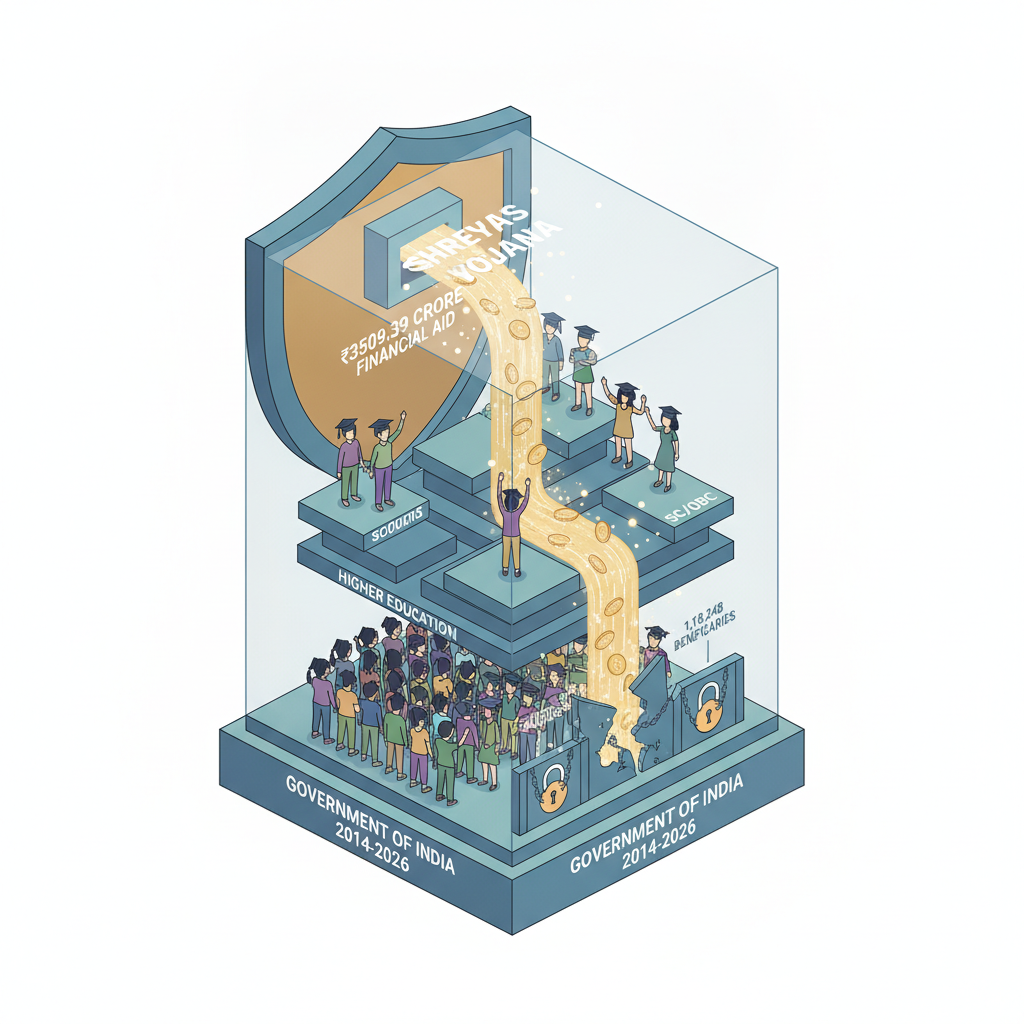
16 Sep SHREYAS Scheme: Rs 3,509 Cr Spent for SC/OBC Higher Education Support
✎ Shreyas Scheme is a Government of India initiative under the Ministry of Social Justice and Empowerment, providing financial support to SC and OBC students for free coaching, higher education in premier institutions, overseas…
Subject Relevance — Where This Topic Fits
- GS Paper II — Social Justice and Empowerment | GS Paper III — Issues Relating to Development and Management of Social Sector/Services Relating to Education
- Prelims: Shreyas Scheme, Social Justice and Empowerment Ministry, SC and OBC scholarships, Higher Education Financing, Competitive Exam Coaching, National Fellowship for SC Students
- Essay: Social equity in education: Challenges and policy interventions, Role of affirmative action in achieving inclusive growth
Quick Revision: Shreyas Scheme is a Government of India initiative under the Ministry of Social Justice and Empowerment, providing financial support to SC and OBC students for free coaching, higher education in premier institutions, overseas studies, and research fellowships, with ₹3,509.39 crore spent and 1,18,248 beneficiaries from 2014-15 to 2025-26.
Why is this in the news?
The Shreyas Scheme has been highlighted due to the release of expenditure data (₹3,509.39 crore) and beneficiary statistics (1,18,248 students) for the period 2014-15 to 2025-26, demonstrating the Government of India’s sustained financial commitment to higher education support for Scheduled Castes (SC) and Other Backward Classes (OBC) students through targeted scholarships and fellowships.
Background
- The scheme operates under the administrative purview of the Ministry of Social Justice and Empowerment, which is responsible for formulating and implementing policies for the welfare of SCs, OBCs, and other disadvantaged groups.
- Higher education in India is marked by significant socio-economic barriers, including limited access to quality coaching, financial constraints, and systemic exclusion, necessitating targeted interventions such as Shreyas.
- The scheme complements other educational initiatives like the Post-Matric Scholarship Scheme for SC students and the National Overseas Scholarship, ensuring a multi-pronged approach to educational empowerment.
- The data released reflects a decade-long financial outlay, underscoring the scheme’s role as a long-term institutional mechanism rather than a short-term relief measure.
What is the Shreyas Scheme?
- The Shreyas Scheme is an umbrella initiative of the Government of India designed to provide financial assistance and support to SC and OBC students across four key components: free coaching for competitive examinations, financial aid for higher education in premier institutions, scholarships for studying abroad, and fellowships for advanced research.
- Administered by the Ministry of Social Justice and Empowerment, the scheme aims to bridge the educational gap by enabling access to quality education, competitive exam preparation, and global academic opportunities.
- The scheme targets students from economically weaker sections within SC and OBC communities, ensuring that financial constraints do not impede their academic and professional aspirations.
- Free coaching under the scheme is provided through empanelled institutions across India, covering exams such as the Civil Services Examination, Engineering Entrance Tests (e.g., JEE), Medical Entrance Tests (e.g., NEET), and other competitive examinations.
- Financial assistance for higher education in premier institutions includes support for tuition fees, hostel charges, and other incidental expenses, thereby reducing the burden on students and their families.
- The National Overseas Scholarship component supports meritorious SC and OBC students in pursuing Master’s and Ph.D. programmes in top-ranked foreign universities, fostering global exposure and academic excellence.
- The National Fellowship for SC Students provides financial support to those pursuing M.Phil. and Ph.D. programmes in Indian universities, encouraging research and innovation among marginalised communities.
- The scheme operates on a demand-driven model, with eligible students applying through a transparent selection process, ensuring equitable distribution of benefits.
Key Features
| Feature | Significance |
|---|---|
| Free Coaching for Competitive Examinations | Provides financial assistance to SC and OBC students for quality coaching to enhance success rates in competitive and professional examinations, thereby improving access to higher education and employment opportunities. |
| Financial Assistance for Top-Class Education | Supports meritorious SC and OBC students in pursuing higher education in prestigious institutions within India, reducing financial barriers to quality education. |
| National Overseas Scholarship | Enables SC and OBC students to pursue master’s, PhD, and post-doctoral studies abroad, fostering global exposure and advanced research capabilities. |
| National Fellowship for Higher Education | Offers fellowships for SC and OBC students pursuing M.Phil. and PhD programmes in Indian universities, promoting research and academic excellence. |
Why it Matters
Social Equity
- Addresses historical educational disparities by providing targeted financial support to SC and OBC students, aligning with constitutional commitments to equality and social justice.
- Enhances representation of marginalised communities in higher education and competitive examinations, contributing to inclusive growth.
- Promotes upward mobility through structured financial assistance, reducing dropout rates and improving graduation outcomes.
Human Capital Development
- Invests in the intellectual capital of SC and OBC students, who form a significant demographic segment, thereby strengthening the nation’s skilled workforce.
- Encourages research and innovation by supporting advanced studies and fellowships, aligning with national goals of knowledge-driven development.
- Facilitates access to global academic opportunities, fostering cross-cultural learning and international collaboration.
Governance and Implementation
- Demonstrates a multi-component, outcome-focused approach to educational empowerment, integrating financial aid with capacity-building measures.
- Leverages data-driven monitoring (e.g., expenditure tracking, beneficiary counts) for transparency and accountability in public expenditure.
- Highlights the role of central ministries (Social Justice and Empowerment) in designing and implementing targeted welfare schemes.
Challenges
1. Inadequate Awareness and Outreach
- Limited awareness among eligible students, particularly in remote and rural areas, reduces participation despite financial provisions.
- Potential mismatch between scheme design and local needs, leading to suboptimal utilisation of allocated funds.
UPSC Link: GS-II: Welfare schemes
2. Administrative Bottlenecks
- Delays in disbursement of funds and approvals may discourage beneficiaries from availing the scheme.
- Complex application processes and stringent eligibility criteria could exclude deserving candidates.
UPSC Link: GS-II: Public service delivery
3. Quality and Relevance of Coaching
- Ensuring high-quality, contextually relevant coaching infrastructure remains a challenge, especially for competitive examinations.
- Risk of over-reliance on private coaching centres, which may not align with public sector standards.
UPSC Link: GS-II: Education policy
4. Monitoring and Evaluation Gaps
- Lack of robust longitudinal tracking of beneficiaries to assess long-term impact on employment, higher education completion, and socio-economic mobility.
- Insufficient data on post-scholarship outcomes limits evidence-based policy refinement.
UPSC Link: GS-II: Governance and accountability
Challenges — UPSC Perspective
| Issue | Concern |
|---|---|
| Low Participation Rates | Insufficient awareness and outreach mechanisms hinder equitable access to the scheme. |
| Fund Disbursement Delays | Administrative inefficiencies may lead to underutilisation of allocated budgets. |
| Quality Assurance in Coaching | Ensuring standardised, high-quality coaching remains a persistent challenge. |
| Eligibility Verification | Stringent criteria may inadvertently exclude borderline cases, reducing inclusivity. |
| Post-Scholarship Tracking | Absence of follow-up mechanisms limits assessment of scheme effectiveness. |
Government Initiatives — Must-Memorise for Prelims
- Scholarships for Higher Education for Young Achievers (SHREYAS) Scheme
Way Forward
- Strengthen grassroots-level awareness campaigns through local institutions (e.g., Panchayats, NGOs) to enhance scheme visibility.
- Simplify application processes and reduce bureaucratic hurdles to improve accessibility for marginalised groups.
- Establish a centralised digital portal for real-time tracking of fund disbursement, beneficiary progress, and outcomes.
- Introduce periodic reviews of coaching centres to ensure adherence to quality benchmarks.
- Expand longitudinal studies to evaluate the scheme’s long-term impact on employment, higher education completion, and socio-economic mobility.
- Collaborate with state governments to align state-level scholarships with SHREYAS for integrated support systems.
- Allocate dedicated funds for capacity-building of implementing agencies to improve administrative efficiency.
UPSC Value Addition
Keywords for Mains Answer-Writing
SHREYAS Scheme · Social Justice and Empowerment Ministry · Scholarships for Higher Education for Young Achievers (SHREYAS) · Reservations for SC/ST/OBC · Higher Education Financing · Competitive Exam Coaching · National Overseas Scholarship · National Fellowship for SC · Educationally Backward Classes · Inclusive Education Policies · Union Budget Allocation · Government Scholarships · Marginalised Sections in Education · Educational Empowerment of SC/ST/OBC
Concept Flow
Identification of educational disparities faced by SC and OBC communities → Design of targeted financial assistance schemes → Allocation of budgetary resources → Implementation through structured components → Beneficiary selection and fund disbursement → Monitoring of outcomes → Policy refinement based on feedback.
Prelims Practice Questions
Q1. Consider the following statements regarding the SHREYAS Scheme:
1. It provides financial assistance for coaching in competitive examinations.
2. It includes a component for studying at prestigious institutions within India.
3. The scheme exclusively targets students from the Scheduled Tribes (ST) category.
4. The National Overseas Scholarship is a part of this scheme.
How many of the above statements are correct?
- Only one
- Only two
- Only three
- All
Answer: Only three — Statements 1, 2, and 4 are correct. Statement 3 is incorrect as the scheme targets both Scheduled Castes (SC) and Other Backward Classes (OBC), not exclusively ST.
Q2. Assertion (A): The SHREYAS Scheme is administered by the Ministry of Social Justice and Empowerment.
Reason (R): The scheme aims to provide financial assistance to students from socially and educationally backward classes for higher education and competitive exam preparation.
Options:
A. Both A and R are true, and R is the correct explanation of A.
B. Both A and R are true, but R is not the correct explanation of A.
C. A is true, but R is false.
D. A is false, but R is true.
Answer: ? — Both A and R are true, and R correctly explains A. The scheme is indeed administered by the Ministry of Social Justice and Empowerment to support SC and OBC students.
Q3. Match the following components of the SHREYAS Scheme with their respective allocations (in crore rupees) as per the data provided:
Component | Allocation (in ₹ crore)
— | —
A. Free Coaching for Competitive Exams | 1. 2,199.28
B. Top Class Education | 2. 145.10
C. National Overseas Scholarship | 3. 703.44
D. National Fellowship | 4. 461.57
Options:
A. A-2, B-3, C-4, D-1
B. A-1, B-2, C-3, D-4
C. A-3, B-1, C-2, D-4
D. A-4, B-3, C-1, D-2
- A
- B
- C
- D
Answer: A — The correct match is: A-2 (Free Coaching: ₹145.10 crore), B-3 (Top Class Education: ₹703.44 crore), C-4 (National Overseas Scholarship: ₹461.57 crore), D-1 (National Fellowship: ₹2,199.28 crore).
Mains Practice Question
✍ The SHREYAS Scheme represents a significant policy intervention by the Government of India to address educational disparities faced by Scheduled Castes (SC) and Other Backward Classes (OBC). Critically examine the scheme’s objectives, components, and outcomes in the context of India’s constitutional commitment to social justice and inclusive education. Also, analyse the challenges in its implementation and suggest measures for its further strengthening. (15 Marks)
Approach: MODEL-ANSWER SKELETON:
1. **Constitutional and Policy Context (3 Marks)**:
– Article 46 of the Constitution: duty of the State to promote educational and economic interests of weaker sections.
– Directive Principles of State Policy (Part IV) and the goal of social justice.
– Role of the Ministry of Social Justice and Empowerment in implementing affirmative action policies.
2. **Objectives and Components of SHREYAS (4 Marks)**:
– Four components: Free Coaching for Competitive Exams, Top Class Education, National Overseas Scholarship, and National Fellowship.
– Target beneficiaries: SC and OBC students from economically weaker sections.
– Financial outlay: ₹3,509.39 crore over 2014-15 to 2025-26, benefiting 1,18,248 students.
– Data on allocations and beneficiaries per component (e.g., National Fellowship: ₹2,199.28 crore for 59,039 students).
3. **Outcomes and Impact (4 Marks)**:
– Quantitative outcomes: Number of beneficiaries, geographical spread, and representation across states.
– Qualitative outcomes: Improved access to higher education, representation in competitive examinations, and research opportunities.
– Alignment with the goal of reducing educational disparities and promoting social mobility.
4. **Challenges in Implementation (3 Marks)**:
– Awareness gaps among target beneficiaries regarding scheme benefits.
– Administrative bottlenecks in disbursement and monitoring.
– Regional disparities in access to coaching and educational institutions.
– Sustainability of funding and scalability of the scheme.
5. **Measures for Strengthening (4 Marks)**:
– Enhancing outreach through digital platforms and local bodies.
– Streamlining administrative processes for faster disbursement.
– Expanding the scope to include more marginalised groups (e.g., EWS categories).
– Strengthening monitoring and evaluation mechanisms with third-party audits.
– Integrating with other schemes like PMKVY or NEP 2020 for holistic skill development.
Source: amarujala.com
Generated by AanyaAi for educational purpose.
Related guides on our sites
- Best PSIR optional coaching for upsc
- Best PSIR optional teacher for upsc
- Best teacher of PSIR optional for upsc
- Best PSIR optional coaching in delhi for UPSC

- SHREYAS Scheme: Rs 3,509 Cr Spent for SC/OBC Higher Education Support - September 16, 2026
- स्वच्छ सेवा आकलन: ग्राम पंचायतों के लिए स्वच्छता मूल्यांकन फ्रेमवर्क - September 16, 2026
- UPSC Exam Alert: Swachh Seva Assessment Launched for SBM-G 2.0 - September 16, 2026

No Comments