


16 Sep UPSC Exam Alert: Swachh Seva Assessment Launched for SBM-G 2.0
✎ Swachh Service Assessment (SSA) is a digital, annual self-assessment tool under SBM (G) 2.0 to monitor rural sanitation services, ensuring ODF sustainability, visual cleanliness, and SLWM functionality through multi-tier…
Subject Relevance — Where This Topic Fits
- GS Paper II — Governance, Transparency and Accountability | GS Paper III — Environment and Disaster Management
- Prelims: Swachh Bharat Mission (Gramin) 2.0, Open Defecation Free (ODF) Plus, Solid and Liquid Waste Management (SLWM), Village Water and Sanitation Committee (VWSC), 73rd Constitutional Amendment Act, Gram Sabha, Gram Panchayat
- Essay: Role of Local Governance in Sustainable Development, Digital Governance as a Tool for Inclusive Growth
Quick Revision: Swachh Service Assessment (SSA) is a digital, annual self-assessment tool under SBM (G) 2.0 to monitor rural sanitation services, ensuring ODF sustainability, visual cleanliness, and SLWM functionality through multi-tier community and institutional participation.
Why is this in the news?
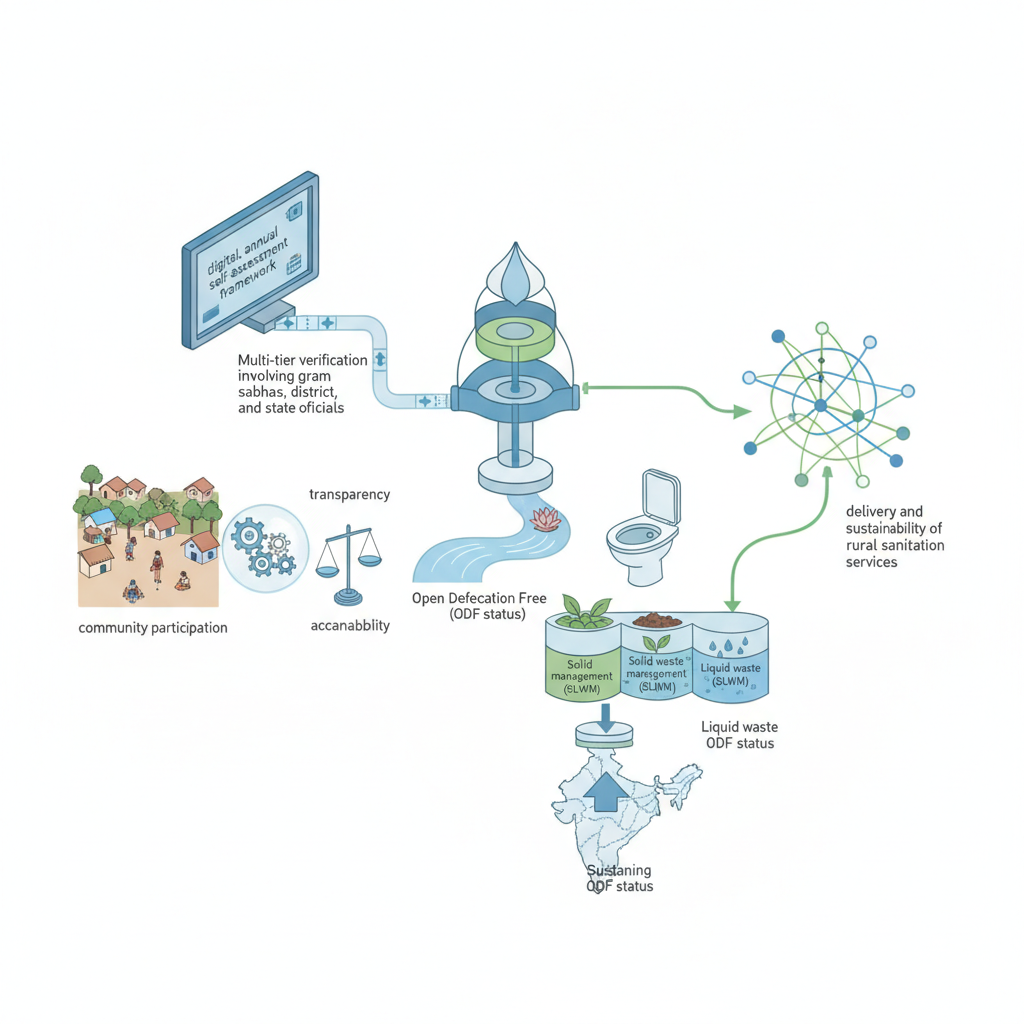
The Department of Drinking Water and Sanitation (DDWS), Ministry of Jal Shakti, launched the Swachh Service Assessment (SSA) on 15 September 2026, as part of the Swachh Bharat Mission (Gramin) 2.0. This initiative introduces a digital, annual self-assessment framework at the gram panchayat level to evaluate the delivery and sustainability of rural sanitation services, including ODF status, visual cleanliness, and solid and liquid waste management (SLWM). The SSA aims to institutionalise community participation, transparency, and accountability in sanitation governance through multi-tier verification involving gram sabhas, district, and state officials.
Background
- The Swachh Bharat Mission (Gramin) Phase II (SBM (G) 2.0) was launched in 2020 with a focus on sustaining Open Defecation Free (ODF) status and improving solid and liquid waste management (SLWM) in rural India.
- The 73rd Constitutional Amendment Act, 1992, decentralised governance by empowering gram panchayats to plan and implement development programmes, including sanitation.
- Under SBM (G) 2.0, the ODF Plus framework classifies villages based on their sanitation infrastructure, with ODF Plus (Model) villages expected to achieve higher standards in SLWM and visual cleanliness.
- The DDWS has been leveraging digital tools to enhance transparency and efficiency in programme implementation, such as the Swachhata App and the IMIS portal.
- Community participation is a cornerstone of rural sanitation programmes, with gram sabhas mandated to approve and monitor development plans under the Panchayati Raj system.
What is the Swachh Service Assessment (SSA)?
- SSA is an annual, digital self-assessment framework developed by the Department of Drinking Water and Sanitation (DDWS) under SBM (G) 2.0 to monitor the delivery and sustainability of rural sanitation services at the gram panchayat level.
- The assessment focuses on key parameters such as the stability of ODF status, visual cleanliness, and the functionality of solid and liquid waste management (SLWM) systems.
- The framework is designed to be participatory, involving gram panchayats, gram sabhas, Village Water and Sanitation Committees (VWSCs), district, state, and union territory officials in a multi-tier verification process.
- VWSCs and local communities are tasked with conducting the self-assessment in collaboration with gram panchayats, ensuring grassroots ownership and accountability.
- The assessment includes an evaluation of the operational and maintenance (O&M) status of sanitation infrastructure, resource efficiency, and community engagement in SLWM activities.
- Findings from the SSA are verified by the gram sabha, which discusses and validates the results before they are submitted to district and state officials for further review and corrective action planning.
- The SSA aims to strengthen transparency and accountability by making sanitation service delivery data publicly accessible and actionable at multiple governance levels.
- The framework is aligned with the principles of the 73rd Constitutional Amendment Act, empowering gram panchayats to review progress, identify gaps, and implement targeted improvements in sanitation services.
Key Features
| Feature | Significance |
|---|---|
| Annual Digital Self-Assessment Framework | Facilitates systematic, data-driven evaluation of rural sanitation services at the gram panchayat level, ensuring continuous monitoring and improvement. |
| Multi-Stakeholder Participation | Involves gram panchayats, gram sabhas, Village Water and Sanitation Committees (VWSCs), and district/state officials, fostering community ownership and accountability. |
| ODF Plus (Model) Villages Focus | Targets villages already declared ODF Plus to assess sustainability of Open Defecation Free status, visual cleanliness, and Solid and Liquid Waste Management (SLWM) effectiveness. |
| Community Verification through Gram Sabha | Ensures transparency and local validation of assessment findings, aligning with participatory governance principles under the 73rd Constitutional Amendment. |
| Integration with Swachh Bharat Mission (Gramin) 2.0 | Serves as a key governance tool within the mission’s framework, enabling evidence-based policy adjustments and targeted interventions. |
Why it Matters
Governance & Institutional Strengthening
- Enhances decentralised planning and implementation by empowering gram panchayats and gram sabhas with data-driven decision-making tools.
- Promotes transparency and accountability in public service delivery through structured self-assessment and community verification mechanisms.
- Aligns with the 73rd Constitutional Amendment’s vision of participatory local governance and fiscal decentralisation.
Sustainable Rural Sanitation
- Ensures long-term viability of ODF status by assessing maintenance, operational efficiency, and resource utilisation in SLWM systems.
- Encourages behavioural change and community stewardship in maintaining sanitation infrastructure and hygiene practices.
- Supports the transition from ODF to ODF Plus status through structured evaluation of solid and liquid waste management systems.
Data-Driven Policy Implementation
- Provides real-time, granular data on sanitation service delivery gaps, enabling evidence-based policy formulation and resource allocation.
- Facilitates targeted interventions by identifying underperforming gram panchayats and districts for focused corrective action.
- Strengthens monitoring and evaluation frameworks within Swachh Bharat Mission (Gramin) 2.0, improving programme outcomes.
Community Empowerment & Social Inclusion
- Involves marginalised sections of rural communities in sanitation governance, ensuring equitable access to services and representation in decision-making.
- Fosters social accountability by making sanitation performance metrics publicly accessible and subject to local scrutiny.
- Encourages collective action and shared responsibility among community members for maintaining cleanliness and hygiene.
Challenges
1. Digital Divide and Infrastructure Gaps
- Limited digital literacy and connectivity in remote rural areas may hinder effective participation in the self-assessment process.
- Inadequate availability of smartphones or internet access could exclude certain sections of the community from the assessment framework.
UPSC Link: GS II: Governance, GS III: Science & Tech
2. Ensuring Genuine Community Participation
- Risk of passive or tokenistic involvement of gram sabhas, leading to superficial assessments rather than meaningful engagement.
- Need for continuous awareness campaigns to sustain community interest and ownership in sanitation initiatives.
UPSC Link: GS II: Governance, GS IV: Ethics
3. Standardisation and Quality Assurance
- Variations in assessment methodologies across states may lead to inconsistent data and hinder comparability of outcomes.
- Requirement for robust training and capacity-building of VWSCs and gram panchayat members to ensure accurate and reliable self-assessment.
UPSC Link: GS II: Governance, GS III: Environment
4. Resource Mobilisation and Sustainability
- Dependence on state and central funds for implementing corrective actions post-assessment may strain fiscal resources in underperforming regions.
- Need for innovative financing models, including public-private partnerships, to ensure long-term sustainability of sanitation infrastructure.
UPSC Link: GS III: Economy
5. Monitoring and Feedback Loops
- Risk of delays in translating assessment findings into actionable plans, reducing the effectiveness of the framework.
- Need for a transparent feedback mechanism to ensure that identified gaps are addressed promptly and effectively.
UPSC Link: GS II: Governance
Challenges — UPSC Perspective
| Issue | Concern |
|---|---|
| Digital Literacy and Access | Limited technological readiness among rural communities may impede participation and data accuracy. |
| Community Engagement | Ensuring authentic and sustained involvement of gram sabhas in the assessment process remains a persistent challenge. |
| Data Standardisation | Inconsistencies in assessment parameters across states could undermine the reliability of comparative analysis. |
| Fiscal Constraints | Underfunded gram panchayats may struggle to implement corrective measures identified through the assessment framework. |
| Implementation Lag | Delays in translating assessment findings into actionable plans could erode the framework’s intended impact. |
| Capacity Building | Inadequate training of VWSCs and gram panchayat members may lead to superficial or inaccurate self-assessment. |
Government Initiatives — Must-Memorise for Prelims
- Swachh Bharat Mission (Gramin) 2.0
Way Forward
- Establish a robust digital literacy programme for gram panchayat members and VWSCs to ensure effective participation in the self-assessment process.
- Develop standardised assessment guidelines and training modules to ensure consistency and reliability across states and union territories.
- Strengthen gram sabha engagement through regular awareness campaigns and capacity-building workshops on sanitation governance.
- Create a transparent feedback mechanism linking assessment findings to actionable plans, with clear timelines for implementation.
- Leverage technology, such as mobile applications and dashboards, to provide real-time data visualisation and monitoring of sanitation performance.
- Foster inter-state knowledge sharing and best practices to address common challenges in rural sanitation service delivery.
- Ensure equitable resource allocation by prioritising gram panchayats with identified gaps in sanitation infrastructure and service delivery.
- Promote public-private partnerships to mobilise additional funding for the maintenance and upgradation of SLWM systems.
UPSC Value Addition
Keywords for Mains Answer-Writing
Swachh Bharat Mission (Gramin) 2.0 · Swachh Seva Assessment (SSA) · Open Defecation Free (ODF) Plus · Solid and Liquid Waste Management (SLWM) · Gram Panchayat-level digital self-assessment framework · Village Water and Sanitation Committee (VWSC) · 73rd Constitutional Amendment Act · Community participation in rural sanitation · Institutional mechanisms for service delivery monitoring · Decentralised governance and accountability · Sustainability of ODF status · Operational and maintenance (O&M) of sanitation infrastructure
Constitutional & Policy Linkages
- 73rd Constitutional Amendment Act (Panchayati Raj Institutions)
Concept Flow
Inception of Swachh Bharat Mission (Gramin) 2.0 → Development of Annual Digital Self-Assessment Framework → Multi-stakeholder participation (gram panchayats, gram sabhas, VWSCs) → Assessment of ODF Plus villages → Community verification through gram sabha → Identification of service delivery gaps → Formulation of corrective action plans → Implementation and monitoring → Continuous improvement in rural sanitation services
Prelims Practice Questions
Q1. Consider the following statements regarding the Swachh Seva Assessment (SSA) under Swachh Bharat Mission (Gramin) 2.0:
1. It is a digital self-assessment framework conducted at the Gram Panchayat level.
2. The assessment is verified by the Gram Sabha to ensure transparency and accountability.
3. The SSA focuses exclusively on the construction of toilets and does not cover solid and liquid waste management.
4. The 73rd Constitutional Amendment Act provides the constitutional basis for the participation of Gram Panchayats in the SSA process.
How many of the above statements are correct?
- Only one
- Only two
- Only three
- All four
Answer: Only three — Statements 1, 2, and 4 are correct. Statement 3 is incorrect as the SSA covers solid and liquid waste management (SLWM) alongside ODF sustainability.
Q2. Assertion (A): The Swachh Seva Assessment (SSA) under Swachh Bharat Mission (Gramin) 2.0 aims to strengthen community participation in rural sanitation services.
Reason (R): The SSA framework mandates verification of self-assessment by the Gram Sabha, thereby enhancing transparency and accountability in service delivery.
Code:
- Both A and R are true, and R is the correct explanation of A.
- Both A and R are true, but R is not the correct explanation of A.
- A is true, but R is false.
- A is false, but R is true.
Answer: Both A and R are true, and R is the correct explanation of A. — Both the Assertion (A) and Reason (R) are true, and R correctly explains A. The SSA framework is designed to foster community participation through Gram Sabha verification, thereby improving transparency and accountability.
Q3. Match the following components of the Swachh Seva Assessment (SSA) framework with their respective roles:
Column I (Component) | Column II (Role)
— | —
A. Village Water and Sanitation Committee (VWSC) | 1. Conducts annual digital self-assessment at the Gram Panchayat level
B. Gram Panchayat | 2. Verifies and validates the self-assessment data
C. Gram Sabha | 3. Implements and monitors sanitation and SLWM activities
D. District and State Authorities | 4. Provides oversight and reviews improvement plans
Select the correct match:
- A-3, B-1, C-2, D-4
- A-1, B-3, C-2, D-4
- A-2, B-1, C-3, D-4
- A-3, B-2, C-1, D-4
Answer: A-3, B-1, C-2, D-4 — The correct matches are: A-3 (VWSC implements and monitors activities), B-1 (Gram Panchayat conducts self-assessment), C-2 (Gram Sabha verifies data), and D-4 (District and State Authorities provide oversight).
Mains Practice Question
✍ The Swachh Seva Assessment (SSA) framework, launched under Swachh Bharat Mission (Gramin) 2.0, represents a paradigm shift towards decentralised, community-driven monitoring of rural sanitation services. Critically examine the institutional architecture of SSA, highlighting its alignment with the constitutional mandate of the 73rd Amendment Act and its potential to ensure sustainability of Open Defecation Free (ODF) status. Also, discuss the challenges in operationalising this framework at the grassroots level. (15 Marks)
Approach: MODEL-ANSWER SKELETON:
1. **Institutional Architecture of SSA** (6 marks):
– **Multi-level participation**: Role of Gram Panchayats, Gram Sabhas, VWSCs, District and State authorities.
– **Digital self-assessment framework**: Annual, Gram Panchayat-level assessment of ODF sustainability, visual cleanliness, and SLWM.
– **Verification mechanism**: Gram Sabha validation for transparency and accountability.
– **Linkage with 73rd Amendment Act**: Empowerment of Panchayati Raj Institutions (PRIs) under Article 243G and 243W.
2. **Alignment with Constitutional Mandate** (4 marks):
– **Decentralisation**: SSA operationalises the principles of subsidiarity and local self-governance enshrined in the 73rd Amendment.
– **Community participation**: Mandates involvement of local communities via Gram Sabha, enhancing democratic accountability.
– **Sustainability of ODF status**: Focus on O&M of sanitation infrastructure and SLWM, addressing long-term viability beyond construction.
3. **Challenges in Operationalisation** (5 marks):
– **Capacity constraints**: Limited technical and administrative capacity at Gram Panchayat level.
– **Digital divide**: Uneven access to digital tools and internet connectivity in rural areas.
– **Community engagement**: Ensuring sustained participation of marginalised groups (women, SC/ST) in Gram Sabha processes.
– **Monitoring and evaluation**: Overcoming bureaucratic inertia and ensuring timely data utilisation for corrective action.
– **Funding and resource allocation**: Adequate financial resources for SLWM and O&M of sanitation infrastructure.
4. **Conclusion** (1 mark):
– SSA is a commendable step towards institutionalising participatory governance in rural sanitation. However, its success hinges on addressing ground-level challenges through capacity building, digital inclusion, and equitable resource allocation.
Source: PIB (Press Information Bureau)
Generated by AanyaAi for educational purpose.
Related guides on our sites
- Best PSIR optional coaching for upsc
- Best PSIR optional teacher for upsc
- Best teacher of PSIR optional for upsc
- Best PSIR optional coaching in delhi for UPSC

- UPSC Exam Alert: Swachh Seva Assessment Launched for SBM-G 2.0 - September 16, 2026
- कर्नाटक: सीएम शिवकुमार करेंगे कल्याण कर्नाटक में 1,775.41 करोड़ के विकास कार्यों का शुभारंभ - September 16, 2026
- यूपीआई व्यापारी भुगतान पर शुल्क लगाने के सरकार के फैसले पर विपक्ष की चिंता - September 16, 2026

No Comments